What did Pedro Sánchez say about the Ley de Memoria Democrática?
Would grandchildren of Franco-era exiles who gained Spanish nationality under the Democratic Memory Law be barred from voting in the 29 November election (while 'grandchildren of the Franco regime' can vote), as Pedro Sánchez claims about the PP/Vox challenge now before the Supreme Court?
Misleading
Sánchez's statement misattributed legal actions regarding voting rights.
Pedro Sánchez's claims in a video regarding PP and Vox's actions to stop about 400,000 people from voting under the Ley de Memoria Democrática are misleading. While legal measures exist, his attribution to PP is inaccurate.
 Deepfake
Claims
✓ 1 trueBoth PP and Vox filed a complaint so that around 400,000 Spaniards recognised by the Ley de Memoria Democrática cannot vote.35
“Tanto el PP como Vox han presentado una denuncia para que no puedan votar 400.000 españoles reconocidos por la Ley de Memoria Democrática.”
Pedro Sánchez's assertion that both PP and Vox filed complaints is misleading. While Vox, alongside the civic group Iustitia Europa, initiated legal actions leading to the Supreme Court's suspension affecting the electoral rights of about 400,000 nationals, the PP did not file the complaint itself; it politically supported the move. This overstates the PP's involvement.
Around 400,000 Spaniards who were nationalised under the Ley de Memoria Democrática will have their voting rights affected (they cannot vote).34
“Unos 400.000 españoles nacionalizados mediante la Ley de Memoria Democrática verán su derecho a voto afectado (no podrán votar).”
This claim is accurate, as multiple sources confirm that the Supreme Court has adopted precautionary measures affecting the registration of roughly 400,000 individuals nationalised under the Ley de Memoria Democrática. These measures will prevent them from voting in upcoming elections.
Those 400,000 people have already voted in 2023, 2024, and 2025 elections and should vote in 2026.
“Esas 400.000 personas ya votaron en 2023, 2024, 2025 y en las elecciones de Castilla y León, y además deberían votar en 2026.”
While some individuals among the 400,000 had voted in past elections, it is misleading to state that all had participated uniformly across those years. Historical data shows low turnout among overseas voters (CERA), which means not everyone has voted in each contest.
What was posted
XIn a video posted to Twitter, Pedro Sánchez discusses the Ley de Memoria Democrática, claiming that legal actions affect voting rights for around 400,000 individuals. He accuses PP and Vox of taking measures against these individuals' rights to vote.
“Nunca les gustó la Ley de Memoria Democrática. ¿Qué pasa, que los nietos de los exiliados del franquismo no van a poder votar y los nietos del régimen franquista sí? Le pido al Tribunal Supremo que frene este atropello. Porque en una democracia, el derecho al voto no se”
“They never liked the Law of Democratic Memory. What happens, that grandsons of Francoist exiles will not be able to vote and grandsons of the Franco regime will? I ask the Supreme Court to stop this outrage. Because in a democracy, the right to vote is not” — translated
Who posted it
X3M followers · Joined August 2009 · 17.1 years old
View the account on X ↗Account check
Estimates from public signals — account age, posting pattern, audience — not a judgement of the person behind the account, and separate from whether this post is true.
What stood out
- The Twitter handle '@sanchezcastejon' is associated with Pedro Sánchez Pérez-Castejón, the current Prime Minister of Spain and Secretary-General of the Spanish Socialist Workers' Party (PSOE).
- The account was created on August 25, 2009, and has over 3 million followers, indicating a significant public presence.
- The bio states: 'Presidente del Gobierno de España. Secretario gral. del @PSOE y presidente de @Soc_Intl. Padre. Trabajamos por instituciones dignas, la igualdad y la justicia.'
- Recent tweets include messages of gratitude to the President of the European Council for support to Ceuta and the southern border of the European Union, and highlighting achievements in Spain's space sector.
- The account is linked to official government communications and has been referenced in reputable news sources, confirming its authenticity.
Signals (1)+
- Posting cadence
- Multiple times per day
Account checked October 11, 2026, 15:06 UTC
The media
Video✓ What is genuine
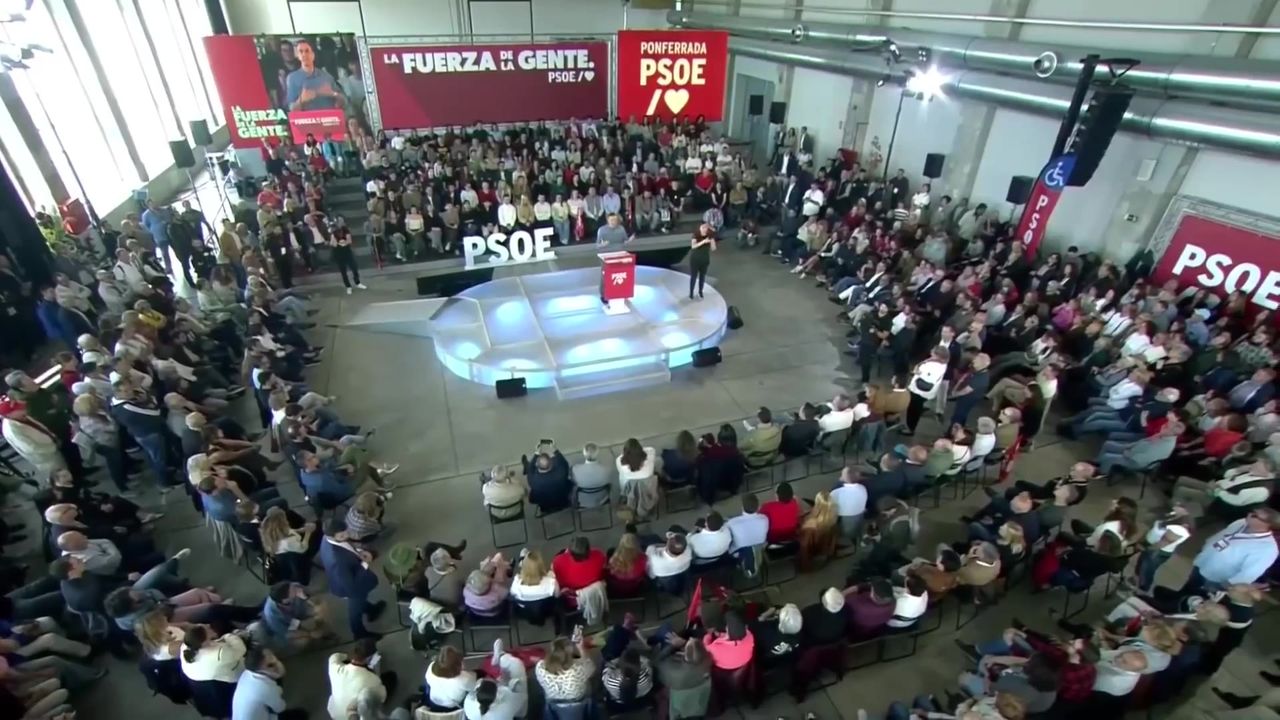
The video footage presents a real event where Pedro Sánchez spoke at a PSOE gathering in Ponferrada on 11 October 2026.
The tells
- ●●● Strong signal The video depicts a political speech, a common format for political discourse.our visual review
- ●●● Strong signal Various news reports confirmed the speech and claims made within.our visual review
- ●●● Strong signal The video features clear staging typical of campaign events.our visual review
Synthetic-media detector
Detector ranThe claim stands or falls on whether the media is real, so the detector ran.
Scores are the detector’s estimate for the file as uploaded. A low score does not rule out editing, a spliced caption, or footage shown out of context — those are judged above. Model v3.
How we checked the media
- Examined the provenance and context of the video.
- Analyzed keyframes and on-screen text, verifying against news reports of the event.
- Engaged a media authenticity detector to assess AI generation likelihood.
Sources
5 sources reviewed- 1Pedro Se1nchez pide al Supremo que frene el "intento de atropello" de PP y Vox contra la ley de nietos ↗
Onda Cero · ondacero.esUntiereduntiered — treated as signal only, never decisiveEvidence
Sánchez's request to the Supreme Court regarding the voting rights of nationals under the ley de nietos.
- 2La fuerza del PSOE de Lef3n arropa en Ponferrada a Pedro Se1nchez en su camino a un nuevo Gobierno ↗
PSOE Por Lef3n (party site) · psoeporleon.esUntiereduntiered — treated as signal only, never decisiveContext
Details the atmosphere during Sánchez's speech and his call to action.
- 3El Supremo suspende de manera cautelar la 'ley de nietos' (resumen y contexto) ↗
RTVE · rtve.esReputable outletCenter/Lean Left — public serviceEvidence
Condensed reporting about the Supreme Court's actions impacting voting rights.
- 4Pedro Se1nchez presiona al Supremo mientras delibera sobre la ley de nietos: "Sereda inconstitucional prohibirles votar" ↗
El Espaf1ol · elespanol.comUntiereduntiered — treated as signal only, never decisiveEvidence
Direct reporting of Sánchez's speech and claims about the Ley de Memoria Democrática.
- 5El PP no recurrif3 ante el Supremo la ley de nietos (verificacif3n) ↗
Newtral · newtral.esPrimary / fact-checkerIFCN + EFCSN; SpainEvidence
Clarification of PP's political support without direct filing in the Supreme Court.
Further reading
- 1Onda Cero Details Sánchez's public statements during the Ponferrada event and their implications.
- 4El Espaf1ol Covers the context of Sánchez's claims regarding the Supreme Court's decisions.
- 5Newtral Provides fact-checking evidence about the role of the PP in the legal actions concerning the Ley de Memoria Democrática.
- 3RTVE Reports on the precautionary measures taken by the Supreme Court affecting voting rights of expatriate Spaniards.
The full story
On 11 October 2026, Pedro Sánchez spoke at a PSOE event in Ponferrada, raising concerns about the Ley de Memoria Democrática and its implications for voting rights of newly nationalised citizens, estimated to be around 400,000 individuals. He asserted that both PP and Vox were working to restrict these individuals' rights to vote, which prompted him to call upon the Supreme Court to intervene. Although his remarks echo the captured event's backdrop, they simplify the complexities surrounding the legal actions taken against citizenship. The Supreme Court's September 2026 measures were indeed sparked by legal actions initiated by Vox and Iustitia Europa, a civic group, while the PP did not initiate the lawsuit but provided political support for it. This conflation misattributes the dynamics at play, generating potential misunderstanding around the political context of the voting rights debate within Spain. As such, the claim reflects a significant concern but presents an imprecise context by grouping PP with Vox inaccurately.
Kernel of truth
The existence of a judicial ruling affecting around 400,000 newly nationalised citizens under the Ley de Memoria Democrática.
How it was framed
The claim distorts actions taken by political parties regarding voting rights, misattributing legal engagements.
- Emotional language. Sánchez uses emotionally charged language, referencing 'atropello' (outrage) to evoke a sense of injustice.
- Us vs. them. Sánchez positions the political right (PP and Vox) as adversaries to those affected by the voting restrictions.
Posted by Pedro Sánchez on Twitter, where he has a significant following and influence as a political leader.
Bias
Leans pro-PSOE / anti-PP-and-Vox. The video is a campaign/precampaign speech by Pedro Se1nchez (PSOE). The language frames PP and Vox as trying to prevent voting rights and asks the Supreme Court to act, which advances a pro-PSOE/anti-PP-Vox narrative in the context of an electoral campaign.
Bias describes how the post frames its message — the slant of the language, selection and emphasis — and is judged separately from whether the claim is true. A true claim can still be framed with a strong slant.
How we checked
1 min 19 s- 1
Reviewed the video content for context and statements by Pedro Sánchez.
- 2
Searched for details regarding the Ley de Memoria Democrática and reactions from political parties.
- 3
Analyzed credible news reports and fact-checks related to Sánchez's claims and legal actions by Vox and PP.
- 4
Conducted a media authenticity check to ensure the video represented the claimed event.
- 5
Cross-referenced facts with multiple sources to establish context and accuracy.
✓ Claim checked✓ Media checked✓ Sources checked
Why 86% confidence
HighThe confidence band is HIGH due to strong independent corroboration of the facts, such as the Supreme Court's measures and accurate news sourcing.
Limits. Lack of direct access to original court filings or the full context of the legal arguments presented.
Spot it yourself
Spot the fakeLooks suspicious, isn’t proof
- The political nature of the claim may prompt skepticism regarding its accuracy.
- His use of emotional appeals could suggest a bias in presentation.
- The complexity of the legal issue is simplified into a single emotional narrative.
The actual evidence
- A confirmation that the Supreme Court has indeed taken measures that affect voting rights for around 400,000 people.
- Vox's actual filing of legal actions that led to court intervention, while PP did not directly file.
- Sánchez's statements have been partially corroborated by multiple credible news outlets.
- 1
Check the source of the claims.
Look for credible news articles or official statements regarding the event.
- 2
Determine if the claim has been evaluated by fact-checkers.
Search for fact-check reports available on reliable platforms.
- 3
Look at the context in which the claims are made.
Assess whether the description aligns with known facts or narratives.
- 4
Compare multiple perspectives.
Check various news sources to see different interpretations of the same event.
Takeaway
When evaluating political claims, always consider the sources and seek corroboration. Simplified narratives can often mask complexities.
Questions people ask
What is the Ley de Memoria Democrática?+
The Ley de Memoria Democrática aims to recognize the rights of descendants of Spaniards exiled during the Franco regime. It fosters civic engagement by granting nationality to these individuals.
Why did Pedro Sánchez criticize PP and Vox?+
Sánchez criticized PP and Vox for attempting to restrict voting rights for around 400,000 newly nationalised citizens under the Ley de Memoria Democrática, claiming that it undermines democratic principles.
Did the PP file a legal complaint regarding the voting rights?+
No, while the PP politically supported the complaint filed by Vox and Iustitia Europa, it did not file the actual legal complaint in the Supreme Court.
Is the video of Sánchez authentic?+
Yes, the video is authentic footage of Sánchez speaking at a PSOE event in Ponferrada on 11 October 2026.
How have fact-checkers evaluated Sánchez's claims?+
Fact-checkers found that while his claims contain elements of truth regarding the Supreme Court's decisions, they misattribute key roles to the PP in the complaint process.
Go deeper
- Ley de Memoria Democrática
- A law aimed at addressing the historical injustices of the Franco regime, facilitating rights for descendants of exiled Spaniards.
- CERA
- The Electoral Register for Spaniards living abroad.
- denuncia
- A legal complaint or accusation.
- precautionary measures
- Temporary orders issued by a court to prevent harm or ensure certain conditions before a final decision.
- political support
- Endorsement or backing of a political position or action without direct participation or legislation.
People also search for
For educators+
- How can emotional language influence public opinion regarding political issues?
- What are the implications of misattributed legal actions in political discourse?
- How should citizens evaluate the credibility of claims made by public figures?
About this check
- Platform
- X
- Posted by
- @sanchezcastejon
- Posted
- October 11, 2026
- Age when checked
- Under 24 hours old when checked
- Where it spread
- Spain
- Audience
- UK & EU audience
- Language
- ES
- Status
- ● Post is live
- Verified
- October 11, 2026, 15:08 UTC
- Published
- October 11, 2026, 15:08 UTC
Reach. 2,509 likes, 2,116 replies (reply-heavy ratio, contested)
This verdict was generated with AI from the sources shown. AI can make mistakes — check the sources before relying on it.
Check anything yourself, in seconds.
Share any social post or video to What the Fact and get the verdict, the confidence, and the receipts.