Did The New York Times Doctor a Photo of Trump National Doral?
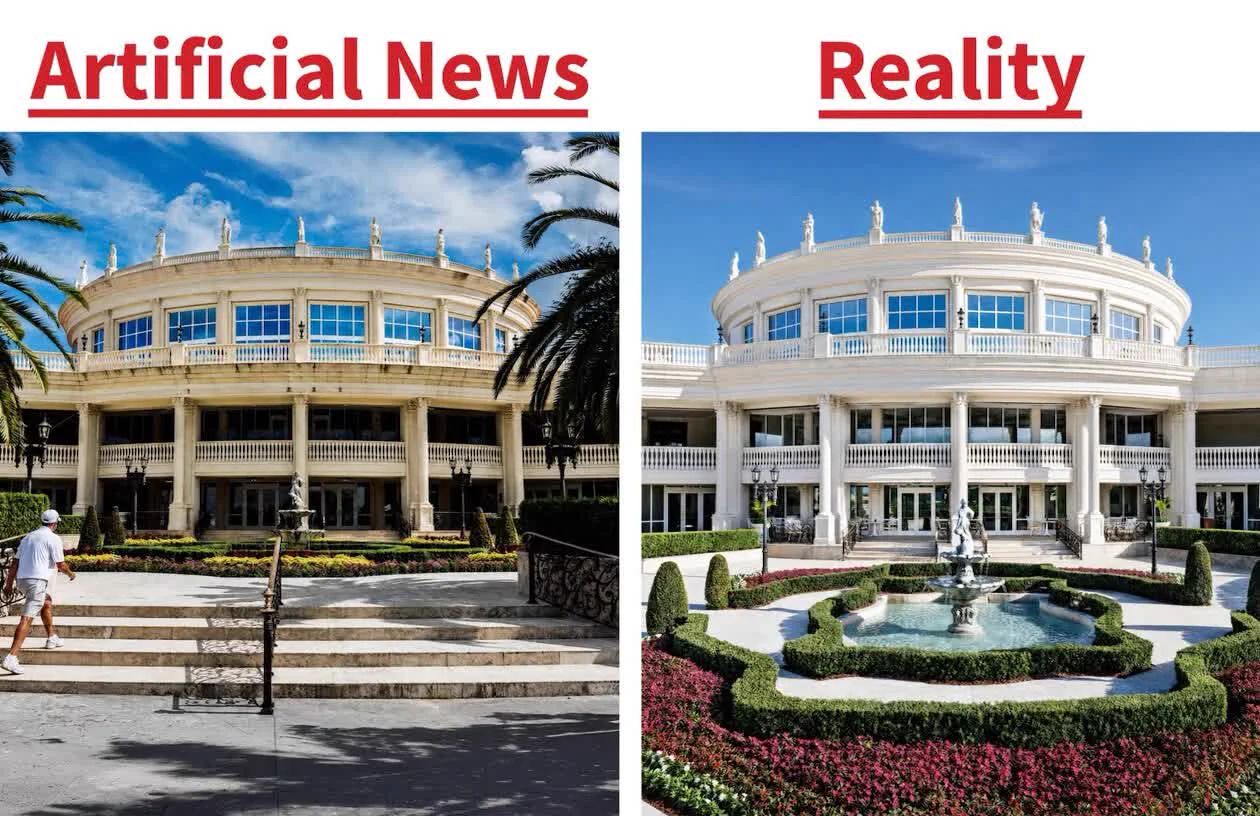
Did The New York Times doctor its photo of Trump National Doral to 'artificially put mold all over the building', as Trump claims?
False
The claim that The New York Times doctored the photo is false.
The claim that The New York Times doctored a photo of Trump National Doral to add mold is false. The Times asserts the image was taken in 2020 and was not altered, confirmed by multiple news outlets.
 Likely genuine
Claims
✕ 1 falseThe New York Times doctored a photo of Trump National Doral by artificially putting mold all over the building.124
The evidence shows that The New York Times used an unaltered photo of Trump National Doral in a recent article. The newspaper confirmed that the photo in question, taken by Scott McIntyre in 2020, was not manipulated. Additionally, several independent media reports corroborate this statement by quoting The Times directly. Given the strength and independence of these sources, readers should give significant weight to the fact that this claim lacks substantial evidence.
What was posted
XA Twitter post alleging that The New York Times manipulated a photograph of Trump National Doral by adding mold.
“Look what The New York Times did to my beautiful Doral! They doctored the photo. They artificially put mold all over the building when referring to it in a story! President DONALD J. TRUMP”
“Look what The New York Times did to my beautiful Doral! They doctored the photo. They artificially put mold all over the building when referring to it in a story! President DONALD J. TRUMP” — translated
Who posted it
XAccount check
Estimates from public signals — account age, posting pattern, audience — not a judgement of the person behind the account, and separate from whether this post is true.
What stood out
- Account lacks a display name and bio, which are typically present in genuine profiles.
- No recent posts available to assess content quality or engagement.
- Account is not verified, reducing credibility.
- Handle 'TrumpReposter' suggests potential bias or automated content aggregation.
Account checked October 13, 2026, 03:11 UTC
The media
Image✓ What is genuine
The image used in the New York Times article is verified as a real photograph taken in 2020.
The tells
- ●●● Strong signal User-generated side-by-side comparison suggests manipulation but does not prove it.our visual review
- ●●○ Supporting signal The original image and the altered comparison may look similar, leading to doubt but not proof.our visual review
Synthetic-media detector
Detector ranThe claim stands or falls on whether the media is real, so the detector ran.
Scores are the detector’s estimate for the file as uploaded. A low score does not rule out editing, a spliced caption, or footage shown out of context — those are judged above. Model v3.
How we checked the media
- Evaluated the authenticity of the photo using a media authenticity detector.
- Conducted a visual review of the images in question.
Sources
4 sources reviewed- 1NYT Fires Back After Trump Fumed Paper 'Doctored' Doral Pic ↗
Mediaite · mediaite.comUntiereduntiered — treated as signal only, never decisiveEvidence
The Times maintained that the photo was never manipulated.
- 2Trump Attacks New York Times Over Photo of Doral Golf Resort ↗
The Daily Beast · thedailybeast.comUntiereduntiered — treated as signal only, never decisiveEvidence
Reports note the image is credited to Scott McIntyre for The New York Times.
- 3Trump Renews Attacks On The New York Times Over Golf Resort Photo, Alleging Added Mold ↗
AOL · aol.comUntiereduntiered — treated as signal only, never decisiveEvidence
Quotes a spokesperson from The New York Times rejecting the alteration claims.
- 4An Outrage in 2019. No Problem in 2026. Trump Has Moved the Ethical Line. ↗
The New York Times · nytimes.comReputable outletLean Left (AllSides) — distinguish news/opinionContext
Analyzes Trump's claims with the correct background and context.
Further reading
- 1Mediaite Mediaite discusses how The Times responded to Trump's accusations, providing additional context.
- 2The Daily Beast The Daily Beast reports on the photo in question and Trump's subsequent allegations.
- 4The New York Times The New York Times piece provides the original context and photo details.
The full story
On October 4, 2026, The New York Times published a piece discussing Trump's plans for hosting the G20 at Trump National Doral, accompanied by a photo taken by Times photographer Scott McIntyre. Shortly thereafter, President Trump shared a post claiming The Times had 'doctored' that image to show mold on the building. This accusation was met with prompt denial from the Times, which stated that the photograph was not altered and dated back to 2020. Media reports quickly picked up the story, providing corroborating citations to the newspaper’s communication office, reinforcing the authenticity of the image used. This claim emerged from a side-by-side user-created comparison that attempted to highlight alleged discrepancies in the photo, which ultimately did not hold up under scrutiny.
Timeline
October 4, 2026
The New York Times published an article including a photo of Trump National Doral. 4The New York Times
How it was framed
The claim falsely suggests that the image was altered when it was unchanged; it uses true information (the photo is of Doral) in a misleading way.
- Emotional language. The term 'doctored' emphasizes a deliberate deceit.
- Urgency. The exclamation and tone suggest urgent concern over media manipulation.
Bias
Leans pro-Trump / anti-New York Times. The post repeats and amplifies President Trump's allegation against The New York Times and is framed to discredit the outlet; it uses a side-by-side image comparison to push that narrative.
Bias describes how the post frames its message — the slant of the language, selection and emphasis — and is judged separately from whether the claim is true. A true claim can still be framed with a strong slant.
How we checked
41 s- 1
Conducted searches for evidence about the claim regarding The New York Times photo.
- 2
Reviewed articles from multiple media outlets discussing the incident.
- 3
Utilized a media authenticity detector alongside a visual inspection of the images.
- 4
Checked published content by The New York Times for confirmatory reports.
- 5
Made inquiries into whether the image was widely reported or if the claim was isolated.
✓ Claim checked✓ Media checked✓ Sources checked
Why 87% confidence
HighWe are highly confident in our findings as multiple credible sources corroborate The New York Times' denial of the claim.
Limits. We did not have access to any additional media analyses or firsthand accounts from those involved.
Spot it yourself
Spot the fakeLooks suspicious, isn’t proof
- Partisan commentary from the original poster
- The side-by-side image can be misleading
- High emotional language can cloud judgment
The actual evidence
- The New York Times confirmed the image has not been altered.
- The photograph was taken prior to the claim's assertion of alteration.
- Multiple independent outlets corroborate the Times' account.
- 1
Check the source of the information.
Investigate who reported on the claim for credibility.
- 2
Look for corroboration.
See if other news organizations confirm the claim.
- 3
Analyze the evidence presented.
Assess if the visuals or textual claims are supported by reliable sources.
- 4
Consider the language used.
Evaluate if the terminology suggests alarm or bias.
Takeaway
Always verify image claims through reliable news sources. Examining the credibility of both the claim and the evidence is essential to discern fact from misinformation.
Questions people ask
What is the claim against The New York Times?+
The claim is that The New York Times doctored a photo of Trump National Doral by adding artificial mold to it.
Why did Trump allege that the photo was altered?+
Trump's claim stems from a desire to dispute negative portrayals of his properties, alleging media bias.
Has The New York Times responded to the allegations?+
Yes, The New York Times asserted that the photograph in question has not been manipulated and dates back to 2020.
Why is it important to verify image claims?+
Image claims can significantly distort reality; verifying them helps prevent the spread of misinformation and protects public understanding.
What tools can I use to verify images?+
You can use reverse image searches and check multiple news outlets to verify the authenticity of any image.
Go deeper
- Media literacy
- The ability to critically analyze and evaluate media messages, including understanding potential biases.
- Verification
- The process of confirming the accuracy of facts and information presented in media.
- Source corroboration
- The act of substantiating claims through multiple credible sources.
People also search for
For educators+
- What are the implications of spreading false claims about media imagery?
- How can critical thinking be applied when evaluating information sources?
- Why is it essential for journalists to maintain ethical standards in reporting?
About this check
- Platform
- X
- Posted by
- @TrumpReposter
- Posted
- October 12, 2026
- Age when checked
- Under 24 hours old when checked
- Where it spread
- United States
- Audience
- US audience
- Language
- EN
- Status
- ● Post is live
- Verified
- October 13, 2026, 03:12 UTC
- Published
- October 13, 2026, 03:12 UTC
Reach. Trump Truth Social post 12 Oct 15:18Z with side-by-side photos (renewing his 5 Oct 'blackened facade' claim); NYT PR rebuttal on X (260 likes); Mediaite, Raw Story, Newsweek, AOL, WND, Daily Beast 12 Oct. The repost account itself has low engagement.
This verdict was generated with AI from the sources shown. AI can make mistakes — check the sources before relying on it.
Check anything yourself, in seconds.
Share any social post or video to What the Fact and get the verdict, the confidence, and the receipts.