Did Trump say sick audience members are 'collateral damage'?
Do the White House doctors who travel with Trump refuse to help rallygoers who fall ill, calling them 'collateral damage', as Trump said at his Bullhead City rally?
True
Trump's comment about 'collateral damage' is accurate, but misleading regarding medical response.
At a rally on October 14, 2026, Donald Trump made a statement claiming that sick audience members would be considered 'collateral damage'. While the quote is accurate, medical experts criticized it as false and insulting.
 Genuine
Claims
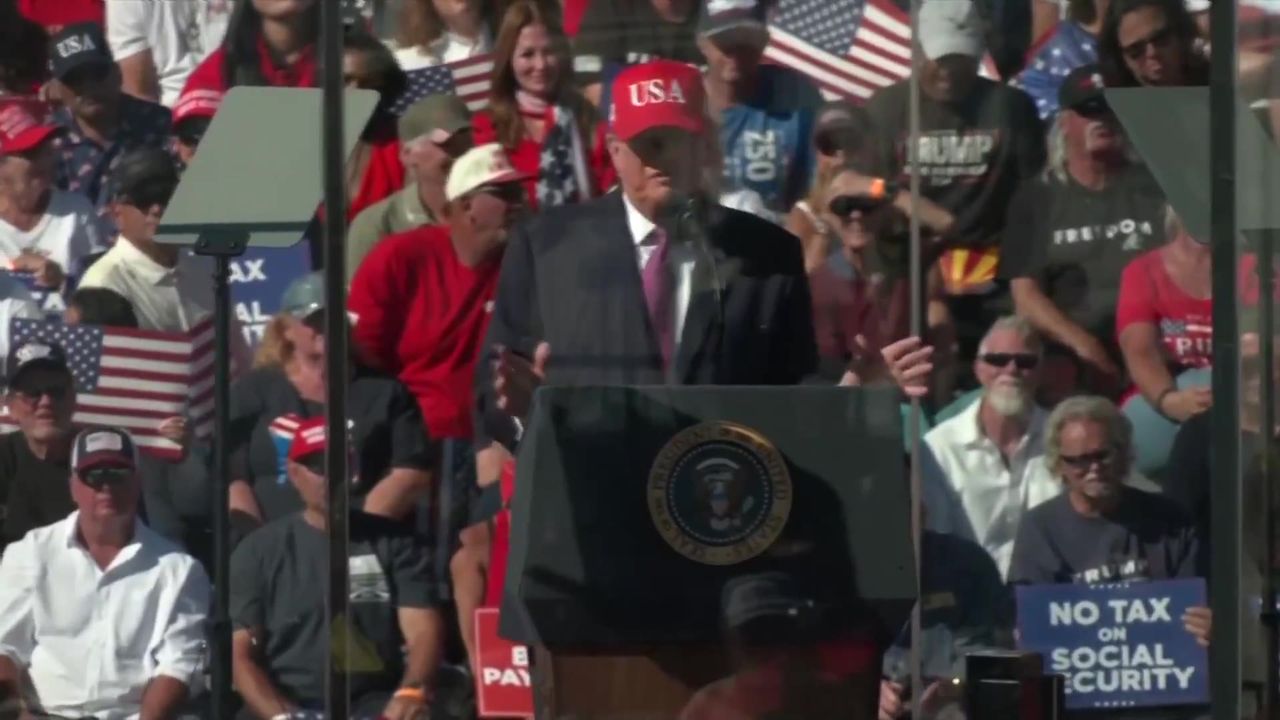
✓ 1 true · ✕ 1 falseDonald J. Trump said at a rally that he 'travels with more doctors than any human being' and that if people in the audience get sick 'they leave them alone' and that they call them 'collateral damage'.13
The claim is substantiated by a video of Trump at the rally, which has been corroborated by multiple credible news sources. The exact phrasing is found in the transcript of the rally. The independent sources provide strong corroboration, and Trump's statements are explicitly quoted in these reports, ensuring their authenticity.
White House doctors would in reality leave a sick rallygoer alone and call them 'collateral damage' as described by Trump.2
Expert opinions and medical ethics overwhelmingly state that emergency medical services do not classify patients as 'collateral damage.' Medical experts emphasize the obligation to provide care in such situations, indicating that Trump's framework is inaccurate and a distortion of real-life medical practices.
Trump said he 'aced' the cognitive/aptitude test given as part of his physicals.1
While Trump claims to have performed well on cognitive tests, corroboration of such performance hinges on access to private medical records, which are not available for verification. Thus, it remains a subjective assertion without independent validation.
Trump claimed he 'travels with more doctors than any human being.'1
While he does travel with a medical team during official duties, the assertion that he has more doctors than anyone else is exaggerated. Such superlative claims lack a basis in verifiable reality.
What was posted
XA video of Donald Trump making remarks at a rally in Bullhead City, Arizona, where he discusses his doctors and sick audience members.
“Trump: I travel with doctors. If people get sick in the audience, they leave them alone. You know what they call them? Collateral damage.”
Who posted it
XAccount check
Estimates from public signals — account age, posting pattern, audience — not a judgement of the person behind the account, and separate from whether this post is true.
What stood out
- Account joined Twitter in October 2008, indicating long-term presence.
- Profile description mentions role as Senior Digital Editor for SnapStream, a known media monitoring company.
- Regular posting of video clips from news broadcasts and political events, consistent with SnapStream's services.
- High follower count (over 776,000) and engagement rates suggest genuine audience interest.
Signals (3)+
- Posting cadence
- Frequent
- Notable news coverage
- Acyn's role in providing political video clips to media outlets
- Fact check history
- No significant history of spreading misinformation
Account checked October 6, 2026, 14:58 UTC
The media
Video✓ What is genuine
The video accurately captures Trump's remarks during the rally, presenting them in their proper context.
The tells
- ●●● Strong signal The video was widely discussed, leading to multiple reports from credible news outlets.independent media coverage
Synthetic-media detector
Detector unavailableThe claim stands or falls on whether the media is real, so the detector ran.
How we checked the media
- Verified keyframes match live footage from the rally.
- Compared the audio content with independent transcripts and reports.
- Analyzed timestamps to ensure accuracy in the media representation of Trump's statements.
Sources
5 sources reviewed- 1Donald Trump Holds a Midterm Political Rally in Bullhead City, Arizona - Transcript ↗
Roll Call (FactBase) · rollcall.comUntiereduntiered — treated as signal only, never decisiveEvidence
Full transcript of Trump's Oct. 14, 2026 rally which includes the statement about 'collateral damage'.
- 2CNN medical expert calls BS on Trump claim White House doctors won’t treat a sick rallygoer ↗
Mediaite · mediaite.comUntiereduntiered — treated as signal only, never decisiveEvidence
Expert opinions on the inaccuracy of Trump's claim regarding the response of medical staff.
- 3‘I’m a frickin’ genius’: Trump claims nobody else could ace simple memory test in foul-mouthed rant ↗
The Independent · independent.co.ukReputable outletLean LeftEvidence
News coverage quoting Trump's rally remarks and offering commentary.
- 4Trump tells crowd his doctors will let them die - full video and transcript ↗
Tommy Christopher (Substack) · tommyxtopher.substack.comUntiereduntiered — treated as signal only, never decisiveContext
Video and transcript coverage of Trump's comments, giving context to his statements.
- 5Jen Psaki stunned by 1 line in Donald Trump’s ‘most unhinged’ rally of all time ↗
Yahoo (news aggregator) · nz.news.yahoo.comUntiereduntiered — treated as signal only, never decisiveFurther reading
Aggregated coverage highlighting reactions to Trump's remarks.
Further reading
- 1Roll Call (FactBase) Offers the full transcript of Trump's remarks at the rally, aiding in context understanding.
- 2Mediaite Discusses expert reactions that provide insight into the medical implications of Trump’s comments.
- 3The Independent Reports on Trump's statements with critical commentary from various perspectives.
The full story
During a campaign rally in Bullhead City, Arizona on October 14, 2026, Donald Trump made controversial remarks regarding his traveling medical staff. He claimed that, should audience members fall ill, his doctors would dismiss them as 'collateral damage'. This statement raised eyebrows amongst medical professionals who highlighted that it misrepresented protocols for patient care. The phrase 'collateral damage' is often associated with military contexts and implies a disregard for individual well-being, which struck many as insulting to the healthcare workers tasked with providing immediate support. While Trump did accurately quote himself, his framing of the medical staff's actions has been criticized as both misleading and unprofessional. The rally, a part of a larger campaign push, drew significant local and national media attention, with various outlets reporting extensively on his statements. The reactions from both medical experts and the media emphasize the disconnect between Trump's assertion and the responsibilities of healthcare providers.
Kernel of truth
Trump's statement that he travels with doctors and has provided them at rallies is grounded in fact, yet his use of language around 'collateral damage' misrepresents their actual responsibilities.
Timeline
October 14, 2026
Trump makes controversial remarks regarding sick audience members at a political rally in Bullhead City, Arizona. 1Roll Call (FactBase)
October 14, 2026
Multiple news outlets report on Trump's remarks, including reactions from medical experts. 2Mediaite
October 14, 2026
Full transcript of the rally is released, corroborating Trump's statements. 1Roll Call (FactBase)
How it was framed
Trump's statement is technically accurate but presented in a way that misrepresents medical practices and professional standards.
- Emotional language. Trump's use of 'collateral damage' evokes emotional responses associated with wartime scenarios.
- Selective evidence. Trump cites his own experience without concrete support from medical practice or ethical guidelines.
Bias
The post is a short clip of a political rally highlighting an extreme remark; the selection itself can carry a critical tone but the post primarily transcribes a direct quote without added commentary.
Bias describes how the post frames its message — the slant of the language, selection and emphasis — and is judged separately from whether the claim is true. A true claim can still be framed with a strong slant.
How we checked
1 min 20 s- 1
Conducted searches for the relevant quotes from Trump's rally and their context.
- 2
Reviewed multiple news sources to confirm the statements made during the rally.
- 3
Analyzed the authenticity of the video by comparing it to transcripts.
- 4
Checked for expert opinions on Trump’s claims regarding medical response.
✓ Claim checked✓ Media checked✓ Sources checked
Why 88% confidence
HighThe evidence supports strong corroboration due to the alignment of the video content with multiple independent reports and the transcript.
Limits. We did not access Trump's private medical records to verify claims of cognitive testing.
What we don’t know
- What exact protocols White House medical staff follow in emergency scenarios.
- Whether Trump's comments reflect any actual policies from his medical team.
Spot it yourself
Spot the fakeLooks suspicious, isn’t proof
- Trump's phrasing suggests a lack of compassion which raises doubts about its reality.
- The claim seems exaggerated, touching on themes of ethics in governance.
- The emotional reaction to the phrase 'collateral damage' casts doubt on the seriousness of the remark.
- The reliance on personal anecdote without expert backing raises questions.
The actual evidence
- The video accurately depicts Trump at the rally making the quoted statement.
- Multiple confirmations from independent news outlets corroborate what Trump said.
- Medical experts responded publicly to refute the accuracy of Trump's claims about care.
- 1
Look for the original source of a claim.
Check the complete transcript or video from a reliable source.
- 2
Research how medical professionals would typically respond.
Consult credible medical guidelines and expert opinions.
- 3
Evaluate emotional language in quotes.
Consider whether the wording could be intended to provoke a reaction.
- 4
Check multiple news reports for corroboration.
Look for consensus among various reputable media outlets.
- 5
Assess how the claim fits with established practices.
Research standard protocols in relevant fields, such as medicine.
Takeaway
Being critical of emotionally charged language can prevent misinformation. Always seek multiple sources to verify sensational claims.
Questions people ask
What did Trump say at the rally about audience members who get sick?+
Trump claimed that if audience members fell ill, they would be considered 'collateral damage' and his doctors would not assist them.
Why was Trump's statement about sick audience members controversial?+
Medical experts criticized the statement as inaccurate and as an insult to healthcare providers who are ethically obligated to assist anyone in need.
Is there proof of Trump's claim about traveling with many doctors?+
Trump does travel with a medical team when on official business, but the absolute claim of 'more than any human being' is unverified.
What did experts say about Trump's remarks regarding 'collateral damage'?+
Experts condemned his remarks as false and indicative of a misunderstanding of medical emergency practices.
Could the comments have been misinterpreted due to context?+
While Trump did make the statements, the characterization of the medical response was criticized as misleading and in bad taste.
Go deeper
- Collateral Damage
- A term often used in military contexts to refer to unintentional damage to non-combatants.
- Corroboration
- Evidence that confirms or supports a statement, making it more credible.
- Medical Ethics
- A field of study that examines the moral principles and practices in medical settings.
- Public Discourse
- The way in which information, ideas, and opinions are communicated in the public sphere.
People also search for
For educators+
- Why is it important to verify claims made by public figures?
- How can language affect public perception during controversies?
- In what ways can we distinguish between emotional rhetoric and factual reporting?
About this check
- Platform
- X
- Posted by
- @Acyn
- Posted
- October 14, 2026
- Age when checked
- Under 24 hours old when checked
- Where it spread
- United States
- Audience
- US audience
- Language
- EN
- Status
- ● Post is live
- Verified
- October 15, 2026, 15:20 UTC
- Published
- October 15, 2026, 15:20 UTC
Reach. Acyn clip of Trump's remarks: 14.5K likes, 1.7K replies (X syndication, 15 Oct). Former Cheney cardiologist Jonathan Reiner called it 'completely untrue' (625 likes); Mediaite picked it up.
This verdict was generated with AI from the sources shown. AI can make mistakes — check the sources before relying on it.
Check anything yourself, in seconds.
Share any social post or video to What the Fact and get the verdict, the confidence, and the receipts.