Did the BBC publish an article titled 'Are Indian GenZ Too Lazy To Burn Down India?'
Did the BBC publish an article titled 'Are Indian Gen Z Too Lazy To Burn Down India?'
False
The claim is false; the image is manipulated and misattributed.
The claim that the BBC published an article titled 'Are Indian GenZ Too Lazy To Burn Down India?' is false. The image in question is a manipulated screenshot and not an authentic article.
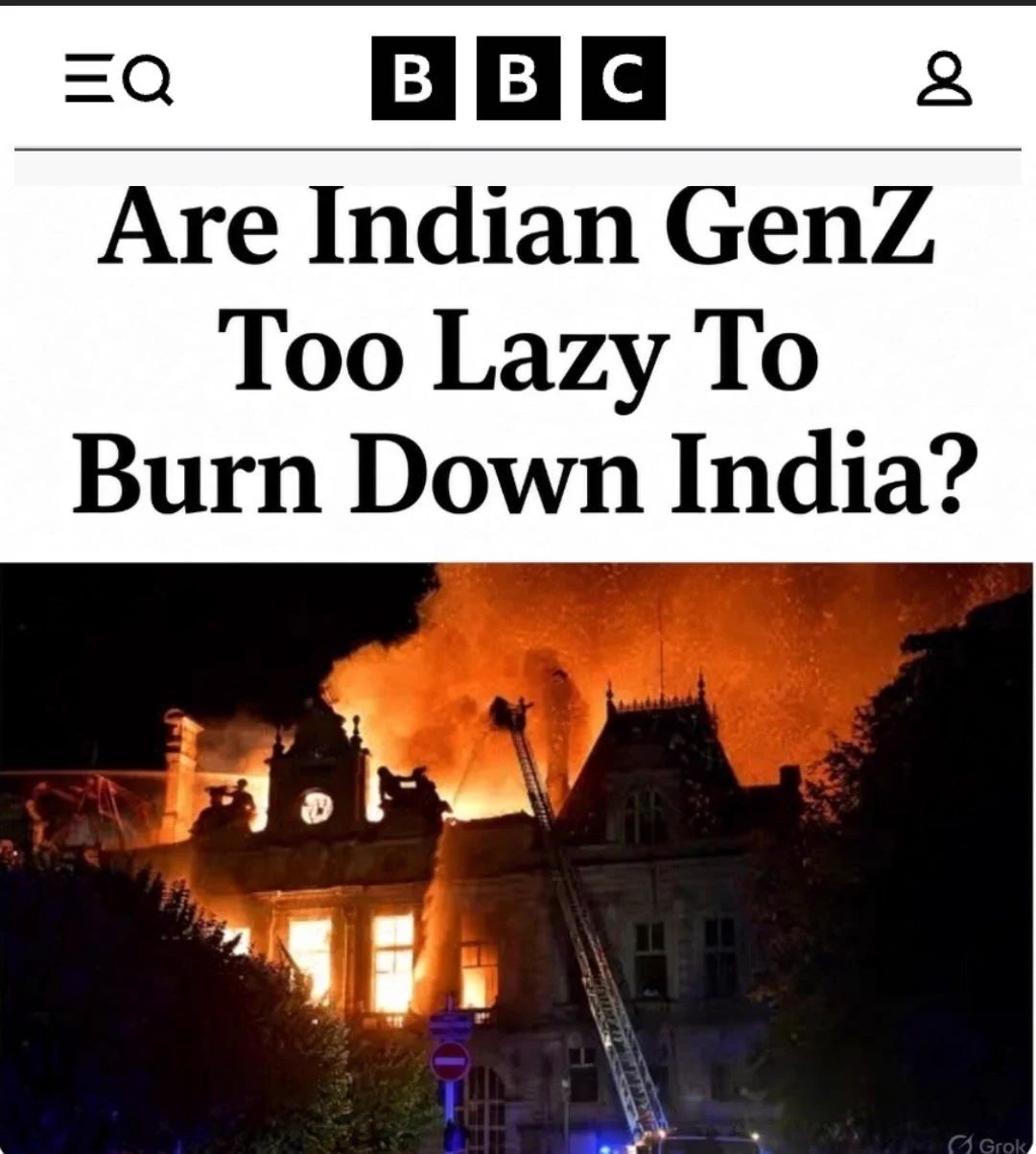 Edited
Claims
✓ 1 true · ✕ 2 falseThe BBC published an article headlined "Are Indian GenZ Too Lazy To Burn Down India?"2
Multiple credible fact-checkers confirm that the screenshot is fabricated and the BBC has not published the article claimed in the viral image. The BBC was contacted, and they confirmed that the depicted article does not exist. Thus, the claim is categorically false.
The photograph in the image shows a building on fire that is connected to the claim about India / Indian Gen Z35
The photograph used in the image is an actual photograph of the Limoges town hall fire from October 17, 2026. It is not connected to India or any Gen-Z protests. Fact-checkers confirmed its origin and its context.
The image carries a 'Grok' watermark and appears to have been produced or edited using an AI tool (Grok/Imagine).2
A visible Grok watermark can be seen on the viral image, indicating that it was either created or edited using Grok's AI tools. This evidence suggests the image is not an authentic newspaper screenshot.
What was posted
XA Twitter post shared an image purporting to be a BBC article featuring a sensational headline about Indian GenZ. The post presents it as genuine news.
“The BBC wants to know”
“The BBC wants to know” — translated
Who posted it
XAccount check
Estimates from public signals — account age, posting pattern, audience — not a judgement of the person behind the account, and separate from whether this post is true.
What stood out
- Account lacks a display name and bio, which are typically present in genuine profiles.
- No follower count or recent posts, suggesting inactivity or a newly created account.
- Handle 'totalwoke' may be associated with satirical or parody content, as 'woke' is often used in such contexts.
Signals (4)+
- Posting cadence
- 0
- Follower ratio
- 0
- Notable news coverage
- No
- Fact check history
- No
Account checked October 21, 2026, 15:06 UTC
The media
Image✓ What is genuine
The fire image originates from a legitimate event in Limoges on October 17, 2026.
The tells
- ●●○ Supporting signal The image looks alarmist and sensationalist.our visual review
- ●●● Strong signal A watermark was observed in the corner, suggesting manipulation.independent fact-checkers
- ●○○ Weak signal The headline is absurd and lacks credibility.our assessment
Synthetic-media detector
Detector ranThe claim stands or falls on whether the media is real, so the detector ran.
Scores are the detector’s estimate for the file as uploaded. A low score does not rule out editing, a spliced caption, or footage shown out of context — those are judged above. Model v3.
How we checked the media
- The image was visually inspected for elements that could indicate manipulation.
- Independent fact-checkers were referenced for confirmation of the article's authenticity and watermark assessments.
Sources
5 sources reviewed- 1Fabricated Headline On Indian Gen Z Falsely Attributed To BBC ↗
BOOM · boomlive.inUntiereduntiered — treated as signal only, never decisiveEvidence
Confirms the headline in question was never published by the BBC and identifies the image as fabricated.
- 2Fake Image Shared as One of Real BBC Article on India's Gen-Z Protests (WebQoof) ↗
The Quint · thequint.comUntiereduntiered — treated as signal only, never decisiveEvidence
Details the manipulation and confirms the photo's origin from the Limoges fire.
- 3Spire collapses at historic Limoges town hall amid violent protests across France ↗
Euronews · euronews.comReputable outletCenter — VERIFY editorial independenceContext
Documents the real event that the fabricated image claims to represent.
- 4Clashes, fires and looting break out as protesters rally across France, joining students ↗
AP · apnews.comPrimary / fact-checkerwire + AP Fact Check (Tier A)Context
Reports on the broader disturbances in France related to the fire incident.
- 5File:Incendie Hotel de ville Limoges 20261019-120538.jpg ↗
Wikimedia Commons · commons.wikimedia.orgUntiereduntiered — treated as signal only, never decisiveEvidence
Provides corroborative visual evidence tracing the manipulated image back to the actual fire.
Further reading
- 1BOOM This article discusses the verification of the manipulated BBC article claim.
- 2The Quint The Quint provides detailed examinations of the image and its misleading implications.
- 3Euronews Euronews reports on the actual fire event depicted in the image.
- 4AP AP's coverage helps contextualize the broader unrest and its impacts across France.
The full story
The viral image claiming that the BBC published an article titled 'Are Indian GenZ Too Lazy To Burn Down India?' features a fabricated screenshot. This screenshot combines actual imagery from the Limoges town hall fire on October 17, 2026, taken amid nationwide protests in France. The claim gained traction due to its sensationalist nature and the visible Grok watermark, which signaling its AI-generated or manipulated origins. Fact-checkers promptly debunked the claim, confirming that the BBC neither published the article nor reported on the sensational headline. Such a manipulation shows how quickly misinformation can spread by leveraging genuine events out of context, creating a false narrative about a demographic group.
Kernel of truth
The fire photo is real, but it has been misleadingly used in a fabricated context.
How it was framed
The image presents genuine photographs under misleading headlines, creating a false narrative.
- Emotional language. The headline uses sensational terminology that evokes strong reactions.
- Urgency. The claim presents a pressing issue, suggesting a need for immediate public awareness.
The image was shared widely on social media platforms, frequented by users critical of current youth movements.
Bias
Leans anti-BBC/anti-GenZ. The fabricated screenshot is designed to portray the BBC as publishing a provocative, insulting headline about Indian Gen Z; the post seeks to inflame opinion against the BBC and/or Gen Z rather than to inform.
Bias describes how the post frames its message — the slant of the language, selection and emphasis — and is judged separately from whether the claim is true. A true claim can still be framed with a strong slant.
How we checked
45 s- 1
We conducted searches using numerous combinations of the article's claimed title and the fire's date to find fact-checking sources.
- 2
We validated information from independent fact-checkers and relevant media to confirm the authenticity of the screenshot.
- 3
We visually inspected the image for signs of manipulation and cross-referenced with original media.
✓ Claim checked✓ Media checked✓ Sources checked
Why 87% confidence
HighOur confidence is high due to multiple fact-checking confirmations and strong evidence against the existence of the claimed article.
Limits. We could not access all archived or deleted content that may have existed prior to the viral spread.
Spot it yourself
Spot the fakeLooks suspicious, isn’t proof
- The sensational headline exaggerates and provokes anger.
- The image presents a low-resolution and poorly designed screenshot that seems fake at first glance.
- A visible watermark is present, indicating it was edited.
- The context of the headlined article seems implausible and created for shock value.
The actual evidence
- The BBC has publicly confirmed that they did not publish the article.
- The fire photo originated from a documented event in Limoges that is completely unrelated to the claim.
- Fact-checking organizations noted the Grok watermark on the image.
- 1
Check if the claim is reported by credible media outlets.
Search major news websites for any reports matching the headline.
- 2
Investigate sources of images or screenshots.
Use reverse image search on significant parts of the image to trace its origin.
- 3
Look for watermarks and graphic design inconsistencies.
Examine the image closely for any elements like watermarks or fonts that indicate manipulation.
- 4
Research the event's context.
Check if the described event has occurred by looking at recent news that matches the details.
Takeaway
Always verify claims with credible news sources and fact-checkers. A quick search can clarify much misinformation.
Questions people ask
How can I tell if an image is manipulated?+
Look for watermarks, inconsistencies in design, or odd resolutions that indicate editing. Using reverse image search can help trace the image's origin.
What should I do if I see misinformation?+
Verify the claim with credible news sources, look for fact-checks, and report the misinformation if it's incorrect.
Why is it important to fact-check social media content?+
Fact-checking helps prevent the spread of false information that can lead to misunderstandings and panic in public discourse.
What are some common tactics of misinformation?+
Misinformation often uses sensational headlines, emotional language, and visual manipulations to provoke reactions or create unbalanced narratives.
Go deeper
- Misinformation
- False or misleading information that is spread regardless of intent.
- Fact-checking
- The process of verifying claims to establish their truthfulness.
- Watermark
- A visible imprint on an image indicating copyright or source information.
- AI manipulation
- Alterations made to content using artificial intelligence tools, often resulting in deceptive appearances.
People also search for
For educators+
- How can we identify and combat misinformation?
- Why do sensational headlines attract more attention than straightforward reporting?
- What role does social media play in the spread of false information?
About this check
- Platform
- X
- Posted by
- @total_woke_
- Posted
- October 18, 2026
- Age when checked
- Older post, still live
- Where it spread
- India, United Kingdom
- Audience
- International audience
- Language
- EN
- Status
- ● Post is live
- Verified
- October 21, 2026, 15:07 UTC
- Published
- October 21, 2026, 15:07 UTC
Reach. 31.6K likes, 1.3K replies; BOOM 19 Oct, new Quint check 21 Oct shows it still spreading
This verdict was generated with AI from the sources shown. AI can make mistakes — check the sources before relying on it.
Check anything yourself, in seconds.
Share any social post or video to What the Fact and get the verdict, the confidence, and the receipts.