Did Defense Secretary Pete Hegseth's staff damage a WWII globe?
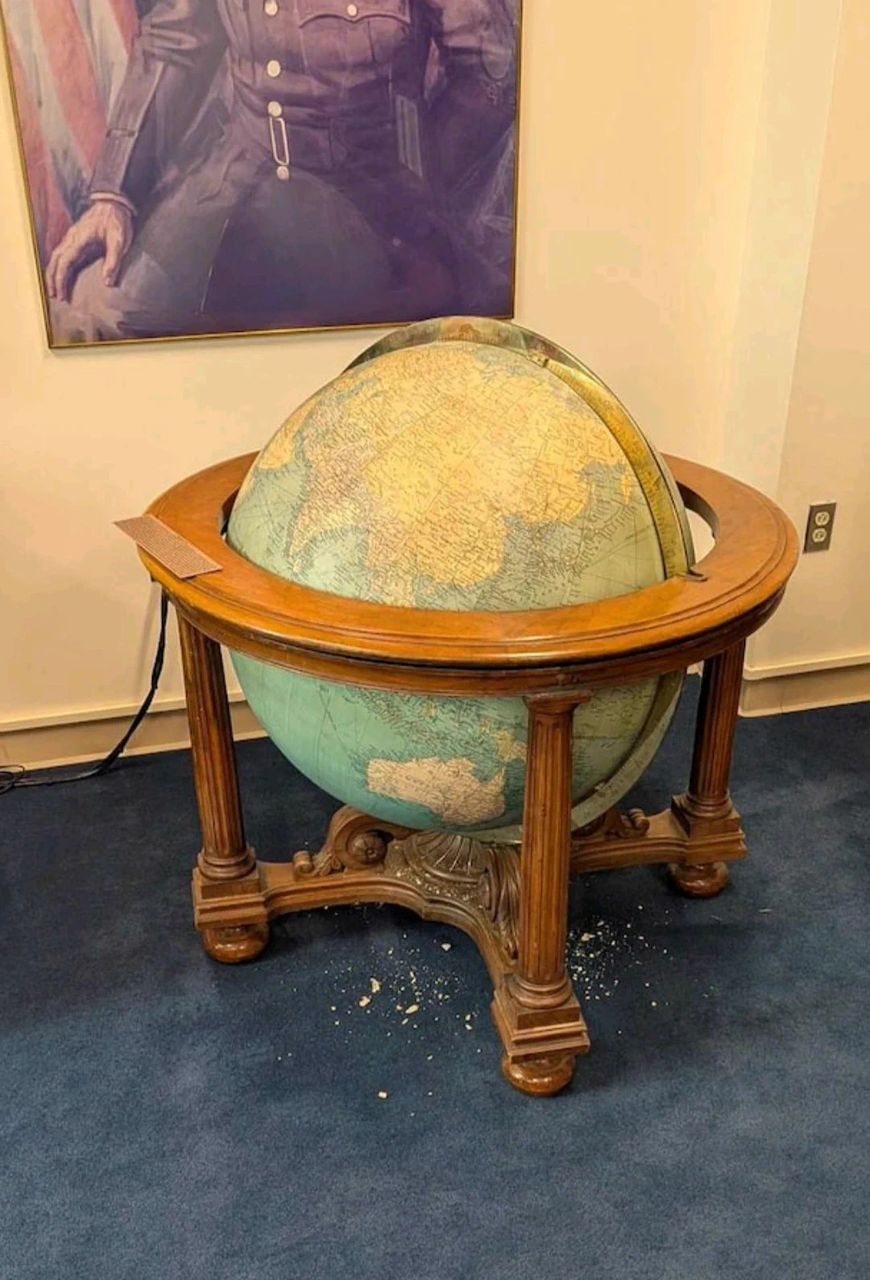
Did Pete Hegseth's staff break Dwight Eisenhower's historic WWII globe while trying to move it into Hegseth's Pentagon office without curators?
True
Hegseth's staff dropped the globe during a relocation attempt.
Yes, Defense Secretary Pete Hegseth's staff damaged a historic World War II globe associated with Dwight D. Eisenhower while trying to move it to Hegseth's Pentagon office on February 3, 2026.
 Genuine
Claims
✓ 4 trueDefense Secretary Pete Hegseth requested that a World War II–era globe associated with Dwight D. Eisenhower be moved to his Pentagon office.12
The assertion that Hegseth requested the globe's relocation is supported by multiple reputable sources, which report that he took a particular interest in the globe. This claim is corroborated by both Common Dreams and The Daily Beast, confirming that Hegseth's staff facilitated the request to move it to his office. This shows a consistent narrative without contradiction across the evidence.
On Feb. 3 (2026) his staff attempted to move the globe while professional curators were unavailable (furloughed during a partial government shutdown).3
This claim holds that on February 3, Hegseth's staff attempted the relocation without curators. While the timeline is mentioned in reports by the Army, it reveals a lack of comprehensive documentation on the absence of curators. An Army spokesperson acknowledged the staff's actions during the attempt, and corroborated reports suggest that curators were furloughed, supporting a probable accuracy of the claim.
Hegseth’s staff dropped the globe during the move, damaging it (a gash/ puncture near Antarctica and detaching it from its mounting).23
Reports confirm that while attempting to move the globe, it was indeed dropped resulting in a significant puncture and damage to its mounting. The Army's acknowledgment of the incident combined with detailed accounts from the media assert this damage, indicating a thorough understanding of the physical nature of the event.
The globe is a historic, World War II–era item associated with Dwight D. Eisenhower (one of a small set of similar globes housed at the Pentagon).12
This claim aligns with multiple reports that classify the globe as a historic artifact tied to Eisenhower. Descriptions note its historical significance as a WWII-era globe and its location amongst other similar artifacts in the Pentagon, supported by thorough descriptions and quality reporting.
What was posted
XThe post on Twitter claims that Defense Secretary Pete Hegseth wanted a WWII-era globe linked to Eisenhower moved to his office. It recounts how on February 3, 2026, his staff attempted this move without professional curators, who were furloughed during a government shutdown, leading to damage of the globe.
“Defense Secretary Pete Hegseth wanted a historic World War II-era globe associated with Dwight D. Eisenhower moved to his Pentagon office. On February 3, his staff tried moving it without professional curators, who were furloughed during a government shutdown. They dropped the globe, puncturing…”
Who posted it
XAccount check
Estimates from public signals — account age, posting pattern, audience — not a judgement of the person behind the account, and separate from whether this post is true.
What stood out
- Clash Report is an English-language news and analysis website focused on global conflicts, defense, and geopolitics, with a contact address in Bahçelievler, Istanbul, Turkey. (mediabiasfactcheck.com)
- The Twitter account @clashreport joined in May 2015, has 887.2K followers, and 94.6K posts, indicating significant activity and a substantial following. (sotwe.com)
- The account has a low following-to-follower ratio (1 following, 887.2K followers), which is uncommon for personal accounts but typical for news organizations. (sotwe.com)
- The account's bio and recent posts align with the content on the Clash Report website, suggesting consistency in branding and messaging. (sotwe.com)
- The account is not verified on Twitter, which is common for news organizations and does not necessarily indicate inauthenticity. (en.wikipedia.org)
Signals (4)+
- Posting cadence
- High
- Follower ratio
- High
- Notable news coverage
- None found
- Fact check history
- None found
Account checked October 19, 2026, 14:56 UTC
The media
Image✓ What is genuine
The image visually represents the damaged globe consistent with descriptions in articles.
The tells
- ●●● Strong signal The image may provoke suspicion as it showcases damage, leading viewers to question authenticity.our visual review
- ●○○ Weak signal The context of the image from a known news source may encourage acceptance.our visual review
Synthetic-media detector
Detector not consultedSources settled the claim on their own; the detector was not needed.
Sources
4 sources reviewed- 1Hegseth wanted Eisenhower’s globe for his office. His staff broke it. ↗
Common Dreams · commondreams.orgUntiereduntiered — treated as signal only, never decisiveEvidence
The core details of the globe's requested move and subsequent damage.
- 2Defense secretary Pete Hegseth's disastrous office makeover (coverage includes photos) ↗
The Daily Beast · thedailybeast.comUntiereduntiered — treated as signal only, never decisiveEvidence
Visual evidence of the damage and contextual coverage.
- 3The historic significance of the WWII-era globe damaged by Pete Hegseth's staff ↗
KNKX Public Radio · knkx.orgUntiereduntiered — treated as signal only, never decisiveEvidence
An official Army statement attesting to the circumstances of the event.
- 4Pete Hegseth’s staff break priceless historic globe he requested for office ↗
The Guardian · theguardian.comReputable outletLean Left (AllSides)Evidence
Photographs depicting the damaged globe and an overview of the incident.
Further reading
- 1Common Dreams Provides an in-depth account of the mishap including contextual background.
- 4The Guardian Features photographs detailing the damage and offers perspective from the Army.
The full story
The incident revolves around Defense Secretary Pete Hegseth's request for a World War II-era globe linked to Dwight D. Eisenhower. On February 3, 2026, his aides attempted to move this globe to his office at the Pentagon during a time when curators were unavailable due to furloughs stemming from a government shutdown. Reports indicate that while moving, the globe was dropped, resulting in a notable gash near Antarctica and detaching it from its mounting. The Army has since acknowledged the incident, stating that the globe is under repair. This event highlights not only the significance of maintaining historical artifacts but also the ramifications of mishandling such items in a high-stakes environment like the Pentagon.
Kernel of truth
The claim originates from a verified attempt to relocate a notable artifact under circumstances that led to its damage.
Timeline
February 3, 2026
Hegseth's staff attempted to move the globe. 3KNKX Public Radio
October 22, 2026
Initial reports of the damaged globe emerge, attributed to The Washington Post. 1Common Dreams
How it was framed
This report accurately reflects an event involving historical artifact damage and is based on multiple corroborated accounts.
Bias
Leans critical_of_hegseth. The caption and most coverage frame the incident as an embarrassing misstep by Hegseth and his staff; reporting is factual but the selection of detail emphasizes incompetence and embarrassment.
Bias describes how the post frames its message — the slant of the language, selection and emphasis — and is judged separately from whether the claim is true. A true claim can still be framed with a strong slant.
How we checked
1 min 4 s- 1
Conducted searches focusing on the incident to gather corroborative reports.
- 2
Reviewed coverage in various news outlets for consistency and details.
- 3
Analyzed the authenticity of the image alongside reports confirming the globe's condition.
✓ Claim checked✓ Media checked✓ Sources checked
Why 82% confidence
HighConfidence is rated HIGH because multiple independent sources corroborated the details surrounding the incident, providing a strong basis for our conclusion.
Limits. No further media authenticity checks were performed due to other validating reports.
Spot it yourself
Why it looked fakeLooks suspicious, isn’t proof
- The sensational account of staff mishandling a historic object could induce doubt.
- Lack of immediate official commentary can make claims susceptible to skepticism.
- Low-resolution images might create uncertainty about authenticity.
- The nature of the subject involving the Pentagon could prompt additional scrutiny.
The actual evidence
- Credible reports from multiple sources detailing the incident.
- Photographs confirmed by reporters showing damage consistent with accounts.
- 1
Check for corroborating news sources covering significant incidents.
Assess major outlets known for reliability on historical and government events.
- 2
Examine references for expert knowledge, particularly on artifacts.
Look for statements from credible historians or official representatives.
- 3
Look for issues pertaining to government transparency in handling artifacts.
Determine if there is a precedent for such claims during government furlough.
- 4
Inspect visual evidence carefully for signs of alteration.
Use reverse image search tools if unfamiliar images appear.
Takeaway
When assessing claims about historical artifacts, always verify across multiple trusted sources and scrutinize the context of the claims.
Questions people ask
What does the incident involving Hegseth's globe reveal about artifact management?+
This incident underscores the importance of proper care and expertise in handling historical artifacts, particularly during times of staff shortages.
What steps are typically taken to move historic artifacts?+
Moving historic artifacts generally involves professional appraisal, careful planning, and dedicated staff trained to handle valuable items to ensure their safety during transportation.
Why are curators important during such relocations?+
Curators possess expertise in the handling and care of artifacts, ensuring that they are moved without causing damage, which is essential during transitions.
Go deeper
- Artifact
- An object made by a human being, typically an item of cultural or historical interest.
- Curators
- Professionals who manage collections of artifacts or artworks, overseeing their care and interpretation.
- Furlough
- A temporary leave of absence from work, typically due to a government decision.
People also search for
For educators+
- What are the implications of mishandling historical artifacts?
- How should organizations handle the relocation of significant cultural objects?
- What role do curators play in artifact management and preservation?
About this check
- Platform
- X
- Posted by
- @clashreport
- Posted
- October 22, 2026
- Age when checked
- Under 24 hours old when checked
- Where it spread
- United States
- Audience
- US audience
- Language
- EN
- Status
- ● Post is live
- Verified
- October 23, 2026, 03:04 UTC
- Published
- October 23, 2026, 03:04 UTC
Reach. 1.75K likes per X syndication 23 Oct; Snopes (True) 22 Oct; picked up by Radio-Canada 22 Oct.
This verdict was generated with AI from the sources shown. AI can make mistakes — check the sources before relying on it.
Check anything yourself, in seconds.
Share any social post or video to What the Fact and get the verdict, the confidence, and the receipts.