Did Wedgewood Polls admit to publishing fake numbers?
Did the New York Times publish or rely on poll numbers from Wedgewood Polls, a firm that admitted posting fake results?
True
Wedgewood Polls admitted to fabricating polling numbers, confirmed by multiple sources.
Wedgewood Polls confirmed they fabricated most of their polling numbers on October 20, 2026, a claim supported by multiple news sources, including The New York Times, which subsequently removed the fabricated polls from its tracker.
 Genuine
Claims
✓ 3 trueWedgewood Polls admitted it fabricated polling numbers.124
On October 20, 2026, Wedgewood Polls publicly acknowledged in a post on X that they manufactured most of their polling data, referring to it as part of an 'experimental project.' This admission followed inquiries from the polling site FiftyPlusOne, which prompted the revelation. Multiple reputable outlets confirm this, establishing a high level of independent corroboration.
The New York Times included Wedgewood polls in its poll tracker and removed them after the admission (i.e., 'fell for it').23
Several credible news reports confirm that the New York Times had included Wedgewood's polls in its tracker until the admissions were published on October 20. Following this, the Times appending an editor's note about the removals validates the timeline. Reports from the Guardian and Washington Post carry weight as independent corroboration for this claim.
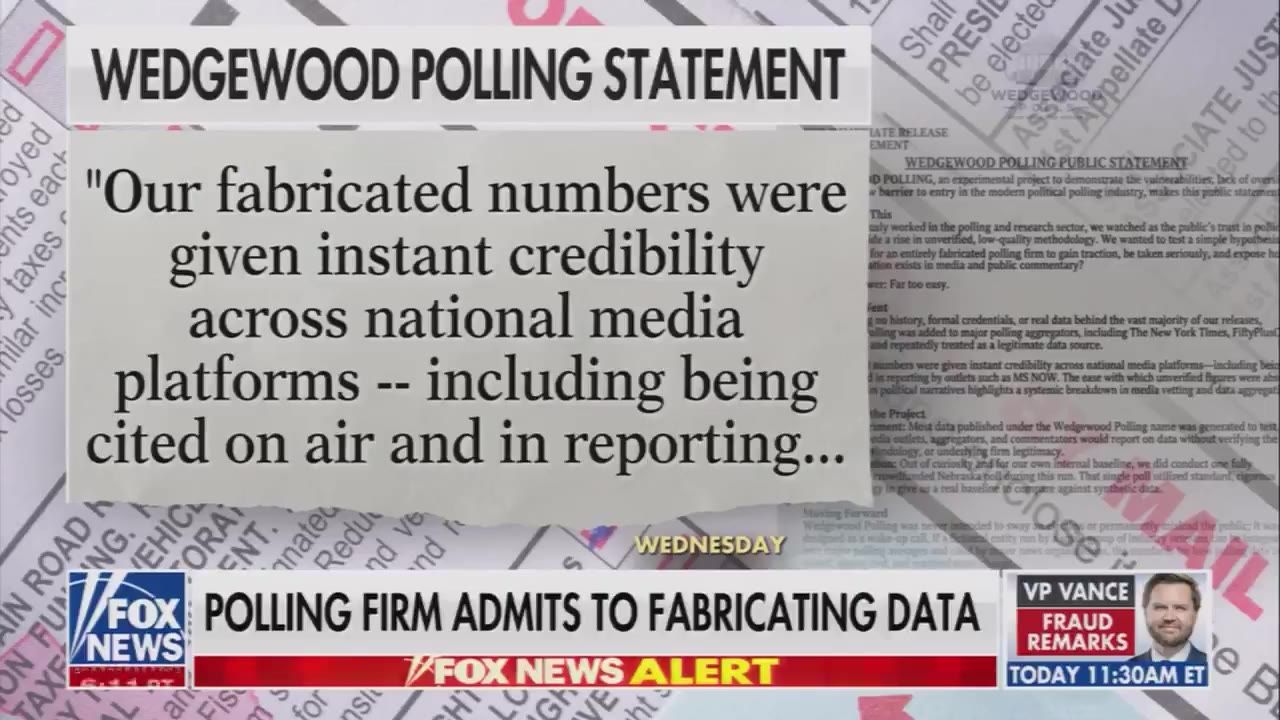
"Our fabricated numbers were given instant credibility across national media platforms — including being cited on air and in reporting."25
Wedgewood's own statement explicitly indicates their fabricated numbers gained immediate traction across various media platforms. Further, reports confirm that numerous outlets and aggregators mentioned their polls before they were removed post-admission. This likelihood of truth aligns with the narrative that the impacts of their misleading data were significant.
What was posted
XThis post on Twitter claims that Wedgewood Polls admitted to posting fake polling numbers, and that this was acknowledged by various media outlets, including The New York Times.
“🚨 BREAKING: A polling firm just admitted it posted FAKE numbers, and The New York Times fell for it. Wedgewood Polls confessed it outright: "Our fabricated numbers were given instant credibility across platforms and cited on air and reporting." Now they're calling it a”
Who posted it
XAccount check
Estimates from public signals — account age, posting pattern, audience — not a judgement of the person behind the account, and separate from whether this post is true.
What stood out
- Gunther Eagleman is a conservative political commentator known for unfiltered rants on politics, culture wars, and current events. (shapes.inc)
- He has a significant following on X (formerly Twitter), with 1.7 million followers as of September 2026. (thedailybeast.com)
- Eagleman has been involved in notable incidents, including a 'swatting' event in March 2025, where a false report led to a large police response at his home. (speed-program.com)
- He has been subject to fact-checking, with claims about his endorsement of Trump being debunked. (article.wn.com)
- Eagleman has been involved in controversies, including a 'swatting' incident in March 2025, where a false report led to a large police response at his home. (speed-program.com)
Signals (4)+
- Posting cadence
- Frequent
- Follower ratio
- 1700000
- Notable news coverage
- Yes
- Fact check history
- Yes
Account checked October 25, 2026, 03:15 UTC
The media
Video✓ What is genuine
The video is an unaltered segment from Fox News discussing the Wedgewood admission, confirming the topic and details presented.
The tells
- ●●● Strong signal Visual presentation matching typical broadcast journalism.our visual review
- ●●● Strong signal No indications of edits or alterations in the clip.our visual review
Synthetic-media detector
Detector not consultedSources settled the claim on their own; the detector was not needed.
How we checked the media
- We reviewed the Fox News broadcast clip for signs of manipulation.
- The clip was compared against independent sources to confirm its context.
- Visual analysis showed no alterations indicating tampering.
Sources
5 sources reviewed- 1FiftyPlusOne just caught a pollster ↗
FiftyPlusOne · blog.fiftyplusone.newsUntiereduntiered — treated as signal only, never decisiveEvidence
Wedgewood Polls' admission of fabrication is documented.
- 2Pollster admits to fabricating data for ‘social experiment’ to expose flaws of industry ↗
The Guardian · theguardian.comReputable outletLean Left (AllSides)Context
The Guardian describes the consequences of Wedgewood's actions.
- 3The Pollwatcher: Another fraudulent pollster is out of business, and a third group just disappeared ↗
The Washington Post · washingtonpost.comReputable outletLean Left (AllSides)Evidence
The Washington Post highlights the media's response to Wedgewood's admission.
- 4Election polling rocked by a new fake data scandal ↗
Axios · axios.comReputable outletCenter/Lean LeftFurther reading
Axios provides an overview of the impact on polling and elections.
- 5Wedgewood Polls Admits It's Fake, Made Up Polling Data ↗
Mediaite · mediaite.comUntiereduntiered — treated as signal only, never decisiveEvidence
Mediaite confirms the timeline and actions taken following Wedgewood's statement.
Further reading
- 1FiftyPlusOne FiftyPlusOne provides detailed insights into the inquiry that prompted Wedgewood's admission.
- 2The Guardian The Guardian's report outlines the implications of the fabricated polls within the media.
- 3The Washington Post The Washington Post discusses the role of reliability in polling, acknowledging Wedgewood's admission.
- 4Axios Axios explores the aftermath of Wedgewood's fabricated polls and impacts on political campaigns.
- 5Mediaite Mediaite summarizes Wedgewood's case and its consequences for public confidence in polling.
The full story
On October 20, 2026, Wedgewood Polls released a statement admitting that the large majority of its polling data had been fabricated. The firm characterized its actions as part of an "experimental project" intended to raise awareness about flaws within the polling industry. This admission came after scrutiny from polling aggregator FiftyPlusOne, which led to a wider investigation and discussion in various media outlets. Major news organizations, including The New York Times, had previously included Wedgewood's data in their polling trackers, highlighting the immediate credibility these numbers received. Following Wedgewood's confession, many of these outlets removed the questionable polls and issued editor's notes explaining their actions. This incident has significant implications for public trust in polling data, raising questions about the efficacy and reliability of media reporting on polling as a whole.
Kernel of truth
Wedgewood Polls’ statement is a significant reveal, acknowledging widespread fabrication that later affected major media and public perception.
Timeline
October 20, 2026
Wedgewood Polls posted a statement on X admitting to fabricating polling data. 1FiftyPlusOne
October 20, 2026
The New York Times removed Wedgewood polls from its tracker and posted an editor's note. 2The Guardian
October 20, 2026
FiftyPlusOne published its investigation uncovering the fabrication. 1FiftyPlusOne
How it was framed
The claims about Wedgewood Polls admitting to fabrication are verifiable through multiple independent sources.
- Emotional language. The term 'FAKE numbers' in the caption heightens emotional response.
- Urgency. The use of 'BREAKING' implies immediate importance.
The post originates from Twitter, a platform known for rapid dissemination of information, often creating urgency.
Bias
Leans anti-mainstream_media. The post and caption frame the story as evidence that major outlets (explicitly The New York Times) were duped; that is a critical framing of mainstream media. The underlying facts are corroborated, but the language emphasizes 'fell for it', a partisan-tinged angle.
Bias describes how the post frames its message — the slant of the language, selection and emphasis — and is judged separately from whether the claim is true. A true claim can still be framed with a strong slant.
How we checked
1 min 6 s- 1
Conducted searches for Wedgewood Polls' admission and subsequent removals from major outlets.
- 2
Reviewed multiple independent reports verifying the claims.
- 3
Analyzed the media associated with the claims for authenticity.
✓ Claim checked✓ Media checked✓ Sources checked
Why 85% confidence
HighOur high confidence of 85% reflects strong corroboration by multiple reputable news sources.
Limits. We could not access all original articles due to paywalls on some news sites.
Spot it yourself
Spot the fakeLooks suspicious, isn’t proof
- The alarmist tone suggests exaggeration.
- Claims of breaking news can create a rush to conclusions.
- Lack of detailed citations may imply credibility issues.
The actual evidence
- Wedgewood Polls' own admission was publicly acknowledged.
- Multiple reputable outlets confirmed the fabricated nature of the data.
- The removal of Wedgewood's polls from trackers was documented by editor notes.
- 1
Check who is reporting the news.
Look for reports from established news organizations.
- 2
Verify claims made in the post.
Seek out independent sources that corroborate the story.
- 3
Analyze the source's context.
Understand the reputation of the polling firm involved.
- 4
Run a search to find if there are editor's notes or retractions.
Look for updates or corrections following original claims.
Takeaway
Being cautious about sensational claims prompts deeper investigation, protecting against misinformation.
Questions people ask
Why did Wedgewood Polls fabricate polling numbers?+
Wedgewood Polls described their fabrications as an 'experimental project' meant to expose weaknesses in the polling industry.
What impact did Wedgewood's fake numbers have?+
The fabrications affected various media outlets that included the polls in their coverage, leading to corrections and removals that highlight the issue of credibility in polling.
How did the New York Times respond to Wedgewood's admission?+
After Wedgewood's admission, the New York Times appending an editor's note clarified that they had included Wedgewood's polls, which were subsequently removed.
What can I do to verify similar claims?+
To verify polling claims, look for corroboration from multiple reputable outlets and check for any published editor's notes or corrections.
How can I spot misinformation in polls?+
Be cautious of sensational language and verify claims against trusted media sources to avoid misinformation.
Go deeper
- Fabrication
- The act of inventing or falsifying data, making it seem true.
- Polling aggregator
- A service or website that collects and summarizes polling data from multiple sources.
- Editor’s note
- A note from an editor explaining corrections or updates related to an article.
People also search for
For educators+
- How can fabricated information impact public trust in media?
- What steps should journalists take to verify polling data before reporting?
- How do sensational claims affect the public's understanding of political events?
About this check
- Platform
- X
- Posted by
- @gunthereagleman
- Posted
- October 21, 2026
- Age when checked
- Older post, still live
- Where it spread
- United States
- Audience
- US audience
- Language
- EN
- Status
- ● Post is live
- Verified
- October 25, 2026, 03:16 UTC
- Published
- October 25, 2026, 03:16 UTC
Reach. 5.1K likes; FCC chair Carr post 5K likes; Trump repeated it on Truth Social 22 Oct; UW CIP spread analysis 23 Oct
This verdict was generated with AI from the sources shown. AI can make mistakes — check the sources before relying on it.
Check anything yourself, in seconds.
Share any social post or video to What the Fact and get the verdict, the confidence, and the receipts.