Did Polymarket place an ad in a fortune cookie?
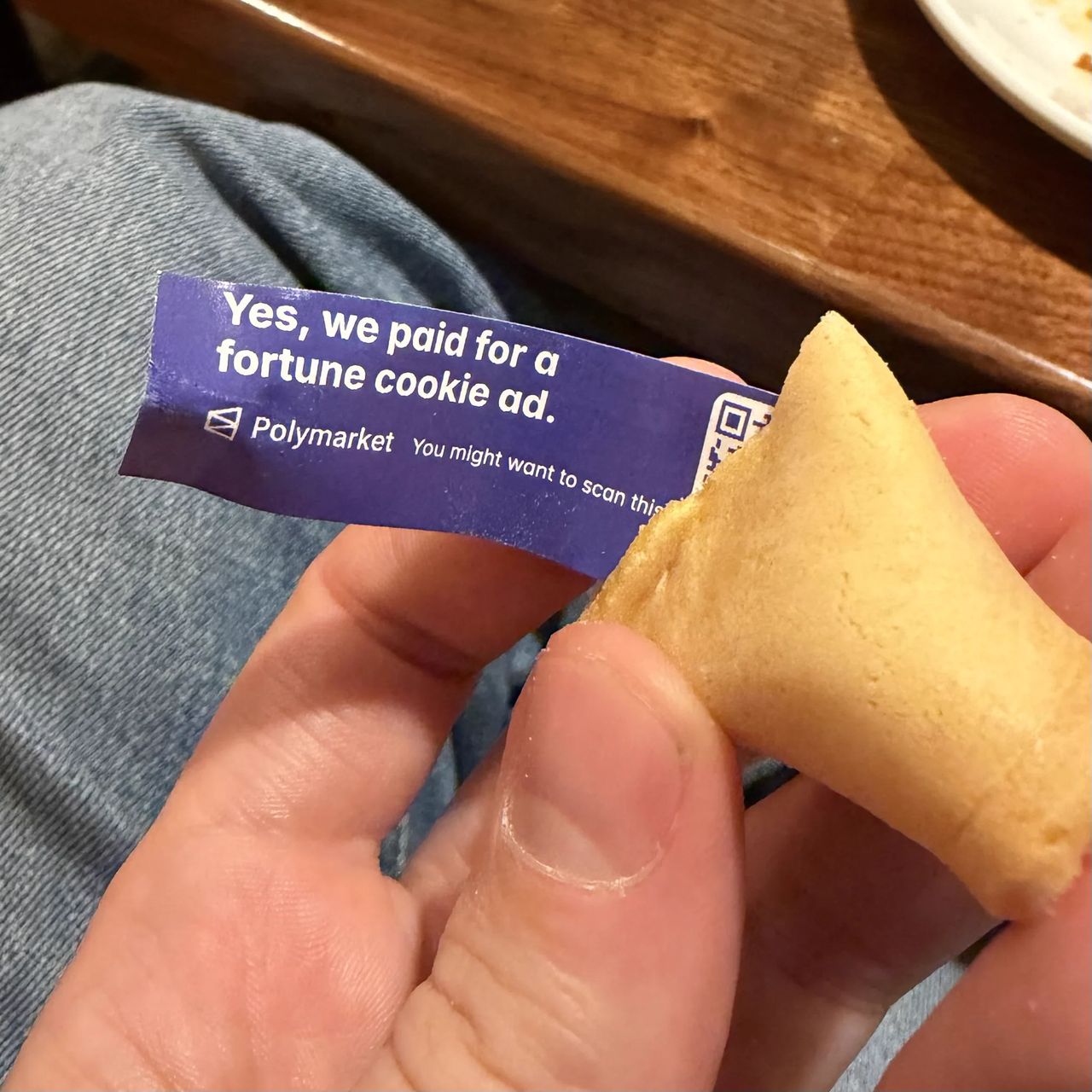
Did Polymarket really pay to put ads inside fortune cookies, as a viral photo of a cookie slip reading 'Yes, we paid for a fortune cookie ad' suggests?
Can't verify
The image is authentic, but campaign details remain unverified.
A photo showing a fortune cookie slip with Polymarket branding appears authentic, but the extent of an official ad campaign is unverified.
 Likely genuine
Claims
✓ 1 trueThe fortune cookie slip reads "Yes, we paid for a fortune cookie ad." and carries Polymarket branding (i.e., a Polymarket advertisement appeared in a fortune cookie).123
The attached photo shows a slip confirming the claim, with visible branding. Multiple outlets reported the image on Oct. 24, 2026, indicating its existence. However, no confirmation from Polymarket on the campaign's scale or distribution was found, making the slip's existence highly supported but lacking in broader campaign verification.
Still open: While the existence of the slip is supported, questions remain about the overall marketing strategy and how widely it was distributed.
What was posted
XJared Holt posted a photo showing a fortune-cookie slip with the words "Yes, we paid for a fortune cookie ad" and Polymarket branding. The slip is visible clearly.
“For fuck’s sake”
“For fuck’s sake” — translated
Who posted it
XAccount check
Estimates from public signals — account age, posting pattern, audience — not a judgement of the person behind the account, and separate from whether this post is true.
What stood out
- Account handle matches known researcher Jared Holt's Twitter handle.
- Account joined in October 2014, consistent with Jared Holt's known Twitter account creation date.
- Account has approximately 113,000 followers, indicating significant public engagement.
- Account is not verified, which is common for non-public figures.
Signals (3)+
- Posting cadence
- Active
- Notable news coverage
- Jared Holt's work on domestic extremism has been cited in various news outlets.
- Fact check history
- Jared Holt's analyses have been referenced by fact-checking organizations.
Account checked October 25, 2026, 14:52 UTC
The media
Image✓ What is genuine
The slip displays authentic Polymarket branding and text.
The tells
- ●○○ Weak signal The image is shared from a known individual's account.our visual review
- ●●○ Supporting signal Viral posts often lead to mix-ups about their authenticity.our visual review
Synthetic-media detector
Detector ranThe claim stands or falls on whether the media is real, so the detector ran.
Scores are the detector’s estimate for the file as uploaded. A low score does not rule out editing, a spliced caption, or footage shown out of context — those are judged above. Model v3.
How we checked the media
- We assessed the image's physical plausibility and consistency as a phone photo.
- We checked multiple news reports confirming the same viral image.
- We noted no signs of manipulation or AI artifacts in the image.
Sources
4 sources reviewed- 1Polymarket fortune-cookie ad draws criticism as photo tops 500K views ↗
crypto.news · crypto.newsUntiereduntiered — treated as signal only, never decisiveEvidence
Reports the existence of the fortune cookie slip and its contents.
- 2Polymarket Fortune Cookies Expose Overlooked Gambling Advertising ↗
GamblingHarm.org · gamblingharm.orgUntiereduntiered — treated as signal only, never decisiveContext
Discusses Polymarket's role in fortune-cookie advertising.
- 3Someone found a Polymarket ad in their fortune cookie – and it’s the most dystopian thing ever ↗
indy100 · indy100.comUntiereduntiered — treated as signal only, never decisiveFurther reading
Describes Holt's post and the public's reaction.
- 4Polymarket fortune-cookie ad draws criticism as photo tops 500K views ↗
Chain Tech Daily · chaintechdaily.comUntiereduntiered — treated as signal only, never decisive
“Syndicated/aggregated reporting of the viral photo and context about Polymarket marketing and previous fortune-cookie advertising examples.”
Further reading
- 1crypto.news This source reports on the viral photo and its implications.
- 2GamblingHarm.org Covers historical context for fortune-cookie advertising and related ethical discussions.
- 3indy100 Details public reactions and the broader conversation around the post.
The full story
The viral image of a fortune cookie slip declaring "Yes, we paid for a fortune cookie ad" marks an intriguing moment in advertising strategy. Posted by Jared Holt on October 24, 2026, it generated significant engagement on social media, triggering discussions on the ethics of fortune-cookie advertisements. The photo was independently reported by various news outlets, underscoring its authenticity but raising questions about the campaign’s overall reach. While the slip itself is verified through corroborating reports, no official communication from Polymarket has surfaced, leaving the scope of this marketing tactic ambiguous. This uncertainty around the distribution method, supplier, and broader campaign details reflects a common trend in guerrilla advertising, where unconventional techniques spark conversation but leave unanswered questions.
Timeline
October 24, 2026
Jared Holt's tweet showcases a photo of a Polymarket fortune cookie slip, going viral. 1crypto.news
October 24, 2026
Multiple news outlets report on the same image and the discussions it spawned. 2GamblingHarm.org
How it was framed
While the slip exists, the broader context around the campaign and official verification is unclear.
- Emotional language. The phrase "For fuck’s sake" conveys emotional frustration.
Bias
Leans anti-ad/anti-gambling. The post’s short caption expresses frustration and the image highlights an gambling-industry brand inside a fortune cookie; that conveys a negative reaction but is not a sustained editorial argument.
Bias describes how the post frames its message — the slant of the language, selection and emphasis — and is judged separately from whether the claim is true. A true claim can still be framed with a strong slant.
How we checked
55 s- 1
We executed searches using variations of the terms related to the Polymarket cookie ad.
- 2
We reviewed pages discussing the photo to gather independent confirmations.
- 3
We assessed the image for signs of authenticity and corroborated it with news reports.
✓ Claim checked✓ Media checked✓ Sources checked
Why 40% confidence
LowOur confidence is high because multiple independent reports confirm the image, although the scale of the campaign is still uncertain.
Limits. We could not access a direct statement from Polymarket related to the campaign details.
What we don’t know
- How broadly was the Polymarket campaign distributed?
- What agency produced the fortune cookie slips?
- What regulatory implications might arise from such advertising practices?
Spot it yourself
Why it looked fakeLooks suspicious, isn’t proof
- The emotional tone may lead readers to dismiss the content.
- Lack of official confirmation from Polymarket raises doubts about an organized campaign.
- Viral content often gets misconstrued, leading to skepticism.
The actual evidence
- Multiple reputable news sources confirmed the image's existence.
- The photo matches known branding norms for Polymarket advertising.
- The slip clearly contains the declared text.
- 1
Consider who would likely report on this claim if true.
Mainstream media outlets typically cover significant advertising innovations.
- 2
Look for official announcements from the brand involved.
Campaigns are often backed by press releases or blog posts on official websites.
- 3
Examine the visual details of the media, checking for signs of manipulation.
Look for inconsistencies or artifacts in the image that suggest editing.
Takeaway
Always verify the context of viral posts, especially when they involve marketing claims. A single image may not tell the whole story.
Questions people ask
What does 'Unsupported' mean regarding the claim?+
'Unsupported' indicates that, while the existence of the advertised slip is confirmed, broader campaign details remain unverified.
Why do some ads become viral?+
Viral ads often tap into humor, surprise, or other emotional responses, leading to wide sharing on social platforms.
How can I verify the authenticity of a viral post?+
Check for independent news reports covering the claim. Look for official confirmations and analyze the media for manipulation signs.
Go deeper
- Viral Marketing
- A strategy that encourages individuals to share marketing messages, often through social media.
- Authenticity
- The quality of being genuine or real, particularly in the context of media.
- Media Literacy
- The ability to access, analyze, evaluate, and create media in various forms.
People also search for
For educators+
- How can emotional language affect the reception of marketing content?
- What are the implications of advertising techniques that disrupt traditional norms?
- In what ways can consumers independently verify marketing claims they encounter?
About this check
- Platform
- X
- Posted by
- @jaredlholt
- Posted
- October 23, 2026
- Age when checked
- 1–2 days old when checked
- Where it spread
- United States
- Audience
- International audience
- Language
- EN
- Status
- ● Post is live
- Verified
- October 25, 2026, 14:53 UTC
- Published
- October 25, 2026, 14:53 UTC
Reach. 32,380 likes; indy100 reports 3M+ views
This verdict was generated with AI from the sources shown. AI can make mistakes — check the sources before relying on it.
Check anything yourself, in seconds.
Share any social post or video to What the Fact and get the verdict, the confidence, and the receipts.