Are churches in Ecuador chaining crucifixes after a priest's death?
Does a viral video really show a priest saying Mass in a safety helmet with the crucifix chained to the wall, after a falling cross killed a priest in Ecuador?
Misleading
The claim about churches chaining crucifixes is misleading.
Claims that churches in Ecuador began chaining crucifixes following a priest's death are misleading. While there was a confirmed death due to a falling cross, no authoritative evidence supports widespread changes in church practices.
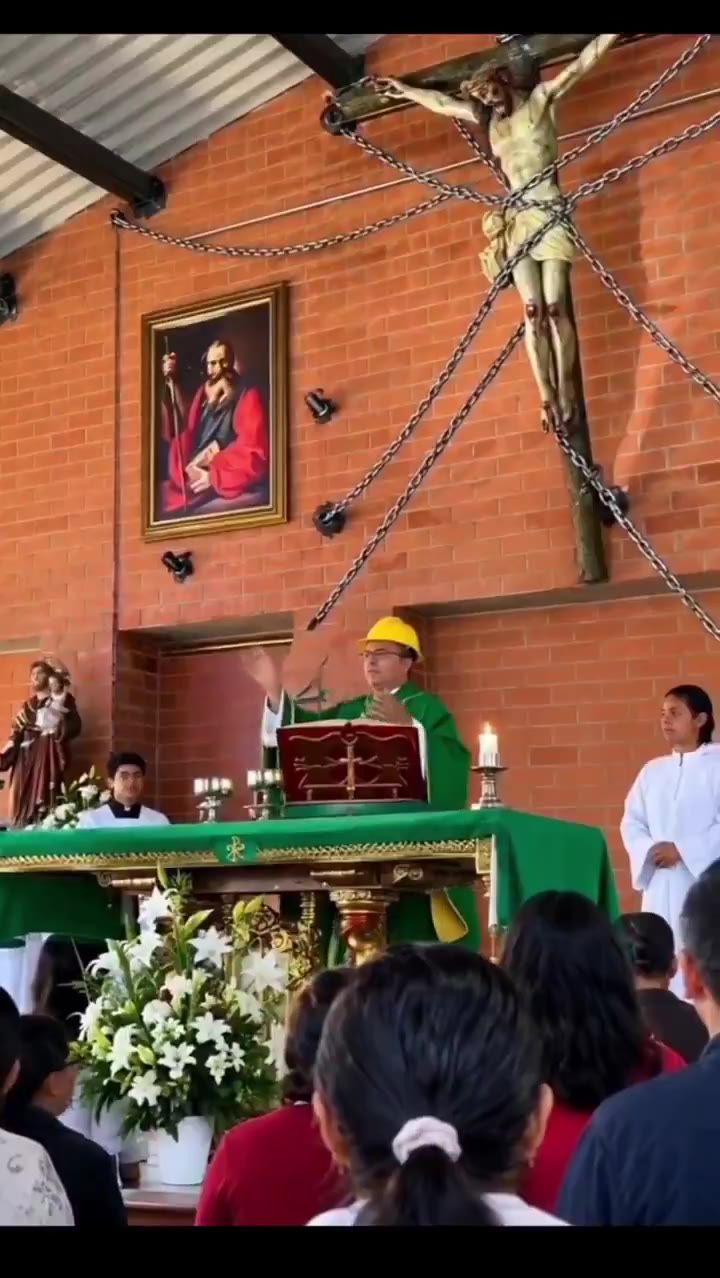 AI-generated
Claims
✓ 2 trueA wooden crucifix fell on Father Patricio Alfredo Sánchez Molinari during a livestreamed Mass in Guayaquil, Ecuador, and he died.1237
The fatal incident involving Father Patricio Alfredo Sánchez Molinari receiving a fatal blow from a falling crucifix during a livestreamed Mass is verified by several reliable sources. Major news organizations, including NBC and Reuters, have confirmed the circumstances surrounding his death, establishing a strong basis for the truth of this claim.
After that incident, churches have begun chaining crucifixes to prevent them from falling on priests (presented as a general or widespread response).456
The claim regarding churches implementing a widespread policy of chaining crucifixes lacks authoritative evidence. While various clips are circulating that suggest this, they do not constitute verified practices by church authorities. No substantial reporting backs the idea of an organized change; hence, the claim is misleading.
The video circulating online shows a priest wearing a yellow hard hat celebrating Mass beneath a crucifix secured with heavy chains.456
The video in question does confirm the presence of a priest wearing a yellow hard hat under a crucifix secured with chains. Observations from various news outlets substantiate the claim that the footage is indeed what it purports to show, although its context and origin remain unverified.
What was posted
XA video featuring a priest in a hard hat and a chained crucifix circulated on social media after a priest's death in Ecuador.
“Following the incident where the cross fell on Father Patrizia Molinari in Ecuador, churches have begun chaining the cross to prevent it from falling on priests.”
“Following the incident where the cross fell on Father Patrizia Molinari in Ecuador, churches have begun chaining the cross to prevent it from falling on priests.” — translated
Who posted it
XAccount check
Estimates from public signals — account age, posting pattern, audience — not a judgement of the person behind the account, and separate from whether this post is true.
What stood out
- Account lacks a display name and bio, which are typically present in genuine profiles.
- No recent posts available, making it difficult to assess the account's activity and engagement.
- The handle 'harri_onuoha' does not appear in any notable news coverage or fact-checking databases, suggesting limited public presence or recognition.
Signals (4)+
- Posting cadence
- 0
- Follower ratio
- 0
- Notable news coverage
- No
- Fact check history
- No
Account checked October 26, 2026, 03:29 UTC
The media
Video✓ What is genuine
The video features a priest in a hard hat under a chained crucifix, presenting a scene that appears authentic.
The tells
- ●●● Strong signal The video is presented as a clip showing a church response to an incident, but its origin is unverified.our visual review
- ●●● Strong signal Visuals appear aligned with the timing of the incident, leading to assumptions about a widespread policy change.our visual review
Synthetic-media detector
Detector ranThe claim stands or falls on whether the media is real, so the detector ran.
Scores are the detector’s estimate for the file as uploaded. A low score does not rule out editing, a spliced caption, or footage shown out of context — those are judged above. Model v3.
How we checked the media
- We examined the video in the post and confirmed the presence of a priest wearing a yellow hard hat under a crucifix secured with chains.
- We searched for additional reports on the video's origin and context.
- We verified the claims made by other news outlets regarding the circulating video.
Sources
7 sources reviewed- 1Priest in Ecuador dies after crucifix falls on him during livestreamed Mass – NBC Chicago ↗
NBC Chicago · nbcchicago.comUntiereduntiered — treated as signal only, never decisiveEvidence
Confirms the death of Father Sánchez due to a falling crucifix during Mass.
- 2Ecuador: Investigation underway into the fall of a cross that killed a priest during Mass in Guayaquil ↗
Reuters (video/licensable item) · reutersconnect.comUntiereduntiered — treated as signal only, never decisiveEvidence
Provides details of the circumstances surrounding Father Sánchez's death.
- 3¿Quién era Patricio Sánchez Molinari? Sacerdote fallece por caída de una cruz en Guayaquil - El Comercio ↗
El Comercio (Ecuador) · elcomercio.comUntiereduntiered — treated as signal only, never decisiveEvidence
Reports the incident and confirms that the crucifix fell during a live ceremony.
- 4Hard-hat priest clip spreads after Ecuador cross tragedy ↗
JAM Radio News · jamradio.ukUntiereduntiered — treated as signal only, never decisiveContext
Discusses the viral video's circulation after the tragedy.
- 5Priest goes viral wearing helmet as wall-mounted crucifix is secured with chains after Ecuador cleric’s death – K24 Digital ↗
K24 Digital · k24.digitalUntiereduntiered — treated as signal only, never decisiveContext
Covers the viral priest video linking it to the incident but notes its unverified nature.
- 6Viral Video Shows Cross Chained Inside Catholic Church Days After One Fatally Fell on Ecuador Priest - Tuko ↗
Tuko · tuko.co.keUntiereduntiered — treated as signal only, never decisiveFurther reading
Describes the priest's viral video and the public's reaction to it.
- 7Priest dies after crucifix falls on him during livestreamed Mass - Euronews (video) ↗
Euronews · euronews.comReputable outletCenter — VERIFY editorial independenceEvidence
Validates the details of Father Sánchez's death through visuals and reports.
Further reading
- 4JAM Radio News This article discusses the spread of the viral video in context with the tragedy.
- 5K24 Digital K24 Digital provides more information about the viral clips and their circulation.
- 7Euronews Euronews covers the incident in detail, providing a factual basis for the story.
The full story
On 17 October 2026, Father Patricio Alfredo Sánchez Molinari tragically died during a livestreamed Mass in Guayaquil, Ecuador, when a large wooden crucifix fell on him. The incident drew significant media coverage, confirming the event through multiple reputable sources. In the aftermath, various online clips surfaced showing a priest wearing a hard hat and a crucifix chained for safety, circulating widely on social media, but without authoritative sources verifying the footage or its context. The narrative that churches adopted a practice of chaining crucifixes as a safety measure lacks substantiation; coverage remains largely anecdotal and not officially documented. The perception of an organized response is misleading as highlighted by the mix of social media posts and viral clips, emphasizing the necessity for critical examination of the information.
Kernel of truth
Father Patricio Alfredo Sánchez Molinari died from a falling crucifix during a live Mass, a real and confirmed event.
How it was framed
The claim misleads by implying a systematic church response which has not been independently verified.
- Emotional language. The post evokes sympathy by framing the priest's death within a context of safety concerns.
- Selective evidence. The footage of the chained crucifix was selected to imply a broader policy change.
The post originated on Twitter, shared by a user discussing church safety protocols.
Bias
The post pairs a verified tragic incident with a viral clip and implies a generalised reaction; that is an inferential / causal claim rather than an ideologically slanted one.
Bias describes how the post frames its message — the slant of the language, selection and emphasis — and is judged separately from whether the claim is true. A true claim can still be framed with a strong slant.
How we checked
1 min 31 s- 1
We conducted multiple searches to find reliable information confirming the incident.
- 2
We examined media reports referring to the viral video to understand its context.
- 3
We assessed if there was any verification or credible reporting on churches changing practices.
✓ Claim checked✓ Media checked✓ Sources checked
Why 45% confidence
LowConfidence is rated LOW due to the lack of independent confirmation of the claim regarding chaining crucifixes.
Limits. We could not access the original post for timestamp verification.
What we don’t know
- Whether any churches have officially enacted a policy regarding chaining crucifixes in Ecuador.
- The exact origin and context of the viral video.
- Potential coordination among church authorities in response to the incident.
Spot it yourself
Spot the fakeLooks suspicious, isn’t proof
- Viral nature of the video could suggest exaggerated claims.
- Lack of verification for the footage raises questions about authenticity.
- Emotional framing may distract from factual discrepancies.
The actual evidence
- Confirmed reports of a priest's death due to a falling crucifix.
- Independent media coverage cites the unverified nature of the chained crucifix footage.
- Multiple credible outlets did not endorse the claim of a formal church policy change.
- 1
Check for reliable news sources covering incidents like this; they often validate claims quickly.
Visit established news websites or use news aggregators.
- 2
Verify the provenance of viral videos; reverse image search can help.
Use tools designed for checking the origin of images or videos.
- 3
Look for statements from authorities or institutions reacting to major incidents.
Search for official statements from relevant organizations.
- 4
Analyze the video content carefully for any unverifiable elements.
Observe for signs of editing or unusual framing.
Takeaway
Always corroborate viral claims with established reporting, as real incidents can often lead to exaggerated or erroneous conclusions.
Questions people ask
What happened to Father Patricio Alfredo Sánchez Molinari?+
Father Patricio died on 17 October 2026 during a livestreamed Mass when a large crucifix fell on him, confirmed by multiple news outlets.
Is it true that churches in Ecuador are chaining crucifixes?+
No authoritative sources have confirmed a formal policy change regarding chained crucifixes, despite circulating videos suggesting otherwise.
What is the significance of the viral video with the priest in a hard hat?+
The video shows a priest beneath a chained crucifix, but it has not been verified to represent a broader safety policy.
Why should I be cautious with viral clips on social media?+
Viral clips can often mislead by presenting unverified claims and visuals, suggesting credibility without sufficient evidence.
How can I verify the accuracy of viral claims?+
Check claims against established news outlets and look for corroborating reports or original sources to ensure authenticity.
Go deeper
- Misinformation
- False or misleading information shared without harmful intent.
- Verification
- The process of establishing the truth or accuracy of information.
- Viral video
- A video that spreads rapidly across the internet, often without verification.
- Provenance
- The origin or source of something, particularly in the context of verified information.
People also search for
For educators+
- What are some challenges in verifying viral content?
- How can we differentiate between legitimate news and misinformation?
- Why is it important to assess the credibility of sources when discussing sensitive topics?
About this check
- Platform
- X
- Posted by
- @harri_onuoha
- Posted
- October 25, 2026
- Age when checked
- Under 24 hours old when checked
- Where it spread
- EC, Mexico
- Audience
- International audience
- Language
- EN
- Status
- ● Post is live
- Verified
- October 26, 2026, 03:31 UTC
- Published
- October 26, 2026, 03:31 UTC
Reach. ~3,220 likes / 704 replies on @harri_onuoha (syndication, 26 Oct 02:40Z); Arabic version @AIToolboxAI ~125 likes; covered by Azteca Veracruz and Azteca Bajío (25 Oct)
This verdict was generated with AI from the sources shown. AI can make mistakes — check the sources before relying on it.
Check anything yourself, in seconds.
Share any social post or video to What the Fact and get the verdict, the confidence, and the receipts.