Did Flávio Bolsonaro's letter prove Brazil's election was stolen?
Did Flávio Bolsonaro's 28 Oct 'Carta à Nação' from the US truthfully claim the Brazilian runoff was fraudulent (Lula's extra votes via Zanin's voting extension), after first calling himself the 'true president-elect'?
False
The letter is authentic; the fraud it alleges is not.
The letter is real: Flávio Bolsonaro posted it on X on 28 October 2026 after flying to the United States. Its central claim is false. Brazil's electoral court certified Lula's win by 4.43 million votes, only about 34,000 votes were cast in the disputed extra hours, and Flávio's own campaign coordinator said there was no proof of fraud.
 Likely genuine
Claims
✓ 1 true · ✕ 2 falseThe election was fraudulent and the Lula-Alckmin ticket should be annulled.15910
No evidence was offered, and the official record points the other way. The electoral court certified Lula's win at 64,256,232 votes (51.79%) against 59,826,041 for Flávio — a margin of 4.43 million. Its president, Kassio Nunes Marques, said the election ran 'within the most absolute normality', and international observers accepted the result. The letter's main factual prop, the voting-hours extension, cannot carry the weight: roughly 34,000 to 35,500 votes were cast in the extra window, about 0.03% of the total and far less than 1% of the margin. Most decisive is that the claim is contradicted not only by the electoral court but by Flávio's own side: his campaign coordinator, senator Rogério Marinho, told journalists neither he nor the party could claim fraud 'because there is no proof', and the PL recognised the outcome. The sources here are independent of one another — court data, wire reporting and a rival campaign's own admission — so this is not one outlet's word against another's.
Lula added more than 10 million votes between the first and second rounds, which is a 'mathematical impossibility' revealing fraud.38
The number is right and the conclusion is wrong. Lula rose from about 53.9 million to about 64.2 million votes, a gain of roughly 10.3 to 10.4 million. That is not mathematically impossible, and the explanation is ordinary electoral arithmetic. Around 9.3 million first-round votes went to third-way candidates who were no longer on the runoff ballot; abstention fell from 21.08% to 19.21%; blank and null votes dropped. Together that put roughly 14 million additional valid votes in play, of which Lula took about 10.3 million and Flávio himself took about 3.7 million. The decisive point is that both halves of the runoff grew, which is what you would expect when the pool of valid votes expands — not what a one-sided fraud would produce. Two independent fact-check desks, AFP Checamos and CNN Brasil, walked through the same arithmetic.
A Supreme Court decision overstepped the electoral court's authority and extended voting at the last minute after polls had already closed, subjecting voters to different rules.149
Justice Cristiano Zanin did order voting extended to 19h, and the order came shortly after 17h, when many polls were already closing — so the sequence described is real. What the letter leaves out is who asked. Both the PT and Flávio Bolsonaro's own campaign requested more time, his campaign citing heavy rain in São Paulo, Paraná and Santa Catarina; only the PT escalated the request to the Supreme Court. That omission matters because it turns a contested procedural episode into a one-sided plot. The decisive evidence on impact is the vote count: about 34,000 to 35,500 votes were recorded in the extra two hours, roughly 0.03% of the total, against a 4.43-million-vote margin. Even if every one of those votes were set aside, the result would not change, which is the test the letter's argument fails.
I am the leader of Brazil / the rightful elected president.68
Flávio Bolsonaro lost the 25 October 2026 runoff by 4.43 million votes, and no institution recognises him as president or head of state. The most telling evidence comes from his own posting history: in the first version of the letter he called himself the 'true president-elect', deleted it, and reissued the text as 'leader of Brazil'. That edit is effectively an admission that the original wording would not stand. He holds no office that entitles him to speak for the Brazilian state, and reporting notes he described his own act as modelled on foreign self-proclamations. The sources are independent — court-certified results and news reporting — and the wording change is documented across more than one outlet, so this does not rest on a single account of what was posted.
There is no arrest warrant against me; there is only politically motivated persecution, and the judge handling my case is himself implicated in a corruption scandal and directly cited in the inquiry used to seize my passports.17
Part of this checks out and part does not. It is accurate that no arrest warrant had been issued against Flávio Bolsonaro; the court order was to surrender his passports, at the Federal Police's request over flight risk, in a money-laundering and currency-evasion inquiry unrelated to the campaign. But the assertion that Justice Alexandre de Moraes is investigated in that inquiry is false. Reporting on the case states that Moraes was mentioned in an intelligence report in the Banco Master case and is not a formal target. That distinction — mentioned versus investigated — is the load-bearing difference between a fair criticism of a judge and a claim that the court proceeding is itself compromised. Lupa rated these passages false and lacking context, and the underlying court order is separate from the election dispute the letter is built around.
I brought my family to the United States, welcomed by President Trump, after President Milei helped with the journey.2
This part of the letter is supported by reporting. Flávio Bolsonaro crossed into Argentina on 27 October, flew via Guayaquil and landed in Miami on 28 October with his wife and two daughters, having refused the Supreme Court order to hand over his passports. The United States granted the family visas; President Trump confirmed he gave them 'a pass to come into the country' and thanked President Milei for the route. The evidence here comes from wire reporting rather than from the letter itself, which is why we treat it as a verified detail and not as corroboration of anything else in the document. A letter can contain true travel details and still be wrong about an election; each claim has to be checked on its own.
What was posted
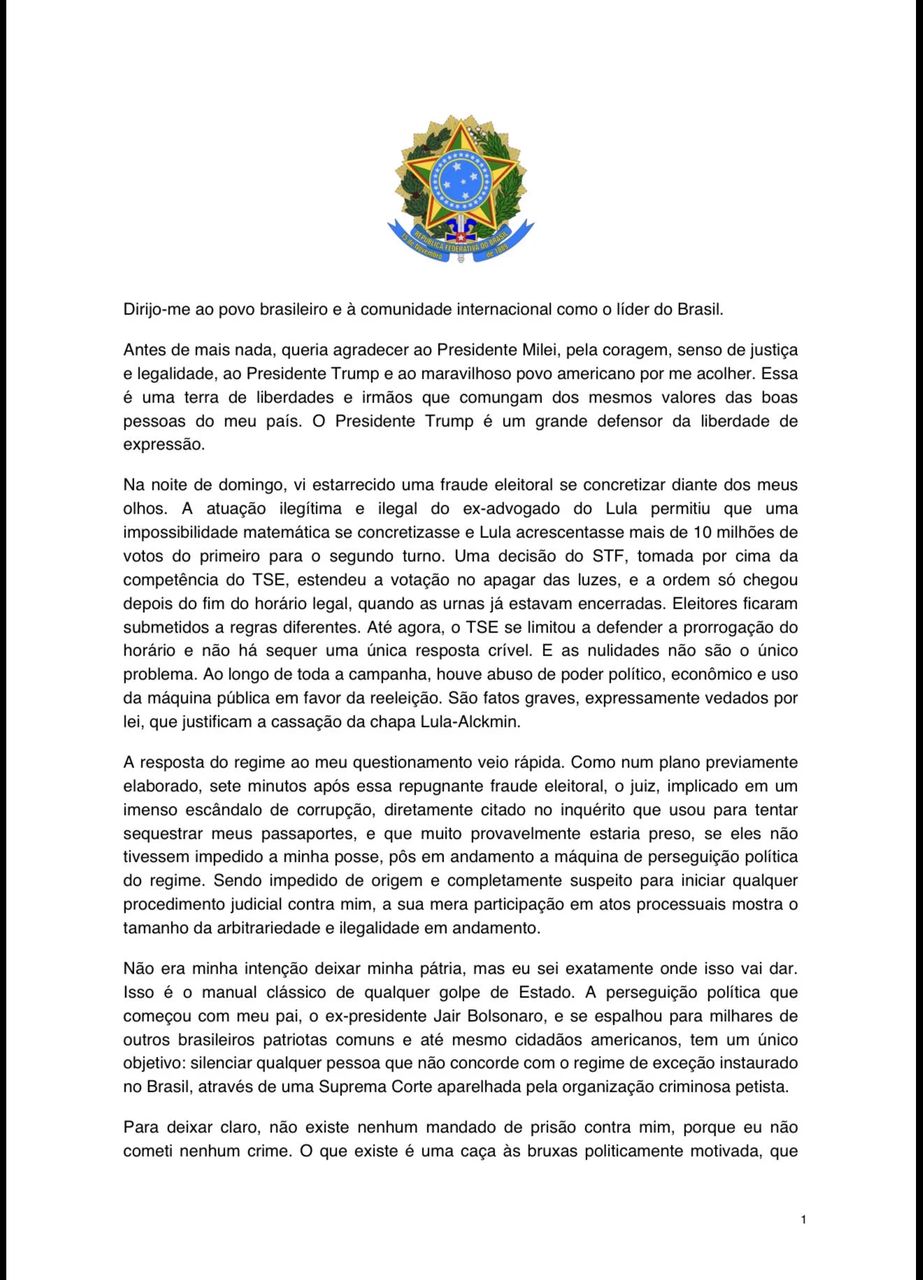
XA document image posted on X by Flávio Bolsonaro's account, showing a typewritten letter headed with the Brazilian coat of arms and addressed to the Brazilian nation. The caption dates it 28.10.26. The letter declares him the country's leader and alleges that the presidential election was fraudulent, centring on a Supreme Court order that extended voting hours.
“CARTA À NAÇÃO BRASILEIRA 🇧🇷 28.10.26”
“LETTER TO THE BRAZILIAN NATION 🇧🇷 28.10.26” — translated
Posted on Flávio Bolsonaro's own X account (@FlavioBolsonaro). Earlier versions of the letter circulated through allies, including one posted by Paulo Figueiredo; Flávio first published a version calling himself 'true president-elect', deleted it, and reissued the text as 'leader of Brazil'.
Who posted it
XAccount check
Estimates from public signals — account age, posting pattern, audience — not a judgement of the person behind the account, and separate from whether this post is true.
What stood out
- Handle @FlavioBolsonaro matches the official X account of Brazilian senator Flávio Bolsonaro; EFE, Folha de S.Paulo, Poder360, O Globo and other outlets cite or embed posts from this exact account.
- Genuine real-person/politician account, but it functions as a partisan communication channel rather than a reliable information source.
- On 28 Oct 2026 the account published a letter calling himself the 'true president-elect' and alleging electoral fraud without evidence; the letter was then edited and reposted to say 'leader of Brazil' after backlash.
- Several versions of the letter circulated, including one with an obsolete national coat of arms reading 'Estados Unidos do Brazil'.
- Strong fact-check record against the account's claims: Lupa, Folha, O Globo, UOL and A TARDE rated numerous statements false or misleading, including 15 of 18 checked debate statements (7 false).
- No signs of automated or coordinated bot behaviour; activity is consistent with a staff-run account of a high-profile politician.
- Profile metadata is unusually sparse (no bio, follower count, creation date, or verification flag), so identity is established mainly through press corroboration, not profile fields.
Signals (8)+
- Account identity confirmed
- Yes
- Official account of real politician
- Yes
- Posting cadence
- High during Oct 2026 election and exile news; no recent_posts supplied in profile sample
- Notable news coverage
- Extensive international and Brazilian coverage
- Fact check history
- Multiple false/misleading ratings from Lupa, Folha, O Globo, UOL, A TARDE and Comprova
- Bot behavior indicators
- None observed
- Platform verified
- No
- Misinformation flags
- unsubstantiated election fraud claims; self-declaration as president-elect; selective editing of public letter
Account checked October 29, 2026, 15:00 UTC
The media
Image✓ What is genuine
The document itself. It is a real letter published by the person it is attributed to, and its text was independently reproduced by several newsrooms.
The tells
- ●●● Strong signal The wording matches, paragraph for paragraph, the version posted on Flávio Bolsonaro's own account and reproduced in full by multiple outlets, so the image is the genuine document rather than a fabricated graphic.our visual review and source comparison
- ●●○ Supporting signal The document is a typed political letter bearing the Brazilian coat of arms, not footage of an event, so there is no scene or crowd to test for manipulation.our visual review
- ●○○ Weak signal Some earlier versions circulated by allies carried an outdated 'Estados Unidos do Brazil' coat of arms — a provenance detail about which version is which, not evidence of AI generation.our visual review
Synthetic-media detector
Detector not consultedSources settled the claim on their own; the detector was not needed.
How we checked the media
- Compared the wording of the document image with the text of the letter published on Flávio Bolsonaro's own X account on 28 October 2026.
- Compared the document against the full text reproduced by Agência Brasil, Folha de S.Paulo and CNN Brasil.
- Reviewed the visual details of the document image, including layout, coat of arms and typing.
Sources
10 sources reviewed- 1Coordenador de campanha do PL admite não ter prova de fraude eleitoral ↗
Agência Brasil · agenciabrasil.ebc.com.brUntiereduntiered — treated as signal only, never decisiveEvidence
Flávio's campaign coordinator said there was no proof of fraud, and the extra hours accounted for 34,393 votes.
- 2Coup-mongering letter: Flávio Bolsonaro thanks Trump, Milei for aid ↗
Agência Brasil · agenciabrasil.ebc.com.brUntiereduntiered — treated as signal only, never decisiveEvidence
Flávio travelled to Miami with his family and changed the self-description from 'true president-elect' to 'leader of Brazil'.
- 3Crescimento de 10 milhões de votos de Lula no 2º turno não é 'impossível' ↗
AFP Checamos · checamos.afp.comReputable outletwire — CenterEvidence
The 10.3-million vote increase is explained by abstention, blank/null votes and third-way votes re-entering the runoff.
- 4Prorrogação do segundo turno teve cerca de 35 mil votos e não alterou o resultado ↗
AFP Checamos · checamos.afp.comReputable outletwire — CenterEvidence
Only about 34,000 votes were counted in the extended hours, and both campaigns had requested the extension.
- 5After landing in US, Flavio Bolsonaro declares himself Brazil's rightful leader ↗
Reuters / The Straits Times · straitstimes.comUntiereduntiered — treated as signal only, never decisiveEvidence
The electoral court, international observers and Flávio's own party recognised Lula's win.
- 6Flávio Bolsonaro Publishes Coup-Backing Letter, Then Changes Self-Description From 'President' to 'Leader of Brazil' ↗
Folha de S.Paulo · www1.folha.uol.com.brUntiereduntiered — treated as signal only, never decisiveEvidence
Several versions of the letter circulated, and the 'president' wording was replaced by 'leader of Brazil'.
- 7Após fuga do Brasil, Flávio Bolsonaro mente sobre eleições em carta com teor golpista ↗
Lupa · agencialupa.orgUntiereduntiered — treated as signal only, never decisiveEvidence
The passport order came from a money-laundering inquiry, and Justice Moraes is not a formal target of it.
- 8Em nova versão de carta golpista, Flávio Bolsonaro recua e diz ser 'líder do Brasil' ↗
CNN Brasil · cnnbrasil.com.brUntiereduntiered — treated as signal only, never decisiveEvidence
The vote growth has an arithmetical explanation, and post-17h votes were less than 1% of the margin.
- 9No 2° turno, apenas 35 mil votos foram registrados após 17h ↗
O POVO · opovo.com.brUntiereduntiered — treated as signal only, never decisiveEvidence
Certified totals and the 35,521 votes recorded after 17h.
- 10Nunes Marques diz que eleições ocorreram em 'absoluta normalidade' após carta de Flávio ↗
Correio do Povo · correiodopovo.com.brUntiereduntiered — treated as signal only, never decisiveEvidence
The electoral court president said the election ran with absolute normality.
Further reading
- 3AFP Checamos Walks through the arithmetic behind the round-to-round vote increase.
- 4AFP Checamos Explains the voting-hours extension and why it did not alter the result.
- 7Lupa Fact check covering the passport order and the claim about Justice Moraes.
- 6Folha de S.Paulo Documents the different versions of the letter and the change in self-description.
The full story
The kernel of truth here is a genuine procedural fight. On 25 October 2026, Brazilians voted in a presidential runoff. Shortly after 17h, with many polling stations already closing, Supreme Court Justice Cristiano Zanin ordered voting extended to 19h. That order was real, it came late, and it is the kind of thing that can reasonably be argued about.
What the letter does with that fact is where it goes wrong. The extension had been requested by both the PT and Flávio Bolsonaro's own campaign, which cited heavy rain in three southern states. Only the PT took the request to the Supreme Court. The letter leaves out its own campaign's role. And the numbers make the impact question easy to answer: about 34,000 to 35,500 votes were cast in the extra two hours, roughly 0.03% of the total, against a certified margin of 4.43 million.
The second prop is arithmetic dressed up as proof. Lula's vote did rise by about 10.3 million between rounds. That figure sounds enormous in isolation. It is what happens when around 9.3 million third-way votes re-enter the runoff, abstention falls from 21.08% to 19.21%, and blank and null votes drop. Flávio's own tally rose by about 3.7 million in the same period. A fraud that added votes to both candidates is not a fraud.
Why did the claim feel plausible to some readers? Because late court orders, changed rules and big round-to-round swings are genuinely unsettling, and because a senator's own letter carries the appearance of inside knowledge. The letter's own edits undercut that: the first version called him 'true president-elect', and it was replaced within minutes by 'leader of Brazil'.
Kernel of truth
There was a real, late Supreme Court order extending voting hours to 19h, and Lula's vote total did rise by about 10.3 million between rounds — both facts are genuine, but neither shows fraud.
Timeline
October 25, 2026
Brazil holds the presidential runoff; Lula wins with 64,256,232 votes (51.79%) against 59,826,041 (48.21%) for Flávio Bolsonaro. 9O POVO
October 25, 2026
Justice Cristiano Zanin orders voting extended to 19h after a PT request; about 34,000 to 35,500 votes are recorded in the extra two hours. 4AFP Checamos
October 27, 2026
Flávio Bolsonaro crosses into Argentina, beginning his route to the United States. 2Agência Brasil
October 28, 2026
He lands in Miami with his family and publishes the letter, first as 'true president-elect' and then as 'leader of Brazil'. 2Agência Brasil
October 28, 2026
Lupa and AFP Checamos publish fact checks rating the letter's election claims false or lacking context. 7Lupa
How it was framed
The document is genuine and was posted by the person it is attributed to, so the misinformation is not the image but the framing built on top of real events: a real late court order and a real round-to-round vote increase, presented as proof of fraud they do not support. The letter also omits that Flávio's own campaign requested the voting extension, which is a misleading use of information to frame the election.
- “Visual proof”. A formal typed letter on letterhead with the Brazilian coat of arms, captioned 'CARTA À NAÇÃO BRASILEIRA', presented as a statesmanlike document rather than a social media post.
- Unsourced statistic. The 'mathematically impossible' 10-million-vote increase is asserted without citing any data source or calculation.
- Missing context. The letter criticises the voting-hours extension without mentioning that Flávio's own campaign requested it in São Paulo, Paraná and Santa Catarina.
- Borrowed authority. References to President Trump welcoming him and President Milei helping with the journey are used to lend standing to the fraud claim.
- Ongoing-threat framing. The letter frames the election as stolen and the country as needing rescue, with himself as its 'leader'.
Posted on Flávio Bolsonaro's verified X account on 28 October 2026, after he had left Brazil for the United States. At least four versions of the letter circulated; he deleted a version calling himself 'true president-elect' and reissued it as 'leader of Brazil'. His party, the PL, recognised the election result, and his campaign coordinator publicly said there was no proof of fraud.
Bias
Leans pro-Bolsonaro / far-right, anti-STF and anti-PT. The post is a first-person political declaration that frames a certified election defeat as a 'coup', calls the Supreme Court a criminal organisation 'staffed' by the PT, presents the author as the country's legitimate leader and thanks foreign leaders for sheltering him. It mixes selected facts with unsupported fraud claims and omits the fact that his own campaign sought the same voting-hours extension he denounces.
Bias describes how the post frames its message — the slant of the language, selection and emphasis — and is judged separately from whether the claim is true. A true claim can still be framed with a strong slant.
How we checked
1 min 19 s- 1
Searched for coverage of the letter and the 25 October 2026 runoff result.
- 2
Compared the wording of the letter image with the text published on Flávio Bolsonaro's own X account and reproduced by Agência Brasil, Folha de S.Paulo and CNN Brasil.
- 3
Checked the electoral court's certified totals and the vote count in the extended voting window against the letter's claims.
- 4
Reviewed the arithmetic behind the round-to-round vote increase using AFP Checamos and CNN Brasil.
- 5
Checked the claim about the passport order and Justice Moraes against Lupa's fact check.
- 6
Reviewed existing fact checks from Lupa and AFP Checamos and the reporting from Reuters and Agência Brasil.
✓ Claim checked✓ Media checked✓ Sources checked
Why 93% confidence
HighWe rate this HIGH because the core claims are contradicted by the electoral court's own certified data, by multiple independent newsrooms, and by public statements from Flávio Bolsonaro's own campaign coordinator and party. The letter's authenticity is documented across several outlets that reproduced its full text. The verdict does not depend on any single source or on any judgement about the author's motives.
Limits. We did not run an AI-generation detector on the image, so our media assessment rests on visual review and comparison with the published text. We could not independently verify the internal reasoning behind the letter's specific wording choices, and we did not review every version of the letter that circulated.
What we don’t know
- Why Flávio Bolsonaro changed the self-description from 'true president-elect' to 'leader of Brazil'; the reporting records the edit but not the reasoning.
- Whether any of the earlier versions of the letter that circulated through allies were altered by anyone other than the author.
- The full detail of the money-laundering inquiry behind the passport order, which is outside the scope of this check.
Spot it yourself
Spot the fakeLooks suspicious, isn’t proof
- The post comes from a partisan source with a direct stake in the result. That is a reason to check the claims, not evidence that they are false.
- The letter's tone is dramatic and self-aggrandising. Alarmist language is a signal to slow down, but it decides nothing.
- The document looks formal, with a coat of arms and a date. Production quality is not evidence of accuracy, and an old or wrong coat of arms does not prove AI either.
- The claim that a result was 'mathematically impossible' sounds technical and precise. A confident number is not a calculation.
The actual evidence
- The electoral court's certified totals: Lula 64,256,232 to Flávio's 59,826,041, a 4.43-million margin.
- The vote count in the disputed hours: about 34,000 to 35,500 votes, roughly 0.03% of the total and far less than 1% of the margin.
- The fact that both campaigns requested the voting extension, which the letter omits.
- The arithmetic of the runoff: about 9.3 million third-way votes re-entering, abstention falling, and Flávio's own total rising by about 3.7 million.
- The concession from Flávio's campaign coordinator that there is no proof of fraud, and the PL's recognition of the result.
- 1
Ask who would be reporting this if it were true.
A stolen presidential election would be reported by international observers, the electoral court and independent newsrooms far beyond one politician's letter. Search for those reports. Here, the observers accepted the result and the court certified it.
- 2
Test the numbers against the margin, not against zero.
When someone claims that a specific group of votes changed the outcome, find that group's total and compare it with the winning margin. Here, roughly 35,000 votes against a 4.43-million margin settles the question.
- 3
Check whether the claim leaves out its own side's role.
Search the key procedural detail plus 'requested' or 'pedido'. In this case, searching the voting extension shows both campaigns asked for it, which the letter does not mention.
- 4
Verify a document by its text, not its look.
Search a distinctive phrase from the letter in quotation marks and compare what you find with the full text published by major outlets. Matching wording shows the document is genuine; it does not show its claims are true.
Takeaway
A genuine document can carry a false claim. Check whether the evidence inside it survives comparison with the official record, especially when the document's author has a direct stake in the conclusion.
Questions people ask
Is Flávio Bolsonaro's letter real?+
Yes. The document image is a genuine copy of the letter he posted on his own X account on 28 October 2026, and its text was reproduced in full by Agência Brasil, Folha de S.Paulo and CNN Brasil. The letter being real does not make its fraud claims true.
Did the voting-hours extension change the election result?+
No. About 34,000 to 35,500 votes were recorded in the extra two hours, roughly 0.03% of the total, against a certified margin of 4.43 million. Both campaigns had requested the extension, and the electoral court said the election ran with absolute normality.
Is it true Lula gained 10 million votes between rounds?+
Yes, about 10.3 million, but that is not impossible. Around 9.3 million third-way votes re-entered the runoff, abstention fell from 21.08% to 19.21%, and blank and null votes dropped. Flávio Bolsonaro's own total rose by about 3.7 million in the same period.
Was there an arrest warrant against Flávio Bolsonaro?+
No. The court order was to surrender his passports, at the Federal Police's request over flight risk, in a money-laundering and currency-evasion inquiry unrelated to the campaign. The claim that Justice Alexandre de Moraes is investigated in that inquiry is false; he was mentioned in a report but is not a formal target.
Why do people believe election fraud claims like this one?+
Late changes to voting rules and large swings between rounds can look suspicious without context. A real court order and a real vote increase are the kind of facts that make a false conclusion feel plausible. Checking them against official totals and the size of the winning margin is what separates a genuine grievance from a false claim.
Go deeper
- Runoff
- A second round of voting held when no candidate wins an outright majority in the first round.
- Abstention
- The share of registered voters who do not cast a ballot.
- Blank and null votes
- Ballots that are left empty or invalidated, which are not counted for any candidate.
- False context
- When genuine material — a real document, image or quote — is presented with a false framing or explanation.
People also search for
For educators+
- The letter contains several statements that are accurate, including the travel details. How should that affect the way we judge the document as a whole?
- If a real court order extended voting hours, what evidence would you need before concluding that it changed the result?
- Why might a reader find a 'mathematically impossible' claim convincing, and what questions would expose its weakness?
About this check
- Platform
- X
- Posted by
- @flaviobolsonaro
- Posted
- October 28, 2026
- Age when checked
- Under 24 hours old when checked
- Where it spread
- Brazil, United States
- Audience
- International audience
- Language
- PT
- Status
- ● Post is live
- Verified
- October 29, 2026, 15:02 UTC
- Published
- October 29, 2026, 15:02 UTC
Reach. 238,832 likes and 34,379 replies on the X post per syndication API (29 Oct 14:46Z). Covered by Metrópoles, Jovem Pan, Poder360, Gazeta do Povo, Congresso em Foco, ND Mais and Lupa. The TSE issued a rebuttal. Greenwald reports the first version, with 'true president-elect', was deleted and re-posted
This verdict was generated with AI from the sources shown. AI can make mistakes — check the sources before relying on it.
Check anything yourself, in seconds.
Share any social post or video to What the Fact and get the verdict, the confidence, and the receipts.