Did Trump pass three cognitive tests and say Obama couldn't have?
Did Trump take and pass three cognitive tests, as he claimed at his 28 Oct Chillicothe rally while saying Obama couldn't have passed them?
Misleading
Real rally footage and an accurate quote — wrapped around claims the tests can't support.
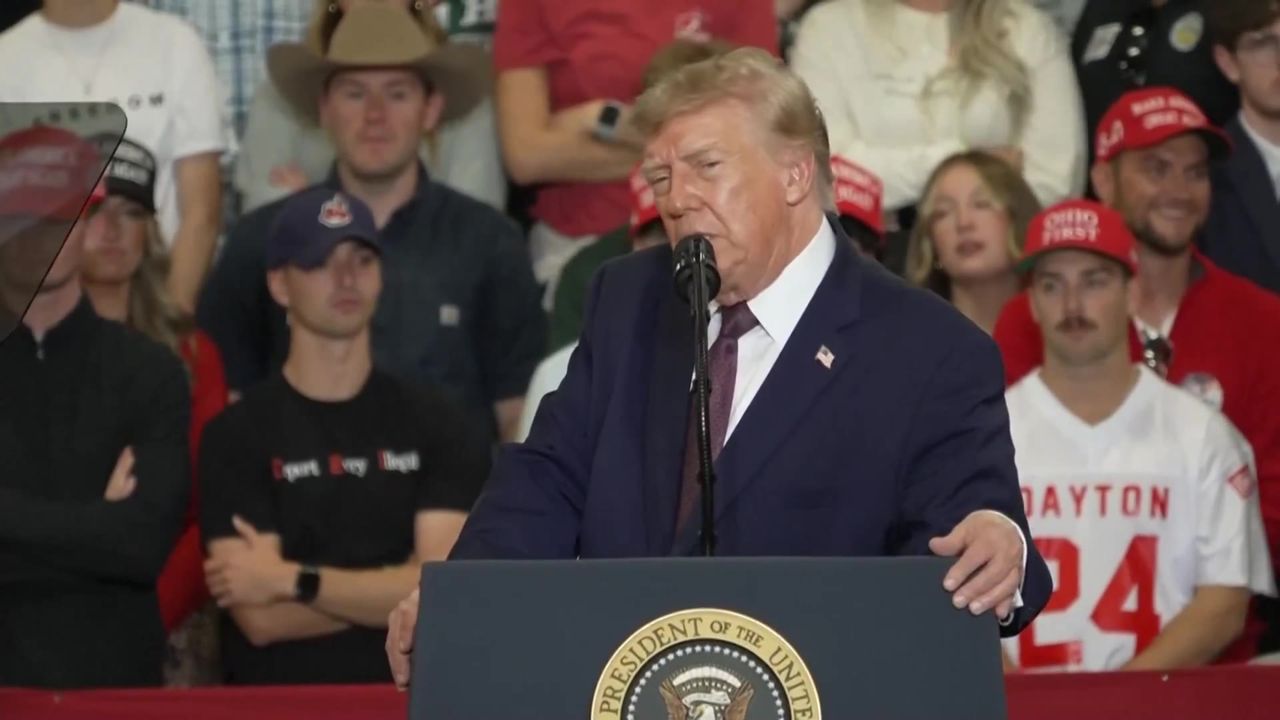
The video is genuine: Donald Trump made these remarks at a rally in Chillicothe, Ohio on 28 October 2026, and the caption quotes him accurately. But his claims inside the clip are misleading. The test he cites is a short screening for cognitive impairment, not an IQ test, and no Obama result exists.
 Genuine
Claims
6 checked"I'm a very high IQ person."16
“I'm a very high IQ person.”
This is a self-assessment, not a factual statement anyone can check. No IQ test result for Trump has ever been released, so there is no score to compare against his description. The evidence he offers in the same breath — the cognitive tests — does not fill the gap: the test he is describing is a screening tool for cognitive impairment, not an intelligence measure, so passing it says nothing about IQ either way. That makes the boast an assertion of self-regard rather than a claim that can be rated true or false. We rate it opinion, which is not the same as saying it is wrong — it means the statement is not the kind of thing evidence settles. Readers should treat it as rhetoric, and weigh the checkable claims that follow it separately.
"I passed three cognitive tests."67
“I passed three cognitive tests.”
One of the three is documented; the rest are not. Trump took the Montreal Cognitive Assessment in 2018 during his annual physical and scored 30/30, a result that was publicly reported at the time. He has said he took the same assessment again during later examinations, and in this clip he puts the total at three. But the detailed results of those later tests have not been released, so a reader cannot confirm the scores or even, from public records, the exact number. That is why this sits at partly true rather than true or false: the core of the statement — that he has taken the test and passed — rests on a real, documented result, while the "three" and the later passes rest on his own account. The distinction matters because the claim is being used as proof of mental fitness; a documented 2018 score is evidence of a moment, not a standing certificate.
Still open: Has any later cognitive assessment result been released in any form, and does the public record support the number three?
The cognitive tests are hard.16
“They're hard.”
The test Trump is describing is not built to be hard. The Montreal Cognitive Assessment takes about ten minutes, is scored out of 30, and is designed to detect mild cognitive impairment; people with normal cognition typically pass it. Its opening task is naming an animal from a set of pictures. Describing it as a difficult exam inverts its purpose: a screening tool is meant to be passable for healthy adults so that failures stand out as a signal. The wording is doing real work here — "they're hard" is what turns a routine screening into an achievement, and it is the hinge on which the rest of the boast swings. The underlying test is real and he did take it; the characterisation of its difficulty is what misleads.
"I'm the only president that agreed to take them."6
“I'm the only president that agreed to take them.”
The narrow version of this holds up better than the impression it creates. We found no public record of another president taking the specific cognitive screening Trump describes, so the literal point is not contradicted by anything in the record. But the framing — that he is uniquely the president whose mental fitness has ever been formally assessed — goes further than the evidence supports, and presidential health disclosures have a long history that this phrasing glosses over. The confidence here is low for a reason: this is a claim about the absence of a record, and absence is hard to prove. Not finding a documented case is weaker evidence than finding one, and we did not find one either way. Readers should treat "only president" as a rhetorical flourish whose accuracy depends entirely on how narrowly you define "them".
Still open: Is there any documented case of another president or major-party nominee taking the MoCA or a comparable screening?
"Obama couldn't have passed them."
“Obama couldn't have passed them.”
There is nothing to check. Barack Obama has never taken the test, so no result exists for anyone to compare against Trump's. A claim that someone "couldn't have passed" an exam they never sat is speculation dressed as a finding, and no amount of searching will produce a score that settles it. What is documented about Obama — graduating magna cum laude from Harvard Law School and serving as president of the Harvard Law Review — offers no support for the assertion, but it does not disprove it either, and we are not treating it as proof of anything. The honest label is unverifiable: not false, because nothing contradicts it, and not true, because nothing supports it. The confidence is high precisely because the absence of any test result is clear and easy to establish.
Democrats put a man named Dan Sullivan on the Alaska ballot to split the vote, and it was voter fraud.38
“they put a Dan Sullivan on the ballot in order to confuse, in order to split up the vote”
The recruitment is reported; the crime is not. A New York Times investigation, referenced in rally coverage, reported that operatives aligned with Democrat Mary Peltola helped recruit a retired teacher named Daniel J. Sullivan, who shares the incumbent Republican senator's name, onto the Alaska ballot. That much is documented. What is not documented is fraud: recruiting same-name candidates to split a vote — ballot stacking — is generally legal and has been used by both parties, and the reporting did not establish criminal wrongdoing. Peltola has denied involvement. So the factual core of the anecdote survives scrutiny while the label attached to it does not. This is a common pattern: take a genuine, reported story, then rename it with a legal conclusion the reporting never reached. The word "fraud" is doing the work, and it is the word the evidence does not support.
Still open: What has the New York Times reporting established since, and has any official body opened an inquiry?
What was posted
XA short video clip posted on X by the account @Acyn, showing Donald Trump speaking at a podium during a campaign rally. In the clip he calls himself a "very high IQ person", says he passed three cognitive tests, calls the tests hard, and says Barack Obama and unnamed Republicans could not have passed them. The post presents the clip as a straight quotation of his remarks, and it is one.
“Trump: I'm a very high IQ person. I passed 3 cognitive tests. They’re hard. Obama couldn’t have passed them. Republicans wouldn't have passed them”
Posted on X within hours of Trump's evening rally at the Shoemaker Center in Chillicothe, Ohio. The clip also includes his remarks about a second "Dan Sullivan" on an Alaska ballot.
Who posted it
XAccount check
Estimates from public signals — account age, posting pattern, audience — not a judgement of the person behind the account, and separate from whether this post is true.
What stood out
- The account '@Acyn' is operated by a young American individual, with a follower count exceeding 2.5 million as of July 2025. (clrn.org)
- The account functions as a content aggregator, primarily focusing on short-form video clips sourced from news broadcasts and political events. (clrn.org)
- The operator's real identity remains undisclosed, and the account lacks a profile picture and bio, which are common signs of authenticity. (asapguide.com)
- The account has attracted criticism for potential selective editing, miscontextualization, and the spread of misinformation. (clrn.org)
Signals (4)+
- Posting cadence
- High
- Follower ratio
- High
- Notable news coverage
- Yes
- Fact check history
- Yes
Account checked October 25, 2026, 15:13 UTC
The media
Video✓ What is genuine
The footage, the setting, the speaker and the quotation. This is real rally video of remarks Trump actually made, accurately captioned. The problem lies in what he says in it, not in the clip.
The tells
- ●●○ Supporting signal The frames show a coherent rally scene: one speaker at a podium with the presidential seal, a stable crowd, natural lighting, and no identity drift or morphing from frame to frame.our visual review
- ●●○ Supporting signal The setting matches press photographs of the Shoemaker Center rally in Chillicothe, Ohio on 28 October 2026.our visual review, cross-checked against source 5
- ●●● Strong signal Multiple independent outlets transcribed the same remarks from the same event, so the words do not depend on this particular clip.HuffPost and WVXU coverage (sources 1 and 3)
Synthetic-media detector
Detector not consultedThe media is incidental to the claim; the detector was not needed.
How we checked the media
- Reviewed frames from the clip for consistency of the scene, speaker and crowd.
- Compared the setting with press photographs of the 28 October 2026 rally at the Shoemaker Center in Chillicothe, Ohio.
- Checked whether independent outlets transcribed the same remarks from the same event.
Sources
8 sources reviewed- 1Trump Puts A New Spin On His Cognitive Brags... And It Involves Republicans ↗
HuffPost · huffpost.comLow reliabilityLeft — partisan digitalEvidence
Reports the same remarks from the rally and explains the test is a screening tool, not an intelligence measure.
- 2Trump boasts about passing 3 cognitive tests at Ohio rally ↗
Prime Timer (via NewsBreak) · newsbreak.comUntiereduntiered — treated as signal only, never decisiveContext
Carries a version of the cognitive-test quotation, consistent with other coverage.
- 3President Donald Trump rallies supporters in Chillicothe in third Ohio rally ahead of midterms ↗
WVXU · wvxu.orgUntiereduntiered — treated as signal only, never decisiveEvidence
Reports the Chillicothe rally and the Alaska ballot remarks citing New York Times reporting.
- 4Trump rally puts spotlight on Chillicothe jobs, Kenworth ↗
USA Today / Chillicothe Gazette · usatoday.comReputable outletLean Left/CenterEvidence
Confirms the venue and date: the Shoemaker Center, 28 October 2026.
- 5Trump rallies supporters in Chillicothe, Ohio ahead of midterms (photo gallery) ↗
Milwaukee Journal Sentinel · jsonline.comUntiereduntiered — treated as signal only, never decisiveEvidence
Press photograph placing Trump at the Shoemaker Center on 28 October 2026.
- 6Trump roasted over Cabinet 'cognitive test' boast with embarrassing fact check ↗
The Independent · independent.co.ukReputable outletLean LeftEvidence
Establishes what the MoCA is, how long it takes and that it is not an IQ test.
- 7Trump, 79, Humiliated With Brutal Community Note on Cognitive Claim ↗
The Daily Beast · thedailybeast.comUntiereduntiered — treated as signal only, never decisiveEvidence
Documents the 2018 MoCA score of 30/30 and that later results are not public.
- 8Trump demands Alaska candidates be removed from ballot over alleged Democratic 'voter fraud' scheme ↗
Head Topics (AFP copy) · my.headtopics.comUntiereduntiered — treated as signal only, never decisiveEvidence
Establishes that ballot stacking is generally legal and no criminal wrongdoing was found.
Further reading
- 6The Independent Clearest explanation of what the Montreal Cognitive Assessment actually measures.
- 7The Daily Beast Documents the 2018 score and the gap in later results.
- 1HuffPost Carries the full remarks and explains the test's design.
- 8Head Topics (AFP copy) Explains ballot stacking and why the fraud framing is not established.
The full story
The clip is real, and so is the event behind it. On the evening of 28 October 2026, Trump took the stage at the Shoemaker Center on the Ohio University Chillicothe campus for a midterm rally, and he did say the words in the post. Outlets including HuffPost, WVXU and the Chillicothe Gazette/USA Today network covered the rally and carried the same quotations, so the caption is not a distortion of the transcript.
The kernel of truth is the test itself. Trump did take the Montreal Cognitive Assessment in 2018, during his annual physical, and scored 30/30 — a perfect score that was publicly reported. That is a real fact, and it is the foundation the rest of the boast is built on.
What gets lost between that fact and the podium is what the test is for. The MoCA is a roughly ten-minute, 30-point screening used to spot mild cognitive impairment. It is designed so that people with normal cognition pass it; its first task is naming an animal from a set of pictures. A perfect score is good news, but it is not a certificate of exceptional intelligence, and it is not an IQ measurement.
The same pattern runs through the Alaska anecdote. There is a real news report underneath it: a New York Times investigation found that operatives aligned with Democrat Mary Peltola helped recruit a retired teacher named Daniel J. Sullivan — the same name as the Republican incumbent — onto the ballot. But ballot stacking is generally legal, both parties have used it, and the reporting did not establish a crime. "Voter fraud" is the speaker's word, not the report's.
Kernel of truth
Trump did take the Montreal Cognitive Assessment in 2018 and scored 30/30. The test is real; the claim about what it proves is not.
Timeline
2018
Trump takes the Montreal Cognitive Assessment during his annual physical and scores 30/30. 7The Daily Beast
October 28, 2026
Trump speaks at a midterm rally at the Shoemaker Center in Chillicothe, Ohio, and boasts of passing three cognitive tests. 4USA Today / Chillicothe Gazette
October 28, 2026
The clip is posted on X by @Acyn within hours of the evening rally.
October 29, 2026
Outlets including HuffPost report the remarks and note the test is a screening tool, not an intelligence measure. 1HuffPost
How it was framed
The video and the quotation are genuine, but the framing invites readers to treat a routine cognitive screening as proof of exceptional intelligence. The genuine 2018 test result is placed in a context — hard exam, uniquely taken, others could not pass — that the test cannot support.
- Borrowed authority. "I passed three cognitive tests" and "I'm the only president that agreed to take them" use a medical screening as external validation of a personal boast.
- “Visual proof”. The post presents rally footage as the evidence; the clip is authentic, which lends credibility to the claims made inside it.
- Selective evidence. The perfect 2018 score is invoked while the nature of the test and the unreleased later results go unmentioned.
- Us vs. them. "Obama couldn't have passed. Biden, we don't even talk about. Republicans wouldn't have passed them."
- Missing context. The Montreal Cognitive Assessment is described as "hard" with no mention that it is a screening tool people with normal cognition typically pass.
Posted on X by @Acyn within hours of the 28 October 2026 rally. The account has a large following and regularly posts clips of political speeches. No engagement figures were available to us.
Bias
Leans anti-Trump. Acyn is a progressive clip account that routinely posts short, unflattering excerpts of Trump's speeches; the selection here highlights a rambling boast, but the words themselves are quoted accurately and without alteration.
Bias describes how the post frames its message — the slant of the language, selection and emphasis — and is judged separately from whether the claim is true. A true claim can still be framed with a strong slant.
How we checked
1 min 5 s- 1
Searched for coverage of the specific remarks, using distinctive phrases from the clip.
- 2
Searched for reporting on the Alaska ballot remarks that appear alongside them.
- 3
Searched for fact-checking and reporting on the cognitive test claims and the 2018 result.
- 4
Searched for rally coverage of the 28 October 2026 event in Chillicothe, Ohio.
- 5
Reviewed frames from the clip and compared the setting with press photographs of the event.
✓ Claim checked✓ Media checked✓ Sources checked
Why 85% confidence
HighHigh confidence on the headline verdict because the event, venue, date and quotation are each confirmed by independent coverage, and the test's actual purpose is described consistently across outlets. The lower confidence bands on individual claims reflect what the public record holds, not uncertainty about what happened: the exact number of later tests, and whether any other president took the same screening, are not documented either way.
Limits. We could not review the full rally video, only the clip and descriptions of it. No later cognitive test results were available to examine, and we ran no forensic detector because the authenticity of the clip was corroborated by independent transcripts rather than by the footage alone.
What we don’t know
- Whether results of any cognitive assessment after 2018 have been released in any form.
- Whether any other president or nominee has taken the same screening — absence of a record is not proof of absence.
- What the full New York Times reporting on the Alaska ballot recruitment has established since it was published.
Spot it yourself
Spot the fakeLooks suspicious, isn’t proof
- The poster's partisan reputation. Who shares a clip tells you nothing about whether the clip is accurate — here the caption is an exact quote.
- The boastful, combative tone. The tone is a reason to check the substance, not evidence that the words were invented.
- The clip's brevity. Short clips can omit context, but a short clip is not automatically a cut one.
The actual evidence
- Independent transcripts. HuffPost, WVXU and the Chillicothe Gazette carried the same words from the same event, so the quotation does not rest on one account.
- The venue and date. Press photographs place Trump at the Shoemaker Center in Chillicothe on 28 October 2026, matching the clip's setting.
- The nature of the test. Reporting establishes the MoCA as a 10-minute, 30-point screening that people with normal cognition pass — which undercuts "they're hard".
- The record. The 2018 MoCA result of 30/30 is documented, but later results have not been released.
- 1
Check whether the quote exists outside the clip
Search a distinctive phrase in quotation marks, like "Obama couldn't have passed", and see whether several outlets carried it from the same event. If only one account has it, be cautious.
- 2
Ask who would be reporting this
A president's public rally remarks are covered by local and national press. If a major speech produced no coverage anywhere, that is a signal the clip may not show what it claims.
- 3
Look up what the test actually is
Search the name of the exam, not the claim about it. Reading its purpose and format answers whether passing it proves what the speaker says.
- 4
Separate the documented result from the later ones
When someone cites multiple tests or exams, check which results are public. A confirmed first result does not confirm the rest.
Takeaway
A clip can be completely genuine and still mislead you — the check is not only whether the words were said, but whether what they claim is true. Authenticity of the media and accuracy of the message are two separate questions.
Questions people ask
Did Trump really say he passed three cognitive tests?+
Yes. He said it at a rally at the Shoemaker Center in Chillicothe, Ohio on 28 October 2026, and outlets including HuffPost and WVXU carried the same remarks. The quotation in the post is accurate. Whether the claim is true is a separate question from whether he said it.
What is the cognitive test Trump keeps mentioning?+
It is the Montreal Cognitive Assessment, a roughly 10-minute, 30-point screening designed to flag mild cognitive impairment. It is not an IQ test and does not measure intelligence. People with normal cognition typically pass it, which is why describing it as "hard" is misleading.
Did Trump score 30/30 on the test?+
He took the Montreal Cognitive Assessment in 2018 during his annual physical and scored 30/30, a result that was publicly reported. He says he has taken it again since, but detailed results of the later assessments have not been released, so only the first is independently confirmed.
Could Obama have passed the test?+
Nobody knows, because Obama has never taken it. A claim that someone could not pass an exam they never sat cannot be checked. Obama's academic record offers no support for the assertion, but it does not settle the question either.
Why is a genuine video rated misleading?+
Because the problem is inside the clip, not in the clip. The footage is real and the words were really spoken. But the claims made in those words — that a screening proves high intelligence, that the tests are hard, that others could not pass — do not hold up. Authentic media can carry a misleading message.
Go deeper
- Montreal Cognitive Assessment (MoCA)
- A short, 30-point screening test used by clinicians to detect mild cognitive impairment, not to measure intelligence.
- IQ test
- A standardised assessment designed to estimate general reasoning ability, producing a numerical score.
- Ballot stacking
- Recruiting a candidate with the same name as an opponent, or multiple similar candidates, to split that opponent's vote; generally legal in the United States.
- Partly true
- A verdict for claims where a real, documented fact sits alongside an exaggeration or an unsupported element.
People also search for
For educators+
- If a clip is verified as genuine, does that make everything said in it trustworthy? Why or why not?
- Why might describing a screening test as "hard" matter more than it first appears?
- How would you check a claim that someone "couldn't have passed" a test they never took?
About this check
- Platform
- X
- Posted by
- @acyn
- Posted
- October 29, 2026
- Age when checked
- Under 24 hours old when checked
- Where it spread
- United States
- Audience
- US audience
- Language
- EN
- Status
- ● Post is live
- Verified
- October 29, 2026, 15:14 UTC
- Published
- October 29, 2026, 15:14 UTC
Reach. Acyn clip 937 likes / 541 replies (29 Oct check); HuffPost write-up 29 Oct
This verdict was generated with AI from the sources shown. AI can make mistakes — check the sources before relying on it.
Check anything yourself, in seconds.
Share any social post or video to What the Fact and get the verdict, the confidence, and the receipts.