Was the AfD poster with the raised arm ruled a crime while the CDU and Greens posters were fine?
Was AfD politician Wilko Möller convicted over an election poster almost identical to CDU and Green posters, as a viral side-by-side comparison claims?
Misleading
A real conviction is used to make a false three-poster comparison look proven.
Misleading. The conviction is real: AfD state MP Wilko Möller was fined 11,600 euros and the Federal Court of Justice made it final in October 2026. But the collage's middle poster is not the one ruled criminal, and the CDU poster in it never existed in that form. The courts did not compare these three posters.
 Edited
Claims
✓ 2 true · ✕ 2 falseThe middle AfD poster shown in the image is the poster ruled a criminal offence, while the other two were not.123
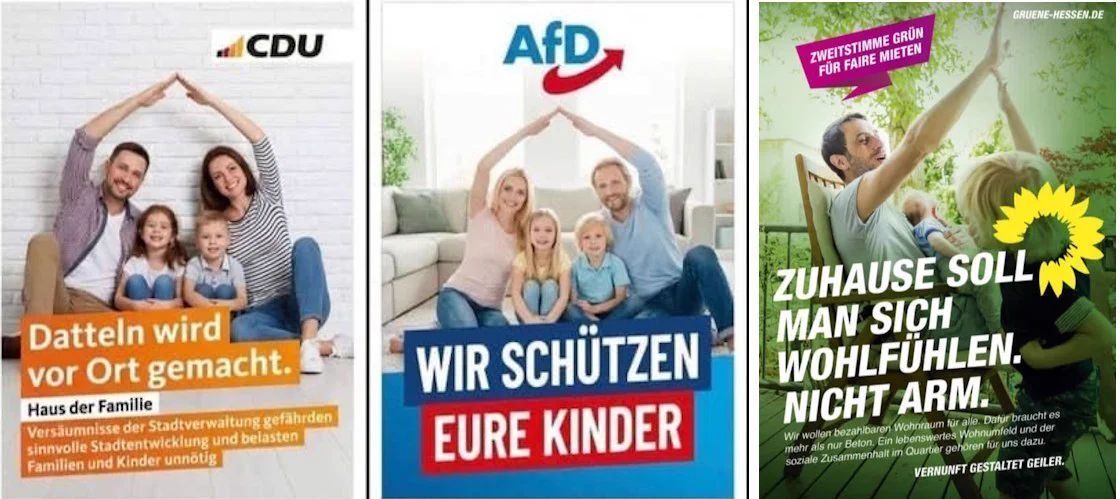
Three independent checks — dpa-Faktencheck, AFP-Faktencheck and Correctiv — examined this collage and agreed on the same point: the AfD motif in it is not the poster at issue in the Frankfurt (Oder) trial. The convicted poster showed a man and a woman standing behind a sofa with three children, with the photo mirrored so that the man's right arm is raised at eye level. In the collage the adults sit beside two children, and no right arm is raised at eye level. The decisive evidence is not a visual hunch but the account of Wilko Möller himself, who told AFP that the collage poster was not the one used. That makes the comparison at the heart of the post wrong, even though the underlying case it refers to is real. Because all three fact-checks trace back to the same court file and the same party statements, they are not three separate discoveries of the same thing — but the poster mismatch is documented from more than one side, which is why we rate the finding HIGH confidence.
The left-hand poster is a genuine CDU Datteln poster ('Datteln wird vor Ort gemacht / Haus der Familie').13
The CDU Datteln district chairman told dpa and Correctiv that this panel is a fake, and he named the details. The party logo's wave has four elements instead of three. The multi-colour version of the logo only exists since September 2023, but the 'Haus der Familie' poster was made in 2022, when the party still used the older red lettering. There is a real kernel here: the CDU did use a family-under-a-roof motif in its 2022 campaign, so the general idea of a CDU family poster is not invented. But the specific poster as shown was put together after the fact. The source for this is primarily the party's own district branch, which has an interest in denying a poster — so we weigh it as one interested but detailed account, backed by a second outlet that checked the same details independently. The combination of a matching 2022 motif with visibly mismatched logo and lettering is what settles it: the version in the collage could not have been printed at the time it claims to be from.
Still open: The original source of the altered CDU panel has not been identified.
The right-hand poster is a Greens (Hessen) election poster that was not treated as a criminal offence.13
This panel holds up. Correctiv and dpa both confirmed that the 'Zuhause soll man sich wohlfühlen. Nicht arm.' motif is an authentic Bündnis 90/Die Grünen poster from the 2018 Hesse state election campaign, and the party said it was never the subject of proceedings under the banned-symbols provision. That matters for two reasons. First, it shows the collage is not wholly synthetic — it mixes real campaign material with altered panels, which is exactly why it looks convincing. Second, it means one part of the post's basic claim is accurate: a Greens poster with a family-and-housing message was not prosecuted. What the post does with that fact is the problem. Placing a genuine poster next to a substituted AfD motif and a fabricated CDU poster turns a correct single observation into a false three-way comparison. A true element can carry a misleading whole, and that is what happens here.
An AfD politician was convicted over a 'Wir schützen eure Kinder' election poster with a Hitler-salute-like arm gesture.45
This is the real event underneath the post, and it is accurately described. Brandenburg AfD state MP Wilko Möller was convicted by the Landgericht Frankfurt (Oder) under section 86a of the Criminal Code, which bans the use of symbols of unconstitutional organisations, because the mirrored photo on his campaign poster raised the man's right arm in a way the court found equivalent to the Hitler salute. He was fined 100 daily rates of 116 euros — 11,600 euros in total. In October 2026 the Federal Court of Justice rejected his appeal, so the conviction is final and no longer pending. The sources are a news report on the final ruling and dpa coverage of the trial. Neither is a party to the case; both report the court's decision. A reader should note the difference between the two things this post does: it correctly reports that a conviction happened, and then incorrectly rebuilds the visual comparison around it. The first part is checkable and true; the second is what we rate false.
Such verdicts create free campaign advertising and are turning ordinary citizens into AfD supporters, possibly pushing the party to 40 percent.
This part is a prediction and a rhetorical question, not a factual assertion that can be checked against evidence. The post asserts that court rulings function as free advertising and that they are pushing voters toward the AfD, and it asks readers whether they want the party to reach 40 percent. There is no named poll, no survey, no election result attached — nothing that could be tested. We classify it as opinion and do not rate it true or false. That matters for how the post should be read: a political argument is legitimate to make, and this one is made openly, with hashtags and a direct appeal to the reader. What is not legitimate is presenting the argument on top of a false visual comparison, because the comparison supplies the appearance of evidence for a conclusion the post has not actually demonstrated. Readers can disagree with the politics and still see the distinction.
What was posted
XA post on X shares a three-panel image of what look like campaign posters: an AfD poster on the right-style family motif, a CDU poster with a house-and-family design on the left, and a Greens poster. The post asks why the middle one was judged a criminal offence while the other two were fine, and frames this as free advertising that will push voters toward the AfD.
“Das mittlere Plakat wird als "Straftat" bewertet, die beiden Anderen sind OK! Warum soviel kostenlose Wahlwerbung für die #AfD? Psychisch gesunde Normalbürger werden mit solchen Urteilen immer mehr zu Fans von #Aliceweidel-#UlrichSiegmund & Co.-Wollt Ihr, dass die Blauen bald bei 40 % liegen?…”
“The middle poster is judged a "criminal offence", the other two are OK! Why so much free election advertising for the #AfD? Mentally healthy normal citizens will increasingly become fans of #Aliceweidel-#UlrichSiegmund & Co. with such verdicts — Do you want the Blues to be at 40 % soon?…” — translated
Posted on X by the account @kutschera_u. The image is a version of a collage that circulated from February 2026 and was shared publicly by AfD politician Maximilian Krah on 18 February 2026, the day after the Frankfurt (Oder) verdict.
Who posted it
XAccount check
Estimates from public signals — account age, posting pattern, audience — not a judgement of the person behind the account, and separate from whether this post is true.
What stood out
- Handle appears to belong to Ulrich Kutschera, a real German plant physiologist/evolutionary biologist (b. 1955, long-time professor at Univ. Kassel, visiting scientist Stanford), corroborated by the @kutschera_u music posts matching his published piano/synth albums.
- Profile is bare: no display name, bio, follower count, creation date or sample posts provided, so identity is inferred rather than proven; no platform verification.
- Content pattern (own music releases, YouTube channel evolutionsbiologenDE, evolutionsbiologen.de, gender-diskurs.de) is consistent with a single real individual, not an automated or coordinated cluster; no bot-farm indicators found.
- He is a genuinely credentialed scientist in plant biology, but in recent years has published contested/politicised claims outside his field: 'gender ideology' polemics (book 'Das Gender-Paradoxon', panned by peers), climate-science equivocation, and COVID 'Querdenker'-style claims about masks/mRNA vaccines and the Subramanian/Kumar paper.
- Board member of the Desiderius-Erasmus-Stiftung (AfD-affiliated foundation) and frequent interviewee in AfD-adjacent/reactionary outlets (achgut.com, kath.net, JF), which raises sourcing and framing concerns.
- German science-blog coverage (ScienceBlogs/Gesundheits-Check) treats him as a once-respected biologist who drifted into political and scientific contrarianism; a 2017 same-sex-marriage/pedophilia remark led to criminal proceedings in which he was acquitted on appeal — legally resolved but reputationally damaging.
- No reverse fact-check verdicts or platform bans surfaced, but his self-published books/pamphlets and interview quotes function as unverified primary assertions rather than sourced reporting.
- As an information source: low-to-moderate trust — authentic person, but a vector for contested claims on gender, climate and COVID; treat his non-botanical commentary skeptically.
Signals (10)+
- Posting cadence
- Unknown (no recent posts supplied)
- Bio present
- No
- Identity corroboration
- Cross-platform: evolutionsbiologen.de, YouTube evolutionsbiologenDE, gender-diskurs.de, CD Services artist profile
- Real person likelihood
- High (Ulrich Kutschera, b. 1955, ex-Univ. Kassel professor, Stanford visiting scientist)
- Bot or coordination indicators
- None found
- Notable news coverage
- Wikipedia/HandWiki biography; Der Spiegel/Welt/Spektrum coverage of gender-debate controversy; ScienceBlogs critical coverage; criminal slander case 2021-22, acquitted on appeal
- Affiliations
- Desiderius-Erasmus-Stiftung (AfD foundation) board member; former Giordano-Bruno-Stiftung advisory board (to 2016); AK Evolutionsbiologie
- Contested claims
- Gender studies attacks, climate activism dismissal, COVID mask/mRNA claims
- Fact check history
- No formal fact-check verdicts found, but multiple critical debunk-style science-blog pieces
- Metadata completeness
- Very low
Account checked October 30, 2026, 15:09 UTC
The media
Image✓ What is genuine
The Greens panel is a real 2018 Hesse state-election poster. The CDU did use a family-under-a-roof motif in its 2022 campaign, so the design language is not invented. The court case and fine are real. The collage itself is a real photograph-based composite — our detector found no sign of AI generation. What is not genuine is the specific CDU poster as printed and the substitution of a different AfD photo for the one the court examined.
The tells
- ●●● Strong signal The AfD motif in the collage shows adults sitting beside two children; the prosecuted poster showed a man and a woman standing behind a sofa with three children.our visual review, matching dpa-Faktencheck and Correctiv
- ●●● Strong signal The prosecuted poster was mirrored so the man's right arm is raised at eye level; the collage motif has no such raised right arm at eye level.dpa-Faktencheck and Correctiv
- ●●● Strong signal The CDU panel's logo wave has four elements instead of three, and the multi-colour logo dates from 2023 although the poster is presented as a 2022 design.the CDU Datteln district chairman, via dpa-Faktencheck and Correctiv
- ●●○ Supporting signal Our detector found no sign that the image was generated by an AI image model (not-AI score 0.997), which fits a composite of photographs rather than a synthetic picture.our detector
Synthetic-media detector
Detector ranThe claim stands or falls on whether the media is real, so the detector ran.
Scores are the detector’s estimate for the file as uploaded. A low score does not rule out editing, a spliced caption, or footage shown out of context — those are judged above. Model v3.
How we checked the media
- We reviewed the three panels visually against the descriptions in the fact-checks: the seating arrangement and arm position in the AfD motif, and the logo and lettering on the CDU panel.
- We ran the image through our synthetic-media detector (hive-v3) to test whether the collage as a whole was AI-generated.
- We compared our visual review with the descriptions published by dpa-Faktencheck, AFP-Faktencheck and Correctiv.
Sources
5 sources reviewed- 1Nach Hitlergruß-Urteil irreführende Plakatmotive verbreitet ↗
dpa-Faktencheck · dpa-factchecking.comUntiereduntiered — treated as signal only, never decisiveEvidence
Establishes that the trial concerned a different AfD poster and that the alleged CDU poster is a forgery.
- 2Falsches Motiv kursierte online: AfD-Politiker wurde für anderes Plakat verurteilt ↗
AFP-Faktencheck · faktencheck.afp.comReputable outletwire — CenterEvidence
Documents that Möller said the collage poster was not the one used.
- 3Hitlergruß auf Wahlplakat: AfD-Politiker verbreitet nach Urteil falsches Motiv ↗
Correctiv · correctiv.orgPrimary / fact-checkerIFCN + EFCSN; German nonprofitEvidence
Rates the collage false and details the differences between the panels, including the CDU logo and the Greens poster's authenticity.
- 4Hitlergrußähnliche Geste auf Wahlplakat: AfD-Abgeordneter Möller rechtskräftig verurteilt ↗
Berliner Zeitung · berliner-zeitung.deUntiereduntiered — treated as signal only, never decisiveEvidence
Confirms the conviction is final after the Federal Court of Justice rejected the appeal, with an 11,600-euro fine.
- 5Hitlergruß auf Plakat? AfD-Abgeordneter vor Gericht ↗
Süddeutsche Zeitung (dpa) · sueddeutsche.deReputable outletLean LeftContext
Covers the trial and the AfD parliamentary group's reference to a CDU poster in Datteln.
Further reading
- 3Correctiv Correctiv's check is the most detailed on which panel is real and which was altered, including the logo and lettering details.
- 1dpa-Faktencheck dpa-Faktencheck lays out the mismatch between the collage poster and the prosecuted poster in plain terms.
- 2AFP-Faktencheck AFP-Faktencheck adds Möller's own statement that the collage poster was not the one used.
- 4Berliner Zeitung Reports the Federal Court of Justice decision that made the conviction and fine final.
The full story
The case at the centre of this post is genuine. On 17 February 2026 the Landgericht Frankfurt (Oder) convicted Brandenburg AfD state MP Wilko Möller of using the symbols of an unconstitutional organisation. The campaign photo on his "Wir schützen eure Kinder" poster had been mirrored, so the man's right arm was raised in a way the court found equivalent to the Hitler salute. Möller was fined 100 daily rates of 116 euros — 11,600 euros. In October 2026 the Federal Court of Justice rejected his appeal, making the conviction final.
That is the kernel of truth. What followed the verdict was a visual argument. A three-poster collage began circulating, and AfD politician Maximilian Krah shared it on X the day after the ruling. Its logic is simple: here are three party posters that look alike, but only the AfD one was treated as a crime.
The comparison falls apart on inspection. The AfD poster in the collage is not the poster the court examined — Möller himself told AFP so. The CDU panel, labelled "Datteln wird vor Ort gemacht / Haus der Familie", is not a real poster: the CDU Datteln district chairman pointed out that the logo and lettering do not match the 2022 original, even though the party did use a similar family motif that year. Only the Greens panel, a genuine 2018 Hesse poster, is what it claims to be.
So the post works the way a lot of convincing misinformation works: it starts from a true, widely reported event, keeps that event intact, and then builds an illustration that invites a conclusion the evidence does not support. The real ruling was about one poster. The collage asks readers to believe it was about a category of posters, and it manufactures the category.
Kernel of truth
An AfD politician really was convicted and fined 11,600 euros over a campaign poster with a Hitler-salute-like arm gesture, and that conviction is now final.
Timeline
February 4, 2026
An earlier CDU-AfD poster comparison is posted online. 3Correctiv
February 17, 2026
The Landgericht Frankfurt (Oder) convicts AfD MP Wilko Möller and fines him 100 daily rates of 116 euros. 5Süddeutsche Zeitung (dpa)
February 18, 2026
AfD politician Maximilian Krah shares the three-poster collage on X, the day after the verdict. 3Correctiv
October 26, 2026
The Federal Court of Justice rejects Möller's appeal, making the conviction and the 11,600-euro fine final. 4Berliner Zeitung
How it was framed
Genuine material — a real court case and a real Greens poster — is combined with a substituted AfD photo and a fabricated CDU poster to support a false comparison. Because the collage itself was altered rather than wholly invented, manipulated content also applies.
- Us vs. them. The post divides "psychisch gesunde Normalbürger" from the courts and institutions passing "solche Urteile", and asks whether readers want "die Blauen" to reach 40 percent.
- “Visual proof”. The three-panel collage is presented as self-evident proof that only the middle poster was treated as a crime.
- Borrowed authority. The wording "wird als 'Straftat' bewertet" invokes a legal judgment, with the quotation marks around "Straftat" casting doubt on it.
- Emotional language. Phrases like "kostenlose Wahlwerbung" and the appeal to "Fans von #Aliceweidel-#UlrichSiegmund" frame the ruling as a gift to a political opponent.
Posted on X by @kutschera_u. The collage format circulated from February 2026 and was shared by AfD politician Maximilian Krah on 18 February 2026, the day after the verdict.
Bias
Leans pro-AfD. The post frames a criminal conviction as proof of a two-tier justice system that unfairly targets the AfD, asserts the ruling amounts to 'free campaign advertising', and openly anticipates the AfD benefiting at the polls. The framing is explicitly partisan and is built on a collage that misrepresents which poster was prosecuted.
Bias describes how the post frames its message — the slant of the language, selection and emphasis — and is judged separately from whether the claim is true. A true claim can still be framed with a strong slant.
How we checked
58 s- 1
We searched for coverage of the AfD poster ruling and the Datteln poster comparison, using three queries in German.
- 2
We reviewed the three-panel image visually and compared each panel with the descriptions in the published fact-checks.
- 3
We ran the image through our synthetic-media detector (hive-v3).
- 4
We compared our findings with the existing checks by dpa-Faktencheck, AFP-Faktencheck and Correctiv, and with news reporting on the final appeal ruling.
✓ Claim checked✓ Media checked✓ Sources checked
Why 90% confidence
HighWe rate the headline HIGH confidence because two independent fact-checking organisations and a German nonprofit examined this exact collage and reached the same conclusion, and because the AfD politician involved confirmed the poster mismatch himself. The final appeal ruling is reported by a news outlet, which settles the status of the conviction. The weakest link is the CDU panel, where the main account comes from the party's own district branch — but the logo and lettering dates give that account independent support.
Limits. We could not open the original fact-check pages directly in this review, so we relied on their published summaries and descriptions. We did not identify who first created the altered CDU panel.
What we don’t know
- Who created the altered CDU panel, and when.
- Who first assembled the three-poster collage before it was shared publicly on 18 February 2026.
- Whether the person who posted this version knew the panels had been altered.
Spot it yourself
Spot the fakeLooks suspicious, isn’t proof
- The poster is partisan and its tone is alarmed and rhetorical — that is a reason to check, not evidence of falsity.
- The collage is a composite, which is common in campaign graphics and can be made honestly.
- The text puts quotation marks around "Straftat", which signals the poster's opinion about the verdict but proves nothing about the posters themselves.
The actual evidence
- The AfD photo in the collage does not match the photo the court examined: different seating, different number of children, no right arm raised at eye level.
- Möller himself told AFP the collage poster was not the one used.
- The CDU panel's logo and lettering do not match the party's 2022 design — the logo shown only exists since September 2023.
- The Greens poster is genuine and was never subject to proceedings, which is what makes the false comparison look plausible.
- 1
Identify which poster the court actually examined
Read the reporting on the verdict and note the description of the photo — who is standing or sitting, how many children, which arm is raised. Then compare that with the collage.
- 2
Check whether the posters belong to the place and year claimed
Look for the party branch and the election year. A 2022 poster cannot carry a party logo introduced in 2023; a poster in one town should not appear in a court case in another.
- 3
Ask who would be talking about this if it were true
A court ruling against one party's poster while identical posters from two others went unpunished would be reported by many outlets, not only by social-media posts. Search for coverage beyond the post itself.
- 4
Run a reverse image search on each panel separately
A single search on the whole collage returns reposts. Cropping one panel at a time can surface the original campaign material or earlier fact-checks.
- 5
Treat an altered panel as decisive for the comparison
A collage is only as strong as its weakest panel. If one poster in a three-way comparison is not real, the comparison no longer shows what it claims, even if the other two are accurate.
Takeaway
Real events are the most durable foundation for false framing: when the underlying case checks out, people stop looking at the illustration. Always verify the specific images a comparison rests on, not just the event it refers to.
Questions people ask
Was an AfD politician really convicted over a campaign poster?+
Yes. Wilko Möller, an AfD state MP in Brandenburg, was convicted under section 86a of the Criminal Code over the mirrored photo on his "Wir schützen eure Kinder" poster, which raised a man's right arm. He was fined 11,600 euros, and the Federal Court of Justice rejected his appeal in October 2026.
Is the poster in the collage the one the court ruled on?+
No. The prosecuted poster showed a man and a woman standing behind a sofa with three children, with the photo mirrored so the man's right arm was raised at eye level. The collage shows adults sitting beside two children, with no raised right arm. Möller himself told AFP the collage poster was not the one used.
Was the CDU Datteln poster real?+
No. The CDU did use a family-under-a-roof motif in its 2022 campaign, but the version in the collage is not authentic. The district chairman said the logo's wave has four elements instead of three, and the multi-colour logo only exists since September 2023 — after the poster was supposedly made.
Was the Greens poster genuine?+
Yes. The "Zuhause soll man sich wohlfühlen. Nicht arm." motif is a real Bündnis 90/Die Grünen poster from the 2018 Hesse state election campaign, and the party said it was never the subject of proceedings under the banned-symbols provision.
Why does a collage mix real and fake posters?+
Because real material makes a false comparison convincing. If all three panels were invented, readers might spot it immediately. Mixing a genuine Greens poster and a real court case with a substituted AfD photo and a fabricated CDU poster makes the whole look credible at a glance.
Go deeper
- Section 86a
- A provision of the German Criminal Code that bans the use of symbols of unconstitutional organisations, including Nazi symbols.
- False context
- When genuine content — a real image, quote or event — is placed in a setting or comparison that gives it a misleading meaning.
- Composite image
- A picture made by combining several images into one, which can be done honestly or to create a misleading scene.
- Daily rate fine
- A German sentencing method where the fine is a number of daily units multiplied by the offender's daily income, so the total reflects both guilt and means.
- Reverse image search
- A search that takes an image as its input and looks for where else that image, or similar ones, have appeared online.
People also search for
For educators+
- The post correctly reports one fact — that a politician was convicted — and then builds a comparison around it. Why is a true starting point more persuasive than an invented one?
- Only one of the three posters in the collage is fully genuine. What does this tell you about how much fake material a misleading image needs?
- How would you check a claim that a court treated two similar posters differently? What would you look for first?
About this check
- Platform
- X
- Posted by
- @kutschera_u
- Posted
- October 26, 2026
- Age when checked
- Older post, still live
- Where it spread
- Germany
- Audience
- UK & EU audience
- Language
- DE
- Status
- ● Post is live
- Verified
- October 30, 2026, 15:11 UTC
- Published
- October 30, 2026, 15:11 UTC
Reach. @kutschera_u post 3,170 likes; dpa fact-check published 30 Oct 14:32 after BGH rejected Möller's appeal
This verdict was generated with AI from the sources shown. AI can make mistakes — check the sources before relying on it.
Check anything yourself, in seconds.
Share any social post or video to What the Fact and get the verdict, the confidence, and the receipts.