Does the Paris police warning mean Halloween masks and fake weapons are illegal?
Can wearing a mask for Halloween in France get you a €150 fine, and carrying a fake weapon up to 3 years in prison, as the Paris police prefecture posted?
Misleading
The post is real. Its legal warnings leave out the festive exception and misplace the 3-year penalty.
The image is a genuine Préfecture de Police de Paris Halloween graphic posted on 28 October 2026, but its legal warnings are misleading. The 150 euro face-covering fine exists, yet the 2010 law exempts festive dress. The 3 years and 45,000 euros penalty applies to weapons carried at demonstrations or used to threaten, not ordinary costume props.
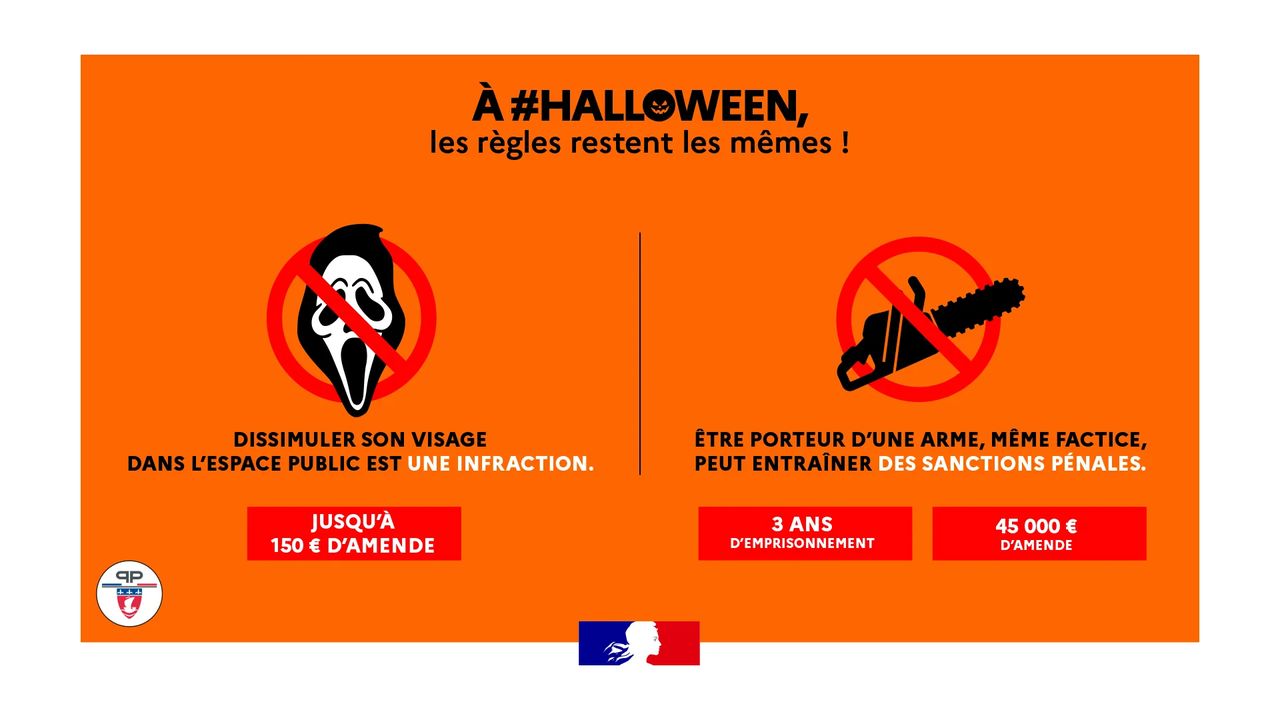 Genuine
Claims
3 checkedAt Halloween the rules stay the same, i.e. Halloween masks and fake weapons in public are punishable as described1235
“À #Halloween, les règles restent les mêmes !”
The post's framing line is what makes it misleading. Each penalty it cites exists somewhere in French law, but presenting them together under 'the rules stay the same' implies that a Scream mask or a plastic chainsaw on 31 October is finable or jailable. It is not, in the ordinary case. Article 2 of the 2010 face-covering law exempts festive, sporting, artistic and traditional dress. The three-year penalty belongs to a demonstration or public-meeting context or to threats with an object resembling a weapon. Two specialist reviewers, Les Surligneurs and 20 Minutes' Fake Off section, reached the same conclusion: the message is incomplete and misleading. Note what makes the finding strong rather than merely plausible: the primary statute text from Légifrance fixes the scope of article 431-10, and the reviewers worked from the same official wording everyone else can see. The post is not invented; it is a real official message that arranges true pieces to support a false impression. A reader should weigh the festive exemption most heavily, because that is the gap that turns a warning into a scare.
Concealing one's face in public space is an offence punishable by a 150 euro fine135
“Dissimuler son visage dans l'espace public est une infraction passible de 150 € d'amende.”
The number is right as a ceiling. Under article 3 of the law of 11 October 2010, hiding your face in public space is a second-class contravention carrying a fine of up to 150 euros. What the post leaves out is article 2 of the same law, which exempts concealment that forms part of sporting, festive, artistic or traditional practices. Halloween dress falls squarely inside that carve-out, which is why a costume is not in principle an offence. The exemption is not a legal technicality buried in case law; it sits in the same statute as the fine, which is what makes the omission decisive rather than marginal. RTL, Les Surligneurs and actu.fr all point to that article. The post's own opening line, 'the rules stay the same', does the work of implying the exception does not apply at Halloween when the statute says the opposite. A reader should take the 150 euro figure as real but conditional, not as a blanket ban on masks.
Carrying a weapon, even a fake one, is punishable by 3 years' imprisonment and a 45,000 euro fine234
“Être porteur d'une arme, même factice, est passible de 3 ans d'emprisonnement et 45 000 € d'amende.”
This penalty exists, but it is attached to situations the post does not mention. Article 431-10 of the penal code imposes three years and 45,000 euros on taking part in a demonstration or public meeting while carrying a weapon, and Légifrance's text of that article is the decisive piece here. Article 132-75 treats an imitation object as a weapon only when it is used to threaten to kill or wound. So a costume prop carried to a party does not, by itself, meet the definition. There is no general ban on carrying a fake weapon in the street, though prefects may prohibit them locally by order, as the Hauts-de-Seine prefecture did around Halloween 2022. Police and legal specialists make the same point, and 20 Minutes' Fake Off review hinges on it. The figure is accurate; the context that would make it apply to Halloween props is missing, and that gap is what makes the statement misleading rather than false.
What was posted
XThe Préfecture de Police de Paris posted a flat-design official infographic on X on 28 October 2026, ahead of Halloween and protests planned for 31 October. The graphic carries the force's logo and the French government's Marianne mark, and sets out two rules it presents as unchanged for the holiday. It tells readers that hiding your face in public is finable and that carrying a weapon, even a fake one, can bring prison time.
“À #Halloween, les règles restent les mêmes ! 🎃 🚫 Dissimuler son visage dans l'espace public est une infraction passible de 150 € d'amende. 🔪 Être porteur d'une arme, même factice, est passible de 3 ans d'emprisonnement et 45 000 € d'amende.”
“At #Halloween, the rules stay the same! 🎃 🚫 Concealing your face in public space is an offence punishable by a 150 euro fine. 🔪 Carrying a weapon, even a fake one, is punishable by 3 years' imprisonment and a 45,000 euro fine.” — translated
Posted by the official @prefpolice account, the Paris police force's own X profile. RTL, 20 Minutes, Les Surligneurs, actu.fr and mesinfos all quote the same wording and date it to 28 October 2026.
Who posted it
XAccount check
Estimates from public signals — account age, posting pattern, audience — not a judgement of the person behind the account, and separate from whether this post is true.
What stood out
- @prefpolice is the official X account of the Préfecture de Police de Paris, confirmed by the prefecture's own website, a moderation charter, and a June 2026 official PDF linking to x.com/prefpolice.
- Live profile and third-party tracker data show the name 'Préfecture de Police', government verification, about 532k followers, joined July 2010, and roughly 22k posts; the supplied blank/unverified metadata appears to be a collection gap rather than evidence of impersonation.
- French and international outlets (CNews, France 3, Europe 1, Maldita.es) quoted or embedded @prefpolice posts in October 2026 as official police communication.
- Fact-checkers have used its footage as primary evidence; one Les Surligneurs piece criticised a Halloween legal warning for omitting a festive exception, a minor accuracy caveat rather than fabrication.
- No evidence found of hijacking, suspension, or impersonation in 2026; activity and follower patterns fit a large institutional broadcaster.
Signals (9)+
- Account created
- 2010-07-09
- Following count
- 384
- Follower ratio
- 1386
- Posting cadence
- Multiple posts per day
- Notable news coverage
- Yes
- Fact check history
- Cited as an official source by Maldita.es; minor legal-accuracy critique by Les Surligneurs (29 Oct 2026)
- Affiliation
- Préfecture de Police de Paris, French Ministry of the Interior
- Handle consistency
- Yes
- Recent activity
- Active through late October 2026
Account checked October 30, 2026, 03:06 UTC
The media
Image✓ What is genuine
The graphic itself. It is the Paris police force's own Halloween infographic, published on its official X account, and the legal provisions it cites all exist in French law in some form.
The tells
- ●●● Strong signal The graphic carries the Préfecture de Police logo and the French government's Marianne mark, and its wording matches what five independent outlets quote.our visual review and the sources
- ●●● Strong signal RTL, 20 Minutes, Les Surligneurs, actu.fr and mesinfos all date the post to 28 October 2026 and reproduce its text.the sources
- ●●○ Supporting signal The design is plain and typographic, with no photographic or synthetic content to test; the dispute is about the words, not the picture.our visual review
Synthetic-media detector
Detector not consultedThe media is incidental to the claim; the detector was not needed.
How we checked the media
- We compared the wording in the post and its caption with the exact wording quoted by RTL, 20 Minutes, Les Surligneurs, actu.fr and mesinfos.
- We reviewed the graphic visually: flat official design, police force logo and government Marianne mark, no photographic or synthetic elements to assess.
- We confirmed through the same outlets that the @prefpolice account published it on 28 October 2026.
Sources
6 sources reviewed- 1"On appliquera les textes" : sera-t-il vraiment interdit de porter un masque dans la rue pour Halloween samedi 31 octobre ? ↗
RTL · rtl.frUntiereduntiered — treated as signal only, never decisiveEvidence
Quotes the police warning and identifies article 2 of the 2010 law, which exempts festive dress, as the omitted provision.
- 2Non, porter un masque ou une arme factice à Halloween ne vous expose pas à 3 ans de prison ↗
20 Minutes (Fake Off) · 20minutes.frUntiereduntiered — treated as signal only, never decisiveEvidence
Concludes the message is incomplete and misleading and explains that article 431-10 applies to carrying a weapon at a demonstration.
- 3Halloween : la préfecture de police veut faire peur et se trompe de règles ↗
Les Surligneurs · lessurligneurs.euUntiereduntiered — treated as signal only, never decisiveEvidence
Finds the prefecture forgets the festive exception and overstates sanctions for fake weapons.
- 4Code pénal — Section 3 : Des manifestations illicites (articles 431-9 à 431-12), article 431-10 ↗
Légifrance · legifrance.gouv.frPrimary / fact-checkerprimary/official source (by domain)Evidence
The penal code text on Légifrance establishing that the three years and 45,000 euros apply to weapons at demonstrations or public meetings.
- 5À Paris, la manifestation du 31 octobre va-t-elle se transformer en défilé d'Halloween ? ↗
Actu.fr · actu.frUntiereduntiered — treated as signal only, never decisiveContext
Reports the 150 euro reminder and the explicit exception for festive dress, and places the post in the context of the 31 October protest.
- 6Halloween 2026 à Paris : peut-on porter un masque ou une fausse arme dans la rue ? ↗
mesinfos · mesinfos.frUntiereduntiered — treated as signal only, never decisiveContext
Notes that the police reminder does not mean every Halloween mask or costume prop is automatically banned.
Further reading
- 4Légifrance The primary legal text that settles the scope of the three-year penalty.
- 220 Minutes (Fake Off) The fullest fact-check treatment of the fake-weapon claim and the demonstration context.
- 3Les Surligneurs A legal review that names both flaws: the missing festive exception and the overstated sanctions.
The full story
The Paris Prefecture of Police did publish this graphic. It went out on the force's official X account on 28 October 2026, three days before Halloween and three days before protests planned for 31 October. That timing explains why a Halloween message reads like a security notice. The force was restating rules it applies around public gatherings, and the two penalties it quotes are real.
The kernel of truth is that French law does penalise hiding your face in public, and it does come down hard on weapons at demonstrations. The 2010 law set a fine of up to 150 euros for face concealment, and article 431-10 of the penal code sets three years and 45,000 euros for carrying a weapon at a demonstration or public meeting. The penal code also treats an imitation object as a weapon when it is used to threaten to kill or wound.
What the post does is drop the conditions. The same 2010 law exempts festive, sporting, artistic and traditional dress. The three-year penalty belongs to a demonstration or to threats, not to a plastic prop on the way to a party. There is no general street ban on fake weapons, though prefects can prohibit them locally, as the Hauts-de-Seine prefecture did around Halloween 2022. A separate and real offence, hiding your face at a demonstration without legitimate reason, carries up to one year and 15,000 euros under article 431-9-1, and that is the provision that mattered for the 31 October 2026 protests. Read together, the post's two true penalties become a warning that frightens people away from costumes the law actually protects.
Kernel of truth
French law does penalise face concealment in public (up to 150 euros) and does impose three years and 45,000 euros for carrying a weapon at a demonstration or public meeting; article 132-75 treats a replica as a weapon when used to threaten.
Timeline
October 11, 2010
The face-covering law is passed: article 3 makes hiding the face in public a second-class contravention, while article 2 exempts sporting, festive, artistic and traditional dress. 1RTL
October 2022
The Hauts-de-Seine prefecture issues a local order around Halloween prohibiting fake weapons, an example of the local bans that exist alongside national law. 220 Minutes (Fake Off)
October 28, 2026
The Préfecture de Police de Paris posts its Halloween graphic on X, warning of a 150 euro fine and three years and 45,000 euros. 1RTL
October 29, 2026
20 Minutes' Fake Off section and Les Surligneurs publish analyses calling the message incomplete and misleading. 220 Minutes (Fake Off)
How it was framed
The post uses real legal provisions but frames them so they appear to cover ordinary Halloween costumes, dropping the festive exemption and the demonstration context that give the penalties their scope. It is not fabricated: every figure and every article exists.
- Missing context. The post omits article 2 of the 2010 law, which exempts festive and traditional dress from the face-covering fine.
- Missing context. The three years and 45,000 euros are quoted without the demonstration or public-meeting setting that article 431-10 requires.
- Ongoing-threat framing. 'les règles restent les mêmes !' presents the holiday as governed by unchanged enforcement, and the post lands three days before protests planned for 31 October.
- Borrowed authority. The graphic carries the Préfecture de Police logo and the government's Marianne mark, lending official weight to the wording.
Posted on X by the official @prefpolice account of the Préfecture de Police de Paris on 28 October 2026. RTL, 20 Minutes, Les Surligneurs, actu.fr and mesinfos all quote the same wording and date.
Bias
Leans law-and-order / public-order framing. The graphic is an official police communication that selects the harshest possible readings of the law and drops the festive exemption, producing a deterrent message timed just before Halloween gatherings and protests against the cost of living. The framing pushes a public-order, heavy-handed tone rather than a neutral statement of the law.
Bias describes how the post frames its message — the slant of the language, selection and emphasis — and is judged separately from whether the claim is true. A true claim can still be framed with a strong slant.
How we checked
57 s- 1
We searched for the exact wording of the police post and for the '3 years, 45,000 euros' penalty to see how it was being reported and where the figures come from.
- 2
We compared the caption with the wording quoted by RTL, 20 Minutes, Les Surligneurs, actu.fr and mesinfos, and confirmed the post's date, 28 October 2026.
- 3
We checked the scope of the cited provisions against the penal code text on Légifrance (article 431-10) and against the reporting on the 2010 face-covering law.
- 4
We reviewed the graphic visually to confirm it is an official infographic and identified what in it is genuine.
- 5
We reviewed the two existing fact checks from 20 Minutes and Les Surligneurs and found they agree with our reading.
✓ Claim checked✓ Media checked✓ Sources checked
Why 90% confidence
HighHigh confidence rests on two independent pillars that point the same way. The legal scope is fixed by primary statute text on Légifrance, and three separate outlets (RTL, 20 Minutes, Les Surligneurs) plus two further reports reach the same conclusion from the same wording. Because the primary text settles the question, we do not depend on any single outlet's interpretation. The media needed no forensic test: the dispute is about the words, and every outlet quotes them identically.
Limits. We did not open the individual article pages in the source list during this check and worked from the quoted wording and the statute as summarised. We could not establish why the force phrased the message this way. We did not examine every local prefectural order in force for Halloween 2026, so a specific local ban could still apply in some areas.
What we don’t know
- Whether the force intended the message as a general warning about public order around the 31 October protests or as a Halloween-specific notice.
- Whether any local prefectural order in force for Halloween 2026 prohibited fake weapons in a particular area.
- How the post was received by the public, since no engagement figures were available to us.
Spot it yourself
Spot the fakeLooks suspicious, isn’t proof
- The warning has an alarming tone and pairs a modest fine with a heavy prison term. Tone alone tells you nothing about whether the figures are accurate.
- It was posted by a police force at a tense political moment. Official sources can still publish incomplete legal summaries, and a security context is not evidence of error.
- The graphic is a plain social media image, not a formal legal text. Design format is not proof that the content is wrong or right.
The actual evidence
- The primary statute: article 431-10 of the penal code, whose text on Légifrance limits the three-year penalty to carrying a weapon at a demonstration or public meeting.
- The 2010 face-covering law itself: the same statute that sets the 150 euro fine exempts festive, sporting, artistic and traditional dress in its article 2.
- Independent legal reviewers: 20 Minutes' Fake Off section and Les Surligneurs both found the message incomplete and misleading, working from the same wording.
- The author's own framing: 'the rules stay the same' is the sentence that turns two conditional rules into an apparent holiday ban.
- 1
Read the actual law, not the summary of it.
Search the article number on Légifrance, France's official legal database. Here, article 431-10 of the penal code and the 2010 law are both public and short. Check whether the penalty has a condition attached before accepting that it applies to you.
- 2
Ask who would be reporting this if it were a new ban.
A change to what people may wear in the street would be covered by national news, local news and consumer outlets, not only by one social media graphic. If the warning exists only as a notice, treat it as a warning, not a new rule.
- 3
Look for the missing half of a legal claim.
When a post pairs a figure with 'the rules stay the same', check whether the same law has an exception for your situation. Exemptions often sit in the same text, one article away from the penalty.
- 4
Check whether the penalty belongs to a different context.
Three years and 45,000 euros sounds enormous for a party prop. That is a clue to check where the figure comes from. Here it comes from weapons at demonstrations, a setting unlike trick-or-treating.
Takeaway
A true figure attached to the wrong situation can mislead more effectively than an invented one, because every part of it can be verified. When an official post cites a penalty, check the conditions and exemptions in the same law before you change your plans.
Questions people ask
Is it illegal to wear a Halloween mask in public in France?+
No, not in the ordinary case. The 2010 law makes hiding your face in public a contravention carrying a fine of up to 150 euros, but article 2 of the same law exempts concealment that forms part of festive, sporting, artistic or traditional practices. A Halloween costume falls within that exception, which the Paris police post left out.
Can you be sent to prison for three years for carrying a fake weapon at Halloween?+
Not simply for carrying a costume prop. The three years and 45,000 euros come from article 431-10 of the penal code, which applies to carrying a weapon at a demonstration or public meeting. Article 132-75 treats a replica as a weapon only when it is used to threaten to kill or wound. A plastic prop carried to a party does not meet that test.
Are fake weapons ever banned in France?+
Yes, locally. There is no general national ban on carrying a fake weapon in the street, but prefects can prohibit them by local order. The Hauts-de-Seine prefecture did so around Halloween 2022. If you are unsure about a specific area, check for a local prefectural order rather than relying on a general social media post.
What about hiding your face at a protest?+
That is a separate and real offence. Hiding your face at a demonstration without a legitimate reason is punishable by up to one year in prison and a 15,000 euro fine under article 431-9-1 of the penal code. It is the provision most relevant to the protests planned for 31 October 2026, and the police post did not mention it.
Was the police graphic itself fake?+
No. It is a genuine infographic published by the official @prefpolice account of the Paris Prefecture of Police on 28 October 2026, and five outlets quote its exact wording. The image is authentic; the problem is that its legal statements leave out the conditions and exceptions that decide whether the penalties apply.
Go deeper
- Contravention
- The least serious category of offence in French law, usually punished by a fine rather than prison.
- Prefectural order
- A local rule issued by a prefect, the state's representative in a department, which can ban something in that area.
- Article 431-10
- The provision of the French penal code that punishes carrying a weapon while taking part in a demonstration or public meeting.
- Marianne
- The figure symbolising the French Republic, used as the official mark on government communications.
People also search for
For educators+
- The post quotes two real penalties accurately. Why can a message made of true statements still mislead people?
- If you were advising the police force, what one sentence would you add to the graphic to make it accurate, and where would you put it?
- How would you check a legal claim like this yourself, using only official sources and news reporting? What would count as enough evidence to change your plans?
About this check
- Platform
- X
- Posted by
- @prefpolice
- Posted
- October 28, 2026
- Age when checked
- 1–2 days old when checked
- Where it spread
- France
- Audience
- UK & EU audience
- Language
- FR
- Status
- ● Post is live
- Verified
- October 30, 2026, 03:07 UTC
- Published
- October 30, 2026, 03:07 UTC
Reach. @prefpolice 766 likes and 785 replies, a heavily ratioed reply count (X syndication, 30 Oct). Sciences Po law professor N. Hervieu's correction got 2,690 likes. 20 Minutes Fake Off and Les Surligneurs both covered it on 29 Oct. Interior Minister Nuñez commented on Thursday.
This verdict was generated with AI from the sources shown. AI can make mistakes — check the sources before relying on it.
Check anything yourself, in seconds.
Share any social post or video to What the Fact and get the verdict, the confidence, and the receipts.