Were these the computers monitoring the section of the Toledo train crash?
Do viral photos of old desktop computers show the equipment Adif used to monitor the stretch of track where the Urda (Toledo) train crash happened, as journalist Javier Negre claimed?
Misleading
A real photo of old rail equipment, but not shown to be the computers monitoring the crash stretch.
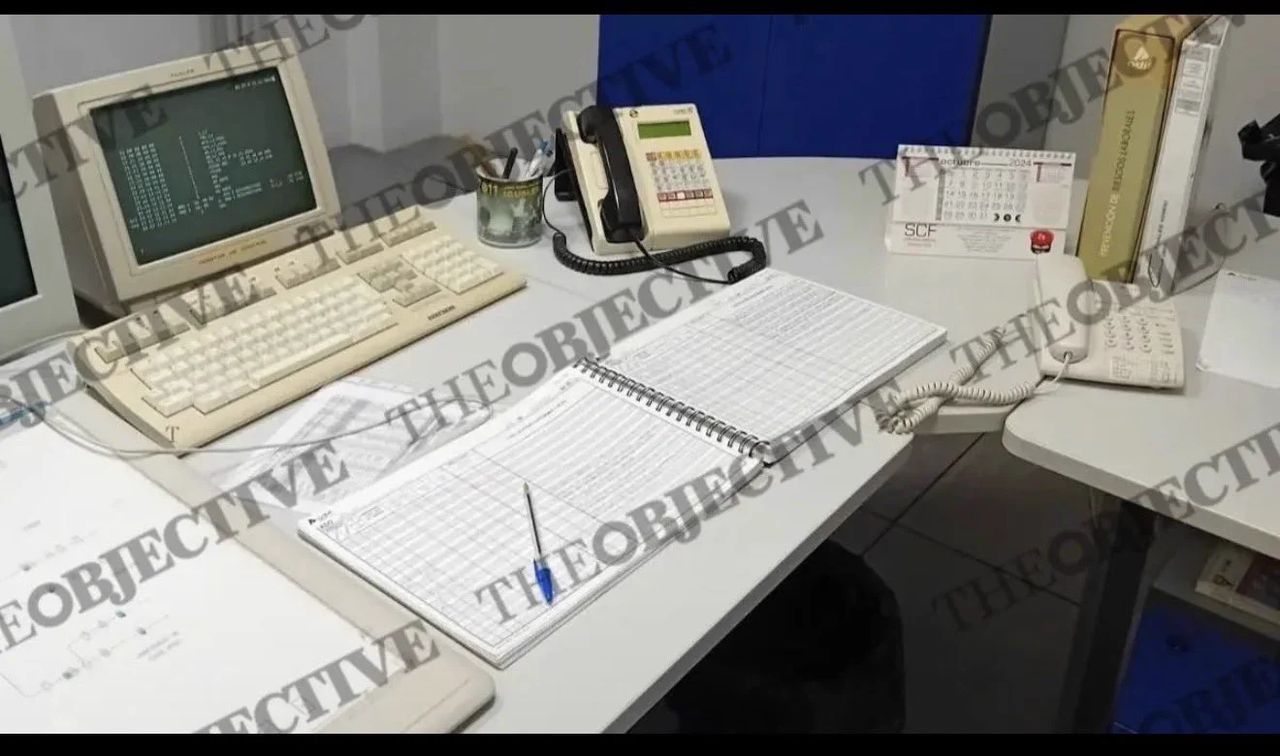
No, this is not established. The photograph is real — The Objective published it on 29 October 2026 about Adif's 1990s LZB equipment — but Adif told Maldita.es the LZB computers look nothing like it and that this is an industrial interface in a Local Operations Post. A calendar in the image reads 2024.
 Likely genuine
Claims
3 checkedThese are the computers with which the section of the accident was being monitored.125
“Los ordenadores con los que se vigilaba el tramo del accidente.”
The photograph is genuine: it carries The Objective's watermark and matches the outlet's 29 October 2026 article on Adif's ageing LZB equipment. But that article did not state where or when the pictures were taken, and it conceded it was unknown whether the old machines caused the failure. The decisive evidence comes from Adif, which told Maldita.es that the computers supporting LZB do not look like the image — what is shown is an industrial interface with two monitors and a panel in a Local Operations Post, not a desktop computer. A calendar visible in the photo reads 2024, so the scene cannot be shown to be contemporaneous with the crash or with that stretch of track. The photo is therefore real but recontextualised: it illustrates a real concern about old equipment, yet nothing anchors it to the accident section.
Still open: When and where was the photograph taken? Maldita.es could not establish this, and The Objective did not say.
The fault was put on the operator.34
“Y la culpa fue del operario.”
This broadly matches the government's public messaging. Transport Minister Óscar Puente called the controller's instruction to let the AVE resume at normal speed an 'inexplicable' and 'erroneous decision', and the controller has declined to testify to the Guardia Civil. But Puente also said he did not intend to attribute responsibility, which he said is for the investigation. Rail unions and Adif objected to pinning the disaster on a single worker, as À Punt reported. So 'the blame was put on the operator' fairly describes the government narrative, not a settled finding. The technical investigation is still open, and a fair reading is that the claim overstates how far blame has been formally assigned.
There is money for prostitutes, Morocco, Uzbekistan — so why do we pay taxes?
“Y sí hay dinero para prostitutas, Marruecos, Uzbekistán. Para qué pagamos impuestos?”
This is a rhetorical jab at public spending. It names no specific programme, figure or document, so there is nothing concrete to check. It reads as political opinion rather than a factual assertion. We include it because it is part of the post, but we treat it as opinion and do not score it as a factual claim.
What was posted
XAn X post sharing a photograph of an old technical desk: a beige CRT terminal, keyboard, analogue phone, handwritten log sheets, a wall calendar and folders. The post says these are the computers that monitored the section of the train accident, that the blame was put on the operator, and complains about public spending. The image carries The Objective's watermark.
“Los ordenadores con los que se vigilaba el tramo del accidente. Y la culpa fue del operario. Manda cojones. Y sí hay dinero para prostitutas, Marruecos, Uzbekistán. Para qué pagamos impuestos?”
“The computers with which the section of the accident was being monitored. And the fault was put on the operator. Unbelievable. And yes there is money for prostitutes, Morocco, Uzbekistan. Why do we pay taxes?” — translated
Posted on X by Javier Negre on 30 October 2026, two days after the Urda crash. The photograph was first published by The Objective on 29 October 2026 and then reposted here. Maldita.es catalogued the post the same day.
Who posted it
XAccount check
Estimates from public signals — account age, posting pattern, audience — not a judgement of the person behind the account, and separate from whether this post is true.
What stood out
- Account belongs to Javier Negre, a real and well-documented Spanish journalist/media owner (Estado de Alarma/EDATV, La Derecha Diario, UHN Plus), active on X since at least 2018.
- He is a genuine, high-output personal account, not an anonymous or sock-puppet profile — automated behaviour is unlikely despite the empty metadata returned.
- However, his reliability as an information source is poor: Spanish and Latin American outlets label him 'el rey del bulo' and a driver of misinformation and racist hoaxes (El País, Deia, Público, Verificado, Factchequeado/La Silla Vacía analyses of The Right News Show).
- Court findings against him: 2019 conviction (with El Mundo) over an interview with a gender-violence victim the ruling said was not consented to / was misrepresented, €30,000 damages; separate rulings ordered him to publish rectifications of hoaxes spread via Estado de Alarma.
- Dismissed by Unidad Editorial in 2020 for unfair competition; dropped as a TV contributor after the 2019 ruling.
- He is a partisan operator with explicit political/financial interests: owner of a media network aligned with Milei, Trump and Spain's far right, and paid/associated content arrangements; claims are frequently presented without verifiable documentation.
- Notable episodes include claiming the Valencian DANA death toll was covered up, presenting a Gaza protest as pro-Hamas, spreading a false claim that an alleged attacker was a 'mena', and a fake red-carpet/event staging in the US.
- Recent (2025–2026) coverage shows him at the centre of disputes with the Mexican government over coordinated inauthentic amplification networks, which cuts against treating his posts as neutral reporting.
- Metadata supplied is entirely empty (no bio, followers, creation date, posts), so profile-level authenticity cannot be corroborated from the sample itself — assessment rests on external identification of the handle.
Signals (8)+
- Identity confirmed
- Javier Negre, Spanish journalist and owner of Estado de Alarma/EDATV, La Derecha Diario, UHN Plus, RAV Español programming
- Notable news coverage
- Extensive: El País opinion piece (Aug 2026), Deia (Apr 2026), Perfil (Oct 2026), Verificado (Sep 2026), El Espectador, Público
- Legal history
- 2019 conviction for unlawful intrusion/false interview (€30,000); multiple rectification orders over Estado de Alarma hoaxes
- Employment history
- El Mundo 2010–2020 (dismissed for unfair competition); former TV pundit dropped after conviction
- Fact check history
- Repeatedly fact-checked and debunked by Maldita, Newtral, Factchequeado, Verificado (immigration, DANA death toll, electoral fraud, Charlie Kirk claims)
- Affiliations
- Media network aligned with Trump/MAGA, Milei and Spanish far right; business ties to Ricardo Salinas Pliego and Fernando Cerimedo
- Posting cadence
- Very high, breaking-news style; unknown from sample (no posts provided)
- Follower ratio
- Unknown
Account checked October 31, 2026, 02:48 UTC
The media
Image✓ What is genuine
The photograph itself is real. It is a genuine picture of old railway technical equipment published by The Objective, and it plausibly shows ageing equipment of the kind at issue. The problem is the caption's claim about what and where it is.
The tells
- ●●○ Supporting signal The image looks physically plausible: a beige CRT terminal, analogue phone, handwritten log sheets and a wall calendar, with natural lighting and no compositing seams.our visual review
- ●●● Strong signal Our detector scored the image as not AI-generated with 0.998 probability and a deepfake score of 0.0.our detector (hive-v3)
- ●●● Strong signal A calendar visible in the image reads 2024, so the scene cannot be shown to be from the time of the crash.our visual review
- ●●● Strong signal The image carries The Objective's repeating watermark and matches a published news article.Maldita.es and provenance records
Synthetic-media detector
Detector ranThe claim stands or falls on whether the media is real, so the detector ran.
Scores are the detector’s estimate for the file as uploaded. A low score does not rule out editing, a spliced caption, or footage shown out of context — those are judged above. Model v3.
How we checked the media
- Reviewed the image visually for signs of manipulation or AI generation.
- Ran our AI-image detector (hive-v3).
- Traced the image's origin to The Objective's 29 October 2026 article via provenance records and Maldita.es.
- Compared Adif's description of LZB computers and Local Operations Post equipment with the pictured set-up.
Sources
5 sources reviewed- 1Qué sabemos de las imágenes de ordenadores viejos que aseguran que son "de Adif" y que los relacionan con el accidente de Toledo ↗
Maldita.es · maldita.esPrimary / fact-checkerIFCN + EFCSN; SpainEvidence
Adif's statement that the LZB computers look nothing like the image and that it shows an industrial interface in a Local Operations Post; also the limits of Maldita.es's independent verification.
- 2Así son los ordenadores de ADIF de los años 90 que hacen fallar el sistema de la vía a Andalucía ↗
The Objective · theobjective.comUntiereduntiered — treated as signal only, never decisiveEvidence
The image's first publication on 29 October 2026 and the outlet's statement that it did not know whether the old computers caused the failure.
- 3Accidente de Toledo: Puente apunta a una "decisión errónea" de un operario de Adif ↗
La Razón · larazon.esUntiereduntiered — treated as signal only, never decisiveEvidence
Puente's description of the controller's decision as erroneous and his statement that he did not intend to assign responsibility.
- 4El controlador d'Atocha que va ordenar a l'AVE reprendre la marxa normal es nega a declarar davant de la Guàrdia Civil ↗
À Punt · apuntmedia.esUntiereduntiered — treated as signal only, never decisiveEvidence
Union criticism of blaming the worker and the controller's refusal to testify.
- 5Del fallo de un sistema de los años 90 que debía ser renovado al error humano: qué provocó la tragedia en Toledo ↗
El Observador · elobservador.com.uyUntiereduntiered — treated as signal only, never decisiveContext
The sequence of the LZB communication failure at around 08:30 that triggered the crash.
Further reading
- 1Maldita.es The fact-check case on this exact post, including Adif's statement and the limits of verification.
- 2The Objective The original article that published the photo, showing what it did and did not say about where and when it was taken.
- 5El Observador A clear account of how the LZB failure led to the crash, which explains why the old-equipment claim felt plausible.
The full story
The kernel of truth is real. On 28 October 2026 a Renfe AVE collided with a stationary Iryo train near Urda in Toledo province. Three computers in the LZB signalling system lost communication at around 08:30, leaving roughly 63 km of the Madrid-Seville line without signalling and handing control to Adif's Atocha centre, where a controller cleared the AVE to run at normal speed. At least 68-69 people died.
The LZB system dates from 1992, and old equipment supporting it had been due for replacement under a 2021 modernisation contract whose deadline expired around the turn of 2025-26. That is why a photograph of dusty, 1990s-looking computers felt like an explanation. It is the kind of image that fits the story people already suspected.
But the photograph does not carry the weight placed on it. The Objective published it on 29 October 2026 without saying where or when it was taken, and noted it was unknown whether the old machines caused the failure. Adif went further, telling Maldita.es that the LZB computers look nothing like the image and that what is shown is an industrial interface in a Local Operations Post. The calendar on the wall reads 2024.
So the post takes a genuine photograph of old rail equipment and arranges it next to a real disaster, inviting the reader to conclude that this is the exact equipment that failed. That conclusion is not established. The crash and the ageing-system concern are real; the specific causal link drawn from this picture is not.
Kernel of truth
Adif's LZB signalling system, dating from the 1990s, failed on 28 October 2026 and was due for replacement — so old equipment really is central to the crash story. The photo illustrates that concern but is not shown to be the monitoring equipment for the accident stretch.
Timeline
October 28, 2026
A Renfe AVE collides with a stationary Iryo near Urda (Toledo) after the LZB signalling system fails at about 08:30; at least 68-69 people die. 5El Observador
October 29, 2026
The Objective publishes an article on Adif's 1990s-era LZB computers, including the photograph later used in the post. 2The Objective
October 30, 2026
The post is published on X and catalogued by Maldita.es; Adif tells Maldita the LZB computers look nothing like the image. 1Maldita.es
How it was framed
A genuine photograph of old rail equipment is presented as the specific equipment that monitored the stretch where the Urda crash happened, a role Adif disputes. The post uses real information arranged to frame the accident and the spending debate in a particular way.
- “Visual proof”. The post shares a photograph and asserts directly: 'Los ordenadores con los que se vigilaba el tramo del accidente.'
- Emotional language. 'Manda cojones' and 'Para qué pagamos impuestos?' frame the claim as outrage.
- Missing context. The caption does not say where or when the photograph was taken or who took it, though The Objective's article also did not say.
- Us vs. them. The line contrasting spending on 'prostitutas, Marruecos, Uzbekistán' with taxpayers sets up a public-spending grievance.
Posted on X by Javier Negre on 30 October 2026. The image was first published by The Objective on 29 October 2026. Maldita.es catalogued the post the same day.
Bias
Leans anti-government (Spanish government / transport minister Óscar Puente); right-leaning. The post frames the Urda train disaster as the product of state neglect rather than an individual worker's error and tacks on a sarcastic line about public money going to 'prostitutes, Morocco, Uzbekistan'. That is a clear partisan attack on the Sánchez government, matching the editorial line of the outlet (The Objective) whose watermarked images it uses.
Bias describes how the post frames its message — the slant of the language, selection and emphasis — and is judged separately from whether the claim is true. A true claim can still be framed with a strong slant.
How we checked
59 s- 1
Read the post and identified its three claims: the computers, the blame, and the spending line.
- 2
Ran four searches on the photograph, Adif and the accident to locate the original publication and any response.
- 3
Opened Maldita.es's case on the post, which records Adif's statement and the limits of independent verification.
- 4
Reviewed the image visually and ran our AI-image detector (hive-v3).
- 5
Compared the timeline of the crash, The Objective's article and the post.
✓ Claim checked✓ Media checked✓ Sources checked
Why 76% confidence
HighWe rate the central claim MODERATE rather than HIGH because the photograph is genuine and the exact date and location could not be independently established; the conclusion rests on Adif's statement and the 2024 calendar, not on a single decisive document. The headline verdict is HIGH because the combination of Adif's denial and the missing provenance is strong.
Limits. We could not visit the site, identify the room, or confirm when the photograph was taken. We relied on Adif's statement as reported by Maldita.es and on The Objective's published article.
What we don’t know
- Exactly when and where the photograph was taken.
- Whether the equipment shown is currently in use, and on which line.
- What the official investigation will conclude about the cause of the LZB failure and responsibility.
Spot it yourself
Spot the fakeLooks suspicious, isn’t proof
- The photo is low-tech and looks old-fashioned. Old equipment is not evidence of anything on its own; Adif's LZB system really does date from the 1990s.
- The poster's tone is angry and partisan. Alarmist language is a reason to slow down, not proof the picture is wrong.
- The image has a news watermark. A watermark shows where a picture was published, not what it depicts or when it was taken.
The actual evidence
- Adif, the infrastructure manager, told Maldita.es that the LZB computers do not look like the image and that the pictured set-up is an industrial interface in a Local Operations Post.
- The Objective's own article did not say where or when the photos were taken and said it was unknown whether the old machines caused the failure.
- A calendar visible in the photo reads 2024, so the scene cannot be shown to be from the time of the crash or that stretch of track.
- Maldita.es could not independently verify the images' date, location or current use.
- 1
Find the original publication of the photo.
Search the watermark or reverse-image search. Here that leads to The Objective's 29 October 2026 article. Check whether the original said when and where the picture was taken.
- 2
Ask who would actually know.
Rail infrastructure is run by Adif. If the claim is about its equipment, look for Adif's own description. Here Adif told Maldita.es the computers look nothing like the image.
- 3
Inspect the details inside the frame.
Look at calendars, clocks, labels and screens. A calendar reading 2024 is a concrete detail that undercuts a claim about a 2026 event.
- 4
Separate the real fact from the link being drawn.
Old LZB equipment really was due for replacement. That does not make every photo of old equipment the equipment that failed. Ask what connects this specific picture to this specific section.
Takeaway
A real photograph can still be used to imply something it cannot support. Before you accept a picture as proof, check what the original source said about it and what the organisation responsible says.
Questions people ask
Is the photo of the computers real?+
Yes, the photograph is real. It was published by The Objective on 29 October 2026 and our detector found no sign of AI generation. The issue is not the image itself but the caption's claim that it shows the equipment monitoring the accident stretch, which Adif disputes.
What does Adif say about the image?+
Adif told Maldita.es that the computers supporting the LZB system do not look like the image and that what is shown is an industrial interface with two monitors and a panel in a Local Operations Post, not a desktop computer.
Did the old computers cause the crash?+
The LZB system failed when three computers lost communication at around 08:30 on 28 October 2026, leaving about 63 km unsignalled. The Objective said it was unknown whether the old machines caused the failure, and the official investigation is still open.
Was the blame put on the operator?+
Transport Minister Óscar Puente called the controller's decision 'inexplicable' and erroneous, and the controller declined to testify. But Puente said responsibility is for the investigation, and rail unions objected to blaming one worker. So it is a fair summary of the government narrative, not a settled finding.
Why does a calendar matter in a photo?+
A wall calendar reading 2024 is a concrete dated detail. If a post presents a picture as showing equipment monitoring a section during a 2026 accident, a 2024 calendar shows the scene cannot be from that time, which weakens the claim.
Go deeper
- LZB
- A railway signalling and train-control system that passes information between the track and the train; the one on the Madrid-Seville line dates from 1992.
- Adif
- Spain's public railway infrastructure manager, which is responsible for tracks and signalling.
- Local Operations Post
- A local control room or office from which a section of railway is managed.
- Recontextualised image
- A genuine photograph or video used with a caption or setting that changes what it appears to show.
People also search for
For educators+
- The photo is real and the LZB system really is old. What exactly makes the caption misleading rather than false?
- If a news outlet publishes a photo without saying where it was taken, whose responsibility is it to check before sharing?
- How should a reader weigh a government minister's description of a worker's decision against the fact that the investigation is still open?
About this check
- Platform
- X
- Posted by
- @javiernegre10
- Posted
- October 29, 2026
- Age when checked
- 1–2 days old when checked
- Where it spread
- Spain
- Audience
- UK & EU audience
- Language
- ES
- Status
- ● Post is live
- Verified
- October 31, 2026, 02:50 UTC
- Published
- October 31, 2026, 02:50 UTC
Reach. Spread by journalist Javier Negre amid national debate over the Urda crash; Google autocomplete already offers 'ordenadores adif bulo'; images taken from a The Objective article
This verdict was generated with AI from the sources shown. AI can make mistakes — check the sources before relying on it.
Check anything yourself, in seconds.
Share any social post or video to What the Fact and get the verdict, the confidence, and the receipts.