Did Florida find arsenic in 60% of popular Halloween candies?
Did Florida testing find arsenic in 60% of popular candies, so that children should eat only a few pieces of brands like Kit Kat or Snickers a year?
Misleading
Real Florida report, real numbers — recast as a Halloween poisoning threat with invented 'limits'.
Florida's health department did report arsenic in 28 of 46 candies tested in January 2026, so the 60% figure is accurate. But the post is misleading: it treats an old state report as an imminent Halloween threat, and its 'pieces per year' limits are the state's own unpublished benchmarks, not a federal safety limit. No products were recalled.
 Likely genuine
Claims
✓ 2 trueFlorida found that 60% of popular candies tested contained arsenic (28 of 46 products).135
“Florida found a STAGGERING 60% of popular candies contained this HIGHLY TOXIC element”
This is the accurate part, and it is why the post travels. Florida's Department of Health, under its 'Healthy Florida First' initiative, announced on 26 January 2026 that it had tested 46 candy products from 10 companies and detected arsenic in 28 of them — about 61%, which the post rounds to 60%. The department's own release gives the 46-and-28 figures, and independent outlets including the Florida Times-Union and Fox News reported the same numbers. The post did not invent the statistic or garble it. That matters for how readers should weigh the rest: a claim built on a genuine official finding earns attention, and the misleading part is what the post does with it, not the figure itself. We rated this claim true at high confidence because the primary source and multiple independent reports agree on the exact counts.
Arsenic is a highly toxic element linked to multi-organ damage and cancer.45
“this HIGHLY TOXIC element linked to multi-organ damage and cancer”
In general terms this is sound: inorganic arsenic is a recognised human carcinogen associated with skin, bladder and lung cancer, and with cardiovascular and neurological harm after high long-term exposure. The problem is what the sentence implies about the candy. Florida's lab used EPA Method 6010D, which measures total arsenic and does not separate the harmful inorganic form from organic forms that are far less concerning. Food Safety Magazine and Fox News both note that the state did not report which form was present. So the toxicology statement can be true in the abstract while telling a reader almost nothing about the actual risk in a candy bar. The post borrows the authority of a real hazard to imply a danger the testing did not establish.
Still open: The state has not published how much of the detected arsenic was the inorganic form.
A child can eat only about 2.4 Kit Kats or 2.4 Snickers, 4 Twizzlers or 6 Jolly Ranchers per year before breaching the 'arsenic safety limit'.34
“Your child can only eat the following amounts per YEAR before breaching the arsenic…”
The per-product numbers are copied correctly from Florida's published table. What is wrong is the label. Those figures are the state's own hypothetical screening benchmarks, devised for this report, not a legal or federal 'arsenic safety limit'. The FDA has no arsenic action level for candy. Toxicologists told Food Safety Magazine that the sample sizes, detection limits and risk-assessment maths behind the benchmarks were never published, which makes the numbers hard to interpret or reproduce. The National Confectioners Association called the benchmarks inconsistent with federal standards and peer-reviewed science. A reader who sees 'safety limit' assumes a regulator set a line and these candies cross it; neither is true. The post also converts a screening exercise into a hard annual allowance, which is not how the state framed it.
Still open: Florida has not published the full methodology behind its per-product benchmarks.
Millions of children are about to fill their Halloween bags with 'arsenic-laced candy'.136
“MILLIONS OF CHILDREN ARE ABOUT TO FILL THEIR HALLOWEEN BAGS WITH ARSENIC-LACED CANDY”
Timing and wording do the work here. The Florida report is from January 2026, nine months before Halloween, and it produced no recall. Arsenic occurs naturally in trace amounts in many foods, and the state itself described the results as transparency, saying risk depends on frequency and total exposure rather than presenting them as a safety alert. Regulators have noted that federal data show far lower levels in confectionery. The phrase 'arsenic-laced' implies deliberate contamination and acute poisoning, which the evidence does not support. Nothing in the post tells readers the report is old, that no product was pulled from shelves, or that the state's own framing was about long-term exposure rather than a Halloween emergency. The result is a genuine finding repackaged as an imminent threat to children.
What was posted
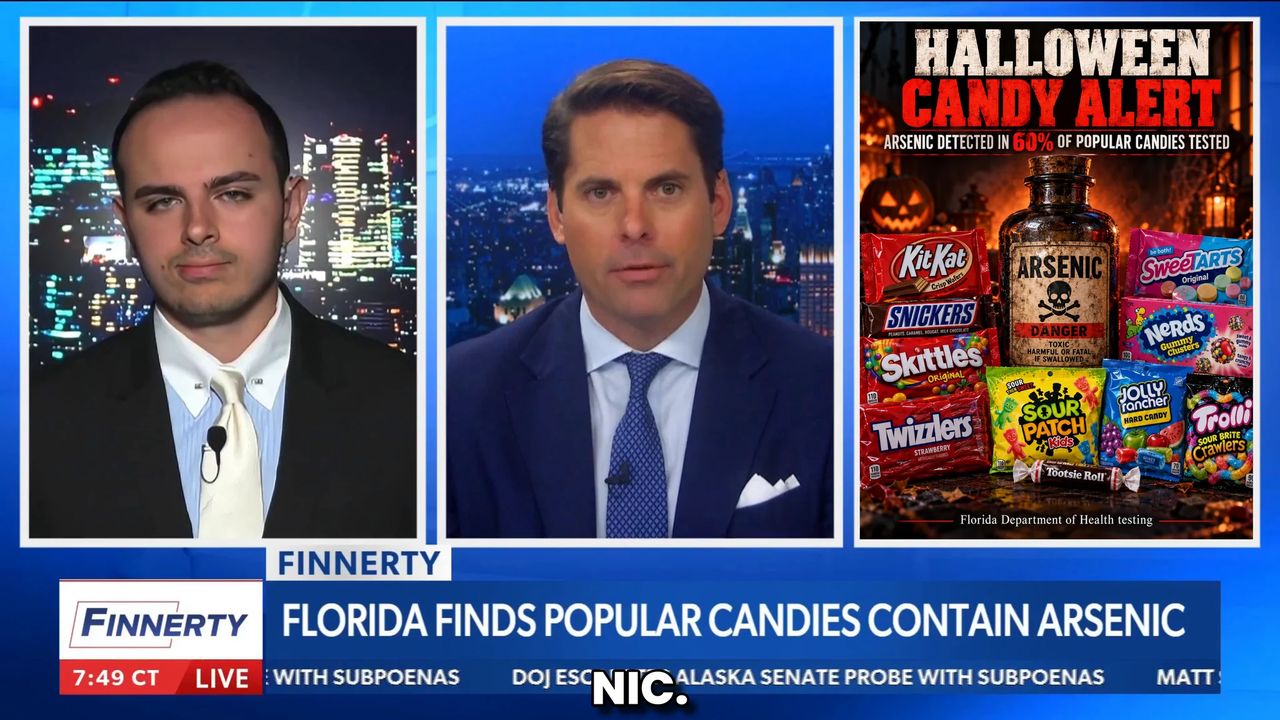
XAn X post by Nicolas Hulscher, MPH, warns that children are about to collect 'arsenic-laced candy' at Halloween, citing Florida's finding that 60% of popular candies contained arsenic. It says a child can eat only a few pieces of specific brands per year before breaching an 'arsenic safety limit' and links the claim to images of a Newsmax broadcast segment and a graphic listing candy brands.
“🚨MILLIONS OF CHILDREN ARE ABOUT TO FILL THEIR HALLOWEEN BAGS WITH ARSENIC-LACED CANDY Florida found a STAGGERING 60% of popular candies contained this HIGHLY TOXIC element linked to multi-organ damage and cancer. Your child can only eat the following amounts per YEAR before breaching the arsenic…”
Posted on X on 29 October 2026, two days before Halloween. The underlying Florida testing results were published on 26 January 2026 and the figures began circulating widely on social media around 16 October 2026.
Who posted it
XAccount check
Estimates from public signals — account age, posting pattern, audience — not a judgement of the person behind the account, and separate from whether this post is true.
What stood out
- Handle resolves to a real, named individual: Nicolas 'Nic' Hulscher, MPH (epidemiology, Univ. of Michigan 2024), epidemiologist/administrator at the McCullough Foundation and writer at Focal Points — a consistent, long-running public identity, not a sockpuppet.
- Account is old (created ~27 Aug 2010 per third-party analytics) and sizeable (~238k followers), consistent with a genuine long-term personal account; no platform verification.
- Despite the 'real person' status, he is a repeat source of fact-checked misinformation: Science Feedback rated his 'negative vaccine efficacy' claim Inaccurate (Jan 2025), Lead Stories debunked his 'vaxxed vs unvaxxed' reanalysis (Jun 2026), Voices for Vaccines and ACSH documented cherry-picking and misuse of an unpublished Henry Ford draft study.
- He promoted a McCullough Foundation report calling vaccination 'the dominant risk factor' for autism — a claim amplified widely and debunked by fact-checkers (e.g., The Week, Nov 2025); the underlying review features Andrew Wakefield.
- Publications appear in low-scrutiny venues (IPAK's Science, Public Health Policy and the Law; IJVT) and non-peer-reviewed preprints (case report on Zenodo used to push 'turbo cancer' claims, debunked by Open/Butac); his work has drawn PubPeer critiques.
- Institutional conflict context: McCullough Foundation is linked to Peter McCullough and The Wellness Company, which sells the ivermectin/mebendazole combination promoted by a Hulscher-authored cancer 'study'.
- Posting behaviour is high-volume, engagement-optimised, sensationalist ('BREAKING', 'CENSORSHIP', claims of X shadowbanning), but organic authorship rather than obvious automation or coordinated inauthentic networks.
- Profile metadata supplied is empty (no bio, no posts, follower count null), so scoring leans on off-platform evidence about the same identity; the handle has a clear, single owner and no evidence of impersonation.
Signals (8)+
- Resolved identity
- Nicolas Hulscher, MPH — epidemiologist/administrator, McCullough Foundation; author at The Focal Points
- Follower count approx
- 238134
- Posting cadence
- Very high, viral-thread oriented
- Follower ratio
- Unknown
- Notable news coverage
- Frequent podcast/YouTube appearances (Flashlights, Healthy & Awake, Wendy Bell Radio); cited by Sridhar Vembu in India autism debate
- Fact check history
- Science Feedback (2025-01): COVID-19 vaccines 'negative efficacy' claim — Inaccurate; Lead Stories (2026-06): vaxxed-vs-unvaxxed 22-category reanalysis — not statistically valid, based on unpublished flawed Henry Ford draft; Voices for Vaccines (2025-12, 2026-07): kidney/organ damage and vaccinated-children claims misleading; ACSH / Genetic Literacy Project (2026-09): 'largest vaxxed vs unvaxxed study' presented as definitive proof, ignores that underlying data showed no autism link; Open / Butac (2026-10, 2026-06): 'turbo cancer' case report misrepresented; ivermectin cancer study funded by product seller
- Affiliations
- McCullough Foundation (Peter McCullough); ties to The Wellness Company products; journals of low repute (IPAK, IJVT)
- Data completeness
- Profile metadata empty — bio, follower count and recent posts missing from submission
Account checked November 1, 2026, 02:51 UTC
The media
Image✓ What is genuine
The collage is assembled from real material: a studio portrait, a genuine Newsmax broadcast frame and a genuine graphic card listing candy brands. It is not a deepfake or a synthetic image. Our assessment rests on visual review and the sources, because no automated detector was run for this check.
The tells
- ●●○ Supporting signal The Newsmax 'Finnerty' chyron reads 'FLORIDA FINDS POPULAR CANDIES CONTAIN ARSENIC', matching a real broadcast segment and the state's finding.our visual review
- ●●○ Supporting signal The graphic card credits 'Florida Department of Health testing' at the bottom, consistent with the department's published results.our visual review
- ●●○ Supporting signal Faces, studio lighting and ticker details are internally consistent; nothing in the scene violates physics or biology.our visual review
Synthetic-media detector
Detector not consultedThe media is incidental to the claim; the detector was not needed.
How we checked the media
- Reviewed the three-panel collage visually for consistency of faces, lighting, set details and on-screen text.
- Compared the broadcast chyron and graphic-card text with the figures in the Florida report and in news coverage.
- Assessed whether the post's core numerical claims depend on the image being genuine.
Sources
6 sources reviewed- 1ICYMI: Florida Releases Candy Testing Results Under Healthy Florida First Initiative ↗
Florida Department of Health · floridahealth.govPrimary / fact-checkerprimary/official source (by domain)Evidence
The Florida Department of Health confirms arsenic was detected in 28 of 46 candy products and frames the results as exposure evaluation.
- 2Florida Releases Candy Testing Results Under Healthy Florida First Initiative ↗
Office of Governor Ron DeSantis · flgov.comUntiereduntiered — treated as signal only, never decisiveContext
The governor's office repeats the 28-of-46 finding and points to the published results.
- 3New report detects arsenic in 28 popular candies: What you need to know ↗
Fox News · foxnews.comLow reliabilityRight (AllSides); partisan — signal onlyEvidence
Fox News reports the testing method, the lack of recalls and the National Confectioners Association's dispute.
- 4Florida Contaminant Testing Program Raises Concerns Over Arsenic in Candy ↗
Food Safety Magazine · food-safety.comUntiereduntiered — treated as signal only, never decisiveEvidence
Food Safety Magazine reports toxicologists' concerns that the methodology and risk calculations were never published.
- 5Is your Halloween candy safe? What Florida testing found in popular brands ↗
The Florida Times-Union · jacksonville.comUntiereduntiered — treated as signal only, never decisiveEvidence
The Florida Times-Union reports the 28-candy result and that the form of arsenic was not specified.
- 6Florida tests popular candy for arsenic. Which ones were the worst? ↗
The Detroit News · detroitnews.comUntiereduntiered — treated as signal only, never decisiveContext
The Detroit News reports the state's finding that more than 60% of tested candies contained elevated arsenic.
Further reading
- 1Florida Department of Health The primary document behind the claim; confirms the 46-and-28 counts and the state's own framing.
- 4Food Safety Magazine Explains the methodological criticism from toxicologists and the missing details behind the benchmarks.
- 3Fox News Covers the testing method, the absence of recalls and the industry response.
The full story
The kernel of truth is a genuine government testing programme. On 26 January 2026, Florida's Department of Health, under its 'Healthy Florida First' initiative, released results for 46 candy products from 10 companies. It reported arsenic in 28 of them, at concentrations of roughly 180 to 570 parts per billion, and published a table of state-calculated annual consumption amounts for each product. Those are the figures in the post, and they are quoted accurately.
The problems start with how the testing was done and how the results were framed. The lab used EPA Method 6010D, a method that measures total arsenic without separating the more harmful inorganic form from organic forms. The state did not publish its sample sizes, detection limits or the maths behind its consumption benchmarks, and the FDA has no arsenic action level for candy. Toxicologists told Food Safety Magazine that this lack of transparency makes the findings difficult to interpret, and the National Confectioners Association called the benchmarks inconsistent with federal standards and peer-reviewed science.
Nothing was recalled. The state cast the results as transparency about exposure over time, not as an acute safety alert, and federal data show far lower levels in confectionery. Then, around 16 October 2026, the January figures began recirculating on social media, and by Halloween they had become a story about children's trick-or-treat bags. The post's power comes from that combination: a real official document, real numbers, a real chemical hazard, and a new and alarming frame that the document itself does not support.
Kernel of truth
Florida's Department of Health did detect arsenic in 28 of 46 candy products in a January 2026 report, and the post quotes those numbers and the state's consumption table accurately.
Timeline
January 26, 2026
Florida's Department of Health releases candy heavy-metals testing under 'Healthy Florida First', reporting arsenic in 28 of 46 products. 1Florida Department of Health
October 16, 2026
The January figures begin circulating widely on social media.
October 29, 2026
Nicolas Hulscher posts the 'arsenic-laced candy' warning on X.
How it was framed
The post uses genuine information — a real state report with accurate numbers — but frames it to imply an imminent Halloween poisoning threat and presents unpublished state benchmarks as a formal safety limit. The old report is also lifted out of its original context and timing.
- Emotional language. 'MILLIONS OF CHILDREN ARE ABOUT TO FILL THEIR HALLOWEEN BAGS WITH ARSENIC-LACED CANDY' and 'STAGGERING'.
- Ongoing-threat framing. 'about to fill' presents a nine-month-old report as an imminent danger tied to Halloween.
- Borrowed authority. Cites 'Florida found' and shows a Newsmax broadcast frame and a card crediting 'Florida Department of Health testing'.
- “Visual proof”. The collage of a broadcast chyron and a branded graphic card is used to make the claim look documented.
- Missing context. No mention that the report is from January, that no products were recalled, or that the 'limit' is the state's own unpublished benchmark.
Posted on X by Nicolas Hulscher, MPH, on 29 October 2026, two days before Halloween. The account presents itself as public-health commentary; we found no IFCN-signatory fact-check of this specific post.
Bias
Leans alarmist, anti-food-industry public-health scare framing (MAHA-adjacent). The post reframes a nine-month-old, methodologically contested state report as an imminent Halloween poisoning threat, using all-caps 'ARSENIC-LACED CANDY' language and presenting the state's own unverified screening benchmarks as a hard 'arsenic safety limit'. It omits that only total arsenic was measured and that toxicologists, the FDA data and the candy industry dispute the conclusions, producing a maximally frightening impression from selective but real numbers.
Bias describes how the post frames its message — the slant of the language, selection and emphasis — and is judged separately from whether the claim is true. A true claim can still be framed with a strong slant.
How we checked
59 s- 1
Searched for the Florida Department of Health candy arsenic testing and for the Halloween framing of the claim.
- 2
Compared the post's 60% and per-product figures with the department's release and with news coverage from Fox News, the Florida Times-Union and the Detroit News.
- 3
Searched for fact-checks of this specific viral framing and found none from IFCN-signatory outlets.
- 4
Reviewed the attached collage visually for consistency and compared its text with the report.
- 5
Checked reporting on the testing method and on criticism from toxicologists and the National Confectioners Association.
✓ Claim checked✓ Media checked✓ Sources checked
Why 78% confidence
HighWe are highly confident in the verdict because the central figure is confirmed by the state itself and by multiple independent outlets, while the misleading elements — the age of the report, the absence of a federal limit, the unpublished methodology and the lack of any recall — are documented in the same coverage. The verdict rests on primary and reputable reporting; no automated media detector was run.
Limits. Florida has not published its full methodology, sample sizes or risk calculations, so we cannot independently assess the state's benchmarks. No IFCN-signatory fact-check of this specific post was found, so the assessment relies on primary documents and reporting.
What we don’t know
- How much of the detected arsenic was the more harmful inorganic form.
- The sample sizes, detection limits and risk-assessment maths behind Florida's per-product benchmarks.
- Whether the post's author intended to mislead or believed the frame was accurate; we found no evidence either way.
Spot it yourself
Spot the fakeLooks suspicious, isn’t proof
- The alarmist tone and capital letters are reasons to slow down, but they do not make the numbers wrong.
- The broadcast-graphic style can look like a fake news card, yet this one matches a real Newsmax segment and a real state report.
- The poster's public-health branding cuts both ways: credentials are not proof, and lack of them is not disproof.
The actual evidence
- The Florida Department of Health's own release confirms 28 of 46 products, so the headline figure is real.
- The consumption numbers match the state's table, but the state never called them a legal or federal safety limit, and the FDA has no arsenic action level for candy.
- The testing method measured total arsenic, not the harmful inorganic form, and the methodology was never published, according to Food Safety Magazine.
- No recall followed the report, and the state framed it as transparency about long-term exposure rather than an acute alert.
- 1
Find the original document
Search the agency name plus the product and year, and read the release yourself. Here, the Florida Department of Health release confirms the 46-and-28 counts.
- 2
Check the date of the underlying report
Look for the publication date on the original release. A January report shared in late October is being reused for a new purpose.
- 3
Ask who set the 'limit'
Search whether a regulator such as the FDA has an action level for this product. If the limit appears only in one state's table, it is a state benchmark, not a national rule.
- 4
Look for recalls or official alerts
Check the regulator's recall pages and the agency's own language. No recall and a transparency framing change how seriously to take an 'imminent threat'.
- 5
Treat broadcast images as illustration, not proof
A chyron can be genuine and still sit on top of a misleading interpretation. Verify the numbers against the primary document, not the graphic.
Takeaway
Accurate numbers can still carry a false message. When a post quotes a real report, check the date, who set the standard it cites, and what the agency actually concluded — the figures may be true while the frame is not.
Questions people ask
Did Florida really find arsenic in 60% of popular candies?+
Yes. Florida's Department of Health reported on 26 January 2026 that it detected arsenic in 28 of 46 candy products, about 61%. The figure is accurate and is confirmed by the department's release and by outlets including the Florida Times-Union and Fox News. The problem is how the post frames that finding.
Is there an official arsenic safety limit for candy?+
No. The FDA has no arsenic action level for confectionery. The 'pieces per year' figures come from Florida's own report, where they are state-calculated screening benchmarks, not a legal or federal limit. Toxicologists noted the state never published how those benchmarks were calculated.
Was any Halloween candy recalled over arsenic?+
No. The January 2026 Florida report did not lead to any recall, and no product was pulled from shelves. The post does not mention this. It presents a nine-month-old testing report as an imminent Halloween threat, which the state's own framing did not support.
Does arsenic in food always mean danger?+
Not necessarily. Arsenic occurs naturally in trace amounts in many foods, and risk depends on the form and the amount. Florida's lab measured total arsenic without separating the more harmful inorganic form from organic forms. Without that detail and without published methods, the results are hard to interpret for real-world risk.
How can I check a scary food claim like this next time?+
Find the original agency release, note its date, check whether a regulator such as the FDA has set the limit being cited, and search for recalls or official alerts. Then compare the post's framing with what the agency itself concluded, rather than relying on a broadcast graphic shared with the claim.
Go deeper
- Inorganic arsenic
- The more toxic form of arsenic, associated with cancer and other health harms, as distinct from organic forms found in some foods.
- Action level
- A threshold set by a regulator such as the FDA that triggers action if a contaminant exceeds it; there is none for arsenic in candy.
- EPA Method 6010D
- A laboratory method that measures total arsenic in a sample without distinguishing between its chemical forms.
- Screening benchmark
- A provisional reference value created for an assessment, not a legally binding safety standard.
People also search for
For educators+
- The post quotes correct numbers from a real report. At what point does accurate data become misleading?
- If a state publishes its own screening benchmark, how should media describe it so readers do not mistake it for a federal safety limit?
- Why might a genuine government report spread more effectively when attached to a Halloween warning than when first published in January?
About this check
- Platform
- X
- Posted by
- @nichulscher
- Posted
- October 30, 2026
- Age when checked
- 1–2 days old when checked
- Where it spread
- United States
- Audience
- US audience
- Language
- EN
- Status
- ● Post is live
- Verified
- November 1, 2026, 02:52 UTC
- Published
- November 1, 2026, 02:52 UTC
Reach. 7.4K likes, 587 replies on the X post; Halloween-eve reshares via resistthemainstream and others (31 Oct). Florida DOH candy testing dates from Jan 2026
This verdict was generated with AI from the sources shown. AI can make mistakes — check the sources before relying on it.
Check anything yourself, in seconds.
Share any social post or video to What the Fact and get the verdict, the confidence, and the receipts.