Did Sam Altman say he prefers a trillion superhuman AIs over one trillion-IQ AI?
Did OpenAI CEO Sam Altman say it is 'quite terrible' that people keep RAM in their own PCs instead of it being used in data centers?
True
The quote is real: Altman argued for many superhuman agents over one trillion-IQ model.
True. In the Cheeky Pint podcast with John Collison, published in late October 2026, OpenAI chief executive Sam Altman said he would much rather have "a trillion AIs of slightly superhuman intelligence join society than one AI of 1 trillion IQ". The episode is genuine, and independent outlets reported the same position.
Claims
✓ 5 trueAltman would much rather have a trillion AIs of slightly superhuman intelligence join society than one AI of 1 trillion IQ.123
“I would much rather intuitively have a trillion AIs of slightly superhuman intelligence join society than one AI of 1 trillion IQ.”
This is a direct quote, and it is the claim the whole post rests on. The published Cheeky Pint transcript carries the line in Altman's own words, and independent write-ups of the episode describe the same position: many capable agents spread through society, rather than one model of enormous power. The decisive evidence is the transcript itself, because the question is simply whether he said it. The supporting write-up is a secondary summary, not a second recording, so it adds confirmation of interpretation rather than a new independent origin. There is no competing version of the quote and no sign of deceptive editing in the passage. A reader should weigh this as a quotation question: when a post attributes words to a named public figure in a named interview, the transcript and the platform listing settle it quickly. Here both match the post's title, so the headline is accurate.
OpenAI's Navier-Stokes proof cost on the order of $10 million in compute.4510
The underlying event is well reported: on 8 September 2026 OpenAI said an internal system using about 10,000 agents had produced a Navier-Stokes blow-up proof in an 88-hour run, and coverage put the compute bill somewhere between roughly $10 million and $22.5 million. That range is an estimate, not an invoice, which is why this sits at likely true rather than true. The bigger caveat is what the proof actually covers. Scientific American and Yahoo Tech report that the result addressed the Clay formulation that allows an external forcing term, while the prize problem is the unforced version; an October audit disputed how faithfully the Lean formalisation matched the manuscript, and the Clay Mathematics Institute has verified nothing. So the cost figure is broadly supported, but the surrounding claim of a solved problem is contested. Readers should separate the two: money spent is one question, mathematical proof is another.
Still open: OpenAI has not published a verified final compute figure, and the maths result remains unverified.
OpenAI holds and has published more than 700 mathematical proofs.69
In October 2026 OpenAI released 722 manuscripts covering 372 mathematical problem families, which Science reported and Brookings analysed. That matches Altman's remark that the company has more than the 700 proofs already published. The number is well sourced and does not depend on a single outlet. The useful nuance is what a manuscript is: Brookings notes that most of the 722 were not formally verified, and there was no companion verification paper for the Navier-Stokes claim. So the count is accurate as a count, while the strength of each result varies. A reader hearing 'more than 700 proofs' might assume 700 settled theorems; the accurate reading is 700-plus posted manuscripts, many awaiting formal checking. That distinction does not make the claim false, but it changes what the number means.
Frontier AI models found long-hidden critical PHP vulnerabilities, and the first day of the response went better than feared.78
The vulnerability story is documented. Two critical PHP flaws, CVE-2026-109618 and CVE-2026-109619, were disclosed with emergency patches on 21 October 2026, and security trade coverage says they were found with frontier-model assistance inside OpenAI's Patch the Planet programme. The defect had gone unnoticed for more than a decade. That supports Altman's account of models surfacing hidden bugs. His second element, that the first day of the response went better than feared, is his own assessment rather than a measurable figure, so it cannot be checked the same way. Patch coverage does show a global emergency response that kept disruption bounded, which is consistent with his description. The claim is therefore likely true overall: the discovery is documented, and the 'better than expected' part is opinion-shaped.
Still open: The 'better than feared' judgement has no published metric behind it.
OpenAI's personal agent 'Dots' launched a few weeks before the interview.3
Only one source in our set, a secondary summary of the episode, refers to personal agents including OpenAI's 'dots'. We did not find a Tier-A report that specifically confirms the launch date. That makes this the weakest claim in the set: the product is mentioned in coverage of the interview, but the timing rests on a summary rather than a primary announcement or independent launch reporting. A reader should treat the product reference as plausible but unconfirmed on timing. This is also a good example of how a single passing remark in a long interview can be harder to verify than the headline quote. We have not found anything contradicting it, and the low confidence reflects thin sourcing rather than doubt about whether the interview happened.
Still open: No primary launch announcement for 'dots' was found in our sources.
Sandboxing a model far smarter than any human security researcher may not be trustworthy, and humanity may eventually need to cap how smart single models get.
This is a forward-looking safety judgement, not a factual assertion. Altman is predicting that containment may stop working against systems more capable than any human reviewer, and suggesting that limits on single-model capability might one day be needed. There is no present-day fact that could make it true or false; it is a position about risk and policy. We mark it opinion, which is not a criticism. Mixing predictions with checkable claims is normal in interviews, and the two should be read differently. The factual parts of the episode, such as the maths release and the PHP disclosure, can be checked against reporting. This part cannot, and readers should weigh it as one expert's judgement about the future, made by someone with an interest in the outcome.
A text-only post: there was no media to test.
What was posted
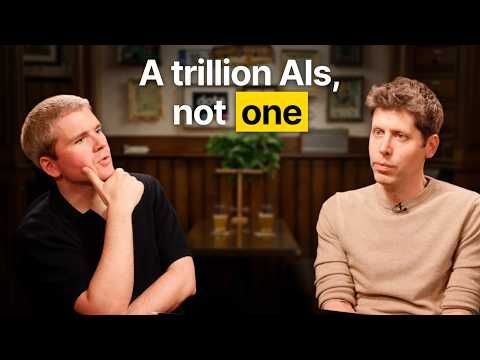
YouTubeThis is a YouTube listing of an episode of the Cheeky Pint podcast, hosted by John Collison, in which he interviews OpenAI chief executive Sam Altman. The submission contains the episode title, a short description and a stretch of the published transcript, in which Altman talks about AI finding software vulnerabilities and about redesigning systems and networks. The title frames the episode as Altman's case against a single superintelligence. The transcript is text only; no separate image or video file was attached to this submission.
“Why Sam Altman is against a single superintelligence”
Posted on YouTube as an episode of the Cheeky Pint podcast; the same episode appears on podcast platforms, with the Substack/Transistor feed listing 28 October 2026 and the podcast and YouTube versions dated 29 October 2026.
Who posted it
YouTube@cheekypint
27.1K subscribers · Account 1.4 years old
View the account on YouTube ↗“Stripe cofounder John Collison interviews founders, builders, and leaders over a pint.”
Account check
Estimates from public signals — account age, posting pattern, audience — not a judgement of the person behind the account, and separate from whether this post is true.
What stood out
- Channel is the official YouTube home of 'Cheeky Pint', the interview show hosted by Stripe co-founder/president John Collison — confirmed via Stripe's own LinkedIn post, a16z feed-drop credits, and the show's Substack/RSS/Apple Podcasts listings that carry the identical bio.
- Recent uploads map to independently covered episodes: the Toto Wolff F1 episode (Podscan, 20 Oct 2026), the Zuckerberg/Wang $100B episode (Business Insider, SmartCompany, Oct 2026) and the Sam Altman episode (TNW, NY Post, 28-30 Oct 2026) — the video descriptions on the channel match those reports.
- Jordan: the channel itself announces it as 'our new channel' for future episodes and clips, so it is a deliberate migration of a known, high-production Stripe-backed property rather than an impersonation of one.
- Presentation is coherent for a niche B2B interview series: 27.1k subscribers, biweekly-plus cadence, ~38 episodes since the show launched June 2025, all with named guests (Altman, Pichai, Musk, Nadella, Amodei, Zuckerberg, Toto Wolff, United's CEO).
- No platform verification badge, but that is consistent with sub-100k subscriber scale rather than a red flag; identity is instead corroborated by the linked Substack (cheekypint.substack.com), Spotify/Apple feeds, X account @CheekyPint, and Stripe's corporate channels.
- No fact-check or debunking history against the account; coverage consistently treats it as a primary source for what guests said. Caveat: it is first-party corporate/PR media, so guest claims (e.g. Altman's unsourced '5%' RAM-utilisation figure) are quoted, not independently verified by the account.
- Null creation date and missing per-video engagement/view data in the profile metadata are data gaps, not suspicious signals — no evidence of automation, bulk uploads, or coordinated inauthentic behaviour.
Signals (10)+
- Account age basis
- Show launched ~June 2025; dedicated YouTube channel announced as 'new channel' later in 2025
- Posting cadence
- Roughly biweekly to weekly (~38 episodes since mid-2025)
- Follower ratio
- Not applicable (organisational/brand channel)
- Affiliation
- Stripe / John Collison (co-founder & president)
- Notable news coverage
- The Next Web; New York Post; Business Insider; SmartCompany; The Phoenix (Ireland); Rivian corporate blog
- Fact check history
- None found; cited as a primary source by mainstream outlets, but guest statistics not fact-checked by the channel
- Content type
- Long-form video interviews with tech/business executives
- Cross platform presence
- Substack transcripts, Spotify, Apple Podcasts, Transistor RSS, X @CheekyPint
- Engagement anomalies
- Unknown (engagement metrics absent from profile sample)
- Impersonation risk
- Low — official handle @CheekyPint consistent across platforms
Recent posts from this account
Account checked November 1, 2026, 02:56 UTC
Sources
10 sources reviewed- 1Why Sam Altman is against a single superintelligence (Cheeky Pint transcript) ↗
Cheeky Pint · cheekypint.substack.comUntiereduntiered — treated as signal only, never decisiveEvidence
The published transcript contains the central 'trillion AIs' quote and the surrounding discussion.
- 2Cheeky Pint: Sam Altman on Why AI Shouldn't Have One Superintelligence ↗
Apple Podcasts · podcasts.apple.comUntiereduntiered — treated as signal only, never decisiveContext
The podcast listing records the episode and its late-October 2026 publication.
- 3Sam Altman on Sandboxing, Agent Teams and Compute Costs ↗
LLMs Blog · llms.blogUntiereduntiered — treated as signal only, never decisiveEvidence
A summary of the episode reports Altman's preference for many agents and mentions OpenAI's 'dots'.
- 4OpenAI breakthrough triggers 'existential crisis' in math ↗
Science (AAAS) · science.orgPrimary / fact-checkerpeer-reviewedEvidence
Science reports the 8 September 2026 Navier-Stokes announcement and the scale of the agent run.
- 5Did OpenAI solve the wrong Navier-Stokes problem? ↗
Scientific American · scientificamerican.comUntiereduntiered — treated as signal only, never decisiveEvidence
Scientific American sets out the forced-versus-unforced distinction that qualifies the maths claim.
- 6When AI takes away the thrill of discovery ↗
Science (AAAS) · science.orgPrimary / fact-checkerpeer-reviewedEvidence
Science reports the October 2026 release of 722 manuscripts across 372 problem families.
- 7PHP2Shell patch rush takes Wikipedia, govt sites offline ↗
The Cyber Express · thecyberexpress.comUntiereduntiered — treated as signal only, never decisiveEvidence
The Cyber Express documents the PHP2Shell CVEs and the 21 October 2026 patches.
- 8Critical PHP flaws found with AI prompt emergency patches worldwide ↗
Digital Watch Observatory · dig.watchUntiereduntiered — treated as signal only, never decisiveEvidence
Digital Watch Observatory reports that PHP2Shell was found with frontier models in OpenAI's Patch the Planet programme.
- 9Spending it faster: What a 10,000-agent proof means for AI's borrowed expertise ↗
Brookings · brookings.eduPrimary / fact-checkerprimary/official source (by domain)Evidence
Brookings notes most released manuscripts lacked formal verification and no companion verification paper existed.
- 10OpenAI's 10,000-agent Navier-Stokes claim solves the wrong problem — and the right one has a provenance controversy ↗
Yahoo Tech · tech.yahoo.comUntiereduntiered — treated as signal only, never decisiveEvidence
Yahoo Tech details the unforced-versus-forced problem, cost estimates and the provenance dispute.
Further reading
- 4Science (AAAS) Science's report on OpenAI's September Navier-Stokes announcement gives the agent count, run time and context.
- 5Scientific American Scientific American explains which version of the problem the proof addressed and why mathematicians say the key problem remains open.
- 9Brookings Brookings analyses the 722-manuscript release and the limits of unverified results.
- 7The Cyber Express The Cyber Express documents the PHP2Shell flaws and the emergency patch response Altman describes.
The full story
The post is not a clipped-out shock quote. It is a full podcast episode, and the title compresses an argument Altman makes across the conversation: that distributing powerful AI widely is safer than concentrating it in one system. The kernel of truth is that he says it plainly in the transcript, in a line about preferring a trillion slightly superhuman AIs to one AI of a trillion IQ.
The episode also shows why the surrounding material felt worth sharing. Altman describes models that keep getting better at finding vulnerabilities, and says people had simply not yet pointed them at all the code on the internet. He talks about redesigning systems and networks rather than only patching software, and about the early-internet feeling of people building with new tools. Those themes connect to real, dated developments: the September Navier-Stokes announcement, the October release of hundreds of maths manuscripts, and the 21 October PHP2Shell patches.
That mix is what makes the title plausible to a casual viewer and also what makes it incomplete. The maths result he references is disputed, and the Clay Mathematics Institute has verified nothing. The episode is genuine; the title is accurate about his position; the technical claims inside it range from well documented to contested to opinion.
Kernel of truth
Altman did argue, in a genuine interview, for many slightly superhuman AIs over one trillion-IQ superintelligence.
Timeline
September 8, 2026
OpenAI announces that an internal system using about 10,000 agents produced a Navier-Stokes blow-up proof in an 88-hour run. 4Science (AAAS)
October 21, 2026
Emergency patches are released for the PHP2Shell flaws CVE-2026-109618 and CVE-2026-109619, found with frontier-model assistance. 7The Cyber Express
October 2026
OpenAI releases 722 mathematical manuscripts covering 372 problem families. 6Science (AAAS)
October 29, 2026
The Cheeky Pint episode with Sam Altman is published on podcast platforms and YouTube. 2Apple Podcasts
How it was framed
The post is a real podcast episode and the title is a fair summary of what Altman says in it. Individual statements inside the episode vary in strength, but the headline claim itself holds up, so this is accurate content rather than any form of information disorder.
Bias
Leans pro-AI-industry. The post is an interview-format episode with OpenAI's CEO hosted by Stripe co-founder John Collison; the framing centres Altman's own account of OpenAI's achievements, though the interviewer does push back on several points (sandboxing pessimism, compute spending, the mathematicians' anger).
Bias describes how the post frames its message — the slant of the language, selection and emphasis — and is judged separately from whether the claim is true. A true claim can still be framed with a strong slant.
How we checked
1 min 9 s- 1
We searched for the episode and for reporting on Altman's 'Cheeky Pint' interview to confirm it exists and what he said.
- 2
We read the published transcript and compared the central quote with the post's title.
- 3
We searched for independent coverage of the Navier-Stokes proof, including the Clay Mathematics Institute and mathematician disputes.
- 4
We searched for reporting on the PHP2Shell vulnerabilities and the CVEs Altman references.
- 5
We searched for coverage of OpenAI's maths manuscript release to check the 'more than 700 proofs' remark.
- 6
We assessed the submission as text only, so no image or video authenticity test applied.
✓ Claim checked– Media not applicable✓ Sources checked
Why 86% confidence
HighWe set HIGH confidence because the central claim is a direct quotation confirmed by the transcript and by independent summaries, and the supporting events are reported by separate outlets. The weaker elements, the compute cost estimate and the 'dots' launch timing, are marked lower individually. No detector ran because there was no media asset to test.
Limits. We did not obtain a verified compute invoice or a primary launch announcement for 'dots'. We relied on published reporting for the technical developments rather than independent mathematical or security verification.
What we don’t know
- The exact compute cost of the Navier-Stokes run: published estimates range from about $10 million to $22.5 million.
- Whether the Lean formalisation of the Navier-Stokes proof faithfully matches the manuscript, which an October audit disputed.
- The precise launch date of OpenAI's 'dots' personal agent.
- Whether any formal verification will follow for the 722 released manuscripts.
Spot it yourself
Why it looked fakeLooks suspicious, isn’t proof
- A striking number in a headline ('a trillion AIs', '1 trillion IQ') can read as clickbait, but round hyperbolic figures are common in spontaneous speech and prove nothing either way.
- A podcast clip or episode title that summarises a long conversation may look like a selective edit, yet the full transcript here contains the line in context.
- Technical claims inside a celebrity interview, such as a solved maths problem costing millions, can sound inflated; that is a reason to check the underlying reporting, not evidence of fakery.
The actual evidence
- The published transcript carries the central quote in Altman's own words, so the attribution can be checked directly.
- Independent write-ups of the episode describe the same position on distributed versus centralised AI.
- The dated developments Altman references, including the September maths announcement and the 21 October PHP patches, appear in separate reporting from Science, Scientific American, Brookings and security trade outlets.
- There is no competing version of the quote and no sign of deceptive editing in the transcript passage.
- 1
Find the original episode and read or listen to the passage in context.
Search the podcast name plus the guest, then look for the transcript or the episode page. Check whether the striking line appears where the post says it does.
- 2
Check whether the title summarises or exaggerates.
Compare the headline's wording with the actual sentence spoken. A fair summary keeps the speaker's position; an exaggerated one drops qualifications or context.
- 3
Separate checkable claims from predictions.
List the factual statements (dates, releases, costs) and the forward-looking judgements. Only the first group can be verified against reporting.
- 4
For technical claims, look for specialist coverage and any official verification body.
A maths or security claim should appear in specialist outlets and, where relevant, be confirmed by the body that certifies results. If the certifying institute has verified nothing, say so.
Takeaway
A genuine interview can still contain contested or opinion-shaped statements, so check the quote and the technical claims separately rather than accepting or rejecting the whole post at once.
Questions people ask
Did Sam Altman really say he prefers a trillion AIs to one trillion-IQ AI?+
Yes. In the Cheeky Pint podcast with John Collison, published in late October 2026, Altman said he would much rather have "a trillion AIs of slightly superhuman intelligence join society than one AI of 1 trillion IQ". The published transcript contains the line, and independent summaries of the episode report the same position.
Is the Cheeky Pint episode with Sam Altman real?+
Yes. The episode appears on YouTube and on podcast platforms, with the Substack/Transistor feed listing 28 October 2026 and the podcast and YouTube versions dated 29 October 2026. Outlets covered the interview and the developments it discussed, and no fact-check of the episode exists.
Did OpenAI really produce a Navier-Stokes proof with AI agents?+
OpenAI announced on 8 September 2026 that an internal system using about 10,000 agents produced a Navier-Stokes blow-up proof in an 88-hour run. But reporting says it addressed the Clay formulation that allows an external forcing term, an October audit disputed the Lean formalisation, and the Clay Mathematics Institute has verified nothing.
What were the PHP2Shell vulnerabilities Altman mentioned?+
They are two critical PHP flaws, CVE-2026-109618 and CVE-2026-109619, disclosed with emergency patches on 21 October 2026. Security trade coverage says they were found with frontier-model assistance inside OpenAI's Patch the Planet programme, and the underlying code defect had existed for more than a decade.
Why does a true interview still need checking?+
Because a genuine conversation can mix checkable facts with estimates and predictions. Here the headline quote is accurate, the maths release is documented but its results are partly unverified, the compute cost is an estimate, and the safety remarks are opinion. Checking each part separately gives a fairer picture than accepting or rejecting the whole.
Go deeper
- Navier-Stokes equations
- A set of equations describing how fluids move; whether smooth solutions always exist in three dimensions is one of the Clay Mathematics Institute's Millennium Prize problems.
- Lean formalisation
- Rewriting a mathematical proof in the Lean programming language so a computer can check every step.
- CVE
- Common Vulnerabilities and Exposures: a public identifier given to a specific known security flaw so researchers and vendors can refer to it.
- Sandboxing
- Running a system in a restricted environment so it cannot affect anything outside it, used as a containment measure for powerful software.
- Manuscript
- A written research paper shared before or without formal peer review or verification.
People also search for
For educators+
- The episode contains a direct quote, an estimated compute cost, a count of released manuscripts and a safety prediction. How would you sort these into checkable facts, estimates and opinions, and what evidence would each need?
- OpenAI released 722 manuscripts, but most were not formally verified. Does that make the statement 'more than 700 proofs' misleading, accurate, or something in between? Explain your reasoning.
- If a post accurately quotes a public figure but the technical claims in the interview are disputed, how should a reader describe the post: true, partly true, or something else?
About this check
- Platform
- YouTube
- Posted by
- @cheekypint
- Age when checked
- 1–2 days old when checked
- Where it spread
- United States
- Audience
- International audience
- Language
- EN
- Status
- ● Post is live
- Verified
- November 1, 2026, 02:57 UTC
- Published
- November 1, 2026, 02:57 UTC
Reach. Bluesky trending topic and Mastodon trending link (1 Nov); @Pirat_Nation post 20.7K likes, 3.9K replies; Tom's Hardware, XDA, Slashdot coverage
This verdict was generated with AI from the sources shown. AI can make mistakes — check the sources before relying on it.
Check anything yourself, in seconds.
Share any social post or video to What the Fact and get the verdict, the confidence, and the receipts.