Did Senator Chris Murphy have a stroke and is the hospital photo real?
Does a viral image show Sen. Chris Murphy in a hospital bed after his stroke?
True, but…
The stroke is real; the hospital-bed photo and the word 'severe' are not.
Chris Murphy really did have a stroke and was hospitalized on 31 October 2026. His office said he was awake and alert and expected to recover fully. But the hospital-bed photo attached to the post is not him: it is a BBC image from November 2025 of an unrelated stroke patient in England, and the post overstates the stroke as 'severe'.
 Edited
Claims
✓ 2 true · ✕ 1 falseU.S. Senator Chris Murphy suffered a stroke and was hospitalized.1234
This is the part that holds up. Murphy's chief of staff, Allison Herwitt, said the senator felt numbness in his arm at his son's hockey game on Saturday 31 October 2026, was taken to a local hospital where a stroke was diagnosed, and was transferred to Johns Hopkins. The statement was carried by the AP wire and reported separately by CNN, NBC News and The Guardian, all within a day or two. Those outlets are independent of one another, though all are working from the same office statement, so they confirm what the office said rather than adding a second medical source. For a public figure's health, that is the standard route: the office statement is the primary record, and multiple newsrooms repeating it verbatim tells you the statement exists and says what is quoted. Nothing in our searches contradicts it. What a reader should weigh is that the core fact here is true; the problems sit in the adjectives and the picture, not in the hospitalisation itself.
The stroke was 'severe'.18
A stroke is always serious, so 'severe' is not invented from nothing. The trouble is that every account of the official statement points the other way on severity: Murphy was awake and alert, responding well to treatment, and doctors were optimistic about a full recovery. No source we found describes the stroke as severe, and no medical detail has been released that would let anyone grade it. That leaves the word as the poster's own addition, doing emotional work rather than reporting work. Our confidence is moderate rather than high because absence of the word 'severe' in public statements is not the same as proof the stroke was mild; offices often release only the reassuring details. But a post that presents itself as breaking news should not upgrade a medical condition beyond what the family and office have said, and here it did.
Still open: No clinical details have been released, so the actual medical severity is not public either way.
Murphy recently warned about a catastrophic U.S. attack plan on Iran.67
This one checks out and is documented. Murphy was among the lawmakers briefed in the last week of October 2026 on new U.S. strike plans against Iran, and he publicly called the plan 'insane'. The Stimson Center, a security-policy think tank, records the remark and that he was among those briefed; Jacobin, a left-leaning magazine, quotes the fuller warning about 'devastating escalation' and 'the likely destruction of our commitment to the rule of law'. These are not independent of each other in the way two news wires would be, and both lean in a direction sympathetic to Murphy's position, so we treat them as corroborating that the remarks were made rather than as neutral arbiters of them. What matters for fact-checking is narrower: the quote exists and the timing fits the post's 'recently'. The post is right about this, which is part of why the whole item feels credible.
Murphy recently criticized Israel in the Iran war.6
The documented criticism is aimed at the U.S. attack plan for Iran, not at Israel. The sources we have quote Murphy calling the plan 'insane' and warning about escalation and the rule of law; none of them quote him criticising Israel in that context. Recasting the remarks as criticism of Israel is a framing choice layered on top of real quotes, and in this post it does a specific job: it places the stroke immediately after the criticism, inviting the reader to connect them. We have no evidence of any connection, and the post never states one outright, which is how insinuation usually works. Our confidence is moderate because the input does not include a full transcript of everything Murphy has said about Israel or the war, so we cannot rule out that he has criticised Israel elsewhere; we can only say the remarks cited in this post were about the U.S. plan.
Still open: The input does not include a complete record of Murphy's statements on Israel, so other remarks cannot be assessed here.
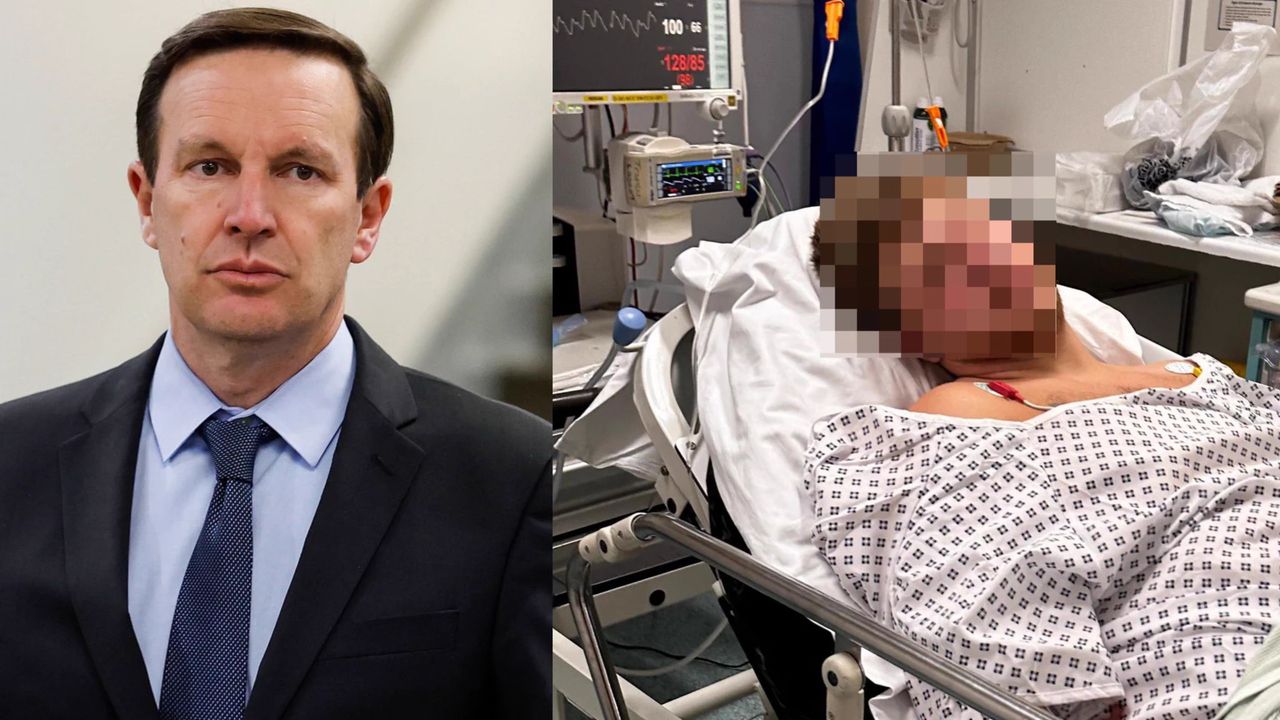
The photograph shows Chris Murphy in a hospital bed after his stroke.5
This is where the post breaks. The hospital-bed half of the image is a real photograph, but not of Murphy and not from this event. Lead Stories traced it by reverse image search to a BBC article published on 17 November 2025 about a stroke patient in England; the face is pixelated, which is exactly why it can be reused without the mismatch jumping out. The post pairs it with a portrait of Murphy so the two read as one scene. No genuine photograph of Murphy in hospital has been published, and the office statement gives no image. Our own detector found no sign of AI generation, which fits: this is not a synthetic image but a real one placed in a false context. That distinction matters, because people who check only for 'AI fakeness' would pass this image as authentic and still be fooled.
What was posted
XAn X post from the account @RabbiJeffx, formatted as a breaking-news alert, claims that U.S. Senator Chris Murphy suffered a 'severe stroke' after criticising Israel over the Iran war. It attaches a composite image: a portrait of Murphy beside a pixelated hospital-bed scene, arranged to suggest the patient is the senator. The post tags @grok and asks it to 'confirm'.
“BREAKING: U.S. Senator Chris Murphy, who recently criticized Israel in the Iran war and warned of a catastrophic U.S. attack plan, suffered a severe stroke and was hospitalized. @grok confirm”
Posted on X on 1 November 2026, the day after Murphy's office announced the stroke. Lead Stories notes the account describes itself as a parody character, yet the post is laid out as a straight breaking-news item.
Who posted it
XAccount check
Estimates from public signals — account age, posting pattern, audience — not a judgement of the person behind the account, and separate from whether this post is true.
What stood out
- Account is a self-described 'memes/parody & satire' fictional character ('AM ISRAEL CHAI – Meme account... Everything is parody'), not a real rabbi or news source — automatically disqualifying as an information source.
- Multiple Lead Stories fact checks (Sept–Nov 2026) document the account fabricating fake New York Post and BBC headlines and out-of-context photos (e.g., Sen. Chris Murphy 'stroke' photo, fake BBC child-survivor story, fake antisemitic-attack staging stories).
- Signature tactic is manufacturing fake screenshots then tagging @grok with leading 'ethnicity/religious background' prompts to bait the AI into laundering the falsehood as verification.
- Account is a ban-evasion successor: X suspended @parodyjeffx, and the operator relaunched as @RabbiJeffx within ~24 hours, continuing identical content.
- Combat Antisemitism Movement research (45-day sample, Jul–Aug 2026): 94.7% of 57 posts met its antisemitism hostility threshold, ~70% antisemitic topics, 20M+ views, blood libel and dehumanizing language; four posts deleted to dodge moderation.
- OSINT investigation (GnasherJew) and Grok's own summary link the handle to a named individual in Norway with prior Holocaust-denial/antisemitic accounts; posts claim the operator faced doxxing/death threats and is part of a multi-handle network (@Parodyjeffx, @JeffreyxEpstein).
- Pacing (~1.3 posts/day) and monetization efforts (Buy Me a Coffee, later banned) suggest a human-run troll operation rather than pure automation — hence moderate, not maximal, bot score.
Signals (10)+
- Account age note
- Successor account created ~Sept 2026 after predecessor ban; under ~2 months old as of 3 Nov 2026
- Platform verified
- No
- Bio self description
- Meme account. Parody & satire. Fictional character. Everything is parody.
- Posting cadence
- ~57 posts / 45 days (~1.3/day); 358,674 avg views per post
- Follower ratio
- Views ~2x follower count, indicating viral reach
- Fact check history
- Repeated Lead Stories fact checks (Sept 24, Sept 26, Sept 28 prebunk, Oct 1, Nov 1 2026)
- Notable news coverage
- Combat Antisemitism Movement report; GnasherJew OSINT investigation; viral Grok 'one-word prompt' episode
- Ban evasion
- Yes
- Network affiliation
- Linked by OSINT to operator of suspended accounts @ParodyJeffx and @JeffreyxEpstein
- Content flags
- fabricated headlines; blood libel; Holocaust denial (prior accounts); dehumanizing language; coordinated AI-prompt manipulation
Account checked November 3, 2026, 02:45 UTC
The media
Image✓ What is genuine
Both panels are genuine photographs. The portrait is really Chris Murphy, and the hospital scene is really a stroke patient in England. The manipulation is in the pairing and the implied caption, not in the pixels.
The tells
- ●●● Strong signal The hospital-bed half is a BBC photograph from 17 November 2025 of a stroke patient in England, not Murphy and not from this event.Lead Stories
- ●●○ Supporting signal The patient's face is pixelated, which lets an unrelated photo be reused without the person being recognisable as someone else.our visual review
- ●●○ Supporting signal The two panels are different photographs spliced side by side, not a single picture of one scene.our visual review
- ●●○ Supporting signal Our detector found no sign of AI generation, which confirms the panels are real photos but says nothing about whether they belong together.our detector
Synthetic-media detector
Detector ranThe claim stands or falls on whether the media is real, so the detector ran.
Scores are the detector’s estimate for the file as uploaded. A low score does not rule out editing, a spliced caption, or footage shown out of context — those are judged above. Model v3.
How we checked the media
- Ran the image through our AI-generation and deepfake detector, which scored it as almost certainly not AI-generated, so the composite is made of real photographs rather than synthetic ones.
- Reviewed the image visually: a portrait of Murphy beside a pixelated hospital-bed scene, assembled as a single visual claim.
- Compared the hospital-bed panel against fact-checking that traced it by reverse image search to a BBC article of 17 November 2025 about a stroke patient in England.
- Checked whether the wire, CNN, NBC News or The Guardian coverage of the stroke included any hospital photograph of Murphy; none did.
Sources
8 sources reviewed- 1Sen. Chris Murphy had a stroke and is in the hospital, his office says ↗
AP News · apnews.comPrimary / fact-checkerwire + AP Fact Check (Tier A)Evidence
Carries the chief of staff's statement confirming the stroke and the transfer to Johns Hopkins.
- 2Sen. Chris Murphy hospitalized with stroke and expected to make full recovery, his team says ↗
CNN · cnn.comLow reliabilityBORDERLINE B/C — reporting w/ strong bias tag; opinion is CEvidence
Independently reports the stroke and the expectation of a full recovery.
- 3Sen. Chris Murphy hospitalized after stroke ↗
NBC News · nbcnews.comReputable outletLean LeftEvidence
Quotes the office saying Murphy is awake and alert after the stroke.
- 4Connecticut senator Chris Murphy hospitalized after stroke ↗
The Guardian · theguardian.comReputable outletLean Left (AllSides)Evidence
Adds Murphy's age, the hockey-game setting and the Johns Hopkins transfer.
- 5Fact Check: Image Does NOT Show Sen. Chris Murphy In Hospital After A Stroke -- It's Someone Hospitalized In England ↗
Lead Stories · hoax-alert.leadstories.comPrimary / fact-checkerIFCN; strong on viral/AI mediaEvidence
Traces the hospital photo to a BBC article of 17 November 2025 about a stroke patient in England and notes the account's parody description.
- 6The Lame Duck Period is Full of Peril in the War on Iran ↗
Stimson Center · stimson.orgUntiereduntiered — treated as signal only, never decisiveEvidence
Records that Murphy was briefed on the attack plans and called them 'insane'.
- 7The Iran War Might Soon Get Catastrophically Worse ↗
Jacobin · jacobin.comLow reliabilityLeft — ideological magazineEvidence
Quotes the fuller wording of Murphy's warning about escalation and the rule of law.
- 8Connecticut Sen. Chris Murphy recovering after suffering stroke, his office says ↗
WTNH News 8 · wtnh.comUntiereduntiered — treated as signal only, never decisiveEvidence
Local confirmation that Murphy is expected to make a full recovery, with no mention of severity.
Further reading
- 5Lead Stories The fact-check that traced the hospital photo to its BBC origin and explains the misattribution.
- 1AP News The clearest account of what Murphy's office actually said about the stroke.
- 6Stimson Center Records the documented Iran attack-plan remarks that the post builds on.
The full story
The kernel of truth here is solid. On Saturday 31 October 2026, Senator Chris Murphy felt numbness in his arm while at his son's hockey game. He was taken to a local hospital, where doctors found he had suffered a stroke, and he was transferred to Johns Hopkins Hospital in Baltimore. His chief of staff said he was awake and alert, responding well to treatment, and expected to make a full recovery. Colleagues from both parties sent good wishes ahead of the 3 November midterms, in which Murphy was not on the ballot. That is a real, serious, newsworthy event, and it is why the post spread.
The post built on that truth in two ways. First, it added the word 'severe', which no official account supports and which the office's own description of an alert, recovering patient works against. Second, it supplied visual proof: a hospital-bed photograph placed beside Murphy's portrait. That photograph is real, but it was published by the BBC on 17 November 2025 to illustrate a stroke patient in England, with the face pixelated. Reusing it here turns a genuine illness into a fabricated scene.
The framing around Iran is the third layer. Murphy's criticism of the briefed U.S. attack plan on Iran is genuine and documented; he called the plan 'insane' and warned of devastating escalation. The post recasts that as criticism of Israel and puts the stroke immediately after it. No source connects the two, and the post never quite says so outright. It does not have to. Ordering the sentences does the work.
The account itself describes its output as parody, yet this item is laid out as straight breaking news, complete with a tagged request for an AI assistant to 'confirm' it. That combination, a true core, a real but borrowed photo, and an insinuation carried by word order, is what makes this kind of post hard to dismiss at a glance and worth checking properly.
Kernel of truth
Chris Murphy genuinely had a stroke on 31 October 2026 and was hospitalized at Johns Hopkins, and he genuinely called the briefed U.S. attack plan on Iran 'insane'.
Timeline
November 17, 2025
The BBC publishes a photograph of a stroke patient in England, face pixelated; this is the image later reused in the post. 5Lead Stories
October 2026
Murphy, briefed on new U.S. attack plans against Iran, calls the plan 'insane' and warns of devastating escalation. 6Stimson Center
October 31, 2026
Murphy feels numbness in his arm at his son's hockey game; a stroke is diagnosed and he is transferred to Johns Hopkins. 1AP News
November 1, 2026
Murphy's chief of staff issues a statement saying he is awake and alert and expected to recover fully; the @RabbiJeffx post appears on X. 3NBC News
How it was framed
The post is built on a genuine event and genuine photographs, but the hospital image is real content from an unrelated person and place presented as Murphy after his stroke. On top of that, the word 'severe' and the ordering of the Iran remarks frame the illness in a way the sources do not support.
- “Visual proof”. A hospital-bed photograph is placed beside Murphy's portrait so the reader sees an image of a patient and reads it as the senator.
- Emotional language. The word 'severe' is added to the stroke, beyond anything in the official statement.
- Missing context. The hospital image is not credited or dated, and its origin as a BBC photo from November 2025 of a patient in England is absent.
- Borrowed authority. The post tags @grok and asks it to 'confirm', wrapping the item in the appearance of automated verification.
Posted on X by the account @RabbiJeffx on 1 November 2026, the day after Murphy's office announced the stroke. Lead Stories notes the account describes itself as a parody character.
Bias
Leans conspiracy-suggestive, anti-Israel framing. The post arranges a real senator's real hospitalization alongside his recent criticism of a U.S./Israeli Iran strike plan and an unrelated hospital photo, inviting the inference that the stroke is connected to that criticism. The 'BREAKING' format and 'severe' framing push a more alarming story than the official account supports.
Bias describes how the post frames its message — the slant of the language, selection and emphasis — and is judged separately from whether the claim is true. A true claim can still be framed with a strong slant.
How we checked
47 s- 1
Searched for coverage of Chris Murphy's health in early November 2026 and read the reports from the AP, CNN, NBC News, The Guardian and WTNH, all quoting his chief of staff's statement.
- 2
Searched for Murphy's remarks on the Iran war and the U.S. attack plan, finding them recorded by the Stimson Center and quoted by Jacobin.
- 3
Searched for fact-checks of the hospital photograph and found Lead Stories' tracing of it to a BBC article of 17 November 2025 about a stroke patient in England.
- 4
Ran the attached image through our AI-generation and deepfake detector, which scored it as not AI-generated, and reviewed the composite visually.
✓ Claim checked✓ Media checked✓ Sources checked
Why 86% confidence
HighWe are highly confident in the overall verdict because the core fact is confirmed by multiple independent newsrooms working from an official statement, and the false part, the hospital photo, is settled by a traceable reverse image search to a dated BBC original. The weaker bands sit where the evidence is genuinely thinner: the word 'severe' cannot be disproved from public statements, only shown to be unsupported, and the Israel framing rests on the limits of what the input records.
Limits. We did not open the original pages directly; our account of them rests on the search results and snippets in our record. We have no clinical information about Murphy's condition beyond the office statement, and no complete record of his statements about Israel.
What we don’t know
- The actual medical severity of the stroke, which has not been made public either way.
- Whether the account has posted similar items before, and whether this one was assembled by hand or copied from elsewhere.
- Whether Murphy has made other remarks about Israel that the post could be gesturing at; the input does not include a full record.
Spot it yourself
Find the overstatementLooks suspicious, isn’t proof
- The account presents itself as a parody character. That is a reason to slow down, not proof this particular post is false; parody accounts sometimes post accurate news.
- The all-caps 'BREAKING' and the dramatic wording are hallmarks of attention-seeking posts, but tone alone tells you nothing about whether a senator had a stroke.
- The image is a composite of two panels rather than one photograph. Plenty of real news graphics are composites, so the layout is a prompt to look closer, not a verdict.
- Tagging an AI assistant to 'confirm' looks like a gimmick, and it is, but it does not by itself make the claim wrong.
The actual evidence
- The core fact is confirmed by Murphy's chief of staff and carried by the AP, CNN, NBC News and The Guardian: he had a stroke on 31 October 2026 and was transferred to Johns Hopkins.
- The hospital-bed photo was traced by reverse image search to a BBC article of 17 November 2025 about a stroke patient in England, so it shows someone else entirely.
- The official statement describes Murphy as awake, alert and responding well, with doctors optimistic about a full recovery; no source calls the stroke 'severe'.
- The Iran remarks are real, but the documented criticism was of the U.S. attack plan, not of Israel, so the sentence order implies a connection the sources do not make.
- 1
Check whether a real photograph of the scene exists anywhere in the mainstream coverage.
Search the senator's name plus 'stroke' and look at the wire, CNN, NBC and Guardian stories. If the hospital photo were real, it would be there. It is not, which is a red flag for the attached image.
- 2
Reverse image search the hospital-bed panel, not the whole composite.
Crop out the portrait and run just the hospital scene through a reverse image search. That is how the BBC origin from November 2025 surfaces; searching the composite returns the post itself.
- 3
Read the official statement before trusting any adjective.
Find what the office actually said, here via the AP report quoting the chief of staff. Compare each descriptive word in the post, like 'severe', against it.
- 4
Look at the order of the sentences, not just the facts in them.
Ask what the post wants you to infer from putting the Iran criticism immediately before the stroke. If no source states a link, the link is the poster's, not the evidence's.
Takeaway
A post can contain several true facts and still mislead you, through one borrowed photo and one added adjective. Check the picture and the wording separately from the headline claim.
Questions people ask
Did Chris Murphy actually have a stroke?+
Yes. His chief of staff said Murphy felt numbness in his arm at his son's hockey game on 31 October 2026, was diagnosed with a stroke at a local hospital and was transferred to Johns Hopkins. The AP, CNN, NBC News and The Guardian all reported the statement. He was described as awake and alert and expected to make a full recovery.
Is the photo of Chris Murphy in a hospital bed real?+
No. The hospital-bed image is a real photograph, but it was published by the BBC on 17 November 2025 to illustrate a stroke patient in England, with the face pixelated. It was placed next to a portrait of Murphy to suggest the patient was him. Lead Stories traced it and rated the claim false.
Was the stroke 'severe'?+
No source describes it that way. The official statement stressed that Murphy was awake and alert, responding well to treatment, and that doctors were optimistic about a full recovery. A stroke is always serious, but 'severe' is the poster's word, not the office's, and it overstates what has been disclosed.
Did Murphy criticise Israel over the Iran war?+
The documented criticism was of the U.S. attack plan on Iran. Murphy was among the lawmakers briefed on the plans and called them 'insane', warning of devastating escalation. The post presents this as criticism of Israel, which goes beyond what the sources quote, and it places the remarks next to the stroke without any evidence of a link.
Why do people share posts that mix true and false details?+
A true core makes a post feel reliable and easy to pass on, so the false details travel with it. Here the hospitalisation was real and widely reported, which made the added 'severe' wording and the borrowed hospital photo far less likely to be questioned. That is why checking the picture and the adjectives separately matters.
Go deeper
- False context
- When genuine content, such as a real photo or video, is shared with a caption or setting that makes it mean something untrue.
- Reverse image search
- A tool that finds where an image has appeared before, often revealing its original date and subject.
- Composite image
- A picture made by placing two or more separate photographs side by side or together as if they were one scene.
- AI-generation detector
- A tool that estimates whether an image was made by artificial intelligence; it can spot synthetic images but not misleading pairings of real ones.
People also search for
For educators+
- The post contains three true or partly true elements and one false one. Which element would you check first, and why?
- If a post is labelled parody, should it be held to the same standard as a news account? What changes if it is formatted like breaking news?
- How would you explain to someone else that a photo can be 'real' and still be used to mislead?
About this check
- Platform
- X
- Posted by
- @rabbijeffx
- Posted
- November 2, 2026
- Age when checked
- Under 24 hours old when checked
- Where it spread
- United States
- Audience
- US audience
- Language
- EN
- Status
- ● Post is live
- Verified
- November 3, 2026, 02:46 UTC
- Published
- November 3, 2026, 02:46 UTC
Reach. 36,834 likes on the X post; Murphy stroke (31 Oct) widely reported
This verdict was generated with AI from the sources shown. AI can make mistakes — check the sources before relying on it.
Check anything yourself, in seconds.
Share any social post or video to What the Fact and get the verdict, the confidence, and the receipts.