Did the RNC send Michigan county clerks a letter about split-ticket voting?
Were Michigan voters given false information on Election Day 2026 that they could not split their ticket between parties?
Can't verify
The letter and its legal claim are real; the reports of misleading instructions are not independently confirmed.
The image is a genuine RNC Counsel's Office letter dated 3 November 2026, sent to Michigan county clerks and reported the same day. Its legal point is correct: Michigan's constitution lets voters pick a straight-party ticket and still vote for individual candidates of another party. Only the letter's claim that voters were 'reportedly' told otherwise is unverified.
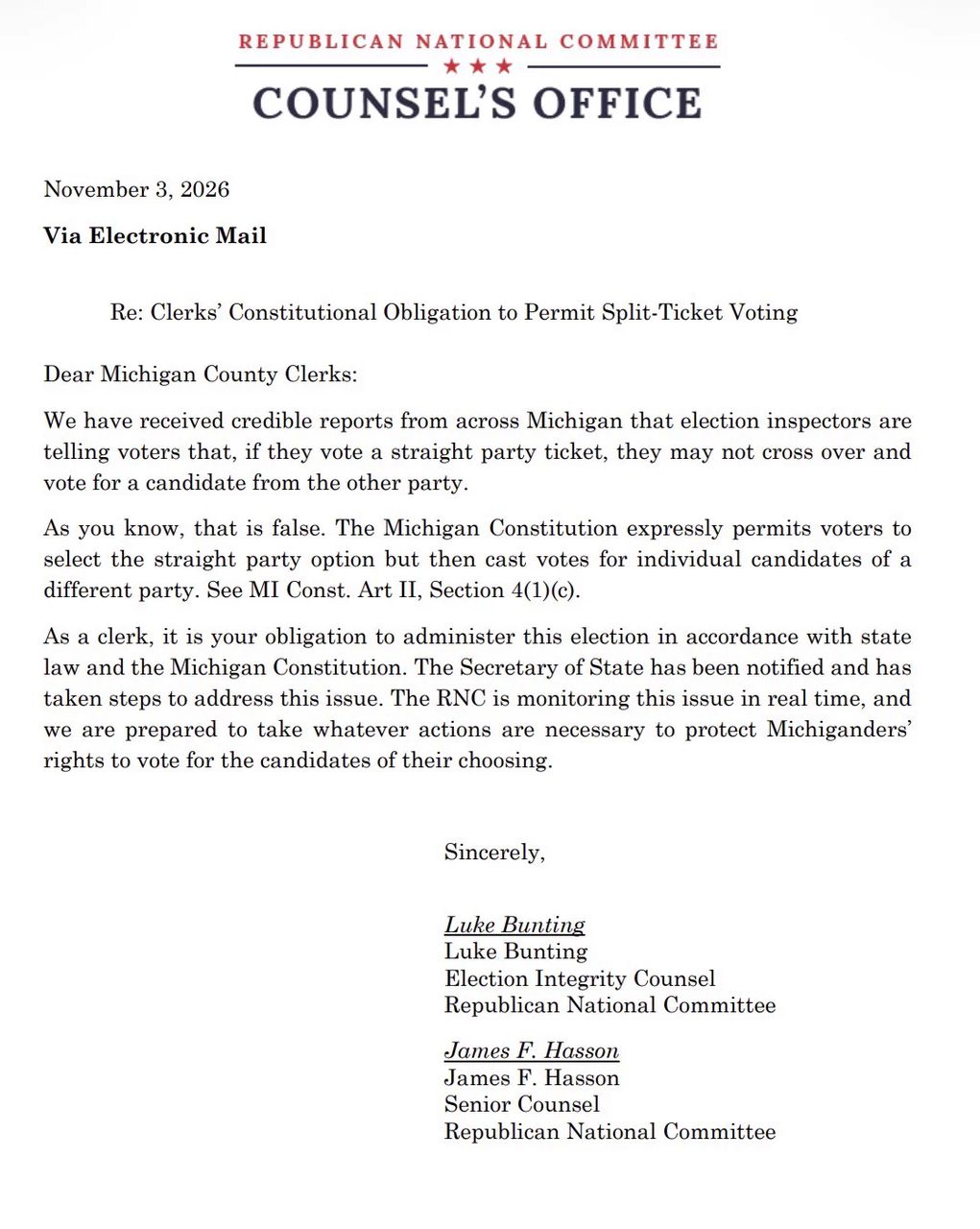 Genuine
Claims
✓ 2 trueThe Republican National Committee sent Michigan county clerks a letter putting them on notice to follow the law on split-ticket voting.12
The decisive point is that the letter exists, is dated 3 November 2026, and is what the post says it is. It was published by the RNC's own account, which is the body that wrote it; the same day, Sinclair's National Desk reported that the RNC 'announced that it sent a letter to county clerks in Michigan to put them on notice to follow the law' (source 1), and Blaze Media reproduced the Bunting/Hasson letter text word for word (source 2). Those two reports are not fully independent of each other or of the RNC — both draw on the RNC's announcement — so they confirm that the letter was sent and what it says, not that every assertion inside it is true. What a reader should weigh is the distinction: the existence and content of the letter are firmly established; the letter's own characterisation of events on the ground is a separate question, handled below.
Michigan law expressly permits a voter to select the straight-party option and then cast a vote for individual candidates of a different party (Mich. Const. Art. II, Sec. 4(1)(c)).345
“The Michigan Constitution expressly permits voters to select the straight party option but then cast votes for the individual candidates of a different party.”
This is the strongest-supported element in the post, because it can be checked against the law itself rather than against anyone's account of events. Article II, Section 4(1)(c) of the Michigan Constitution provides that the voter 'may vote a split or mixed ticket' (sources 3 and 4, two separate legal databases carrying the same text). The Michigan Bureau of Elections ballot guidance, as republished by a township clerk, states that a voter 'may vote a straight ticket AND vote for individual candidates of your choice' (source 5). The letter's citation is accurate, and the underlying rule is clear. The legal databases are independent of the RNC and of each other, which is why this claim carries the highest confidence on the page. Nothing in the post overstates what the law allows.
Voters are reportedly being given false information by election inspectors about split-ticket voting.67
“Voters are reportedly being given FALSE information about split-ticket voting.”
This is the part of the post that cannot be confirmed, and the word 'reportedly' is doing a lot of work. The letter attributes the allegation to 'credible reports from across Michigan' received by the RNC (sources 1 and 2). Separately, the NRSC said it sent cease-and-desist letters to four county clerks — Kent, Shiawassee, Wayne and Monroe — making a similar allegation that inspectors were telling voters their ballots would be rejected (sources 6 and 7). Those are partisan bodies describing reports they say they received; neither the Michigan Secretary of State nor any court is cited as having substantiated how widespread the instructions were, or whether they were given at all. Some official response may exist but we could not confirm it in what we found. The claim is therefore neither confirmed nor refuted: it rests on the RNC's and NRSC's own accounts, which trace to the same side of the dispute.
Still open: Did any Michigan election official, court or independent observer confirm that inspectors told voters they could not split their ticket, and if so in which counties and how many voters were affected?
What was posted
XThe RNC's election-integrity account on X posted an image of a letter on Republican National Committee Counsel's Office letterhead, dated 3 November 2026 and signed by two RNC lawyers, addressed to Michigan county clerks. The post's caption tells readers the RNC is putting clerks 'on notice to follow the law' because voters are 'reportedly being given FALSE information about split-ticket voting.' The image is the evidence for the claim, so the post and its central assertion are the same object.
“🚨 MICHIGAN: THE RNC IS PUTTING COUNTY CLERKS ON NOTICE TO FOLLOW THE LAW. Voters are reportedly being given FALSE information about split-ticket voting. Michigan law is clear. We’re taking action 🎯”
Posted by @RNCVoteProtect, the Republican National Committee's own election-integrity account, on Michigan's general election day. The letter is the RNC's own document, so the post is the author publishing its own correspondence.
Who posted it
XAccount check
Estimates from public signals — account age, posting pattern, audience — not a judgement of the person behind the account, and separate from whether this post is true.
What stood out
- Handle @RNCVoteProtect is the widely-cited official X account of the Republican National Committee's Election Integrity operation (display name 'RNC Election Integrity'), referenced by name in RNC/press releases and by third-party press since at least March 2024.
- Mainstream outlets (WJLA/National Desk, WSBT, LaPatilla) quote its Election Day 2026 posts almost verbatim, and its scam-text voter alert was corroborated by local reporting on Fulton County, GA — evidence of genuine operational sourcing rather than content-farm behaviour.
- The account functions as a party communications channel: posts are partisan-framed ('Democrats will do ANYTHING to gain power'), amplify RNC litigation wins, and occasionally make assertive claims about local officials ('reportedly being given FALSE information') that rest on unspecified reports.
- Its parent 'election integrity' programme has a documented history of being built on contested/unsubstantiated widespread-fraud premises (Washington Post reporting on the RNC internal report), so reliability as a neutral information source is limited even though the account is genuine.
- No profile metadata was supplied (no follower count, creation date, bio, verification flag) and no recent posts in the sample, so identity could only be corroborated externally, not from the profile itself.
- High-volume, rapid-release posting during the Nov 3 2026 election cycle is consistent with an official rapid-response comms team, not automated amplification.
Signals (10)+
- Account identity
- Official RNC Election Integrity account
- Handle corroborated by
- gop.com press releases; RedState; Townhall; JustTheNews (2024); WJLA / National Desk; WSBT; LaPatilla
- Earliest cited activity
- 2024-03-28
- Posting cadence
- Burst/rapid-response during election week 2026
- Follower ratio
- Unknown (not provided)
- Organisation type
- Political party committee (partisan primary source)
- Notable news coverage
- Quoted by national and local outlets during Nov 2026 midterms
- Fact check history
- No direct fact-checks of the account found; parent programme criticised for premises rooted in unsubstantiated fraud claims
- Conflict of interest
- Advances the electoral interests of its own party; claims are self-serving
- Impersonation indicators
- None found
Account checked November 4, 2026, 03:06 UTC
The media
Image✓ What is genuine
The letter itself is genuine: it is the RNC Counsel's Office document dated 3 November 2026, signed by Election Integrity Counsel Luke Bunting and Senior Counsel James F. Hasson, and its legal citation is correct.
The tells
- ●●○ Supporting signal Our detector scored the image as not AI-generated with very high confidence (ai_generated score about 0.0009; not_ai_generated about 0.999), with no deepfake signal.our detector
- ●●● Strong signal The letter's quoted passage matches word for word what independent outlets reported the RNC sent, including the constitutional citation.our visual review and sources 1 and 2
- ●●● Strong signal The document is internally consistent: letterhead, date, two named signatories with titles, a coherent legal argument, and a real constitutional provision cited accurately.our visual review
- ●●○ Supporting signal No compositing, garbled text or generative artifacts are visible.our visual review
Synthetic-media detector
Detector ranThe claim stands or falls on whether the media is real, so the detector ran.
Scores are the detector’s estimate for the file as uploaded. A low score does not rule out editing, a spliced caption, or footage shown out of context — those are judged above. Model v3.
How we checked the media
- Reviewed the image visually: it is a document scan on RNC Counsel's Office letterhead, dated 3 November 2026, signed by two named RNC lawyers, with coherent body text.
- Compared the passages visible in the image with the text quoted by Sinclair's National Desk (source 1) and reproduced by Blaze Media (source 2).
- Checked the legal citation in the letter against the Michigan Constitution (sources 3 and 4) and Bureau of Elections ballot guidance (source 5).
- Ran our AI-image detector (Hive v3) on the image.
Sources
7 sources reviewed- 1Voting delayed in different Michigan counties due to malfunctioning tabulators ↗
WJLA (Sinclair National Desk) · wjla.comUntiereduntiered — treated as signal only, never decisiveEvidence
Sinclair's National Desk reported the same day that the RNC announced it had sent Michigan county clerks a letter putting them on notice to follow the law, quoting a passage matching the image.
- 2Last-minute dirty tricks: Michigan voters reportedly being told they can't split their ticket ↗
Blaze Media · theblaze.comUntiereduntiered — treated as signal only, never decisiveEvidence
Blaze Media reproduced the Bunting/Hasson letter text word for word, confirming the document's authenticity.
- 3Michigan Constitution Article II, Section 4 — Place and manner of elections ↗
Justia Law · law.justia.comUntiereduntiered — treated as signal only, never decisiveEvidence
The Michigan Constitution states that the voter 'may vote a split or mixed ticket.'
- 4MI CONST Art. 2, § 4 ↗
Westlaw · content.next.westlaw.comUntiereduntiered — treated as signal only, never decisiveEvidence
A second legal database carries the same constitutional text, including the straight-party option and the split-or-mixed-ticket right.
- 5Options for Straight Ticket, Split Ticket and Mixed Ticket Voting ↗
Highland Township Clerk (Michigan Bureau of Elections guidance) · highlandtwp.netUntiereduntiered — treated as signal only, never decisiveEvidence
Michigan Bureau of Elections ballot guidance says a voter may select the straight-party option and then vote for individual candidates of another party.
- 6NRSC Sends Cease and Desists to County Clerks Misinforming Michigan Voters ↗
NRSC · nrsc.orgUntiereduntiered — treated as signal only, never decisiveEvidence
The NRSC said inspectors were reported as falsely telling voters their ballots would be rejected if they split their ticket.
- 7Cease-and-desist letters sent to 4 Michigan clerks accused of spreading misinformation ↗
The National Desk (Sinclair) · thenationaldesk.comUntiereduntiered — treated as signal only, never decisiveEvidence
Sinclair's National Desk reported the NRSC sent cease-and-desist letters to four named Michigan county clerks over alleged misinformation.
Further reading
- 3Justia Law The constitutional text the letter cites, so readers can check the legal point themselves.
- 5Highland Township Clerk (Michigan Bureau of Elections guidance) Ballot guidance that shows in plain language how straight-ticket and split-ticket voting works in Michigan.
- 7The National Desk (Sinclair) Reporting on the NRSC's cease-and-desist letters, which shows the separate allegation from the same side of the dispute.
The full story
The kernel of truth here is straightforward: on Michigan's 3 November 2026 general election day, the Republican National Committee's Counsel's Office really did send county clerks a letter about split-ticket voting. The letter, signed by Luke Bunting and James F. Hasson, said the RNC had received reports that election inspectors were telling voters they could not select a straight-party ticket and then cross over to another party. The letter said those instructions are wrong under Article II, Section 4(1)(c) of the Michigan Constitution, which allows split and mixed tickets, and warned that the RNC was monitoring and prepared to act.
That legal point is solid, and it is independently checkable. The Michigan Constitution says a voter 'may vote a split or mixed ticket,' and the Michigan Bureau of Elections ballot guidance says a voter 'may vote a straight ticket AND vote for individual candidates of your choice.' So the letter's core instruction to clerks is accurate.
What makes the post harder to rate is the next layer. The allegation that inspectors were giving voters false information is attributed to 'credible reports from across Michigan' — the RNC's own sourcing. The NRSC separately said it sent cease-and-desist letters to four county clerks, Kent, Shiawassee, Wayne and Monroe, making a similar allegation. Those are serious claims, but they come from partisan bodies and we found no confirmation from the Michigan Secretary of State or any court about how widespread the instructions were, or whether they occurred. The post mixes a verified document and a verified legal rule with an unverified account of what happened at polling places — which is why it reads as stronger than the evidence behind that third element supports.
Kernel of truth
The RNC did send Michigan county clerks a letter on 3 November 2026, and its statement of Michigan's split-ticket law is accurate.
Timeline
November 3, 2026
The RNC Counsel's Office sends Michigan county clerks a letter on split-ticket voting, signed by Luke Bunting and James F. Hasson. 1WJLA (Sinclair National Desk)
November 3, 2026
Sinclair's National Desk reports the RNC announced the letter, and Blaze Media reproduces its text the same day. 2Blaze Media
November 3, 2026
The NRSC says it sent cease-and-desist letters to four Michigan county clerks — Kent, Shiawassee, Wayne and Monroe — over alleged misinformation. 7The National Desk (Sinclair)
How it was framed
The post is a real document from the RNC making a legally accurate point, but its framing claim that voters were being given false information rests on reports the RNC says it received, which we could not independently confirm. That fits the unverifiable category rather than fabricated or manipulated content, because the central object — the letter — is genuine and its legal citation is correct.
- Ongoing-threat framing. The caption opens with '🚨 MICHIGAN' and says voters are 'reportedly being given FALSE information,' framing an active problem at the polls.
- Borrowed authority. The letter is on RNC Counsel's Office letterhead and cites the Michigan Constitution by article and section, lending legal weight to the post.
- Missing context. The caption says voters are 'reportedly' being given false information without saying who reported it; the letter attributes it only to 'credible reports from across Michigan.'
- Us vs. them. The post is from a party election-integrity account and frames the issue as the RNC putting clerks 'on notice' to follow the law.
Posted on X by @RNCVoteProtect, the Republican National Committee's election-integrity account, on Michigan's 3 November 2026 general election day. The letter is the RNC's own document, and the post is the author publishing its own correspondence.
Bias
Leans Republican partisan framing. The post comes from the RNC's own election-integrity account and is framed as the party 'taking action' on election day in a race where Democratic cross-over votes for Republican Senate candidate Mike Rogers were being discussed. The legal content of the letter, however, is accurate and matches state constitutional text and official ballot instructions, so the slant is in framing and motive rather than in the facts asserted.
Bias describes how the post frames its message — the slant of the language, selection and emphasis — and is judged separately from whether the claim is true. A true claim can still be framed with a strong slant.
How we checked
53 s- 1
Searched for the letter using its subject, date and signatories, and reviewed the sources that came up.
- 2
Reviewed the image visually and compared its text with the passages quoted by Sinclair's National Desk and Blaze Media.
- 3
Checked the letter's constitutional citation against two legal databases and the Michigan Bureau of Elections ballot guidance.
- 4
Ran our AI-image detector on the image.
- 5
Searched for any confirmation or denial from the Michigan Secretary of State or any court about the allegation that inspectors gave misleading instructions.
✓ Claim checked✓ Media checked✓ Sources checked
Why 40% confidence
LowWe rate the headline as CANT_VERIFY with a LOW band because the post combines a verified document and a verified legal rule with an unverified allegation. The letter's existence and its legal point are supported at HIGH confidence by independent sources and by the law itself. The allegation about what voters were told rests only on the RNC's and NRSC's own accounts, and we found no confirmation from election officials or courts. That gap is why the overall picture cannot be rated higher.
Limits. We were not able to open and read the original pages behind all search results, and we did not find a statement from the Michigan Secretary of State or any court confirming or denying the allegation about inspectors. We could not verify how widespread any misleading instructions were.
What we don’t know
- Whether election inspectors actually told any voters they could not split their tickets, and if so in which counties and how many voters were affected.
- Whether the Michigan Secretary of State or any court has responded to the RNC letter or the NRSC cease-and-desist letters.
- Whether there is any independent record — poll-worker accounts, voter complaints, local reporting — beyond the RNC and NRSC's own statements.
Spot it yourself
Why we can't tellLooks suspicious, isn’t proof
- The post comes from a partisan election-integrity account on election day. That is a reason to check carefully, but it proves nothing about whether the letter is real or the legal point is correct.
- The alarmist tone — '🚨 MICHIGAN', 'FALSE information', 'We're taking action 🎯' — is designed to grab attention, but tone is not evidence.
- The word 'reportedly' hides the source. That is a fair reason to ask who reported it, but it does not by itself make the letter fake.
- A clean, official-looking document can be fabricated as easily as a messy one. A professional layout is not proof either way.
The actual evidence
- The letter's text matches word for word what Sinclair's National Desk and Blaze Media reported the RNC sent the same day.
- The legal citation checks out against the Michigan Constitution and the Bureau of Elections ballot guidance.
- Our AI-image detector found no sign of generation, and the document is internally consistent — letterhead, date, two named signatories, a real provision cited correctly.
- The unverified part is separate: the claim that voters were being given false information rests on the RNC's own reports, not on a named official or court finding.
- 1
Check the document against independent reporting
Search the letter's date, the names of its signatories and a distinctive phrase. If real outlets quote the same text the same day, the document is likely genuine.
- 2
Check the legal citation against the law itself
Look up the constitutional article and section the letter cites. A citation that checks out tells you the legal point is accurate, even if the surrounding claim is not.
- 3
Separate the document from the allegation
Ask which part of the post is verified. A real letter proves the letter exists; it does not prove what the letter says happened.
- 4
Look for the official response
Check the state election authority and local courts for any statement on the allegation. If the people who run elections have not confirmed it, treat it as unverified.
Takeaway
A real document can carry an unverified claim, and a partisan source can be right about a law. Separate what you can check — dates, names, legal text — from what you cannot, and let each part stand on its own evidence.
Questions people ask
Is the RNC letter to Michigan county clerks real?+
Yes. The letter is dated 3 November 2026, signed by RNC Election Integrity Counsel Luke Bunting and Senior Counsel James F. Hasson, and was published by the RNC's own account. Sinclair's National Desk and Blaze Media reported it and quoted its text the same day. Our image detector also found no sign it was generated or altered.
Does Michigan law really allow split-ticket voting?+
Yes. Article II, Section 4(1)(c) of the Michigan Constitution says a voter 'may vote a split or mixed ticket,' and the Michigan Bureau of Elections ballot guidance says a voter 'may vote a straight ticket AND vote for individual candidates of your choice.' The letter's legal point is accurate.
Were Michigan voters really told they couldn't split their ticket?+
We could not confirm that. The RNC letter says it received 'credible reports from across Michigan,' and the NRSC said it sent cease-and-desist letters to four county clerks. But those are the partisan bodies' own accounts, and we found no confirmation from the Michigan Secretary of State or any court about how widespread the instructions were, or whether they occurred.
Why did WTF rate this CANT_VERIFY if the letter is real?+
Because a post can be partly verified and partly not. The letter and its legal point are confirmed. The claim that voters were being given false information rests on reports the RNC says it received and we could not independently check. We rate the overall post on its weakest central element, not its strongest.
What does 'reportedly' mean in a post like this?+
It means the poster is relying on reports they have not identified. Sometimes those reports are solid; sometimes they are anonymous or come from one side of a dispute. A reader should ask who reported it and whether anyone independent has confirmed it before treating the claim as fact.
Go deeper
- Split-ticket voting
- Voting for candidates of different parties in the same election, such as picking a straight-party ticket and then crossing over for one office.
- Cease-and-desist letter
- A formal written demand telling someone to stop an activity the sender says is unlawful, often used as a first step before legal action.
- AI-image detector
- A tool that analyses an image for patterns associated with generative AI; a high score for 'not AI-generated' supports authenticity but is not proof on its own.
- Unverifiable claim
- A statement that cannot be confirmed or refuted with the evidence available, often because it relies on anonymous or one-sided reports.
People also search for
For educators+
- The letter is real and its legal citation is accurate, yet the post still cannot be fully verified. How should a reader weigh a post that is partly confirmed and partly not?
- Why does it matter that the claim about inspectors comes from the RNC and NRSC rather than from an election official or court? What would count as independent confirmation?
- If you were an election official in one of the four counties named by the NRSC, what would you want to see before responding publicly?
About this check
- Platform
- X
- Posted by
- @rncvoteprotect
- Posted
- November 3, 2026
- Age when checked
- Under 24 hours old when checked
- Where it spread
- United States
- Audience
- US audience
- Language
- EN
- Status
- ● Post is live
- Verified
- November 4, 2026, 03:07 UTC
- Published
- November 4, 2026, 03:07 UTC
Reach. 6,894 likes on RNC post (syndication, 2026-11-04); The Blaze article 'Last-minute dirty tricks' 3 Nov; RNC says it put county clerks on notice
This verdict was generated with AI from the sources shown. AI can make mistakes — check the sources before relying on it.
Check anything yourself, in seconds.
Share any social post or video to What the Fact and get the verdict, the confidence, and the receipts.