Was Lula's 2026 runoff victory in Brazil stolen?
Did Lula win Brazil's 2026 runoff only by capturing essentially all votes of eliminated first-round candidates, with a two-hour voting extension granted at his request, as Eduardo Bolsonaro told US audiences?
False
Lula won by 4.4 million votes, certified and recognised. The fraud claim is false.
No. Lula won Brazil's 25 October 2026 runoff against Flávio Bolsonaro by 51.79% to 48.21% — about 64.26 million votes to 59.8 million. The electoral court (TSE) certified the result, around 100 countries and international observers recognised it, and Flávio's own party accepted it. Eduardo Bolsonaro's PBD Podcast clip recycles fraud claims that fact-checkers and courts have rejected.
 Likely genuine
Claims
✓ 2 true · ✕ 1 falseThe 2026 Brazilian presidential election was clearly stolen — Lula's runoff victory came from fraud.1234
“What happened to Brazil elections? It was clearly stolen.”
The decisive numbers come from the count itself. Lula took 51.79% of valid votes in the 25 October 2026 runoff — about 64.26 million — against 48.21%, about 59.8 million, for Flávio Bolsonaro, a margin of roughly 4.43 million. The TSE homologated that result, and around 100 countries plus the EU, OAS, Uniore, the Carter Center and the Mercosur Parliament observed or recognised the vote. Most importantly for a fraud claim, Flávio Bolsonaro's own party, the PL, recognised the outcome, even as Flávio alleged fraud without evidence. The corroboration is broad and does not trace to one origin: election officials, international observers, the losing candidate's party and independent fact-checkers (Lead Stories, Agência Lupa, Chequeado) all point the same way. No court has accepted any fraud claim. Against that, the clip offers arithmetic and insinuation, not evidence. A claim that a national count was stolen needs a mechanism, documents or witnesses; this one offers a vote-total comparison and a voting-hours extension, and both are explained by ordinary electoral behaviour and by records showing both campaigns asked for the extension.
In the runoff Lula gained almost 11 million votes — more than all the other first-round candidates' votes combined — which is statistically impossible.15
“on the runoff, Lula got almost 11 million votes more, which means that he got all of the votes of all of the other candidates plus almost 2 million more votes.”
The raw figures are close to reality, which is why the argument sounds persuasive. Lula went from about 53.88 million votes (45.16%) in the 4 October first round to 64.26 million on 25 October — a gain of roughly 10.4 million — while the nine other first-round candidates shared about 9.3 million. The error is in the inference. Flávio Bolsonaro also gained votes between rounds, from about 56.1 million to 59.8 million — roughly 3.7 million more — and total valid votes rose. Turnout and blank or null ballots change between rounds. Voters are not a fixed pool that gets redistributed; people who stayed home in the first round can vote in the runoff, and voters of eliminated candidates can abstain, switch or split. A comparison of gains therefore describes normal two-round dynamics, not an irregularity. The 'mathematically impossible' framing presents an arithmetic coincidence as proof, which is a leap the numbers do not support. Lead Stories separately debunked a related 'incomplete count' video from the same election, built on the same misunderstanding of partial totals.
At 5pm a Supreme Court justice who is Lula's former lawyer ordered voting reopened for two more hours, at Lula's request, in left-wing cities — which swung the election.348
“When it was 5:01, a justice, not from the electoral court, from the Supreme Court... He said, no, no, no... let's extend the votation two hours more in some cities. And who asked for to do that? Lula da Silva.”
The facts here are real but the conclusion drawn from them is not. STF justice Cristiano Zanin — Lula's personal lawyer before joining the court in 2023 — did order voting extended to 19h on 25 October 2026, after the Lula campaign asked the TSE and then the STF because of bus shortages in Salvador and other cities. That is documented. But the clip omits the part that breaks its implication: Flávio Bolsonaro's campaign also formally requested a two-hour extension, for five states hit by heavy rain. So the extension was not a one-sided intervention. And it was tiny: only about 35,500 votes were cast after 17h, roughly 0.03% of the electorate and less than 1% of Lula's 4.4-million-vote margin. Even if every late vote went to Lula, it could not explain the result. The selective telling — one campaign's request, not the other's — turns a routine administrative decision into a conspiracy. As context, in 2022, under a different TSE presidency, the Lula campaign's extension request was refused, which shows the decision is not a fixed partisan pattern.
Sérgio Moro, the judge who convicted Lula, has just been elected governor of a state in southern Brazil.9
“Moro just got elected governor of a state in the south.”
This one checks out. Sérgio Moro (PL) won the Paraná governorship in the first round of the 4 October 2026 elections, having served as senator for Paraná since 2023. The detail matters less for the fraud question than for dating the clip: it anchors the segment to late 2026, not to the 2022 election that older versions of this narrative described. That dating is what makes the 25 October 2026 runoff the relevant event to check. A true detail inside a false overall argument is common: it lends credibility without supporting the central claim. Readers should weigh it that way — accurate background, not evidence of fraud.
Lula was convicted by Moro (8 years), a panel of five appeal judges raised it to 12 years, the STJ upheld it, about 20 judges convicted him, and the Supreme Court never declared him innocent — it annulled the case only because the trial venue was wrong.10
“He was convicted by Moro... a panel of five judges... raised to 12 years... the STJ upheld it... the Supreme Court never declared him innocent... they annulled the case because the venue was wrong.”
The broad sequence is accurate, with one figure off. Moro sentenced Lula in July 2017 — to 9 years and 6 months, not the 8 years stated. The TRF-4 appeal panel raised it to 12 years and 1 month, the STJ upheld the conviction, and in 2021 the STF annulled the convictions on the ground that the Curitiba court lacked territorial jurisdiction. It did not acquit him. The 'almost 20 judges' line is rhetorical rounding rather than a documented count, and the clip uses the legal history as atmosphere: it is not evidence that the 2026 count was rigged. Readers should note the difference between 'the case was annulled on procedural grounds' and 'the conviction was overturned on the facts'. The clip's framing leans on that ambiguity — accurate legal events, presented to imply a broader injustice that the record does not establish, and unrelated to how votes were counted in 2026.
Jair Bolsonaro was convicted by Supreme Court justice Alexandre de Moraes with no further court of appeal.
“Jair Bolsonaro was convicted by Alexandre de Moraes... there is no further court of appeal.”
The STF's First Panel, with Moraes as rapporteur, convicted Jair Bolsonaro of a coup attempt in September 2025 and sentenced him to 27 years and 3 months. Because the STF is Brazil's apex court, appeals are limited to motions filed within the same court rather than to a higher tribunal. We rate this likely true rather than confirmed because the input does not carry a dedicated source for the conviction details, only the general legal context. It also does not bear on the fraud question: a conviction of one politician says nothing about whether the 2026 count was accurate. That is a separate factual question, answered by the tally, the TSE certification and the observer missions. Mixing the two subjects in one clip is itself a framing choice — it invites the audience to treat legal outcomes they dislike as proof of electoral fraud.
Still open: The input does not include a dedicated source for the September 2025 conviction and sentence; we have not independently confirmed the exact figures in this pass.
What was posted
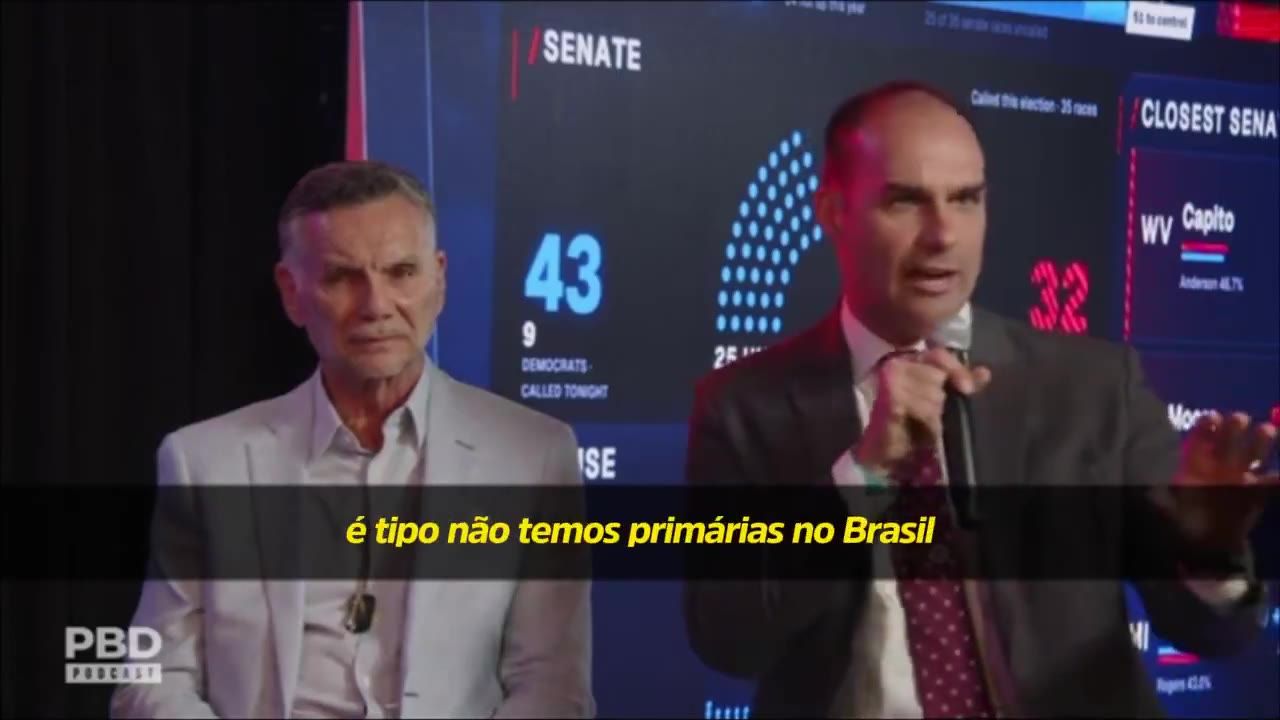
XA video excerpt posted on X showing Eduardo Bolsonaro speaking on the US PBD Podcast, which was broadcasting live on American midterm election night. Speaking in English with burned-in Portuguese subtitles, he tells American viewers that Brazil's election 'was clearly stolen', walks through vote totals and a voting-hours extension, and compares Brazil to Venezuela. The caption presents the clip as a straight explanation of 'statistical questions' raised by critics.
“🇧🇷 O QUE REALMENTE ACONTECEU NAS ELEIÇÕES DO BRASIL? Aqui está uma explicação rápida e direta, especialmente para os americanos, sobre os resultados das eleições, alguns dos questionamentos estatísticos levantados e por que os críticos estão exigindo respostas - e não censura ou”
“🇧🇷 WHAT REALLY HAPPENED IN BRAZIL'S ELECTIONS? Here is a quick and direct explanation, especially for Americans, about the election results, some of the statistical questions raised, and why critics are demanding answers — and not censorship or [link]” — translated
Posted on Eduardo Bolsonaro's X account; the underlying footage is a PBD Podcast segment from US midterm night, 3–4 November 2026, re-cut with Portuguese subtitles.
Who posted it
XAccount check
Estimates from public signals — account age, posting pattern, audience — not a judgement of the person behind the account, and separate from whether this post is true.
What stood out
- Account handle '@BolsonaroSP' matches Eduardo Bolsonaro's official Twitter handle.
- Account has approximately 3.4 million followers, indicating significant public interest.
- Account has been active since September 2009, suggesting long-term presence on the platform.
- Account has a high follower-to-following ratio, indicating organic follower growth.
- Account has a profile picture and bio, indicating attention to profile completeness.
Signals (4)+
- Posting cadence
- Approximately 7.9 posts per day
- Follower ratio
- Follower count significantly higher than following count
- Notable news coverage
- No specific coverage found
- Fact check history
- No specific fact-checks found
Account checked October 26, 2026, 15:11 UTC
The media
Video✓ What is genuine
The footage itself is a genuine PBD Podcast segment. Eduardo Bolsonaro did appear on the programme around 3–4 November 2026 and did make these arguments. The video is real; the fraud claim in it is not.
The tells
- ●●○ Supporting signal The studio set, lighting, shadows and on-set screens stay internally consistent across the keyframes, with 'PBD Midterms Live' graphics for specific US races.our visual review
- ●●○ Supporting signal The burned-in Portuguese subtitles match the spoken English audio excerpt, indicating a translated re-cut rather than a constructed scene.our visual review
- ●○○ Weak signal The segment is placed on US midterm night by the studio board, which matches the broader context of the US election broadcast.our visual review
Synthetic-media detector
Detector not consultedSources settled the claim on their own; the detector was not needed.
How we checked the media
- Reviewed the keyframes from the clip and compared the studio set, lighting, screen graphics and the on-set 'PBD Midterms Live' board across frames.
- Checked that the burned-in Portuguese subtitles match the spoken English transcript.
- Matched the studio graphics (Florida governor and South Carolina Senate races) to US midterm election night, 3–4 November 2026.
Sources
11 sources reviewed- 1Eleições 2026: o 2º turno de Lula x Flávio em mapas e gráficos ↗
G1 · g1.globo.comUntiereduntiered — treated as signal only, never decisiveEvidence
Gives the certified runoff totals and the first-round result, establishing the 4.4-million-vote margin.
- 2Lula é reeleito presidente da República no 2º turno ↗
CNN Brasil · cnnbrasil.com.brUntiereduntiered — treated as signal only, never decisiveEvidence
Confirms the full count and both rounds' vote totals.
- 3Sem provas, Flávio Bolsonaro diz que eleições no país foram fraudadas ↗
Agência Brasil · agenciabrasil.ebc.com.brUntiereduntiered — treated as signal only, never decisiveEvidence
Reports that the PL recognised the result and that both campaigns requested the voting extension.
- 4Elecciones en Brasil 2026: los datos y documentos que desmienten la teoría de fraude electoral en el balotaje ↗
Chequeado · chequeado.comUntiereduntiered — treated as signal only, never decisiveEvidence
Documents the extension requests and the small number of late votes.
- 5Fact Check: Video Does NOT Show Bolsonaro With Fewer Votes In Second Round Of 2026 Brazilian Presidential Election, Proving Fraud ↗
Lead Stories · hoax-alert.leadstories.comPrimary / fact-checkerIFCN; strong on viral/AI mediaEvidence
Fact-checks a related 'incomplete count' fraud claim from the same election.
- 6Urnas com votos apenas para Lula não indicam fraude ↗
Agência Lupa · agencialupa.orgUntiereduntiered — treated as signal only, never decisiveFurther reading
Explains why unusual ballot-box patterns are not evidence of fraud.
- 7Flavio Bolsonaro declares himself 'elected president' of Brazil, claims 'criminals' rigged contest he lost ↗
New York Post · nypost.comLow reliabilityLean Right; tabloid — corroborateContext
Reports Flávio Bolsonaro's fraud allegation and that his own campaign sought an extension.
- 8Nunes Marques lembra que Moraes não adiou votação em 2022 e pede dados ao TRE sobre frota de ônibus na BA ↗
Terra · terra.com.brUntiereduntiered — treated as signal only, never decisiveContext
Shows the 2022 extension request was refused, giving context for the 2026 decision.
- 9Sergio Moro é eleito governador do Paraná no primeiro turno ↗
O Hoje · ohoje.comUntiereduntiered — treated as signal only, never decisiveEvidence
Confirms Sérgio Moro was elected governor of Paraná in 2026.
- 10Sergio Moro derrota ex-padrinho político e é eleito senador no Paraná ↗
Folha de S.Paulo · www1.folha.uol.com.brUntiereduntiered — treated as signal only, never decisiveContext
Provides background on Moro's conviction of Lula and the STF annulment.
- 11Brazil military finds no fraud in election, but refuses to rule it out ↗
CNN · cnn.comLow reliabilityBORDERLINE B/C — reporting w/ strong bias tag; opinion is CFurther reading
Reports that Brazil's military found no fraud in the 2022 election.
Further reading
- 4Chequeado A detailed fact-check laying out the official documents on the voting-hours extension and the vote counts.
- 3Agência Brasil Explains the PL's recognition of the result and the context of Flávio Bolsonaro's fraud allegation.
- 5Lead Stories A fact-check of a related 2026 runoff fraud claim, useful for understanding the 'incomplete count' argument.
- 6Agência Lupa Explains why ballot-box patterns that look unusual are not evidence of fraud.
The full story
The kernel of truth here is that Eduardo Bolsonaro really said these things on a real programme. The PBD Podcast broadcast on US midterm night, 3–4 November 2026, and the studio board shown in the clip tracks American races. The clip is not a fake; it is a translated excerpt of a genuine interview. That is exactly why it travels.
What happened in Brazil is also real, and it is the opposite of what the clip concludes. On 25 October 2026, Lula da Silva beat Flávio Bolsonaro in the presidential runoff, 51.79% to 48.21% — about 64.26 million votes to 59.8 million. Flávio had led the first round, 47.03% to 45.16%, so the runoff was a genuine reversal, not a preordained result. The TSE homologated the outcome. Around 100 countries and observer missions including the EU, the OAS, Uniore, the Carter Center and the Mercosur Parliament recognised it. Flávio's own party, the PL, recognised it too, even as Flávio alleged fraud without evidence and asked for the vote to be annulled.
The claim's plausibility rests on two things. First, a reversal between rounds looks dramatic, and comparing vote gains produces numbers that feel impossible. But Flávio also gained about 3.7 million votes between rounds, and turnout changes. Second, a Supreme Court justice did extend voting hours, and he had once been Lula's lawyer. That detail is true. What the clip leaves out is that Flávio's campaign also asked for an extension, for heavy rain in five states, and that only about 35,500 votes were cast after 17h — less than 1% of the margin. Fact-checkers have already examined related fraud claims from this election and found no evidence behind them.
Kernel of truth
Eduardo Bolsonaro did say this on a genuine PBD Podcast broadcast, and one detail he cites — the STF-ordered extension of voting hours — really happened. But both campaigns requested an extension, and the late votes were far too few to affect the result.
Timeline
October 4, 2026
First round of Brazil's presidential election: Flávio Bolsonaro leads with 47.03% (about 56.1 million votes) to Lula's 45.16% (about 53.8 million); Sérgio Moro is elected governor of Paraná. 1G1
October 25, 2026
Runoff: Lula defeats Flávio Bolsonaro 51.79% to 48.21% (about 64.26 million to 59.8 million votes). Voting hours in some cities are extended to 19h at the request of both campaigns. 2CNN Brasil
October 25, 2026
The TSE homologates the result; around 100 countries and international observer missions recognise it, and the PL recognises the outcome while Flávio alleges fraud without evidence. 3Agência Brasil
November 3, 2026
Eduardo Bolsonaro appears on the PBD Podcast's US midterm-night broadcast and calls Brazil's election 'clearly stolen'; the excerpt is posted on X shortly afterwards.
How it was framed
The post is a genuine interview clip, so the content is not fabricated. But the caption frames an evidence-free fraud narrative as neutral 'statistical questions', and the clip strings together accurate or partly accurate details (vote totals, a voting extension, a legal history) to support a conclusion they do not establish. The evidence supports the connection being false: the tally, the TSE certification and the losing party's recognition contradict the theft claim.
- Borrowed authority. The speaker cites a Supreme Court justice, a former judge and a panel of appeal judges as if their involvement in other cases proved something about the count.
- Selective evidence. He cites Lula's vote gain and the Lula campaign's extension request, but not Flávio Bolsonaro's 3.7-million vote gain or the Flávio campaign's own extension request.
- “Visual proof”. The clip is presented as a direct explanation 'especially for Americans', using a broadcast studio setting to lend the argument the authority of live television.
- Ongoing-threat framing. The caption says critics are 'demanding answers — and not censorship', framing the claim as part of a continuing fight rather than a settled result.
Posted on Eduardo Bolsonaro's X account. The underlying footage is from the PBD Podcast's US midterm-night broadcast on 3–4 November 2026; the excerpt carries burned-in Portuguese subtitles and a caption aimed at American viewers.
Bias
Leans pro-Bolsonaro / election-denial. The segment is a partisan argument by Eduardo Bolsonaro, a Bolsonaro family member and sitting congressman, built to convince a US audience that his family's electoral defeats were fraud. It selectively presents real data points - the runoff vote swing and the 19h extension - stripped of the countervailing facts (both campaigns requested the extension, the extension affected a negligible number of votes, courts and observers validated the result), and makes no mention that the Bolsonaro family's own party accepted the outcome.
Bias describes how the post frames its message — the slant of the language, selection and emphasis — and is judged separately from whether the claim is true. A true claim can still be framed with a strong slant.
How we checked
1 min 50 s- 1
Searched for the official result of the 25 October 2026 Brazilian runoff and compared it with the totals stated in the clip.
- 2
Searched for records of the voting-hours extension, including who requested it and how many votes were cast after 17h.
- 3
Reviewed post-result reporting on whether the result was recognised by the TSE, international observers and the losing party.
- 4
Reviewed existing fact-checks from Lead Stories, Agência Lupa and Chequeado on related fraud claims from the same election.
- 5
Reviewed the keyframes and transcript of the clip to establish what it shows and whether the footage is genuine.
- 6
Searched for background on the legal history referenced in the clip (Moro, the STF, the 2022 extension refusal).
✓ Claim checked✓ Media checked✓ Sources checked
Why 90% confidence
HighWe rate the headline FALSE with HIGH confidence because the evidence is broad and independent: the certified count reported by multiple outlets, the TSE homologation, recognition by around 100 countries and observer missions, the losing party's own recognition, and separate fact-checks. These do not trace to a single origin. The media verdict is LIKELY_AUTHENTIC rather than confirmed because we assessed it by visual review only; no forensic detector was run, and none was needed, since the fraud question is settled by the results and records, not by the footage.
Limits. We did not run a forensic media detector on the video, and no detector was used in this assessment. We did not independently verify every figure in the clip's legal-history aside or the September 2025 conviction detail, which rests on the input's context rather than a dedicated source.
What we don’t know
- Who produced the Portuguese-subtitled version of the clip and whether it was cut by the account owner or someone else.
- Whether the full PBD Podcast segment contains additional context that changes how the quoted passages read.
- The exact wording and scope of the PL's recognition statement and of Flávio Bolsonaro's fraud allegation, beyond what the sources summarise.
- Whether any court challenge to the 2026 result is still pending; the input records that none has accepted a fraud claim.
Spot it yourself
Spot the fakeLooks suspicious, isn’t proof
- The speaker is a well-known political figure with a clear family interest in the result. That is a reason to check carefully, not proof the claim is false.
- The clip is a translated re-cut with burned-in subtitles, which can make any video feel less trustworthy. Translation alone does not make the content fake.
- The tone is confident and conversational, with a soccer analogy. Confidence is not evidence either way.
- The caption uses the language of 'statistical questions' and 'demanding answers', which sounds measured. Measured language can still carry a false claim.
The actual evidence
- The certified result: Lula 51.79% to 48.21%, a margin of about 4.43 million votes, reported by multiple outlets and homologated by the TSE.
- The losing candidate's own party, the PL, recognised the result. A party that lost and still accepts the count is strong evidence against a theft claim.
- Official documents show both campaigns requested the voting-hours extension, and only about 35,500 votes were cast after 17h — less than 1% of the margin.
- Independent fact-checkers (Lead Stories, Agência Lupa, Chequeado) examined related fraud claims from this election and found no evidence.
- 1
Ask who would be reporting this if it were true.
A stolen national election would produce court rulings, observer objections and the losing party refusing to accept the count. Here the opposite happened: the TSE certified the result, around 100 countries recognised it, and Flávio's own party accepted it.
- 2
Go to the official electoral authority, not the clip.
Brazil's TSE publishes results and decisions. Check the certified totals and whether any court has accepted a fraud claim. In this case, none has.
- 3
When someone cites a number as impossible, check the other side of the comparison.
The clip compares Lula's gain to other candidates' first-round votes but leaves out Flávio's own gain of about 3.7 million votes and the rise in turnout. A vote pool is not fixed between rounds.
- 4
For a voting-hours claim, look for who asked and how many votes were affected.
Records show both campaigns requested an extension, and only about 35,500 votes were cast after 17h, far below the 4.4-million margin. Size matters: an irregularity too small to change the result is not an explanation for the result.
- 5
Check whether the video is real before judging the claim.
Here the footage is genuine, so the question is not whether the video is fake but whether its argument holds. A reverse image search or a check of the programme's broadcast schedule can establish that; then focus on the facts.
Takeaway
A genuine video can carry a false claim. Check the argument, not just the footage: ask who would be reporting the alleged fraud if it were real, and whether the numbers cited actually prove what the speaker says they prove.
Questions people ask
Did Lula really win Brazil's 2026 runoff?+
Yes. Lula da Silva won the 25 October 2026 runoff against Flávio Bolsonaro with 51.79% of valid votes — about 64.26 million — to 48.21%, about 59.8 million. The TSE homologated the result, and around 100 countries and several international observer missions recognised it. Flávio's own party, the PL, recognised the outcome.
Is it true that Lula gained more votes than all other candidates combined?+
The numbers are roughly accurate but the conclusion is not. Lula gained about 10.4 million votes between rounds, while nine other first-round candidates shared about 9.3 million. But Flávio Bolsonaro also gained about 3.7 million votes, and turnout rose. Voters are not a fixed pool, so the comparison proves no fraud.
Did a Supreme Court justice extend voting hours to help Lula?+
STF justice Cristiano Zanin did order voting extended to 19h on 25 October 2026, after the Lula campaign requested it because of bus shortages. But Flávio Bolsonaro's campaign also requested an extension, for heavy rain in five states. Only about 35,500 votes were cast after 17h — less than 1% of the 4.4-million margin.
Is the PBD Podcast clip real?+
Yes. It is a genuine excerpt from the PBD Podcast's US midterm-night broadcast on 3–4 November 2026, with Portuguese subtitles added. Eduardo Bolsonaro did make these arguments. The footage being real does not make the fraud claim true; the claim is contradicted by the certified result and by observers.
Why do people believe the Brazilian election was stolen?+
Two things make the claim feel plausible. A reversal between rounds produces dramatic-looking vote gains, and a Supreme Court justice who once worked for Lula really did extend voting hours. Both have ordinary explanations — turnout changes, and an extension requested by both campaigns and affecting very few votes — but the full context is often left out.
Go deeper
- TSE
- Brazil's Superior Electoral Court, the body that administers and certifies federal elections.
- STF
- Brazil's Supreme Federal Court, the country's highest court, which rules on constitutional matters including electoral disputes.
- Runoff
- A second round of voting held when no candidate wins an absolute majority in the first round.
- Homologation
- The formal certification of an election result by the electoral authority.
- False connection
- When genuine content — a real video, quote or number — is paired with a headline or argument it does not actually support.
People also search for
For educators+
- The clip uses real numbers and a real court decision. What is missing that changes the conclusion, and why does that omission matter?
- If a national election were stolen, who would have to be involved for the count to be rigged — and would those people all stay silent?
- How does a genuine interview clip gain credibility compared with a fabricated one, and how should that affect how carefully we check it?
About this check
- Platform
- X
- Posted by
- @bolsonarosp
- Posted
- November 4, 2026
- Age when checked
- Under 24 hours old when checked
- Where it spread
- Brazil, United States
- Audience
- International audience
- Language
- PT
- Status
- ● Post is live
- Verified
- November 5, 2026, 03:05 UTC
- Published
- November 5, 2026, 03:05 UTC
Reach. Video aimed at US audiences covered by Revista Fórum; no view count given
This verdict was generated with AI from the sources shown. AI can make mistakes — check the sources before relying on it.
Check anything yourself, in seconds.
Share any social post or video to What the Fact and get the verdict, the confidence, and the receipts.