Did Nigel Farage correctly predict Republicans would avoid a midterm rout?
Did Elon Musk put £450 million of his own money into the 2026 US midterms, as Nigel Farage said on GB News?
Misleading
Real broadcast, but the forecast it pushes was refuted by the results within hours.
The video is a real GB News segment from US midterm election day, 3 November 2026. But Nigel Farage's on-air prediction that Republicans would beat the polls and avoid a rout was wrong: Democrats won both the House and Senate within hours. He also wrongly attributed a 98% Clinton win probability to the New York Times.
 Genuine
Claims
✓ 4 true · ✕ 2 falseThe Republican Party is better organised than in 2016, the polls' consensus is wrong, and Trump is not going to get 'smashed' - expect a surprise on election night.1239
“So I don't go with that consensus that Trump's going to get absolutely smashed. ... I do believe that Republicans have got an amazing get-out-the-vote campaign and that people might be in for a surprise.”
This is the claim the clip is built around, and the election results settled it within hours. Farage argued that a superior Republican turnout operation and a weak Democratic leadership would confound the polls. Instead, the Associated Press called the House for the Democrats at 1:26am on 4 November, and Democrats also took the Senate, flipping at least seven Senate seats including in Texas, Kansas, Iowa, Ohio, Maine and the Carolinas. Even Republicans described the result as a 'blue tsunami' or, in one governor's words, close to an 'extinction-level event' for the party. The evidence here is unusually strong because it is not a matter of interpretation: the outcome is a public, independently recorded fact, reported by multiple outlets, including the BBC and Roll Call. Farage's forecast was not merely optimistic; it was contradicted by the count. A reader should weigh that the clip was posted before the results were known, but the claim is presented as a confident prediction that the polls were wrong, and that prediction failed.
In 2016 the New York Times said there was a 98% probability that Hillary Clinton would win.78
“And don't forget, when Trump won in '16, the New York Times said there was a 98% probability of Hillary winning the election.”
This is a checkable factual error inside an otherwise statistics-heavy argument. The New York Times' Upshot model gave Hillary Clinton about 84-85% on election day 2016; the Times told readers in its Upshot feature that she had an 84% chance. The 98% figure belonged to a different forecaster: the Huffington Post model put Clinton at 98.2%. A separate near-99% figure came from Princeton's Sam Wang, which Knowles correctly cites later in the same segment. So Farage has taken a real number from the 2016 forecasting debate and attached it to the wrong outlet. The error matters because it is used rhetorically to suggest the establishment media were wildly overconfident, when the Times' own model was notably more cautious than others. The evidence is direct: the Times' own reporting on its 2016 figure, and a Newsweek round-up that lists both the HuffPost 98.2% and Times 85% numbers side by side.
Harvard's model currently puts the Democrats' chance of winning the House at 96%.6
“We're seeing similar numbers come out of Harvard today, 96% chance that the House goes to the Democrats.”
Unlike Farage's forecast, this specific number from Knowles holds up. A Harvard University election model updated on election day 2026 gave Democrats a 96% chance of taking the House and 78% for the Senate, projecting about 242 House seats. The Hill reported the figures directly. The claim is included here because it is the strongest counterweight in the clip: Knowles, the conservative guest, is the one accurately citing a model that predicted a Democratic win, while Farage dismisses the consensus. That makes the clip more interesting than a simple partisan broadcast: it contains accurate statistics used in service of a forecast that failed. The evidence is a single news report citing the model, so we rate confidence HIGH but note the figure rests on one outlet's account of the model rather than the model's own published page.
The Princeton University consensus in 2016 put Hillary Clinton's chances at 99%.
“It's true back in 2016, there was a consensus at Princeton University that there was a 99% chance that Hillary would win.”
Knowles is broadly right here, though the wording 'consensus at Princeton University' overstates it. The Princeton Election Consortium, run by Sam Wang, gave Clinton roughly a 99% chance of winning in 2016. That figure was widely cited afterwards as the high-water mark of mistaken forecasting. It was one academic forecaster's model, not a university-wide consensus, but the number and the attribution are essentially accurate. We rate confidence MODERATE rather than HIGH because the input does not include a direct source for the Princeton figure; the finding rests on the general record of the 2016 forecasts rather than a specific document we opened. A reader should treat the 99% number as broadly correct but the phrase 'consensus at Princeton' as loose language.
Still open: We did not open a Princeton Election Consortium page directly; the 99% figure is supported by the general record of 2016 forecasting rather than a specific linked document.
Elon Musk has put roughly $450 million of his own money into helping Republicans' turnout operation.45
“And Elon Musk hasn't chucked in $450 million of his own money just for fun. He's helping and working on that.”
Farage's figure is close to the mark. Federal Election Commission-based tallies reported by The New York Times put Musk's 2026 cycle spending at about $445.6 million, and The Guardian reported at least $446 million to Republican-aligned Super PACs, including roughly $216 million through his America PAC field operation. That made him the cycle's largest donor, outdoing his own 2024 spending of nearly $290 million. The claim that he spent the money 'not for fun' but to help Republican turnout is an interpretation, but the underlying dollar figure is accurate. Two independent outlets, one of them the Times' donor analysis, support the number. The evidence is strong on the amount; the motive framing is Farage's characterisation, not a fact we can verify.
The United States is at war with Iran and the resulting fuel prices and cost of living are weighing on voters.13
“Yes, of course, the Iran War, the cost of diesel and gas, all of those things are not good.”
This is the part of Farage's argument that the post-election coverage confirms. The war with Iran, fuel prices and inflation were central drivers of the Republican defeat, according to BBC and Roll Call coverage, and Trump himself acknowledged that gas prices contributed. Farage raises these as headwinds that Republicans nonetheless overcame; in reality they were among the reasons they did not. The facts he cites are accurate; the conclusion he draws from them is where the clip misleads. The evidence is independent and multi-outlet: BBC World Service attributes the Democratic success to voter anger about the Iran war and the economy, and BBC live coverage and Roll Call describe the same drivers.
What was posted
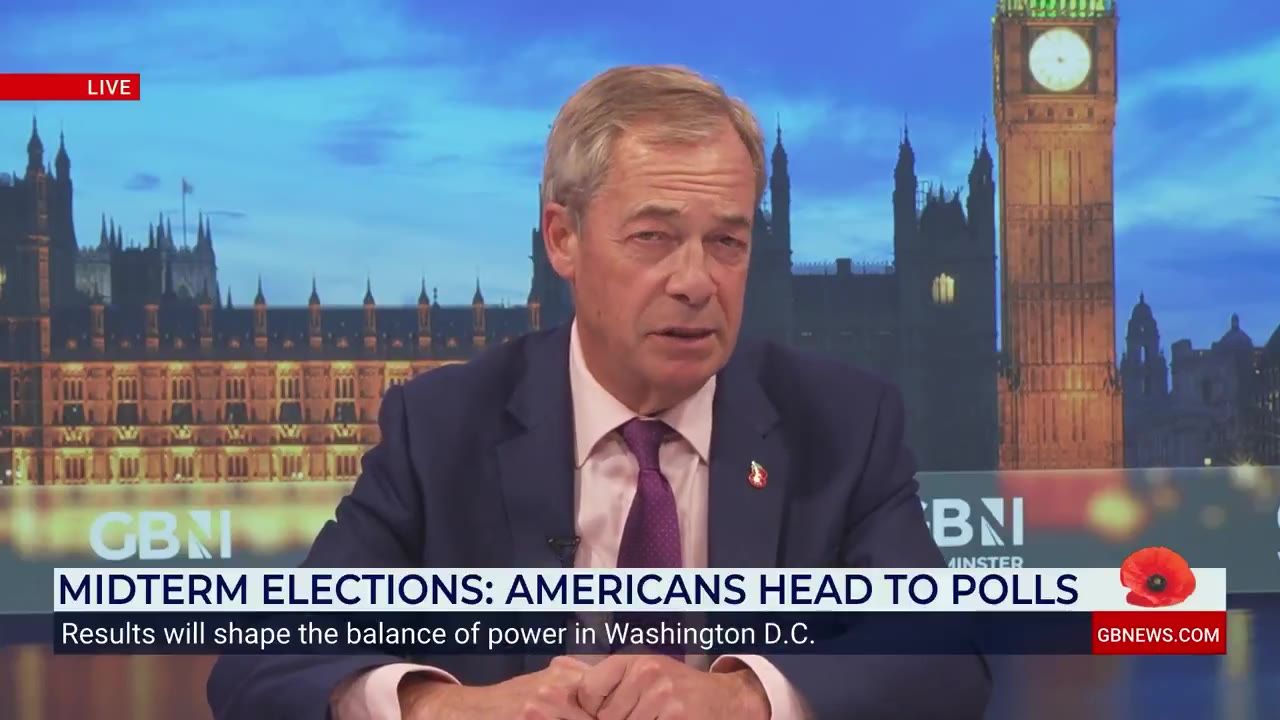
XGB News posted a clip of a live segment from US midterm election day in which Nigel Farage argues that the poll consensus is wrong and Republicans will avoid a heavy defeat. He is joined remotely by Daily Wire host Michael Knowles, who warns that Harvard's model gives Democrats a high chance of winning the House. The clip asks viewers to accept Farage's forecast that the results will surprise the pollsters.
“"I don't go with the consensus that Trump is going to get smashed." Nigel Farage is joined by the Daily Wire's Michael Knowles as Americans head to the polls in the midterm elections.”
Posted by the verified GB News account on X. The clip is a live two-way between Farage in the Westminster studio and Knowles on a remote feed.
Who posted it
XAccount check
Estimates from public signals — account age, posting pattern, audience — not a judgement of the person behind the account, and separate from whether this post is true.
What stood out
- Handle @GBNEWS is the official X account of GB News, the UK TV news channel launched in June 2021 — a genuine, identifiable media organisation, not an impersonator.
- Recent posts (Nov 2026) are standard newsroom output: programme promos (Freeview 236 / Sky 512), clip quotes from ministers, and links to gbnews.com stories — consistent with a professional editorial feed.
- High-frequency, multi-post-per-day cadence driven by a social/publishing team; institutional account rather than a single identifiable person.
- No automated/coordinated inauthentic behaviour found; the account is a mainstream broadcaster with an Ofcom licence and published editorial leadership.
- Reliability caveats: Ofcom found the Mark Steyn programme (Apr 2022) materially misleading on COVID vaccine data (Rule 2.2 breach); GB News was fined £100,000 for due-impartiality breaches over the Rishi Sunak 'People's Forum' (2024).
- Critics and campaign groups (Reliable Media, Hacked Off-adjacent voices, MPs) accuse it of airing unchallenged climate scepticism, unverified immigration crime 'statistics' (Nov 2025) and an unchallenged Trump interview (Nov 2025); Ofcom declined to investigate several of these.
- Note: GB News partly won a 2025 High Court judicial review overturning two Ofcom impartiality breaches, so regulatory findings are contested.
- Metadata supplied is largely null (no bio, follower count, creation date) and isplatformverified=false, which is likely a scraping artefact; the handle is nonetheless cited as official on gbnews.com and third-party pages.
- MBFC rates GB News 'biased and questionable' with numerous failed fact checks — low credibility as a source even though the account is real and human-run.
Signals (8)+
- Account type
- Institutional / broadcaster
- Account age note
- Channel launched 13 June 2021; X handle active since around then
- Posting cadence
- High, multiple posts per day (newsroom feed)
- Follower ratio
- Unknown (follower_count null); ~620k+ X followers reported in 2024
- Notable news coverage
- Yes — extensive UK press coverage of Ofcom rulings, £100k fine, High Court judicial review win (2025)
- Fact check history
- Ofcom Rule 2.2 breach (Mark Steyn COVID data, Mar 2023); £100,000 Ofcom fine for impartiality breach (2024, partly overturned on JR); repeated climate/immigration accuracy complaints; MBFC 'questionable'
- Affiliation
- GB News Limited, UK; politically right-leaning, strong Reform UK / Trump-world ties
- Recent topics
- UK politics, Treasury/minister clips, crime stories, programme promotion
Account checked November 5, 2026, 03:10 UTC
The media
Video✓ What is genuine
The video is an unaltered GB News live broadcast. Farage and Knowles really said what the transcript records, and the broadcast context is real; the problem lies in the accuracy of the forecast, not in the footage.
The tells
- ●●● Strong signal Continuous studio broadcast with authentic GB News graphics and a live two-way between Farage in Westminster and Knowles on a remote feed.our visual review
- ●●● Strong signal Lip-sync is consistent with the transcript and facial expressions are natural throughout the clip.our visual review
- ●●○ Supporting signal No compositing, frame-duplication or morphing artefacts were visible in the keyframes.our visual review
Synthetic-media detector
Detector not consultedThe media is incidental to the claim; the detector was not needed.
How we checked the media
- We reviewed the keyframes and compared them with the transcript; the scene is a continuous GB News studio broadcast with authentic channel graphics and a live remote feed.
- We checked the transcript against the visuals for lip-sync and continuity, and found no compositing or morphing artefacts.
- We confirmed the segment's date from the on-screen caption and the posting context, which match US midterm election day, 3 November 2026.
Sources
9 sources reviewed- 1Democrats flip House as Republicans confront 'blue tsunami' ↗
Roll Call · rollcall.comUntiereduntiered — treated as signal only, never decisiveEvidence
Establishes that the AP called the House for Democrats at 1:26am on 4 November, refuting Farage's forecast.
- 2Live updates: 2026 US midterm elections and results ↗
BBC · bbc.comReputable outletCenter; light bias tagEvidence
Records that Democrats took back Congress and that Republicans described the result in extreme terms.
- 3Democrats storm to success in US midterm elections ↗
BBC World Service · bbc.co.ukReputable outletCenter; light bias tag (BBC Verify is Tier A)Evidence
Explains the drivers of the Democratic win, including the Iran war and the economy.
- 4Meet the Megadonors Pumping $2 Billion Into the 2026 Midterms ↗
The New York Times · nytimes.comReputable outletLean Left (AllSides) — distinguish news/opinionEvidence
Provides the FEC-based figure of $445.6 million for Musk's Republican spending.
- 5Elon Musk's nearly half a billion dollars in midterms spending was a flop ↗
The Guardian · theguardian.comReputable outletLean Left (AllSides)Evidence
Corroborates Musk's spending at at least $446 million and compares it with 2024.
- 696 percent chance Democrats take House, 78 percent for Senate: Harvard model ↗
The Hill · thehill.comReputable outletCenterEvidence
Reports the Harvard model's 96% House and 78% Senate forecasts.
- 7The Polls Weren't as Wrong as Trump Thinks ↗
Newsweek · subscribe.noothan.newsweek.comUntiereduntiered — treated as signal only, never decisiveEvidence
Lists the HuffPost 98.2% and New York Times 85% figures for 2016.
- 8Want to Know What America's Thinking? Try Asking ↗
The New York Times · nytimes.comReputable outletLean Left (AllSides) — distinguish news/opinionEvidence
Shows the New York Times' own Upshot figure of 84% for Clinton in 2016.
- 9US Democrats take House majority, wresting control from Republicans ↗
Anadolu Ajansı · xn--anadoluajans-d5b.com.trUntiereduntiered — treated as signal only, never decisiveEvidence
Independently confirms that Democrats won control of the House.
Further reading
- 1Roll Call Roll Call's account of the AP call gives the precise timing and scale of the Democratic House win.
- 3BBC World Service BBC World Service explains the drivers of the Democratic success, including the Iran war and the economy.
- 7Newsweek Newsweek's comparison of the 2016 forecasting numbers shows where the 98% and 85% figures came from.
- 4The New York Times The New York Times' donor analysis provides the FEC-based figure for Musk's spending.
The full story
The clip is not a fake. It is a genuine GB News segment broadcast on 3 November 2026, as Americans voted in the midterms. Nigel Farage, in the Westminster studio, argued that the polls were wrong and that Republicans would avoid a heavy defeat. He pointed to the party's turnout operation and to Elon Musk's spending, and he argued that the Democrats lacked a clear leader. Michael Knowles, joining remotely from the Daily Wire, was more cautious, noting that Harvard's model gave Democrats a 96% chance of taking the House.
The problem is that Farage's central prediction did not survive the night. The Associated Press called the House for the Democrats at 1:26am on 4 November, and Democrats also flipped the Senate, gaining at least seven seats including in Texas, Kansas, Iowa, Ohio, Maine and the Carolinas. The result was widely attributed to voter anger over the war with Iran, fuel and grocery prices, and immigration. Even Republican voices described it as a 'blue tsunami'.
What makes the clip misleading rather than simply wrong is the way real numbers are arranged around a false conclusion. The Musk spending figure is close to the mark; the Harvard 96% figure is accurate; the Iran war and fuel prices are real. But Farage uses those facts to dismiss the consensus, and he misattributes a 98% Clinton probability to the New York Times when the Times' own model had her at about 85%. The clip was posted before the results were known, so it is not a fabricated account of the results. It is a real broadcast whose central forecast was refuted within hours.
Kernel of truth
The segment is a genuine GB News broadcast from election day, and several statistics cited in it - Musk's roughly $450 million in spending, Harvard's 96% House forecast, the Iran war and fuel prices - are accurate.
Timeline
November 3, 2026
US midterm elections are held; GB News broadcasts the Farage-Knowles segment and posts it to X.
November 4, 2026
The Associated Press calls the House for the Democrats at 1:26am, hours after Democrats are projected to win the Senate. 1Roll Call
How it was framed
The footage is genuine and the statistics are mostly accurate, but they are arranged to support a forecast - that Republicans would beat the polls - that the results refuted within hours. Farage also attributes a real 2016 forecasting number to the wrong outlet, adding false context to an otherwise factual segment.
- Selective evidence. Farage cites Musk's spending and the 2016 forecasting errors as reasons to doubt the polls, but does not mention the Harvard model Knowles raises until Knowles himself does.
- Borrowed authority. "Political science, get-out-the-vote campaign, data" and the reference to the New York Times are used to lend weight to the forecast.
- Us vs. them. "You've got a new hard-left coming in" frames the contest as a choice between a organised right and a radical left.
- “Visual proof”. The clip presents the two presenters on screen as if their on-air confidence is itself evidence that the polls are wrong.
Posted by the verified GB News account on X. The clip is a live two-way between Farage in the Westminster studio and Knowles on a remote feed from the Daily Wire.
Bias
Leans pro-Republican. The segment is a conservative-framed discussion in which the GB News host argues Republicans will beat expectations; the counter-view is supplied by another conservative, Michael Knowles, so the slant is present but limited.
Bias describes how the post frames its message — the slant of the language, selection and emphasis — and is judged separately from whether the claim is true. A true claim can still be framed with a strong slant.
How we checked
1 min 6 s- 1
We searched for the 2026 midterm election results and found multiple independent reports that Democrats won both the House and the Senate.
- 2
We searched for Elon Musk's 2026 midterm spending and found FEC-based tallies of about $445-446 million from The New York Times and The Guardian.
- 3
We searched for the New York Times' 2016 Clinton probability and found the Times' own 84% figure and a Newsweek comparison with the HuffPost 98.2% figure.
- 4
We searched for the Harvard model forecast and found The Hill's report of a 96% chance for the House and 78% for the Senate.
- 5
We reviewed the video keyframes and transcript to confirm the footage is an unaltered GB News broadcast.
✓ Claim checked✓ Media checked✓ Sources checked
Why 82% confidence
HighWe rate confidence HIGH because the central claim is settled by the public election results, which are reported by multiple independent outlets including the BBC, Roll Call and Anadolu. The statistical claims are supported by named sources or, in the case of the Princeton figure, by the general record of 2016 forecasting, which is why that one is MODERATE rather than HIGH.
Limits. We did not open the original Harvard model page or the Princeton Election Consortium page directly; those figures rest on news reports. We also could not verify Farage's motive or whether he believed the forecast at the time.
What we don’t know
- Whether Farage or GB News corrected or revisited the forecast after the results were known.
- The exact wording of the Harvard model's methodology and whether its 96% figure was updated during the day.
- Whether the clip was edited from a longer segment; the transcript suggests a continuous live two-way, but we did not review the full broadcast.
Spot it yourself
Spot the fakeLooks suspicious, isn’t proof
- The partisan source: GB News and Nigel Farage are openly pro-Brexit and pro-Republican, which may make viewers distrust the clip, but a partisan source can still broadcast accurate statistics.
- The confident, conversational tone: Farage sounds certain, but confidence is not evidence and often accompanies wrong forecasts.
- The use of numbers: citing '96%' and '98%' can look like precision, but numbers can be accurate or misattributed regardless of how authoritative they sound.
- The live broadcast format: a real studio segment with graphics can feel authoritative, but production quality says nothing about whether the forecast is right.
The actual evidence
- The election results: the AP called the House for Democrats at 1:26am on 4 November, and Democrats also took the Senate, directly contradicting Farage's forecast.
- The New York Times' own 2016 figure: the Times' Upshot gave Clinton about 84-85%, not 98%, which exposes the misattribution.
- The FEC-based tallies of Musk's spending: about $445-446 million, which makes Farage's figure roughly correct and shows the clip mixes accurate and inaccurate claims.
- The Harvard model figure: 96% for the House, as reported by The Hill, which confirms Knowles' number and shows the clip contains accurate counter-evidence.
- 1
Check the date of the broadcast against the date of the results.
Look for the on-screen caption or posting date, then search for the official result. In this case the clip was posted on election day, before the count, which explains why the forecast is speculative rather than a description of the result.
- 2
Ask who would be reporting the result if the forecast were right.
If Republicans had avoided a rout, the AP, BBC, Reuters and major US outlets would all have reported it. Search for the official call and compare it with the forecast.
- 3
Check the specific statistics against the original source.
For the 2016 Clinton probability, search for the New York Times Upshot figure and compare it with the Huffington Post and Princeton numbers. For Musk's spending, search FEC-based tallies.
- 4
Separate the accurate parts from the conclusion.
List each factual claim in the clip and check it individually, then ask whether the conclusion follows even if the facts are right. Here several facts are accurate but the forecast still failed.
Takeaway
A clip can be genuine, well-produced and full of accurate statistics and still mislead if those facts are arranged around a false conclusion. Check the conclusion against the outcome, not just the individual numbers.
Questions people ask
Did Nigel Farage predict Republicans would avoid a midterm rout?+
Yes. In the GB News segment he said he did not go with the consensus that Trump was going to get smashed, and argued Republicans were better organised than in 2016. The prediction was wrong: Democrats won the House and Senate within hours.
Did the New York Times really give Hillary Clinton a 98% chance in 2016?+
No. The New York Times' Upshot model gave Clinton about 84-85% on election day 2016. The 98% figure belonged to the Huffington Post model, and a near-99% figure came from Princeton's Sam Wang. Farage attributed the wrong outlet's number to the Times.
Was Elon Musk's midterm spending really about $450 million?+
Yes, close to it. FEC-based tallies reported by The New York Times and The Guardian put Musk's 2026 cycle spending at about $445-446 million, including roughly $216 million through his America PAC field operation, making him the cycle's largest donor.
Was the Harvard model's 96% forecast accurate?+
The figure itself was accurately reported: a Harvard model gave Democrats a 96% chance of taking the House and 78% for the Senate on election day 2026. The forecast proved broadly correct, as Democrats won both chambers.
Is the video itself fake or AI-generated?+
No. The video is an unaltered GB News live broadcast. The keyframes show a continuous studio segment with authentic graphics and a live remote feed. The problem is the accuracy of the forecast, not the footage.
Go deeper
- Misleading content
- Genuine information used in a way that frames an issue or person falsely, often by arranging accurate facts around a false conclusion.
- False context
- Genuine content shared with false contextual information, such as the wrong date, place or source.
- FEC
- The Federal Election Commission, the US agency that regulates campaign finance and publishes donor data.
- Super PAC
- A US political action committee that can raise and spend unlimited sums from donors, subject to disclosure rules.
- Upshot
- The New York Times' data-driven polling and forecasting feature, which published election probability estimates.
People also search for
For educators+
- The clip contains several accurate statistics. Does that make the overall segment more or less trustworthy? Why?
- If a broadcaster makes a confident prediction that turns out to be wrong, should that be treated as misinformation? What if it was made before the result was known?
- How would you check the claim about the New York Times' 2016 forecast using primary sources?
About this check
- Platform
- X
- Posted by
- @gbnews
- Posted
- November 3, 2026
- Age when checked
- 1–2 days old when checked
- Where it spread
- United Kingdom, United States
- Audience
- International audience
- Language
- EN
- Status
- ● Post is live
- Verified
- November 5, 2026, 03:12 UTC
- Published
- November 5, 2026, 03:12 UTC
Reach. Farage mocked for his election prediction; HuffPost UK piece with replies embedded; Guardian sketch
This verdict was generated with AI from the sources shown. AI can make mistakes — check the sources before relying on it.
Check anything yourself, in seconds.
Share any social post or video to What the Fact and get the verdict, the confidence, and the receipts.