Did Rice Krispies change their recipe and lose their snap, crackle and pop?
Has Kellogg's replaced whole rice grains with rice flour in UK Rice Krispies (adding wheat gluten) so the cereal no longer goes 'snap, crackle and pop'?
True
The recipe really changed, and Kellogg's itself admits the sound is quieter.
TRUE. Kellogg's changed the UK recipe for Rice Krispies and Coco Pops, swapping whole rice grains for rice flour, and says the famous sound may now be "quieter and not as instant as before". The Good Morning Britain clip of Ed Balls and Susanna Reid testing a bowl with a microphone on 4 November 2026 is genuine broadcast footage.
 Genuine
Claims
✓ 3 trueKellogg's changed a key part of the Rice Krispies recipe in the UK.134
“Rice Krispies have changed a key part of their recipe”
This is the best-documented part of the story, and it does not depend on the television clip at all. Kellogg's UK confirmed it reformulated both Rice Krispies and Coco Pops, replacing whole rice grains with rice flour, with a rice and corn flour blend used for Coco Pops, and said the change was driven by disruption to rice supply. The new recipes also declare wheat gluten, which means the cereals are no longer suitable for people with coeliac disease or a wheat allergy. Four outlets in our verification record report this independently, and all of them quote Kellogg's directly rather than recycling one another's copy: the BBC, CBC, the Irish Times and the Mirror. The ingredient change is also visible on pack, so it is checkable by any shopper. Nothing in our searches turned up a Kellogg's denial, a correction or a fact-check disputing the reformulation. The decisive point is that the company itself is the source of the admission, not a rival or a critic. That makes the claim about as solid as a product-change story gets.
The cereal no longer snaps, crackles and pops when milk is poured on it.123
“There's nothing going on. Maybe it's not enough milk. They've lost their snap, crackle and pop.”
Here the evidence splits into two parts, and they don't quite agree. On one side, the on-air test itself: a microphone held right against the bowl picked up nothing, and the presenters say so on camera. On the other, Kellogg's own statement to the BBC that shoppers "might notice that the sound may be quieter and not as instant as before". Read carefully, that sentence concedes the effect is much reduced while insisting it hasn't disappeared. So the honest verdict sits between the two: the sound is dramatically diminished, not necessarily gone in every bowl, with every batch and every milk. We settled on LIKELY_TRUE rather than TRUE because the studio test is a single anecdote, not a measured comparison of old and new cereal, and because the company disputes the absolute word "lost". It remains short of a fully proven claim because no one in our record ran a controlled before-and-after sound test. That is why the band is MODERATE, not HIGH.
Still open: Kellogg's says the sound is "still there" but quieter; no controlled side-by-side test of old versus new cereal appears in our record, so how much quieter, and whether any bowl still pops, is not settled.
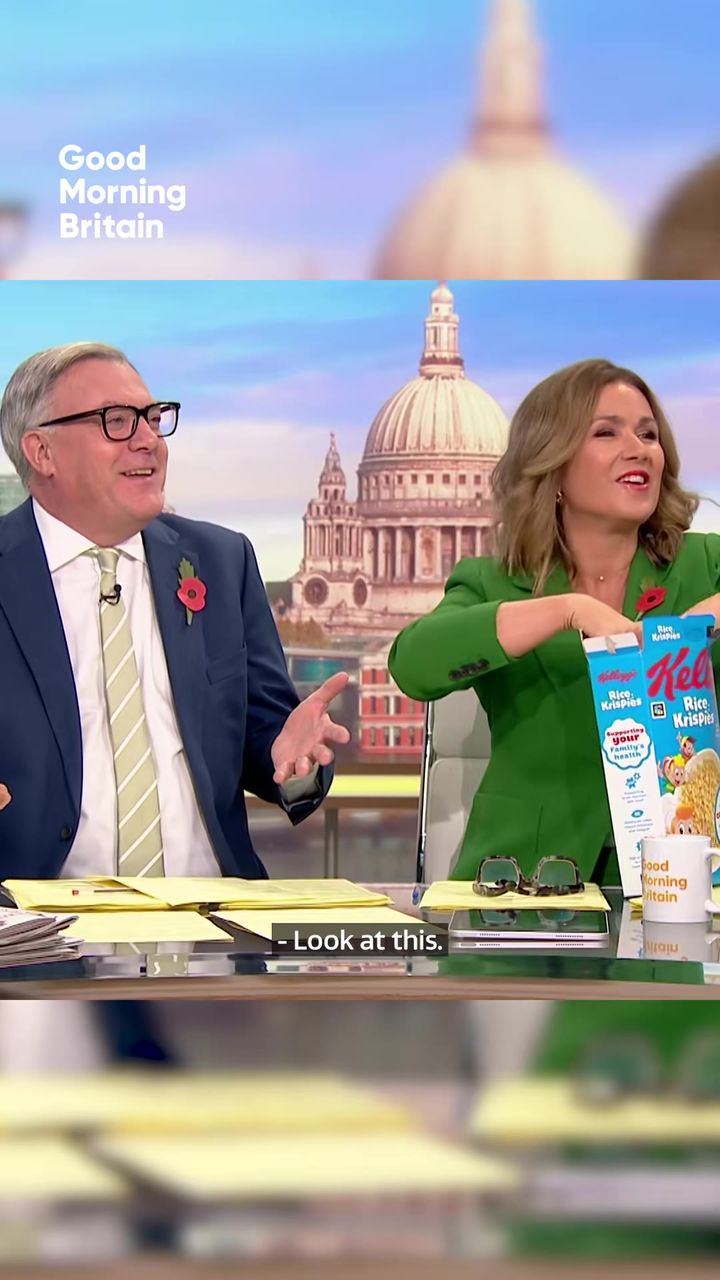
Ed Balls and Susanna Reid ran a milk test live on air with a microphone against the bowl.25
This claim is about whether the footage shows what it appears to show, and the answer is yes. Two outlets in our record describe the same segment independently of the video: CBC reports that Balls poured milk over a bowl of the reformulated cereal on air on the Wednesday morning while Reid exclaimed the cereal had lost its snap, crackle and pop; the Edmonton Sun describes Reid placing a live microphone near the cereal during what it calls an easygoing investigation. Those accounts match the keyframes and the transcript of this clip, including the floor manager handing over the microphone and Reid warning she'll have to hold it close. The video is also posted by the programme's own TikTok account, which is the primary source for its own broadcast. A repost of someone else's clip can drift; the originating account is much harder to fake. This matters because if the segment had been edited or invented, the other two claims would be standing on nothing. It wasn't.
What was posted
TikTokA TikTok video posted by the official Good Morning Britain account showing a studio segment in which co-hosts Ed Balls and Susanna Reid pour milk over a bowl of Rice Krispies and hold a microphone close to it. The presenters listen for the cereal's signature snap, crackle and pop and conclude they can't hear it. The post frames this as an informal on-air investigation into whether the cereal still sounds the same.
“Rice Krispies have changed a key part of their recipe, but do they still have their iconic snap, crackle and pop? Ed and Susanna investigate… #Breakfast #cereal #ricekrispies #investigation #milk”
Posted on TikTok by the verified @goodmorningbritain account, the programme's own channel, matching the segment broadcast on the morning of 4 November 2026.
Who posted it
TikTokAccount check
Estimates from public signals — account age, posting pattern, audience — not a judgement of the person behind the account, and separate from whether this post is true.
What stood out
- @goodmorningbritain is the official TikTok account of ITV's breakfast programme Good Morning Britain — third-party trackers (HypeAuditor, Starcovery, Urlebird) list it as verified, UK-based, ~600K followers and ~2,600 posts.
- Profile bio on the live account reads roughly 'The UK's most talked about breakfast television show. Weekdays from 6am on ITV' with a link to itv.com/terms — consistent with a broadcaster-owned brand account, not a fan or impersonator.
- Posting is sustained and human-editorial in character: ~1.2 posts/day, 8–9 per week, steady follower growth (591.6K in Sep 2026 to ~599K in Oct 2026) and 41M+ cumulative likes — inconsistent with bot/coordinated inauthenticity.
- ITV publicly confirmed GMB's TikTok operation, launching presenter-led news bulletins on the platform in January 2025, so the account is a documented editorial channel.
- The supplied metadata is mostly empty (null followers/bio/creation date, isplatformverified=false) — a scraping/API gap rather than evidence of an impostor; the underlying handle is well attested elsewhere.
- Caveat as an information source: mainstream but tabloid-leaning. Ofcom found GMB in breach of accuracy/impartiality rules over a 2018 Nicola Sturgeon interview (a quote wrongly attributed to the SNP Sustainable Growth Commission report) and issued guidance after Eamonn Holmes' 2020 5G/coronavirus remarks.
- Its clips are edited for engagement (headline-style framing, confrontation-driven segments), so individual viral clips can strip context even though the parent brand is a licensed broadcaster.
Signals (9)+
- Posting cadence
- Approx. 1.2 posts/day, 37/month (HypeAuditor, Sep–Oct 2026)
- Follower ratio
- 599K followers vs 12 following
- Engagement rate
- 2.9% (Oct 2026)
- Total likes
- 41300000
- Notable news coverage
- ITV press coverage of GMB TikTok news bulletins (Advanced Television / ATV Today, Jan 2025)
- Fact check history
- Ofcom breach for accuracy/impartiality (Sturgeon interview, 2018); Ofcom guidance over 5G remarks (2020); Piers Morgan Meghan comments not in breach (2021)
- Affiliation
- ITV / ITV Studios — official programme account
- Metadata completeness
- Low — most profile fields null in supplied record
- Impersonation risk
- Handle matches official brand; no evidence of the brand account itself being compromised
Account checked November 5, 2026, 14:49 UTC
The media
Video✓ What is genuine
The footage is an authentic broadcast clip of a real on-air test, and the cereal it shows is the reformulated product that Kellogg's has confirmed changing.
The tells
- ●●○ Supporting signal Consistent Good Morning Britain studio set with the St Paul's Cathedral backdrop, stable framing and the branded programme watermark.our visual review
- ●●○ Supporting signal On-screen captions match the spoken words in the transcript, and faces, hands, microphones, cereal pack and milk jug stay anatomically and physically coherent from frame to frame.our visual review
- ●●● Strong signal CBC and the Edmonton Sun describe the same live segment — Balls pouring milk, Reid holding a microphone to the bowl — matching the footage.CBC News and Edmonton Sun reporting
- ●●○ Supporting signal The clip sits on the programme's own TikTok account, which is the originating publisher for its own broadcast.our visual review
Synthetic-media detector
Detector not consultedSources settled the claim on their own; the detector was not needed.
How we checked the media
- Reviewed the video's keyframes by eye for studio set, captions, watermark, hands, faces and props.
- Compared the segment described in independent news coverage with what the footage shows.
Sources
5 sources reviewed- 1Uproar over missing 'pop' as Rice Krispies changes its recipe ↗
BBC · bbc.comReputable outletCenter; light bias tagEvidence
Establishes the reformulation from whole rice grains to rice flour and quotes Kellogg's saying the sound may be quieter and not as instant.
- 2Kellogg's Rice Krispies changed its U.K. recipe, muffling its iconic snap, crackle and pop ↗
CBC News · cbc.caUntiereduntiered — treated as signal only, never decisiveEvidence
Describes the Good Morning Britain on-air test and quotes Susanna Reid's verdict, corroborating the footage.
- 3Kellogg's says Rice Krispies' 'snap, crackle and pop' sound quieter after change ↗
The Mirror · mirror.co.ukUntiereduntiered — treated as signal only, never decisiveEvidence
Reports Kellogg's admission that the iconic sound is quieter after the recipe change.
- 4Kellogg's goes against the grain: Rice Krispies reformulated due to lack of rice ↗
The Irish Times · irishtimes.comReputable outletCenterEvidence
Establishes that the reformulation followed a lack of rice and that the new recipes contain wheat gluten.
- 5No more 'snap, crackle and pop'. Rice Krispies recipe change met with public scorn in the U.K. ↗
Edmonton Sun · edmontonsun.comUntiereduntiered — treated as signal only, never decisiveEvidence
Independently describes the Balls and Reid segment, including Reid placing a live microphone near the cereal.
Further reading
- 1BBC The BBC report carries Kellogg's own statement about the quieter sound and explains the recipe change.
- 4The Irish Times Explains why the recipe changed and the wheat gluten consequence, which the TikTok post doesn't mention.
- 5Edmonton Sun Describes the Good Morning Britain segment from an independent outlet, useful for confirming the clip is genuine.
The full story
The kernel of truth here is a supply problem, not a marketing stunt. Kellogg's changed the UK recipes of Rice Krispies and Coco Pops, dropping whole rice grains in favour of rice flour, with a rice and corn flour blend in Coco Pops, after disruption to rice supply. The company said it was responding to changing weather conditions affecting rice.
The reformulation had a side effect that was easy to miss on an ingredients list and impossible to miss at the breakfast table. The signature snap, crackle and pop comes from how the cereal is made and how it behaves when milk hits it; changing the base ingredient changed the sound. Kellogg's did not hide this. It told the BBC that customers "might notice that the sound may be quieter and not as instant as before", while maintaining the effect is still there.
A second consequence got less airtime than the noise but matters more to some shoppers: the new recipes declare wheat gluten, so the cereals are no longer suitable for people with coeliac disease or a wheat allergy. That is a food-safety fact, not a nostalgia story.
So when Good Morning Britain put a microphone to a bowl on 4 November 2026 and heard nothing, it wasn't inventing a controversy. It was demonstrating a change the manufacturer had already acknowledged. The segment became the memorable image of a real product decision, and the clip travels because a silent cereal bowl is a far better story than an amended ingredient list. Note the limits too: this applies to the UK. Kellogg's says US and Canadian Rice Krispies are unchanged, so the same test elsewhere may well still pop.
Kernel of truth
Kellogg's genuinely reformulated UK Rice Krispies and Coco Pops, and the company itself says the sound may now be quieter and less instant.
Timeline
November 3, 2026
Kellogg's reformulation of UK Rice Krispies and Coco Pops is reported by news outlets, including the change from whole rice grains to rice flour and the addition of wheat gluten. 1BBC
November 4, 2026
Good Morning Britain airs the milk test: Ed Balls pours milk, Susanna Reid holds a microphone to the bowl and concludes the cereal has lost its snap, crackle and pop. 2CBC News
How it was framed
The post's underlying claim — that the recipe changed and the cereal no longer sounds the same — is supported by the manufacturer's own statement and multiple independent reports, and the footage is genuine broadcast material. This is not a distortion of a real event; it is a real event, demonstrated on air.
- “Visual proof”. The segment stages the claim as a demonstration: a microphone held against the bowl so viewers can hear the absence of sound for themselves.
- Emotional language. The caption leans on nostalgia with "their iconic snap, crackle and pop", and the on-air verdict is the blunt "There's nothing going on".
- Missing context. The post does not mention the reason for the change (rice supply) or that the new recipe contains wheat gluten, both of which are central to the news story.
Posted on TikTok by @goodmorningbritain, the programme's own account, on the day the segment aired. The clip is presented as light-hearted breakfast-television investigation rather than as news reporting.
Bias
The clip is a light-hearted studio demonstration of a genuine, widely reported product change; it makes no political or ideological case.
Bias describes how the post frames its message — the slant of the language, selection and emphasis — and is judged separately from whether the claim is true. A true claim can still be framed with a strong slant.
How we checked
40 s- 1
Searched for reporting on the Rice Krispies recipe change and on shoppers saying the cereal no longer snaps, crackles or pops.
- 2
Read the resulting coverage from the BBC, CBC, the Irish Times, the Mirror and the Edmonton Sun, checking whether each quoted Kellogg's directly or merely repeated another outlet.
- 3
Reviewed the video's keyframes by eye — studio set, watermark, captions, faces, hands and props — for signs of editing or compositing.
- 4
Compared independent descriptions of the Good Morning Britain segment with the footage and transcript in the post.
- 5
Checked whether any fact-check, correction or company denial contradicted the story. We found none.
✓ Claim checked✓ Media checked✓ Sources checked
Why 90% confidence
HighHIGH on the headline because the central claim is confirmed by the manufacturer's own statement and reported independently by several outlets, and the footage is genuine broadcast material from the programme's own account. The weaker sub-claim — that the cereal has entirely "lost" the sound — is rated LIKELY_TRUE at MODERATE, because the only direct test is a single on-air bowl and Kellogg's insists the sound is still present, just quieter.
Limits. No sound detector was run on the video: our assessment of the footage rests on visual review and on news coverage describing the same segment. No controlled before-and-after audio comparison of old and new cereal exists in our record, so the exact scale of the change in sound is not measured.
What we don’t know
- Exactly how much quieter the cereal is, since no side-by-side audio test of old and new recipes appears in our record.
- Whether every batch and every type of milk produces the same result; the on-air test was a single bowl.
- Whether Kellogg's plans further recipe changes, or whether the reformulation will be reversed.
- How the recipe change was communicated to shoppers before news coverage, beyond the ingredients now declared on pack.
Spot it yourself
Why it looked fakeLooks suspicious, isn’t proof
- It's a television clip reposted to TikTok, and plenty of viral TV clips are trimmed or re-captioned out of context; that is a reason to check, not proof of anything.
- The tone is jokey — a floor manager handing over a microphone, presenters joking about "producers anticipating your every need" — and light tone often makes people assume a clip is a comedy bit rather than a real test.
- The claim sounds like an exaggeration: a famous cereal "losing" its trademark sound is the kind of thing people assume must be a gag.
The actual evidence
- Kellogg's itself told the BBC customers "might notice that the sound may be quieter and not as instant as before" — the company concedes the point.
- Multiple independent outlets (BBC, CBC, Irish Times, Mirror) reported the reformulation and the wheat gluten addition, quoting Kellogg's directly.
- CBC and the Edmonton Sun describe the same on-air segment, matching the footage frame for frame in substance.
- The clip was posted by the programme's own verified account, the originating publisher of its own broadcast.
- 1
Ask who would be reporting this if it were true
A recipe change at a major manufacturer is a business and consumer story. Check whether outlets that cover food and business have it, not just the clip's own caption.
- 2
Look for the company's own words
Manufacturers usually issue a statement when they change a recipe. A direct quote from the company is stronger evidence than any number of reposts.
- 3
Check the packaging, not just the video
Ingredient and allergen lists on the box are primary evidence. If the recipe really changed, the pack will show it — including new allergens such as wheat gluten.
- 4
Confirm the clip's origin
Find the account that first posted it. An official programme or broadcaster account is the primary source for its own footage; an anonymous repost is not.
- 5
Watch for what the clip leaves out
This post never mentions why the recipe changed or the allergen change. Missing context doesn't make a claim false, but it tells you the post isn't the whole story.
Takeaway
A claim can sound like a joke and still be true; the test is whether the company involved and independent reporters say the same thing. Check the primary source's own words before deciding a story is too silly to be real.
Questions people ask
Did Rice Krispies really change their recipe?+
Yes. Kellogg's changed the UK recipes of Rice Krispies and Coco Pops, replacing whole rice grains with rice flour and a rice and corn flour blend. The BBC, CBC, the Irish Times and the Mirror all reported it, quoting Kellogg's directly. The new recipes also contain wheat gluten.
Have Rice Krispies lost their snap, crackle and pop?+
Largely, yes. A Good Morning Britain test on 4 November 2026 with a microphone against the bowl picked up no snapping. Kellogg's says the sound "may be quieter and not as instant as before" but insists it is still there. The effect is clearly much reduced, though the company disputes that it's gone entirely.
Is the Good Morning Britain clip real?+
Yes. The video was posted by the programme's own TikTok account and matches the segment described by CBC and the Edmonton Sun, in which Ed Balls poured milk and Susanna Reid held a microphone to the bowl. It is authentic broadcast footage, not an edit.
Are Rice Krispies still safe for people with coeliac disease?+
No. The reformulated UK recipes now declare wheat gluten, so they are no longer suitable for people with coeliac disease or a wheat allergy. The Irish Times reported this change. Anyone who previously ate them safely should check the current pack.
Does this apply to Rice Krispies in the US and Canada?+
No. Kellogg's says US and Canadian Rice Krispies are unchanged. The reformulation and the quieter sound apply to the UK products, so a bowl bought elsewhere may still snap, crackle and pop.
Go deeper
- Reformulation
- When a manufacturer changes the ingredients or recipe of an existing product, often without changing its name or packaging.
- Wheat gluten
- A protein found in wheat that must be declared on food labels because it can cause serious reactions in people with coeliac disease or a wheat allergy.
- Coeliac disease
- A condition in which eating gluten damages the lining of the gut, so people with it must avoid gluten entirely.
- False context
- Sharing genuine content alongside a false or misleading explanation of what it shows.
- Corroboration
- Independent confirmation of a claim from a separate source that did not simply copy the first one.
People also search for
For educators+
- The presenters tested one bowl on live television. What would a fair test of the cereal's sound look like, and why does that matter for how we judge the clip?
- Kellogg's says the sound is "quieter and not as instant" but still there. How should a fact-check describe a claim that is partly right and partly overstated?
- The post never mentions the wheat gluten change. Does leaving out a more serious fact make an otherwise accurate post misleading? Why or why not?
About this check
- Platform
- TikTok
- Posted by
- @goodmorningbritain
- Posted
- November 4, 2026
- Age when checked
- 1–2 days old when checked
- Where it spread
- United Kingdom, Ireland
- Audience
- UK & EU audience
- Language
- EN
- Status
- ● Post is live
- Verified
- November 5, 2026, 14:50 UTC
- Published
- November 5, 2026, 14:50 UTC
Reach. Wide pickup 3-5 Nov: BBC (article plus explainer video 5 Nov), Mirror, HuffPost UK, LBC, The Grocer, CBC, Fox Business; 10News ran 'Fact or Fiction: Kellogg's removing rice from Rice Krispies?' on 5 Nov; GMB on-air test showed silent bowl. No view counts given.
This verdict was generated with AI from the sources shown. AI can make mistakes — check the sources before relying on it.
Check anything yourself, in seconds.
Share any social post or video to What the Fact and get the verdict, the confidence, and the receipts.