Were the Irish Independent, RTÉ and Newstalk evacuated after bomb threats?
Were RTÉ, the Irish Independent and Newstalk evacuated on 6 November after a wave of bomb threats against Irish media?
True
Genuine on-scene footage; the evacuations are confirmed by Gardaí, AFP, BBC and the Irish Times.
TRUE. On the morning of 6 November 2026, the Irish Independent's Dublin offices on Talbot Street, RTÉ's Donnybrook campus, Newstalk and Today FM at Marconi House, and Virgin Media in Ballymount were evacuated after bomb threats were emailed to newsrooms. Gardaí said they were investigating threats against media in Ireland and Europe. No devices were found and the Newstalk threat was assessed as a hoax.
 Genuine
Claims
✓ 4 trueThe Irish Independent offices on Talbot Street were evacuated due to a bomb threat emailed in that morning.14
This is the claim the whole video rests on, and it is confirmed from two directions. Mediahuis Ireland, the publisher of the Irish Independent, confirmed that its Dublin city-centre offices were evacuated after threatening correspondence, and the Irish Times reports the same detail, adding that staff had returned to their desks by mid-morning (sources 4 and 1). The two accounts are not fully independent in the strictest sense: the Irish Times is covering the same incident and the Irish Independent is reporting on itself, but Mediahuis's confirmation is a direct statement from the organisation affected, which is the strongest kind of confirmation for an evacuation claim. A publisher has little reason to confirm its own building was cleared unless it was. The video adds a visual layer: the reporter stands at the branded entrance on Talbot Street, which matches the address named in the reporting. Taken together, the direct confirmation and the location match leave no plausible alternative reading.
RTÉ, Newstalk and Virgin Media offices were also evacuated as part of the same wave of bomb threats.23
Each outlet named in the video is covered by at least one wire or national report. The BBC reports that RTÉ, Ireland's public service broadcaster, was among the organisations evacuated after threats were made against them (source 3). AFP reports more broadly that staff at several Irish media organisations were evacuated after bomb threats were emailed to newsrooms (source 2). The Irish Times names RTÉ, the Irish Independent and Newstalk in its headline and adds Today FM and Virgin Media (source 4). These are separate newsrooms working from separate sources, including statements from the organisations themselves, so this is genuine multi-source corroboration rather than one report copied across outlets. What settles it is the RTÉ detail: the broadcaster's Donnybrook campus was cleared and searched by Gardaí with sniffer dogs, and Radio 1 moved to pre-recorded output. An evacuation of that scale is not something a reporter could invent on camera without immediate contradiction. The video says 'Virgin TV' where reports say Virgin Media; that is a colloquial shortening of the same company, not an error in substance.
An adjoining supermarket was cleared of customers because of the threat.4
This is the smallest and least-documented detail in the video, and our verdict reflects that. The video's own frames show a SuperValu on Talbot Street next to the Independent House entrance, with staff and Gardaí outside, which is consistent with a cordon that includes the neighbouring shop. The Irish Times report confirms the Talbot Street evacuation and the return to work by mid-morning (source 4), but none of the wire or broadsheet coverage we found describes the supermarket being cleared of customers specifically. We rated it LIKELY_TRUE rather than TRUE because the visual evidence supports it and nothing contradicts it, but no source states it directly. It is also the kind of minor, local detail a reporter standing at the scene would see and report without it ever reaching a wire story. Readers should treat it as plausible and unremarkable rather than confirmed; it does not affect the central claim either way.
Still open: No source we found describes the supermarket clearance directly; only the video's own frames support it.
The media threats come after a wider wave of threats in Ireland and Europe in recent days, including against aircraft.23
The reporter frames the newsroom evacuations as part of a pattern, and the reporting supports that framing. AFP's coverage is headlined around bomb hoaxes spreading from flights to media, and it reports that nearly 30 passenger flights across Europe, including Ryanair and Aer Lingus services, received hoax bomb threats the previous day; a cruise ship was also targeted earlier in the week (source 2). The BBC reports the media evacuations in the same wave (source 3). The link is not just a reporter's hunch: Irish ministers publicly connected the newsroom threats to that wider pattern. This matters because it is the kind of framing claim that is easy to inflate. Here the sequence of events is documented in wire coverage independent of the Irish Independent, so the connection holds on the evidence rather than on the reporter's say-so. Note that the transcript phrase 'fridge freezers' appears to be a garbled automatic transcription; the checkable assertion about aircraft threats is accurate.
What was posted
XThe Irish Independent posted a short vertical video to X from outside its own Dublin offices. A reporter, standing in front of the branded 'Independent' entrance on Talbot Street, says the building has been evacuated because of a bomb threat emailed in that morning. He goes on to say RTÉ, Newstalk, Virgin TV and an adjoining supermarket were also being cleared, and places this in a wider series of threats. The post asks readers to believe that Irish newsrooms were emptied that morning as part of a coordinated threat.
“Irish Independent, RTÉ and Newstalk among Irish media organisations evacuated after wave of bomb threats”
Posted by the Irish Independent's own X account (@Independent_ie), the outlet whose Talbot Street offices are shown being evacuated in the footage.
Who posted it
XAccount check
Estimates from public signals — account age, posting pattern, audience — not a judgement of the person behind the account, and separate from whether this post is true.
What stood out
- Handle @Independent_ie matches the official X account of Independent.ie / the Irish Independent, Ireland's largest-circulation daily, owned by Mediahuis Ireland.
- Account created November 2009, ~17 years old, with roughly 900k followers and ~561k posts — consistent with a long-running newsroom account, not a sock puppet.
- Live activity confirmed: the account posted breaking news on the 6 Nov 2026 bomb-threat evacuations of RTÉ, Newstalk and Independent offices, as quoted by Greek outlets (Creta24, Enikos).
- Third-party references (Ken McCarthy, Broadsheet, Medem news-source registry) have long cited @Independent_ie as the paper's official feed.
- Outlet-level reliability: Ad Fontes Media rates high factuality (centre); Media Bias/Fact Check rates high factual reporting with a right-leaning editorial stance.
- Independent.ie joined the Trust Project in Nov 2025 and publishes a public corrections policy (corrections@independent.ie).
- Caveats: the supplied record has no bio, follower count, creation date or verification flag, so identity cannot be confirmed from metadata alone — a lookalike/impersonation handle remains possible.
- The paper has documented accuracy lapses (e.g., 2012 'welfare tourism' mistranslation; a Sept 2026 X thread disputing claims about the @JohnnyGpops account), and Mediahuis Ireland sued X in Feb 2025 over scam ads misusing its branding.
Signals (10)+
- Approximate created
- 2009-11
- Posting volume
- 561000
- Posting cadence
- Very high, continuous breaking-news feed
- Metadata completeness
- Very low (bio, followers, creation date all null in record)
- Ownership
- Mediahuis Ireland (Irish Independent / Independent.ie)
- Media bias rating
- Ad Fontes: centre, high factuality; MBFC: right-leaning, high factual
- Trust project member
- Yes
- Corrections policy
- Yes
- Notable news coverage
- Quoted as source for 6 Nov 2026 Irish bomb-threat evacuations
- Fact check history
- No fact-checker debunks of the account itself; outlet has documented corrections/accuracy disputes
Account checked November 6, 2026, 14:57 UTC
The media
Video✓ What is genuine
The scene, the reporter, the Talbot Street location and the evacuation it describes are all real and independently confirmed by reporting and by the organisations themselves.
The tells
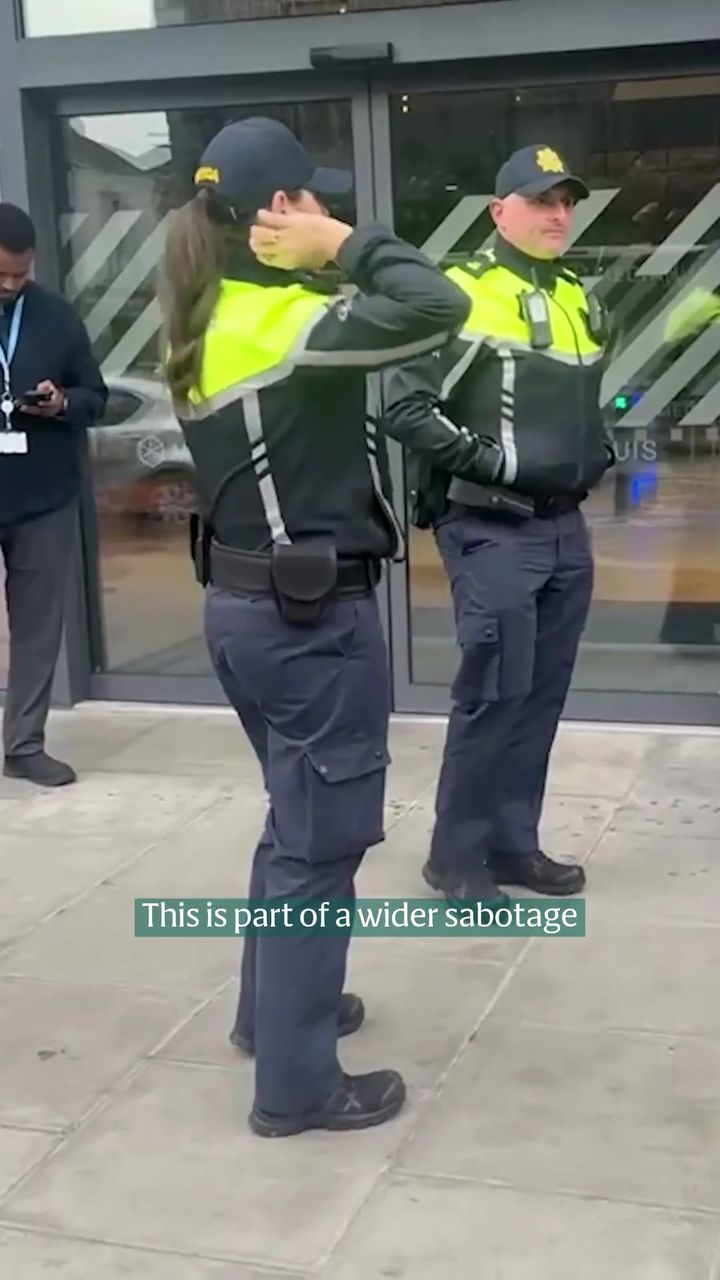
- ●●● Strong signal The reporter stands at an 'Independent' branded glass entrance on Talbot Street, matching the address named in the reporting.our visual review
- ●●○ Supporting signal Uniformed Gardaí in high-visibility jackets and a SuperValu shopfront appear in the same streetscape, consistent with a real cordon on a Dublin street.our visual review
- ●●○ Supporting signal Face, clothing and background details stay consistent across frames, with no compositing artefacts or morphing detail; the minor hand blur is ordinary motion blur in a vertical phone video.our visual review
- ●●○ Supporting signal The footage was published by the newspaper group that was itself evacuated, which is consistent with staff filming their own building.our visual review
Synthetic-media detector
Detector not consultedSources settled the claim on their own; the detector was not needed.
How we checked the media
- Reviewed the video frames for physical consistency: the reporter, clothing and background stay consistent across the clip.
- Compared the location shown with the address and incident described in reporting on 6 November 2026.
- Checked whether the claim in the video is independently confirmed by Gardaí statements and by AFP, BBC and Irish Times reporting, since the footage is illustrative rather than the sole evidence.
Sources
4 sources reviewed- 1Irish Independent, RTÉ and Newstalk among Irish media organisations evacuated after wave of bomb threats ↗
The Irish Independent · independent.ieUntiereduntiered — treated as signal only, never decisiveEvidence
The Irish Independent's own report that staff at various media organisations were evacuated after bomb threats.
- 2Europe bomb hoaxes spread to media as more flights hit by alerts ↗
AFP · afp.comReputable outletwire — CenterEvidence
AFP reports the media evacuations and links them to nearly 30 flight hoax threats the previous day.
- 3Some media outlets evacuated after bomb threats ↗
BBC · bbc.comReputable outletCenter; light bias tagEvidence
The BBC reports that RTÉ and other high-profile media organisations were evacuated after threats.
- 4Staff at RTÉ, Irish Independent, Newstalk evacuated due to security alert ↗
The Irish Times · irishtimes.comReputable outletCenterEvidence
The Irish Times reports the Mediahuis, RTÉ and Newstalk evacuations and staff returning by mid-morning.
Further reading
- 2AFP AFP places the newsroom evacuations in the wider wave of hoax threats across Europe, including flights.
- 4The Irish Times The Irish Times gives the clearest account of which Dublin offices were cleared and when staff returned.
- 3BBC The BBC explains the RTÉ evacuation and the official response.
The full story
The kernel of truth here is the whole claim: on the morning of 6 November 2026, a wave of emailed bomb threats emptied newsrooms across Dublin.
RTÉ's Donnybrook campus was cleared and searched by Gardaí with sniffer dogs, and Radio 1 switched to pre-recorded programming. Mediahuis Ireland evacuated its city-centre offices on Talbot Street, the building shown in the video. Bauer Media's Newstalk and Today FM at Marconi House and Virgin Media's Ballymount offices were also cleared. Gardaí said they were aware of threats made against media organisations in Ireland and Europe and that the threats would be investigated. The Newstalk threat was assessed as a hoax and staff were allowed back; no explosive devices were found.
The newsroom threats did not come out of nowhere. The previous day, nearly 30 passenger flights across Europe, including Ryanair and Aer Lingus services, had received hoax bomb threats, and a cruise ship had been targeted earlier in the week. Irish ministers publicly linked the two. That context is why the reporter's line about a 'wider threat' is accurate rather than alarmist.
The video itself is straightforward: a reporter from the evacuated newspaper standing outside his own building, telling viewers what he could see. It spread because it was first-hand, local and dramatic, not because it contained anything surprising or manipulated.
Kernel of truth
Irish media organisations really were evacuated after emailed bomb threats on 6 November 2026, and the video was filmed at the scene that morning.
Timeline
November 5, 2026
Nearly 30 passenger flights across Europe, including Ryanair and Aer Lingus services, receive hoax bomb threats; a cruise ship had been targeted earlier in the week. 2AFP
November 6, 2026
Emailed bomb threats are sent to Irish and UK media organisations; RTÉ's Donnybrook campus, Mediahuis's Talbot Street offices, Newstalk and Today FM at Marconi House, and Virgin Media in Ballymount are evacuated. 4The Irish Times
November 6, 2026
Gardaí say they are aware of threats against media organisations in Ireland and Europe and will investigate; the Newstalk threat is assessed as a hoax and staff return. 3BBC
How it was framed
The video is genuine on-scene news footage and every checkable assertion in it is confirmed by Gardaí statements and by AFP, BBC and Irish Times reporting. One minor detail, the supermarket clearance, is only partly documented, but the substance of the post is accurate.
- “Visual proof”. The reporter films the branded 'Independent' entrance and Gardaí on Talbot Street, inviting viewers to trust the scene as first-hand proof.
- Ongoing-threat framing. 'This is part of a wider sabotage threat to media organisations across the country' and 'probably part of a wider threat that we've seen across Ireland... in recent days.'
Posted on X by the Irish Independent's own account (@Independent_ie), the outlet whose Talbot Street offices appear in the footage.
Bias
The video is a straight on-scene news report from a media organisation that was itself evacuated; it relays confirmed facts and official responses without advocacy or a political slant.
Bias describes how the post frames its message — the slant of the language, selection and emphasis — and is judged separately from whether the claim is true. A true claim can still be framed with a strong slant.
How we checked
1 min 15 s- 1
Searched for coverage of the Irish media evacuations on 6 November 2026, including the Irish Independent, RTÉ, Newstalk and Virgin Media.
- 2
Reviewed the video frames for physical consistency and compared the location shown with the Talbot Street address named in reporting.
- 3
Cross-checked each checkable assertion in the video against AFP, BBC, Irish Times and Irish Independent coverage.
✓ Claim checked✓ Media checked✓ Sources checked
Why 93% confidence
HighHIGH confidence because the evacuations are confirmed by the organisations themselves and by multiple independent outlets, including a wire service, and Gardaí publicly acknowledged the threats. The one weaker point, the supermarket clearance, is a minor detail that does not affect the central claim.
Limits. We did not open the full articles behind all the snippets, and no automated media detector was run; our authenticity assessment rests on visual review and the independent reporting. We could not independently confirm the supermarket clearance.
What we don’t know
- Whether the person or group behind the emailed threats has been identified.
- How many individual threats were sent and to exactly which outlets beyond those named.
- Whether the supermarket next to Independent House was formally evacuated or simply closed as part of the cordon.
Spot it yourself
Why it looked fakeLooks suspicious, isn’t proof
- It is a self-interested source: the newspaper is reporting on its own evacuation, which makes some readers suspect hype. That is a reason to check, not evidence of fakery.
- The vertical phone video is shaky, with a blurred hand and imperfect audio, which can read as amateurish or staged.
- The claim sounds dramatic: a coordinated bomb threat against newsrooms is the kind of story that feels too big to be true.
- One phrase in the automatic transcript, 'fridge freezers', is garbled, which can make the whole clip look unreliable.
The actual evidence
- Mediahuis Ireland, the publisher, confirmed its Dublin offices were evacuated and that staff returned by mid-morning, per the Irish Times.
- RTÉ confirmed its Donnybrook campus was cleared and searched by Gardaí with sniffer dogs, per BBC reporting.
- AFP and the BBC independently reported the same evacuations on the same day, so this is not one outlet's story repeated.
- Gardaí said they were aware of threats against media organisations in Ireland and Europe and would investigate.
- The location shown in the video matches the Talbot Street address named in the reporting.
- 1
Ask who else would be reporting this if it were true
A multi-site evacuation of national broadcasters would be covered by wires and rival outlets within hours. Search the organisation names plus 'evacuated' and see whether outlets other than the one posting are reporting it.
- 2
Find the official account
Look for a statement from the organisation affected or from the police. Here, the publisher and Gardaí both spoke publicly, which is stronger than any single video.
- 3
Check whether outlets are copying each other
Open two or three reports and see whether they cite their own reporting or statements, or all repeat the same single source. Independent sourcing is what makes corroboration meaningful.
- 4
Inspect the visual details
Pause the video and compare signage, street names and uniforms with what the reports describe. A branded entrance and named street that match the coverage support authenticity; they do not prove it alone.
- 5
Separate the transcript from the claim
Automatic captions garble words. Judge the checkable assertions, such as which buildings were cleared, not the odd phrase in the subtitles.
Takeaway
A post being dramatic, self-interested or amateurish tells you to check it, not to dismiss it. The test is whether independent sources, especially the organisations and authorities involved, confirm the specific facts.
Questions people ask
Were Irish media offices really evacuated on 6 November 2026?+
Yes. RTÉ's Donnybrook campus, the Irish Independent's Talbot Street offices, Newstalk and Today FM at Marconi House, and Virgin Media in Ballymount were evacuated after bomb threats were emailed to newsrooms. Gardaí said they were investigating, no devices were found, and the Newstalk threat was assessed as a hoax.
Was the Irish Independent video of the evacuation real?+
Yes. The footage shows a reporter outside the branded Independent entrance on Talbot Street with Gardaí present, matching the address named in reporting. The scene is consistent across frames, and the evacuations it describes are independently confirmed by AFP, the BBC and the Irish Times.
Who was behind the bomb threats to Irish media?+
We do not know from the reporting available. Gardaí said they were aware of threats made against media organisations in Ireland and Europe and that the threats would be investigated. No arrests or identified suspects are described in the coverage we reviewed.
How do bomb threats to newsrooms relate to the flight threats?+
The media threats came the day after nearly 30 passenger flights across Europe, including Ryanair and Aer Lingus services, received hoax bomb threats. A cruise ship was also targeted earlier in the week. Irish ministers publicly linked the newsroom threats to that wider pattern.
Why did the post mention 'fridge freezers'?+
That phrase appears in the automatic transcript of the video and appears to be a transcription error. It is not part of the reporter's checkable claims. The assertions about which buildings were evacuated and about the wider threat pattern are accurate.
Go deeper
- Corroboration
- Confirmation of a claim by independent sources that did not get their information from each other.
- Hoax
- A false threat or claim made to cause alarm or disruption, with no real device or danger behind it.
- Gardaí
- The national police service of the Republic of Ireland.
- Wire service
- A news agency such as AFP that supplies reporting to many outlets, which then often publish it with little change.
- False context
- Sharing genuine material with a misleading caption, date or backstory so it appears to show something it does not.
People also search for
For educators+
- If a newspaper reports on its own evacuation, does that make its account less trustworthy or more? What would you check either way?
- The video is authentic, but how would you verify it if no reporting existed yet? What would you look for in the frames and on the street?
- Why might a garbled word in a transcript make viewers doubt an otherwise reliable video, and how should that affect our judgment?
About this check
- Platform
- X
- Posted by
- @independent_ie
- Posted
- November 6, 2026
- Age when checked
- Under 24 hours old when checked
- Where it spread
- Ireland
- Audience
- UK & EU audience
- Language
- EN
- Status
- ● Post is live
- Verified
- November 6, 2026, 14:59 UTC
- Published
- November 6, 2026, 14:59 UTC
Reach. Google Trends IE "bomb scare rte" 20000+ (6 Nov); TheJournal, Irish Independent coverage; post 47 likes
This verdict was generated with AI from the sources shown. AI can make mistakes — check the sources before relying on it.
Check anything yourself, in seconds.
Share any social post or video to What the Fact and get the verdict, the confidence, and the receipts.