Did John Healey's Budget cut defence spending to fund welfare?
Are UK taxes heading for a record high to pay for rising welfare spending, as Kemi Badenoch claims?
Misleading
Tax-burden claim holds, but the Budget raised defence spending, not cut it.
MISLEADING. Kemi Badenoch's video is genuine, and her tax-burden point largely holds: the OBR puts the burden at a record 37.9% of GDP by 2027-28, the highest since records began in 1948. But her charge that the 28 October 2026 Budget 'cuts spending for defence' is false. It fully funded the £4.7bn defence plan and raised defence spending.
 Genuine
Claims
✓ 4 true · ✕ 1 falseThis Budget cuts spending for defence2358
This is the claim the whole video turns on, and it is the one that fails. The Budget delivered on 28 October 2026 fully funded the £4.7bn shortfall in the Defence Investment Plan and set a path for defence spending to reach about 2.7% of GDP by 2027, with a 3% target for 2030. ITV News reported the 'fully funding' commitment directly. Nato's Mark Rutte welcomed the plan, and Badenoch herself said in the Commons that Healey 'has funded the defence investment plan – that is welcome', as the Guardian recorded. That is about as decisive as evidence gets: the speaker's own on-the-record words contradict the claim made in her own video. What critics can fairly say is that the Budget left hard choices for later — the IFS noted an extra £11bn would be needed to fund the full 3% commitment, and the Daily Mail reported the plan for meeting defence commitments was pushed down the road. Delaying and under-funding a target is not the same as cutting defence spending, which is what the video asserts. The sources here do not all trace to one origin: they include broadcaster reporting, a business channel, financial press and the IFS, and they agree on the direction of defence spending.
Still open: The full multi-year funding path beyond 2030 is not settled; whether later spending reviews deliver the 3% target remains open.
Welfare spending rises in this Budget, and taxes are rising partly to pay for it68
This part checks out, and it helps explain why the video feels plausible. The OBR forecasts welfare spending climbing from around £334bn to £431bn by 2030. Benefits were uprated by 3.5%, and the Budget contained no welfare cuts: reform was deferred to reviews reporting later. So the statement 'this Budget increases spending on welfare' is accurate. Where the video moves from fact to framing is in saying taxes rise 'to fund ever more welfare' rather than defence. Rising receipts also reflect frozen income tax thresholds, health spending and debt interest, and the same Budget raised defence spending. The sources for this come largely from post-Budget coverage of the same OBR document, so they are not fully independent of one another — they are reading the same forecasts. That is fine for a factual question about what the Budget contains, because the OBR figures are the primary record. Readers should weigh the direction of travel, which is well evidenced, separately from the 'to fund what?' framing, which is a political argument rather than a finding.
Taxes are rising to fund welfare for people who can work but choose not to, not for defence or veterans58
The benefits bill is genuinely rising by roughly £100bn over six years, so the first half is grounded. But the video's causal story is a simplification. The growth is driven mainly by pensions and by disability and health-related benefits, not primarily by unemployment benefits for people judged able to work. The Budget also raised, not cut, defence spending, so the contrast with veterans does not hold as stated. And the Budget did not cut welfare, despite the video's framing of reform being needed. Because the claim mixes a true number with a selective account of what drives it and who receives it, we rate it partly true at moderate confidence. The underlying figures come from the OBR via news coverage, which is solid on totals but does not by itself support the characterisation of who the money goes to. This is the kind of claim where the number is real and the story around it is doing the persuading.
Still open: The input does not give a full breakdown of welfare growth by category beyond pensions and disability/health-related benefits.
John Healey is the new Labour chancellor in 2026, taking over from a predecessor who left the economy in a mess58
The factual core is right: John Healey delivered his first Budget on 28 October 2026 as Chancellor under Prime Minister Andy Burnham, having replaced Rachel Reeves. The 'left the economy in tatters' line is a partisan gloss rather than a factual finding, and readers should treat it as such. We rate the underlying fact true at high confidence because it is confirmed across post-Budget coverage from more than one broadcaster. This matters for the page because it establishes that the video's premise — a new Chancellor, a new Budget, a Labour government with a large majority — is accurate. A post can be built on correct facts and still mislead through what it adds. That is exactly the pattern here: the accurate framing earns trust that the false defence claim then borrows.
The last time the UK tax burden was as high as it is now was under Stafford Cripps in 194747
The substance holds, with a small date wobble. OBR forecasts put the tax burden at 36.0% of GDP in 2025-26, rising to a record 37.9% in 2027-28 and 38.6% by 2031-32 — the highest since current records began in 1948. The previous record was about 37.2%, set in 1948-49, when Stafford Cripps was Chancellor (he took the job in November 1947). So the comparison to the Cripps era is sound, but the precise year is a simplification: the record being beaten dates from 1948-49, not 1947. We say likely true rather than true because of that. The figures are well corroborated: the Independent and the Telegraph both report the same OBR record, and they sit on opposite sides of the political spectrum, which reduces the chance that either is spinning the number. The historical detail is also broadly right — rationing continued into the 1950s, the BBC was the only television broadcaster, and the first motorway opened in 1958. The video is on firm ground here, which is part of why viewers may assume the rest is equally solid.
In 1947 Britain still had rationing, only one television channel and the first motorway was a decade away4
This is period colour rather than the crux, and it is accurate. Rationing continued into the 1950s, ending in 1954. The BBC was the sole television broadcaster, so there was effectively one channel. The first UK motorway, the M6 Preston bypass, opened in 1958 — roughly a decade after 1947. We rate it true at high confidence because the details are widely documented and consistent. Its role in the video is atmospheric: it paints the Cripps era as austere and difficult so that the comparison with today lands harder. Accurate scene-setting is not a flaw in itself, but readers should notice that vivid, verifiable details can make an adjacent, unverified claim feel equally trustworthy. The historical parts are the scaffolding; the defence claim is the load-bearing wall, and that one fails.
What was posted
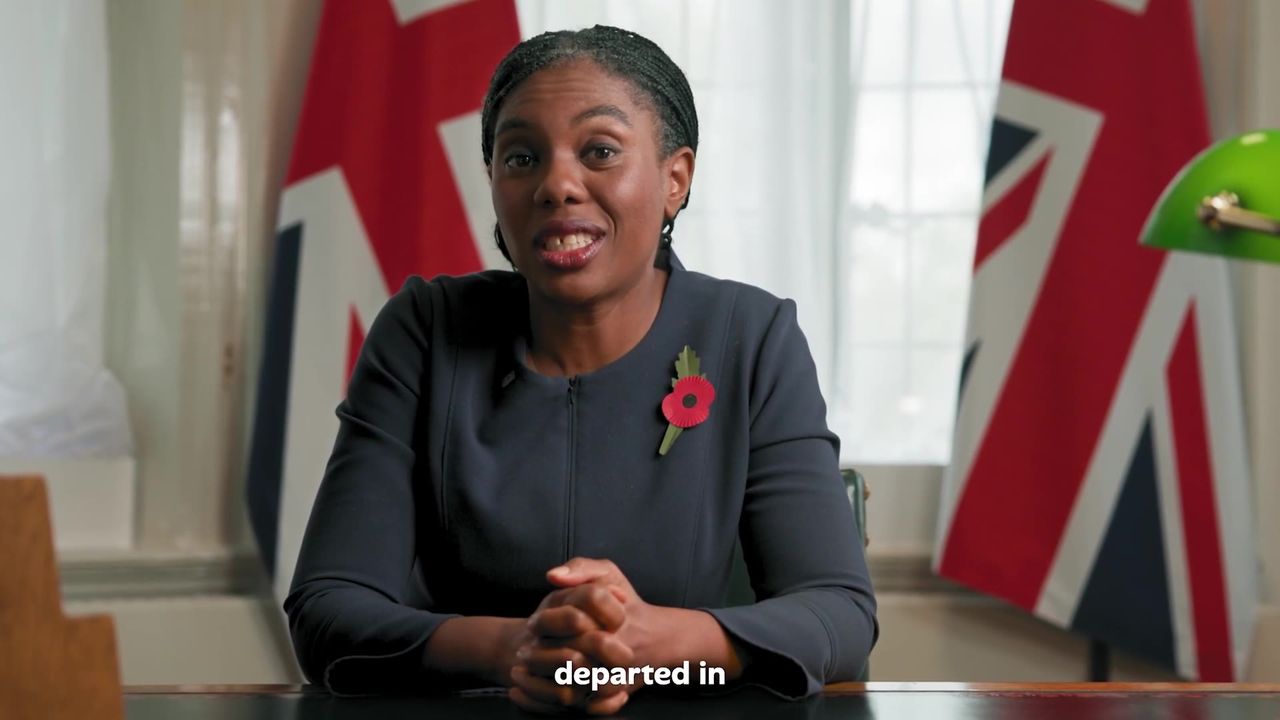
XA video posted on X from Kemi Badenoch's official account, days after the 28 October 2026 Budget. It is a professionally produced party political broadcast: Badenoch speaks to camera, intercut with archive 1940s footage and Budget-day news clips. The clip asks viewers to remember that taxes are heading for a record high and that, in her words, the Budget cuts defence to fund 'ever more welfare'.
“Andy Burnham and John Healey want you to forget about the Budget I won't. Because your taxes are heading for a record high to pay for ever more welfare Don't let them forget it.”
Posted from Kemi Badenoch's official X account in early November 2026, days after the Budget and ahead of Remembrance Sunday. The video carries no independent fact-check label; a British Pathé watermark is visible on the 1940s archive material.
Who posted it
XAccount check
Estimates from public signals — account age, posting pattern, audience — not a judgement of the person behind the account, and separate from whether this post is true.
What stood out
- Handle @KemiBadenoch matches the verified X account of Rt Hon Kemi Badenoch, Leader of the UK Conservative Party and former Business & Trade Secretary — the account is consistently cited by mainstream press (BBC, Guardian, Daily Mail, Independent) as her official channel.
- Account is demonstrably active and current: her X posts are quoted in October 2026 coverage (Budget response on 27-28 Oct 2026, Commonwealth/reparations comments 30 Oct 2026), so it is a live, first-party political broadcaster, not a dormant or hijacked profile.
- Profile metadata supplied here is essentially empty (no bio, no follower count, no creation date) and isplatformverified=false — this looks like an API/scrape gap rather than evidence of a clone, since the exact handle belongs to the real politician and no impersonation of this handle surfaced in search.
- Content pattern is consistent with an authentic politician account: policy statements, Commons Budget reaction, conference messaging, partisan attacks on Labour and Reform UK — high volume and media-synchronised, not spammy or engagement-farming.
- Reliability caveats: she is a partisan source whose claims are routinely checked. Full Fact found her 2026 Budget claim that unemployment rose by ~250,000 under Labour to be correct, but other claims (e.g. Nigerian citizenship being untransferable to her children; the disputed Stanford scholarship offer) have been rated false or questioned.
- Full Fact has separately debunked fabricated posts falsely attributed to her (e.g. a fake 'you spew hatred' Commons remark), indicating third-party misattribution exists around her name — a reason to verify screenshots against the real account.
- No evidence of automated/coordinated inauthentic behaviour: content is hand-written, ideologically coherent, and tied to her real-world public appearances.
Signals (9)+
- Identity confirmation
- Handle matches official account of UK Conservative Party leader; corroborated by BBC, Guardian, Daily Mail, Independent citations
- Account type
- Official politician / party leader account
- Posting cadence
- Regular, event-driven political commentary; multiple posts in Oct 2026
- Follower ratio
- Unknown
- Last activity observed
- 2026-10-30 (X post on Commonwealth reparations, cited by Daily Mail)
- Notable news coverage
- Extensive mainstream coverage of her X posts in Oct 2026
- Fact check history
- Claims assessed by Full Fact (2026 Budget: some correct, some misleading); Nigerian citizenship claim rated false by CableCheck; false posts misattributed to her debunked by Full Fact
- Affiliation
- Leader of the Opposition / Conservative Party (UK)
- Source bias
- Partisan political actor — treat as primary source for her own statements, not for factual claims about opponents
Account checked November 1, 2026, 03:12 UTC
The media
Video✓ What is genuine
The video itself: it is genuine, professionally produced political content from Badenoch's official account, built from real archive and news material. What is not reliable is one of the things it says, not the footage.
The tells
- ●●● Strong signal The 1940s archive footage carries a visible British Pathé watermark, marking it as licensed historical material rather than something staged.our visual review
- ●●○ Supporting signal The Budget-day and parliamentary clips are standard news footage consistent with the 28 October 2026 Budget.our visual review
- ●●○ Supporting signal The to-camera sections are a conventional party political broadcast setup, with Union flags in the background.our visual review
Synthetic-media detector
Detector not consultedThe media is incidental to the claim; the detector was not needed.
How we checked the media
- Reviewed the video's keyframes and the supplied transcript against the caption and identified the archive and news footage used.
- Compared on-screen claims against post-Budget coverage from BBC, ITV, the Guardian, the Independent, the Daily Mail and IFS analysis.
Sources
8 sources reviewed- 1Budget 2026 live: Tories criticise 'disjointed' Budget as watchdog warns of 'pretty grim' economic picture ↗
BBC · bbc.comReputable outletCenter; light bias tagContext
Post-Budget reporting on Badenoch's criticism of Healey's first Budget and OBR warnings.
- 2Budget 2026 live: £100 energy payment for millions and rise in bank tax as watchdog warns on stalling living standards ↗
The Guardian · theguardian.comReputable outletLean Left (AllSides)Evidence
Badenoch's Commons remark welcoming the funded defence investment plan.
- 3Budget 2026: How will the chancellor fund commitment to defence? ↗
ITV News · itv.comReputable outletCenterEvidence
The £4.7bn defence funding commitment and 2.7% of GDP defence path by 2027.
- 4Budget 2026 forecasts: Which records have been set and milestones passed? ↗
The Independent · the-independent.comUntiereduntiered — treated as signal only, never decisiveEvidence
The OBR tax-burden record figures and the 1948 origins of current records.
- 5Healey's budget paves way for 'brutal' spending review next year, warns IFS ↗
The Guardian · theguardian.comReputable outletLean Left (AllSides)Evidence
IFS analysis of deferred spending decisions and the £11bn funding gap for the 3% target.
- 6What's NOT in the Budget? Healey kicks tough decisions on cutting benefits and funding defence down the road ↗
Daily Mail · dailymail.comUntiereduntiered — treated as signal only, never decisiveEvidence
That welfare cuts were absent from the Budget and defence commitments were pushed later.
- 7Labour's stealth raid on workers to push tax burden to record high ↗
Yahoo Finance / The Telegraph · finance.yahoo.comUntiereduntiered — treated as signal only, never decisiveEvidence
The previous tax-burden record of 37.2% in 1948-49 under Cripps.
- 8Tory leader criticises 'piecemeal' Budget measures saying savings should come from welfare ↗
BBC · bbc.comReputable outletCenter; light bias tagEvidence
Welfare bill rising, benefits uprated 3.5%, defence plan fully funded and 3% target for 2030.
Further reading
- 3ITV News The clearest account of the £4.7bn defence funding commitment and the 2.7% of GDP path.
- 2The Guardian Records Badenoch's own Commons welcome for the funded defence plan.
- 5The Guardian The IFS view on where the Budget deferred hard choices, including the £11bn gap in the 3% defence target.
- 4The Independent Explains the record tax-burden forecasts and the historical comparisons behind the video's 'pop quiz'.
The full story
The video is built on a real and striking fact. According to OBR forecasts, the UK tax burden is on course to reach a record 37.9% of GDP in 2027-28, the highest since records began in 1948. The previous record, around 37.2%, was set in 1948-49 — when Stafford Cripps was Chancellor. That is why the comparison to rationing, one television channel and a motorway still a decade away feels so effective: it is essentially accurate.
The rest of the story is more mixed. Welfare spending does rise in this Budget, from roughly £334bn to £431bn by 2030, with benefits uprated 3.5% and welfare reform pushed to later reviews. So the sense that the benefits bill is growing is grounded.
But the pivot of the argument — that the Budget cuts defence to pay for it — is contradicted by the Budget itself. Healey fully funded the £4.7bn gap in the Defence Investment Plan, with defence spending reaching about 2.7% of GDP by 2027 and a 3% target for 2030. Nato's Mark Rutte welcomed the plan. Critically, Badenoch told the Commons that Healey 'has funded the defence investment plan – that is welcome', as the Guardian reported.
There is a fair criticism buried here: the IFS said an extra £11bn would be needed to fund the full 3% commitment, and the Daily Mail noted hard choices were deferred. Deferring a target is not cutting defence. The video swaps one for the other, and the accurate tax record gives the swap its credibility.
Kernel of truth
The tax burden really is heading for its highest level since the late 1940s, and welfare spending really is rising. The false move is pairing that with a claim that defence spending was cut, which the Budget contradicts.
Timeline
October 28, 2026
Chancellor John Healey delivers the UK Budget under Prime Minister Andy Burnham, leaving welfare reform to later reviews and fully funding the Defence Investment Plan. 3ITV News
October 28, 2026
Badenoch responds in the Commons, welcoming the funded defence investment plan while criticising the Budget. 2The Guardian
November 2026
Badenoch posts the 'pop quiz' video on X arguing taxes are rising to fund welfare while defence is cut.
How it was framed
The video is genuine and several of its building blocks are accurate, but the overall argument is arranged to frame the Budget as cutting defence to fund welfare, which the Budget does not do. The false note is the framing rather than a fabricated document.
- Selective evidence. The video cites the record tax burden and rising welfare bill accurately but omits that the same Budget funded the £4.7bn defence plan.
- Us vs. them. 'Not welfare for our veterans, but welfare for people who can work, but choose not to.'
- Emotional language. 'Ever more welfare', 'left the economy in tatters', 'profoundly difficult moment'.
- Ongoing-threat framing. 'Your taxes are heading for a record high' and 'Don't let them forget it.'
- Borrowed authority. The 'pop quiz' format and archive references to Stafford Cripps and 1947 lend a historical, factual register.
Posted from Kemi Badenoch's official X account in early November 2026, days after the 28 October 2026 Budget and ahead of Remembrance Sunday. The post has no fact-check label attached.
Bias
Leans Conservative Party / anti-Labour. The video is a party political broadcast by the Leader of the Opposition, framing the Budget entirely as Labour overtaxing and overspending on welfare while underfunding defence, with loaded language ('welfare for people who can work but choose not to', 'not serious').
Bias describes how the post frames its message — the slant of the language, selection and emphasis — and is judged separately from whether the claim is true. A true claim can still be framed with a strong slant.
How we checked
1 min 32 s- 1
Searched for post-Budget coverage of the 28 October 2026 Budget, focusing on welfare and defence.
- 2
Searched for OBR tax-burden records and the comparison with the late 1940s.
- 3
Searched for analysis of whether defence spending rose or fell in real terms.
- 4
Reviewed the video's keyframes and transcript to confirm it was genuine political content and to identify the archive material used.
✓ Claim checked✓ Media checked✓ Sources checked
Why 78% confidence
HighHIGH reflects that the decisive fact — defence spending rose and the plan was fully funded — is reported by broadcasters including ITV and the BBC and confirmed by the speaker's own Commons remarks. The tax-burden figure is corroborated across outlets of different leanings. We did not run a synthetic-media detector because the footage's authenticity is not what decides the claim.
Limits. We did not open the primary Budget or OBR documents in full and relied on reporting of them. No independent fact-check of this specific video was found. Long-term defence funding beyond 2030 is not settled.
What we don’t know
- Whether later spending reviews will actually deliver the full 3% of GDP defence target the Budget set for 2030.
- How much of the welfare growth is attributable to each benefit category beyond the pensions and disability/health split.
- Whether the video was coordinated with any wider campaign; we found no evidence either way.
Spot it yourself
Spot the fakeLooks suspicious, isn’t proof
- It comes from a party leader's official account and is openly political — that tells you to check, not that it is wrong.
- The slick production and archive footage are designed to persuade, but production quality is not evidence either way.
- The punchy, repetitive style ('ever more welfare') is rhetoric, not proof of a false claim.
The actual evidence
- The Budget document and post-Budget reporting show defence spending rising to about 2.7% of GDP by 2027, with the £4.7bn gap fully funded.
- Badenoch's own Commons response welcomed the funded defence plan, directly contradicting the video.
- The OBR forecasts confirm the tax-burden and welfare figures, which is why most of the video sounds right.
- Multiple outlets of different political leanings report the same defence direction of travel.
- 1
Separate the true from the false inside one post
List each factual assertion separately and check each. Here the tax and welfare numbers hold; the defence line does not.
- 2
Go to what the decision-maker said at the time
Commons and Budget-day recordings often catch a politician saying the opposite of their later framing. Badenoch's welcome for the funded plan is the clearest example.
- 3
Ask what the official forecasts actually cover
Defence spending figures appear in the OBR and Budget documents; a rising percentage of GDP is hard to reconcile with a 'cut'.
- 4
Treat vivid historical detail as scene-setting, not proof
Accurate colour about rationing or one TV channel makes the next claim feel trustworthy. Judge the load-bearing claim on its own.
Takeaway
A post can get most of its facts right and still mislead you through the one thing it adds. Check the claim that does the persuading, especially when it fits a political narrative you already lean towards.
Questions people ask
Did John Healey's Budget cut defence spending?+
No. The 28 October 2026 Budget fully funded the £4.7bn shortfall in the Defence Investment Plan, taking defence spending to about 2.7% of GDP by 2027, with a 3% target for 2030. Nato's Mark Rutte welcomed it, and Kemi Badenoch herself welcomed the funded plan in the Commons.
Is the UK tax burden really the highest since the 1940s?+
Yes, on OBR forecasts. The tax burden is 36.0% of GDP now, rising to a record 37.9% in 2027-28 and 38.6% by 2031-32. The previous record was about 37.2% in 1948-49, when Stafford Cripps was Chancellor — so the comparison holds, though the exact year in the video is a slight simplification.
Is Kemi Badenoch's video real or AI-generated?+
The video is real. It is a professionally produced party political broadcast from her official X account, using her to camera, British Pathé archive footage with the watermark visible, and Budget-day and parliamentary news clips. The problem is one of its claims, not the footage.
Does welfare spending go up in the 2026 Budget?+
Yes. The OBR forecasts welfare spending rising from around £334bn to £431bn by 2030, with benefits uprated 3.5%. The Budget contained no welfare cuts; reform was deferred to reviews reporting later. The growth is driven mainly by pensions and disability and health-related benefits.
Why does a partly accurate post still count as misleading?+
Because the overall impression can be wrong even when many individual facts are right. Here the tax and welfare figures are accurate, but the conclusion that the Budget cuts defence is false, and the accurate parts make that false conclusion easier to accept.
Go deeper
- Tax burden
- Taxes as a share of the whole economy (GDP), which allows fair comparison across different decades.
- OBR
- The Office for Budget Responsibility, the independent body that produces official forecasts for the UK's public finances.
- Defence Investment Plan
- The government's programme for defence equipment and spending; the Budget fully funded a £4.7bn shortfall in it.
- Welfare spending
- Government spending on benefits and pensions, which this Budget forecasts rising from about £334bn to £431bn by 2030.
- Selective evidence
- Citing only the facts that support a conclusion while leaving out those that contradict it.
People also search for
For educators+
- The video gets several facts right. Does that make the overall message more or less misleading, and why?
- How would you check the claim about defence spending using only official documents and recordings?
- If you were writing a correction, how would you separate the true parts from the false one without dismissing the whole post?
About this check
- Platform
- X
- Posted by
- @kemibadenoch
- Posted
- November 6, 2026
- Age when checked
- Under 24 hours old when checked
- Where it spread
- United Kingdom
- Audience
- UK & EU audience
- Language
- EN
- Status
- ● Post is live
- Verified
- November 7, 2026, 03:10 UTC
- Published
- November 7, 2026, 03:10 UTC
Reach. 2,055 likes (X syndication, 7 Nov ~02:40Z); video post
This verdict was generated with AI from the sources shown. AI can make mistakes — check the sources before relying on it.
Check anything yourself, in seconds.
Share any social post or video to What the Fact and get the verdict, the confidence, and the receipts.