Did Viktor Orbán refuse a state-security recruitment attempt during military service?
Did Hungary's communist-era secret police try and fail to recruit Viktor Orbán as an informer, as he says, or did he file informant reports, as ex-PM Miklós Németh claims?
True, but…
Genuine archive files, but the refusal itself is Orbán's word, not the paperwork's.
Partly. The state-security documents Orbán posted on Facebook on 3 November 2026 are genuine. They show a 1982 recruitment study of him was dropped, and that he and his wife were later surveilled and bugged. But no document records him refusing: 'I said no' is his own account, and other records suggest he was a military-counterintelligence 'social contact'.
 Genuine
Claims
✓ 2 trueDuring the early part of his compulsory military service, state security tried to recruit him, he refused, and the attempt therefore failed.12810
“Sorkatonai szolgálatom első időszaka alatt megpróbáltak beszervezni, de ezt visszautasítottam, így a kísérlet sikertelenül végződött.”
Split the caption into its two halves and the evidence separates cleanly. The first half — that state security studied recruiting him — is documented. Telex's archive explainer quotes the key line: in 1982 the Interior Ministry's III/III-2 department studied Dr Orbán 'for the purpose of recruitment' but then 'elálltak' from recruiting him. Magyar Nemzet reports the same preliminary examination and the same decision to drop it. The second half — that he refused — is not in the published pages. The files record the service abandoning the idea, not the target turning it down. Against that gap sit records Orbán does not show: a surviving military-counterintelligence 'A' card listing him as a 'social contact' of an officer from 20 October 1981 to the end of his service, and former prime minister Miklós Németh's 2026 statement that he saw three handwritten reports attributed to Orbán, handwriting unverified. Historian Krisztián Ungváry and Telex's archive experts both say there is no proof Orbán was recruited as an agent, and Fidesz called the informant allegations a lie. So: the recruitment attempt is real; the personal refusal is his account, contested and undocumented. Those are one source (the files) against another account (his), not two independent confirmations.
Still open: Whether the military-counterintelligence 'A' card entry as a 'social contact' involved any actual reporting, and whether Németh's three handwritten reports are genuine and by Orbán. Neither is settled by the published pages.
Afterwards he, his wife and his opposition associates were kept under continuous surveillance and were targets of the state party's secret investigations.139
This is the part of the post the documents carry most strongly. The images are genuine III/III records: confidential investigations opened under cover names 'Viktória' (Orbán) and 'Bojtár' (his wife Anikó Lévai), reports on their circle of opposition lawyers, and the 1986 closure of the 'Viktória' inquiry for lack of evidence. The files describe targets and methods, not just a name in a ledger, which is why historians treat them as reliable on surveillance. Telex's English edition summarises the same set: documents showing Orbán was himself kept under regular surveillance along with his wife. Ungváry, who sits on the committee overseeing the classified-documents review, likewise states Orbán was a surveillance target after his discharge. The sources here are several and partly independent — Telex's archive experts, Magyar Szó on the wiretaps, and Ungváry — though many draw on the same ÁBTL fond, so they corroborate the documents rather than replace them. On this claim, the post understates rather than overstates: the record is clear.
Listening devices were installed at their workplaces, in their homes and even in their bedroom.39
The wiretapping is documented; the most intimate detail is Orbán's own phrasing. A 29 August 1986 report in the published set records that listening devices were installed and put into operation the previous day in the 'Bojtár' and 'Viktória' cases, according to Magyar Szó's account of the release. A 1987 report describes preparation and execution of bugging of the couple's Szolnok flat ahead of a planned opposition meeting. That establishes devices in the home and at organising sites. What the fragments shown do not spell out is the bedroom specifically — that word comes from the caption, not the visible pages. We rate it LIKELY_TRUE rather than TRUE because the underlying surveillance is solid but the single most vivid element is not independently pinned down in what was published. A reader should weigh the documented bugging heavily and treat the bedroom detail as an unverified embellishment of a real practice.
Still open: Whether any published page explicitly places a device in the couple's bedroom, or whether that detail comes only from Orbán's caption.
What was posted
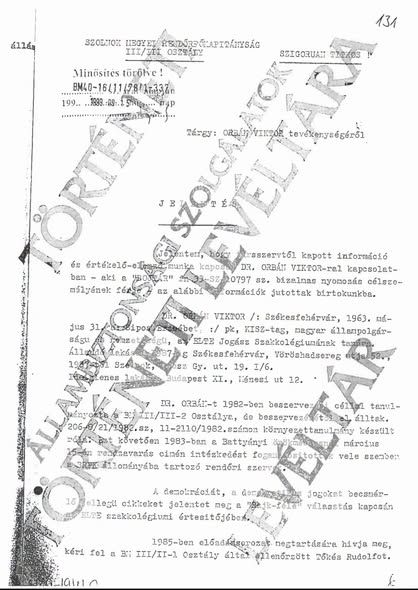
FacebookOn 3 November 2026, two days before Hungary's communist-era informer database opened, Viktor Orbán posted five images on Facebook. The images are typewritten Hungarian state-security reports and internal notes, marked 'strictly secret' and carrying the ÁBTL archive watermark. The caption tells the story the images are meant to support: that state security tried to recruit him during the early part of his military service, that he refused, that the attempt failed, and that he and his associates were then kept under continuous surveillance.
“Sorkatonai szolgálatom első időszaka alatt megpróbáltak beszervezni, de ezt visszautasítottam, így a kísérlet sikertelenül végződött. Később folyamatos megfigyelés alatt tartottak engem, a...”
“During the early part of my compulsory military service they tried to recruit me, but I refused this, so the attempt ended unsuccessfully. Later I was kept under continuous surveillance, the...” — translated
Posted on Orbán's own public Facebook page, published in the same days that Hungary prepared to open its communist-era informer archive database. The same documents were previously published by him in 2005 and in 2012.
The media
Image✓ What is genuine
The document scans themselves: they appear to be authentic copies of Hungarian state-security records, and the post presents them as exactly that. The dispute is over what the documents mean and what they leave out, not over whether the paper is real.
The tells
- ●●● Strong signal The scans carry 'Szigorúan titkos' markings, BM III/III file numbers and the Historical Archives of the State Security Services (ÁBTL) watermark, in the layout of genuine typewritten state-security reports.our visual review
- ●●○ Supporting signal Our detector scored the images as overwhelmingly not AI-generated (0.998 not_ai_generated; AI-generated probability about 0.014).our detector
- ●●● Strong signal The same document set has been public since 2005 and 2012, so there is a long, checkable publication history rather than a single unexplained upload.Északhírnök
Synthetic-media detector
Detector ranThe claim stands or falls on whether the media is real, so the detector ran.
Scores are the detector’s estimate for the file as uploaded. A low score does not rule out editing, a spliced caption, or footage shown out of context — those are judged above. Model v3.
How we checked the media
- Reviewed the five images by eye for document format, 'strictly secret' markings, III/III file references and the ÁBTL archive watermark.
- Compared the content of the images with what archive-based reporting describes the files as containing.
- Ran our AI-image detector on the scans to rule out synthetic fabrication.
- Checked provenance: the same documents were published by Orbán in 2005 and again in 2012, which is consistent with genuine archival copies.
Sources
11 sources reviewed- 1Orbán: Sorkatonai szolgálatom első időszaka alatt megpróbáltak beszervezni, de ezt visszautasítottam ↗
Telex · telex.huUntiereduntiered — treated as signal only, never decisiveContext
Establishes that the post was a response to Németh's informant allegation and summarises its content.
- 2Ami tudható: Orbán Viktorról a katonai elhárításnál készült akta, de a beszervezésére nincs bizonyíték ↗
Telex · telex.huUntiereduntiered — treated as signal only, never decisiveEvidence
Quotes the 1982 recruitment-study line and the decision to desist, and records the 'A' card 'social contact' entry.
- 3Orbán: They tried to recruit me during the early period of my military service, but I refused ↗
Telex (English) · telex.huUntiereduntiered — treated as signal only, never decisiveEvidence
Confirms the document set covers surveillance of Orbán and his wife, and describes the 1987 bugging.
- 4Hungary releases secret police files from communist era ↗
Politico Europe · politico.euReputable outletCenter/Lean LeftContext
Establishes the statement was made on Facebook and its timing relative to the archive opening.
- 5Orbán tvrdí, že odmietol spolupracovať s komunistickou tajnou službou ↗
TERAZ.sk (TASR/Reuters) · teraz.skUntiereduntiered — treated as signal only, never decisiveContext
Corroborates the existence and date of the post through a wire-service report.
- 6Hungary to open Communist-era informer files ↗
AFP via Yahoo News · malaysia.news.yahoo.comUntiereduntiered — treated as signal only, never decisiveContext
Corroborates the post as a denial made ahead of the vote, with documents showing a failed recruitment attempt.
- 7„Handschriftliche Berichte“: War Viktor Orbán ein Spitzel der Kommunisten? ↗
Die Presse · diepresse.comReputable outletCenter/Lean RightContext
Reports the post and the competing claim that he may have reported to military counterintelligence.
- 8Orban says he rejected recruitment during communist era, former Hungarian PM claims he saw informant reports from him ↗
Insight Hungary (444) · insighthungary.444.huUntiereduntiered — treated as signal only, never decisiveEvidence
Reports Orbán's refusal claim together with Németh's statement about handwritten reports.
- 9ÜGYNÖKAKTÁK NYILVÁNOSSÁGRA HOZATALA ↗
Magyar Szó · magyarszo.rsUntiereduntiered — treated as signal only, never decisiveEvidence
Describes the 29 August 1986 report on installing listening devices in the 'Bojtár' and 'Viktória' cases.
- 10Orbán Viktor nyilvánosságra hozta, hogyan próbálta beszervezni és megfigyelni a kommunista állambiztonság ↗
Magyar Nemzet · magyarnemzet.huUntiereduntiered — treated as signal only, never decisiveEvidence
Confirms the 1982 preliminary recruitment examination and the decision to abandon it.
- 11Orbán. Hogyan értelmezzük a volt miniszterelnök „A” kartonját? ↗
Északhírnök · eszakhirnok.comUntiereduntiered — treated as signal only, never decisiveContext
Establishes the documents were previously published in 2012 and 2005, relevant to provenance.
Further reading
- 2Telex The clearest archive-based explainer, quoting the decisive 1982 line and noting the 'A' card.
- 3Telex (English) The English-language summary of what the document set shows about surveillance and bugging.
- 9Magyar Szó Details the 1986 bugging report and the 'Bojtár'/'Viktória' case files.
- 11Északhírnök Explains the publication history of the same documents in 2005 and 2012, relevant to provenance.
The full story
The kernel of truth here is solid and documented: Hungarian state security did take an interest in Viktor Orbán during his military service, and later did surveil him and his wife. In 1982 the Interior Ministry's III/III-2 department studied him 'for the purpose of recruitment' and then abandoned the idea — the file uses the word 'elálltak', they stepped back. That is a real recruitment attempt that really ended without a recruit, and it is why the post feels plausible to anyone who opens the scans.
What the papers do not contain is Orbán saying no. A file that records a service dropping a target is not the same as a file recording the target refusing. The refusal is his account, offered in the caption, and it runs into records he did not post: a surviving military-counterintelligence 'A' card that lists him as a 'social contact' of an officer from October 1981 to the end of his service, and Miklós Németh's 2026 statement that he saw three handwritten reports attributed to Orbán. Neither proves he informed; the handwriting was not verified, historians including Krisztián Ungváry and Telex's archive experts say there is no proof he was recruited as an agent, and Fidesz called the informant allegations a lie.
On surveillance the documents are strong: the 'Viktória' and 'Bojtár' investigations, the 1986 bugging, the planned wiretap of the Szolnok flat. The post's weakness is not fabrication but selection — real paper arranged to answer an accusation with a story that the paper only half supports.
Kernel of truth
A 1982 state-security recruitment study of Orbán was genuinely opened and genuinely dropped, and he and his wife were genuinely surveilled and bugged in the 1980s.
Timeline
October 20, 1981
Start date of the period in which the military-counterintelligence 'A' card records Orbán as a 'social contact' of an officer, lasting to the end of his service. 2Telex
1982
The Interior Ministry's III/III-2 department studies Orbán 'for the purpose of recruitment' and then abandons recruiting him. 2Telex
August 29, 1986
A report records that listening devices were installed and put into operation the previous day in the 'Bojtár' and 'Viktória' cases. 9Magyar Szó
1986
The 'Viktória' investigation into Orbán is closed for lack of evidence. 2Telex
1987
A report describes preparation and execution of bugging of the couple's Szolnok flat ahead of a planned opposition meeting. 3Telex (English)
November 3, 2026
Orbán posts the state-security documents on Facebook, two days before Hungary opens its communist-era informer database. 4Politico Europe
How it was framed
The documents are real and the surveillance they describe is real, but the caption frames them as proof that Orbán refused recruitment — a claim the pages do not establish and which other records contest. The post uses accurate material selectively to answer an informant allegation, which is misleading framing rather than fabrication.
- “Visual proof”. Five scanned reports are attached to the caption as if the paper itself carries the whole story, including the refusal.
- Missing context. The post does not mention the military-counterintelligence 'A' card listing him as a 'social contact' or Németh's claim to have seen handwritten reports attributed to him.
- Selective evidence. The pages chosen document the recruitment study being dropped and the later surveillance, but no page records a refusal.
- Us vs. them. The caption sets his own refusal against an implied accusation, published days before the informer database opened.
Posted on Orbán's public Facebook page on 3 November 2026. Multiple outlets — Telex, Politico Europe, AFP, TERAZ.sk (TASR/Reuters) and Die Presse — report it as his response to resurfaced informant allegations, notably Miklós Németh's statement, ahead of the archive opening. No outlet rating of the page applies here; the post is by the subject of the claim himself.
Bias
Leans pro-Orbán / self-serving victimhood framing. The post is published on Viktor Orbán's own page and is built to rebut accusations that he was a communist-era informant: it foregrounds genuine surveillance files that cast him as a target, characterises the failed recruitment attempt as his own refusal, and does not mention the surviving military-counterintelligence record listing him as a 'social contact' or Németh's claim to have seen reports attributed to him. The documents are real; the selection and framing are advocacy.
Bias describes how the post frames its message — the slant of the language, selection and emphasis — and is judged separately from whether the claim is true. A true claim can still be framed with a strong slant.
How we checked
2 min 11 s- 1
We searched in Hungarian and English for Orbán's military-service recruitment, the III/III files, and the 'Viktória' agent allegation.
- 2
We searched for international reporting on the Facebook post to establish when it appeared and what it contained.
- 3
We compared the content of the posted scans with archive-based reporting that quotes the 1982 file line and describes the later surveillance.
- 4
We reviewed the five images visually for document format, markings and the ÁBTL watermark.
- 5
We ran our AI-image detector on the scans to rule out synthetic fabrication.
✓ Claim checked✓ Media checked✓ Sources checked
Why 76% confidence
HighHIGH on the headline because multiple independent outlets confirm the post and its content, and archive-based reporting quotes the decisive 1982 file line. The central claim is rated PARTLY_TRUE at HIGH confidence: the documented recruitment study is not in dispute, and the absence of a documented refusal is a clear gap in the published pages. The bedroom detail is held at MODERATE because the underlying bugging is well documented but the specific location is not spelled out in the visible fragments.
Limits. We did not examine the original ÁBTL files ourselves; we rely on archive-based reporting and the posted scans. Handwriting attribution in Németh's claim was not verified, and we could not determine whether the 'social contact' entry involved any reporting.
What we don’t know
- Whether the three handwritten reports Miklós Németh says he saw are genuine and were written by Orbán.
- What the military-counterintelligence 'social contact' entry actually involved — whether any information was passed or it was a routine contact record.
- Whether any unpublished page in the files records a refusal by Orbán that was simply not among the five images posted.
- Why Orbán chose these particular five pages from a larger set that was already public.
Spot it yourself
Find the overstatementLooks suspicious, isn’t proof
- The post comes from a politician defending himself against an allegation — that makes it advocacy, but advocacy is not the same as falsification.
- The caption talks about 'continuous surveillance' and a bedroom bugging, which sounds dramatic — dramatic wording is a reason to look closely, not a finding.
- The scans are grainy typewritten pages in a foreign language — low readability makes people either trust or distrust them reflexively, and neither reaction is evidence.
The actual evidence
- The documents are genuine ÁBTL state-security records, confirmed by archive-based reporting and consistent with the same set published in 2005 and 2012.
- The 1982 file line itself says III/III-2 studied Orbán for recruitment and then dropped it — evidence for an attempt, not for a refusal.
- The military-counterintelligence 'A' card and Németh's 2026 statement are real countervailing records the post does not show.
- Two independent expert assessments — Ungváry and Telex's archive experts — agree there is no proof Orbán was recruited as an agent.
- 1
Separate what the document says from what the caption says.
Read the quoted file text: 'studied for the purpose of recruitment' and 'desisted' are the file's words; 'I refused' is the caption's. Ask whether any page you can see actually records the refusal.
- 2
Ask what a document of this kind would look like if the claim were true.
A refusal would normally appear as a note that the target declined. If the visible pages only show the service stepping back, the refusal is not documented there.
- 3
Look for the records the post does not show.
Search the person's name with terms like 'A-karton', 'társadalmi kapcsolat' or 'ügynök' alongside the archive name, and read archive-based explainers rather than only the post.
- 4
Check timing against what was happening.
The post appeared two days before the informer database opened; that context tells you the post is an intervention in a live argument, which is when selective framing is most likely.
Takeaway
Real documents can still be arranged to prove more than they say. The question is never only 'is this paper genuine?' but 'does this paper actually contain the sentence the caption claims?'
Questions people ask
Are the documents Orbán posted real?+
Yes. The five images appear to be authentic copies of Hungarian state-security reports, carrying 'strictly secret' markings, III/III file numbers and the ÁBTL archive watermark. They are consistent with documents Orbán published in 2005 and 2012, and archive-based reporting describes the same material. The dispute is over interpretation, not authenticity.
Did Orbán refuse to be recruited?+
That is his own account. The published files show that in 1982 the Interior Ministry studied him for recruitment and then dropped the idea, but no visible page records him refusing. Other records — the military-counterintelligence 'A' card and Németh's statement — complicate the picture, though neither proves he informed.
Was Orbán under surveillance in the 1980s?+
Yes. The documents include genuine III/III records of the 'Viktória' investigation into Orbán and the 'Bojtár' investigation into his wife Anikó Lévai, reports on their opposition circle, and a 1986 report on installing listening devices. A 1987 report describes bugging of their Szolnok flat.
Was Orbán an informant?+
There is no proof of that. Historians including Krisztián Ungváry and Telex's archive experts say no document establishes he was recruited as an agent, and Fidesz called the informant allegations a lie. The 'social contact' entry and Németh's handwritten-report claim raise questions but do not settle them.
Why does it matter when he posted it?+
Orbán posted the documents on 3 November 2026, two days before Hungary opened its communist-era informer database. That timing makes the post an answer to a live accusation, which is exactly when selective use of real material is most likely. It does not make the documents fake; it explains the framing.
Go deeper
- III/III
- The department of Hungary's communist-era Interior Ministry responsible for internal state-security surveillance and counterintelligence.
- ÁBTL
- The Historical Archives of the Hungarian State Security Services, which holds the surviving state-security files and whose watermark appears on the posted scans.
- A-karton ('A' card)
- A military-counterintelligence record card listing a person as a contact or source; it is a register entry, not proof of actual reporting.
- Cover name
- An alias used in state-security files for an investigation or a person — here 'Viktória' for Orbán and 'Bojtár' for his wife.
- Selective evidence
- Presenting only the genuine material that supports a claim while leaving out genuine material that weakens it.
People also search for
For educators+
- If a file records a service 'desisting' from recruiting someone, what would an actual refusal look like in the paperwork, and why does that distinction matter?
- Orbán posted real documents to answer an allegation. Does presenting accurate material selectively count as misleading? Where is the line?
- How would you check a claim like this yourself if you did not read Hungarian?
About this check
- Platform
- Age when checked
- 1–2 days old when checked
- Where it spread
- HU
- Audience
- UK & EU audience
- Language
- HU
- Status
- ● Post is live
- Verified
- November 7, 2026, 03:01 UTC
- Published
- November 7, 2026, 03:01 UTC
Reach. Wide pickup 5-6 Nov: VSquare, InsightHungary/444, hromadske, mezha, MSN syndications; Google suggest 'orbán ügynökakták' top hit
This verdict was generated with AI from the sources shown. AI can make mistakes — check the sources before relying on it.
Check anything yourself, in seconds.
Share any social post or video to What the Fact and get the verdict, the confidence, and the receipts.