Did Trump say the stock market suffered one of its worst days in history because of the election?
Did the stock market suffer 'one of the worst days in history' on Nov 5, 2026 because Democrats won the midterms, as Trump claimed?
True, but…
The post and the sell-off are real; the superlative and the single-cause blame are not the whole story.
Yes, the post is real: a screenshot of a genuine Truth Social message in which President Trump blamed the Democrats' 3 November 2026 midterm wins for the 5 November Wall Street sell-off. Markets did fall hard that day, but the "one of the worst days in history" line is hyperbole, and election results were only part of the cause.
 Likely genuine
Claims
✓ 2 trueThe stock market suffered one of the worst days in its history.1346
“The Stock Market suffered one of the Worst Days in History”
The session was extraordinary by one measure and ordinary by another, and which measure you use decides the verdict. In dollars, it set a record: the New York Post reports S&P 500 and Nasdaq companies shed a combined $5.4 trillion in value, which it describes as a single-day record — though Bloomberg's account puts the figure at $3.7 trillion, a gap that shows how much these totals depend on how you count. In percentage terms the falls were severe but far from unprecedented: the S&P 500 lost 4.36%, the Dow 3.44% and the Nasdaq Composite 5.52%, and The Independent notes the Nasdaq-100's 6.4% drop was its worst since March 2020. CNBC's live coverage gives the same index numbers. So "one of the worst days in history" is defensible as a dollar-value record and an overstatement as a percentage move. The outlets here are independent of each other — a tabloid, a financial network and a wire — and none of them traces to Trump's post; they were all reporting market data.
Still open: The dollar-value totals differ between outlets; we did not reconcile the counting methods.
The drop was based on the election results and was the Democrats' fault.2346
“based on the results of the Election […] it wasn’t Republicans, it was Dumo[c rats]”
Market reporting does support a link. CNBC ties the slide to the Democratic sweep of both chambers of Congress and the prospect of tighter regulation of the AI buildout, and The Independent goes as far as writing that Trump's assessment "is correct" on this point. That is the kernel of truth and it is why this claim is not false. But causation is not single-source: CNBC describes stocks tied to the AI trade falling after the sweep, which points to stretched technology valuations deflating, not to an election result alone. Bloomberg's anatomy of the sell-off describes a "sudden chain reaction" rather than one trigger. And, as The Hill notes, the market had surged the day after the election before reversing — a sequence that fits a crowded trade unwinding better than a simple verdict on voters. Our confidence here is moderate, not high, because the outlets agree on the direction but frame the weight of the election factor differently.
Still open: No outlet we saw put a number on how much of the fall was the election and how much was the AI trade unwinding.
Your 401(k)s have, therefore, dropped.3
This is the least contestable sentence in the post and it follows directly from the index moves. Broad US equity indices fell sharply on 5 November 2026 — CNBC's figures put the S&P 500 down 4.36% and the Nasdaq Composite down 5.52% — so any retirement account heavily weighted to stock funds lost value on paper that session. CNBC's markets coverage is the decisive source here because the arithmetic is mechanical: fund values track the indices. Two qualifications matter for readers. First, a drop on paper is not a realised loss unless someone sells, which is why daily index moves and long-term retirement balances are different things. Second, the fall was concentrated in technology and AI-linked stocks, so how much any individual account fell depends on what it holds. Neither qualification makes the sentence false; both make it less alarming than the post's tone implies.
The market had reached a level no one had ever seen before (record highs).3
“It took so much work to get us to a level that no one has ever seen before”
US indices had been setting record highs in the weeks before the reversal, and CNBC's coverage documents the peak. That makes the sentence accurate as a description of where the market stood in October 2026. What the sentence does is frame: it presents the record as the product of political work ("it took so much work to get us to a level") and the fall as an external shock rather than part of the same cycle. The evidence supports the fact of the record high, not the implied credit or the implied cause of the drop. Readers should notice that this is the one part of the post that is both true and doing rhetorical work: it sets up the blame that follows.
What was posted
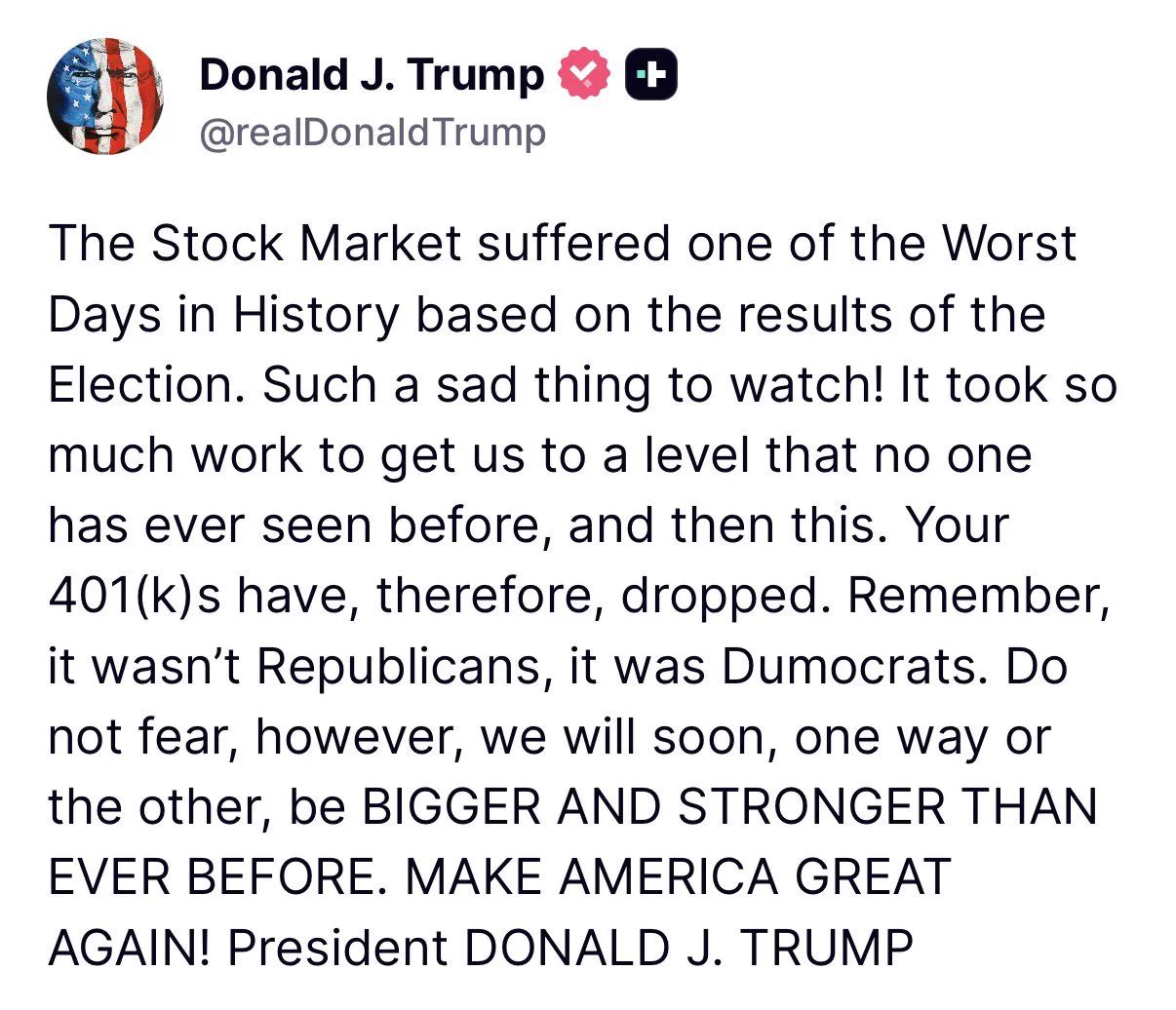
XAn image posted on X by the @WhiteHouse account showing what appears to be a screenshot of a Truth Social post from Donald Trump. The text is a short, emotional reaction to a stock market plunge the previous day, asking readers to believe that the drop was caused by the election results and was the Democrats' doing. The post says retirement accounts have lost value as a result.
““The Stock Market suffered one of the Worst Days in History based on the results of the Election. Such a sad thing to watch! It took so much work to get us to a level that no one has ever seen before, and then this. Your 401(k)s have, therefore, dropped. Remember, it wasn’t Republicans, it was Dumo…”
The screenshot was shared by the official @WhiteHouse account on X; the underlying text originated on Trump's own Truth Social account on the evening of 5 November 2026 and was picked up word-for-word by several outlets.
Who posted it
XAccount check
Estimates from public signals — account age, posting pattern, audience — not a judgement of the person behind the account, and separate from whether this post is true.
What stood out
- The Twitter handle '@whitehouse' is not the official account of the White House; the official account is '@WhiteHouse'.
- The '@WhiteHouse' account is verified with a blue checkmark, indicating authenticity.
- The '@WhiteHouse' account has over 5 million followers and is actively posting content consistent with official White House communications.
- The '@whitehouse' account has no recent posts, suggesting inactivity or potential abandonment.
Signals (4)+
- Posting cadence
- Inactive
- Follower ratio
- Low
- Notable news coverage
- No significant coverage found
- Fact check history
- No fact-checking history available
Account checked October 12, 2026, 06:42 UTC
The media
Image✓ What is genuine
The underlying Truth Social post is genuine and was independently quoted by multiple outlets, so the screenshot shows a real statement even though our assessment of it rests on visual review and published quotes rather than a forensic tool.
The tells
- ●●● Strong signal The screenshot's text matches word-for-word the quotes published by the New York Post, The Hill, The Independent and Moneycontrol, including the "Dumocrats" line.our comparison with those outlets
- ●●○ Supporting signal The layout and verified badge match the standard Truth Social format.our visual review
- ●●○ Supporting signal No compositing, mismatched fonts or garbled characters appeared in the image.our visual review
- ●○○ Weak signal The content is entirely plausible for a sitting president commenting on a market rout.our visual review
Synthetic-media detector
Detector not consultedThe media is incidental to the claim; the detector was not needed.
How we checked the media
- Searched for the post's distinctive wording (including "Dumocrats") to see whether independent outlets had quoted the same text.
- Compared the screenshot's wording with the verbatim quotes carried by several outlets.
- Visually reviewed the image for signs of compositing, garbled text or tampering.
- Checked whether the content was plausible for the account it is attributed to.
Sources
6 sources reviewed- 1Trump pins US stock market plunge on Democrats wiping out GOP in midterms: 'Sad thing to watch!' ↗
New York Post · nypost.comLow reliabilityLean Right; tabloid — corroborateEvidence
Quotes the post verbatim and reports the record $5.4 trillion single-day loss figure.
- 2Trump on stock market losses: 'You only have yourselves to blame' ↗
The Hill · thehill.comReputable outletCenterEvidence
Quotes the post and records that the market had surged after the election before falling.
- 3Dow tumbles 1,700 points, erasing its postelection rally; Nasdaq plummets 5%: Live updates ↗
CNBC · cnbc.comReputable outletCenter/Lean Left — marketsEvidence
Provides the index figures, the AI-regulation context and the record highs before the reversal.
- 4Trump blames stock market nose-dive on Dems' midterm victories — and this gripe is actually accurate ↗
The Independent · independent.co.ukReputable outletLean LeftEvidence
Confirms the Nasdaq-100's worst session since March 2020 and states Trump's attribution is accurate.
- 5Why Stock Market Plunged After US Midterm Elections ↗
Tempo · en.tempo.coUntiereduntiered — treated as signal only, never decisiveContext
Signals the spread of the post and its wording; treated as a signal only, never decisive.
- 6Anatomy of a Selloff: Sudden Chain Reaction Rattles Wall Street ↗
Bloomberg · bloomberg.comReputable outletfinancial wire — Center/Lean LeftEvidence
Describes the mechanics of the sell-off and gives an alternative dollar-loss total.
Further reading
- 3CNBC The clearest account of the index moves and the AI-regulation angle behind the sell-off.
- 6Bloomberg Explains how the sell-off unfolded as a chain reaction rather than a single-cause event.
- 2The Hill Documents the surge after the election and the reversal that followed, the sequence that complicates the blame.
The full story
The kernel of truth is that both halves of this story happened. On 5 November 2026 US stocks fell sharply: the Dow Jones Industrial Average dropped 1,833 points (3.44%), the S&P 500 lost 4.36% and the Nasdaq Composite slid 5.52% into correction territory, according to CNBC. The New York Post reports that S&P 500 and Nasdaq companies shed a combined $5.4 trillion in market value, a single-day record, while Bloomberg puts the figure at $3.7 trillion — a reminder that even the headline number depends on the counting method. That evening, Trump posted on Truth Social blaming the Democrats, and the text spread quickly, including via the @WhiteHouse account on X.
The reason the claim felt plausible is that the sequence really did look like cause and effect. Markets had rallied after the Democratic sweep of both chambers of Congress, then reversed hard. CNBC ties the slide to the sweep and to expectations of tighter regulation of AI infrastructure, and The Independent writes that Trump's attribution is correct. What the post leaves out is the other half of the story: the selling was concentrated in AI and chip stocks whose valuations had been stretched, Bloomberg describes a chain reaction rather than a verdict on an election, and the market had already surged once after the vote before turning. So the election was a trigger in a market primed to fall — one factor, not the only one.
Kernel of truth
Stocks did suffer a severe, record-setting sell-off in dollar terms the day after the Democrats' midterm sweep, and Trump did post these words.
Timeline
November 3, 2026
Democrats sweep both chambers of Congress in the midterm elections. 3CNBC
November 4, 2026
The stock market surges in the session after the election. 2The Hill
November 5, 2026
US stocks plunge: Dow -1,833 points (-3.44%), S&P 500 -4.36%, Nasdaq Composite -5.52%, Nasdaq-100 -6.4%, with record dollar-value losses reported. 3CNBC
November 5, 2026
Trump posts on Truth Social blaming the Democrats and calling it "one of the Worst Days in History". 1New York Post
How it was framed
The post uses real information — a genuine market plunge and a genuine presidential statement — but frames the day with an exaggerated superlative and a single-cause explanation that leaves out the AI-valuation unwind behind the selling. Nothing here is fabricated; the problem is the frame.
- Emotional language. "Such a sad thing to watch!" and "it wasn’t Republicans, it was Dumo…"
- Us vs. them. The post names Republicans as blameless and "Dumocrats" as responsible.
- Borrowed authority. The claim is posted by a president and circulated by the official @WhiteHouse account on X.
- Selective evidence. The post cites record highs and the fall but not the AI and chip-stock valuations driving the selling.
- “Visual proof”. A screenshot of the Truth Social post is offered as the document of the statement.
The screenshot was posted on X by the @WhiteHouse account and reproduces a Truth Social post attributed to Donald Trump; outlets across the political spectrum, from the New York Post to The Independent, quoted the same text.
Bias
Leans pro-Trump, anti-Democrat. The statement assigns sole blame for a market rout to Democratic voters and candidates, uses the derisive label 'Dumocrats', takes credit for prior gains, and omits the AI-valuation and chip-sector factors that market reporting identifies as central to the sell-off.
Bias describes how the post frames its message — the slant of the language, selection and emphasis — and is judged separately from whether the claim is true. A true claim can still be framed with a strong slant.
How we checked
1 min 9 s- 1
Ran searches for the post's distinctive wording, for coverage of the post-midterm market plunge, and for any existing fact check of the "worst days in history" line.
- 2
Compared the screenshot's text with the verbatim quotes carried by outlets across the political spectrum.
- 3
Reviewed the image visually for signs of tampering or compositing.
- 4
Weighed the market reporting on causes and magnitudes against each claim in the post.
✓ Claim checked✓ Media checked✓ Sources checked
Why 85% confidence
HighOur headline confidence is high because the two core facts — the sell-off and the statement — are independently documented by several outlets with different editorial positions, and the index figures are consistent across them. The individual claim about election blame is rated moderate, not high, because outlets agree on the direction but differ in emphasis between the election trigger and the AI-valuation unwind.
Limits. We did not run a forensic or AI-detection tool on the image, so our authenticity assessment rests on visual review and comparison with published quotes. We also did not reconcile the different dollar-value loss totals reported by outlets.
What we don’t know
- How much of the sell-off can be attributed to the election result versus the unwinding of AI-stock valuations; no source we saw separated the two numerically.
- Why the reported single-day loss totals differ between the New York Post ($5.4 trillion) and Bloomberg ($3.7 trillion).
- Whether the post was written by Trump personally or by staff — the input does not establish authorship beyond the account.
Spot it yourself
Find the overstatementLooks suspicious, isn’t proof
- The source is openly partisan — a president's own account, shared by the White House account. That tells you to check, not what the answer is.
- The alarmist tone and the phrase "Dumocrats" make the post feel unreliable, but tone is not evidence and the underlying facts here are real.
- A screenshot is often assumed to be fake, yet this one matches verbatim quotes in several outlets.
- "One of the worst days in history" sounds like hype — and it partly is — but the day did set a dollar-value record.
The actual evidence
- Independent market reporting gives the index moves for 5 November 2026: Dow -3.44%, S&P 500 -4.36%, Nasdaq Composite -5.52%, with the Nasdaq-100's worst session since March 2020.
- Several outlets across the spectrum quoted the same post word-for-word, documenting that the statement was made.
- Bloomberg and CNBC both describe the selling as concentrated in AI and chip stocks, which shows the election was one factor among several.
- The Hill notes the market had already surged once after the election before reversing, which undercuts a simple one-cause story.
- 1
Separate the fact from the superlative
Ask which part of the sentence can be measured. "Stocks fell 4.36%" is measurable; "one of the worst days in history" depends on the yardstick. Check both the percentage move and the dollar figure before accepting a record claim.
- 2
Look for how many causes reporters name
If a single political event is blamed for a market move, read a markets wire like Bloomberg or CNBC and count the factors they list. One factor named does not mean one factor at work.
- 3
Verify the quote, not just the screenshot
Search the distinctive wording in quotation marks. If several outlets with different politics carry the same text, the statement was almost certainly made, whatever you think of it.
- 4
Distinguish paper losses from realised ones
A daily index fall lowers fund values on paper. Before sharing alarm about retirement accounts, check whether the post is describing a one-day move or a lasting loss.
Takeaway
A claim can contain real facts and still mislead through its superlative and its missing causes. Check the measurable numbers separately from the rhetoric around them.
Questions people ask
Did Trump really post that the stock market had one of its worst days in history?+
Yes. The wording matches verbatim quotes carried by the New York Post, The Hill, The Independent and Moneycontrol, all attributing it to a Truth Social post from 5 November 2026. The screenshot shared on X by the @WhiteHouse account reproduces that text, so the statement itself is genuine.
Was 5 November 2026 really one of the worst days in stock market history?+
By dollar value, yes: the New York Post reports a record combined $5.4 trillion lost, though Bloomberg gives $3.7 trillion. By percentage, no. The S&P 500 fell 4.36% and the Nasdaq Composite 5.52% — severe, with the Nasdaq-100's worst day since March 2020, but not among the largest percentage drops on record.
Did the election results cause the market drop?+
Partly. CNBC links the slide to the Democratic sweep and expected tighter regulation of AI infrastructure, and The Independent calls Trump's attribution correct. But the selling was concentrated in already-stretched AI and chip stocks, Bloomberg describes a chain reaction, and the market had rallied once after the vote before turning.
Did people's 401(k)s actually lose money?+
Accounts heavily invested in stock funds lost value on paper that day, because broad indices fell sharply. That is a paper loss, not a realised one unless someone sold. How much any individual account fell depends on what it holds, since the drop hit technology and AI-linked stocks hardest.
Why do posts like this get shared even when the facts check out?+
Because the frame travels faster than the nuance. A real market fall plus a real presidential quote makes an attention-grabbing post, and the exaggerated superlative and single-cause blame are the parts most likely to be repeated. The facts survive checking; the framing is what needs qualifying.
Go deeper
- Correction territory
- A market term for an index falling 10% or more from its recent peak.
- Paper loss
- A decline in the value of an investment that has not been sold, so the loss is not yet locked in.
- Superlative
- A word claiming the highest degree, such as "worst" or "best", which depends entirely on the measure used.
- Single-day record
- The largest one-day figure ever recorded for a measure — here, the dollar value wiped off stocks.
- Truth Social
- The social media platform where the original post was published before the screenshot spread on X.
People also search for
For educators+
- The post's numbers are real. At what point does selecting which real numbers to cite become misleading?
- If a market falls the day after an election, what else would you need to know before saying the election caused it?
- Why might a dollar-value record and a percentage record tell different stories about the same day?
About this check
- Platform
- X
- Posted by
- @whitehouse
- Posted
- November 5, 2026
- Age when checked
- 1–2 days old when checked
- Where it spread
- United States
- Audience
- US audience
- Language
- EN
- Status
- ● Post is live
- Verified
- November 7, 2026, 02:51 UTC
- Published
- November 7, 2026, 02:51 UTC
Reach. 45,517 likes on the White House post (syndication, 2026-11-07); covered by Fox Business, Forbes, Washington Examiner, IBTimes, KATV, Benzinga
This verdict was generated with AI from the sources shown. AI can make mistakes — check the sources before relying on it.
Check anything yourself, in seconds.
Share any social post or video to What the Fact and get the verdict, the confidence, and the receipts.