Did one Wikipedia editor quietly reshape Abdul El-Sayed's page before the Michigan Senate election?
Did a single Wikipedia editor systematically remove or soften references to Abdul El-Sayed's controversies (medical licence, Hasan Piker, criticism over antisemitism) from his page before his Senate win?
True, but…
The edits are documented; the coordinated-operation insinuation is not.
Yes, largely. Wikipedia revision history and reporting by the New York Post show an account called CopyleftEverything became the top editor of Abdul El-Sayed's Wikipedia article, adding over 15,000 bytes, with most edits between October 10 and November 1, 2026, days before the Michigan Senate election. The specific edits check out; the claim of a coordinated 'op' is unproven.
 Likely genuine
Claims
✓ 4 trueA single Wikipedia editor has been quietly shaping Abdul El-Sayed's Wikipedia entry over the past months.13
The public revision history backs this up. An account using the handle CopyleftEverything became the article's top editor, adding more than 15,000 bytes, and all but two of the account's 19 edits landed between October 10 and November 1, 2026 — the final stretch before the November 3 election. The New York Post reported the diffs and the timing, attributing the analysis to Rindsberg and researcher Yehuda Teitelbaum, and the same edit timestamps can be checked by anyone in Wikipedia's own history. Two things make this solid rather than merely repeated: the underlying record is public and independent of any outlet, and the Post's account matches what the revision history shows. A reader should still weigh the Post's framing — it is a tabloid with a right-leaning rating — but here it is reporting a checkable record, not a private source's assertion.
Still open: Who operates the CopyleftEverything account, and whether the edits were coordinated with anyone else, is not established.
The Hasan Piker controversy was cut down on the page.12
This is a specific, dated change. On October 10, 2026, the editor changed Piker's description from 'a controversial left-wing Twitch streamer and political commentator' to 'left-wing political commentator', dropping the word 'controversial'. That is exactly what the post's first bullet describes, and it is visible in the public diff, so it does not depend on trusting any single outlet. The wording shift is small in length but changes how a reader meets Piker before reading anything else about him — a classic case of an edit doing its work through a single adjective. The Times of India's account of the revisions also notes the Piker change among the tracked edits.
El-Sayed's antisemitism problem was deleted from the page.15
The deletions are documented; the label attached to them is the poster's. Paragraphs about El-Sayed hiring a Jewish community liaison amid tensions over his criticism of Israel and his remarks after the March 2026 Temple Israel attack were removed on October 12 and October 31. PolitiFact's reporting establishes what the underlying dispute was about: El-Sayed condemned the synagogue attack but also said 'hurt people hurt people', drew criticism, and later apologised. So the removed material described real, reported controversy. Calling the whole subject an 'antisemitism problem' is a characterisation, not a fact we can verify — but the sentence 'his antisemitism problem was deleted' is best read as shorthand for 'paragraphs about criticism framed as antisemitism were deleted', and that part holds.
Still open: The removed paragraphs covered a contested public dispute; whether their removal improved or damaged the article's balance is an editorial judgement, not a factual one.
Harris and Obama endorsements went in.34
Coverage notes that positive material, including endorsements by Barack Obama and Kamala Harris and a line criticising AIPAC, was on the page. PolitiFact confirms Obama publicly backed El-Sayed and that El-Sayed endorsed Harris in 2024, so the content being added was accurate. What the record supports less firmly is the exact timing and size of the endorsement additions, which is why this sits at LIKELY_TRUE rather than TRUE. It matters because it shows the editing was not purely subtractive: the same account was adding favourable, sourced material as well as removing unfavourable material. That pattern is consistent with an editor 'shaping' an entry, which is what the post says, and does not by itself show anything improper — Wikipedia editors add sourced endorsements all the time.
Still open: The precise dates and sizes of the endorsement edits are less clearly pinned down in the available reporting than the deletions.
The editing amounts to a coordinated 'op' to whitewash El-Sayed's record.1
The edit pattern is documented, and it is unusual enough to warrant scrutiny. But the step from 'one account made many directed edits' to 'an organised influence operation' is an inference about motive, and nothing in the record establishes who ran the account or on whose behalf. Wikipedia is also an open system: other editors can revert or dispute changes, and the revision history is public precisely so edits can be challenged. Larry Sanger calling the exposé 'old-fashioned journalism' supports the value of scrutiny, not the existence of a coordinated campaign. A reader should treat the factual bullets as checkable and the 'op' framing as the author's interpretation. We cannot call it false — it may be true — but it is not demonstrated by the evidence presented.
Still open: Who is behind CopyleftEverything, and whether anyone else directed the account's edits.
What was posted
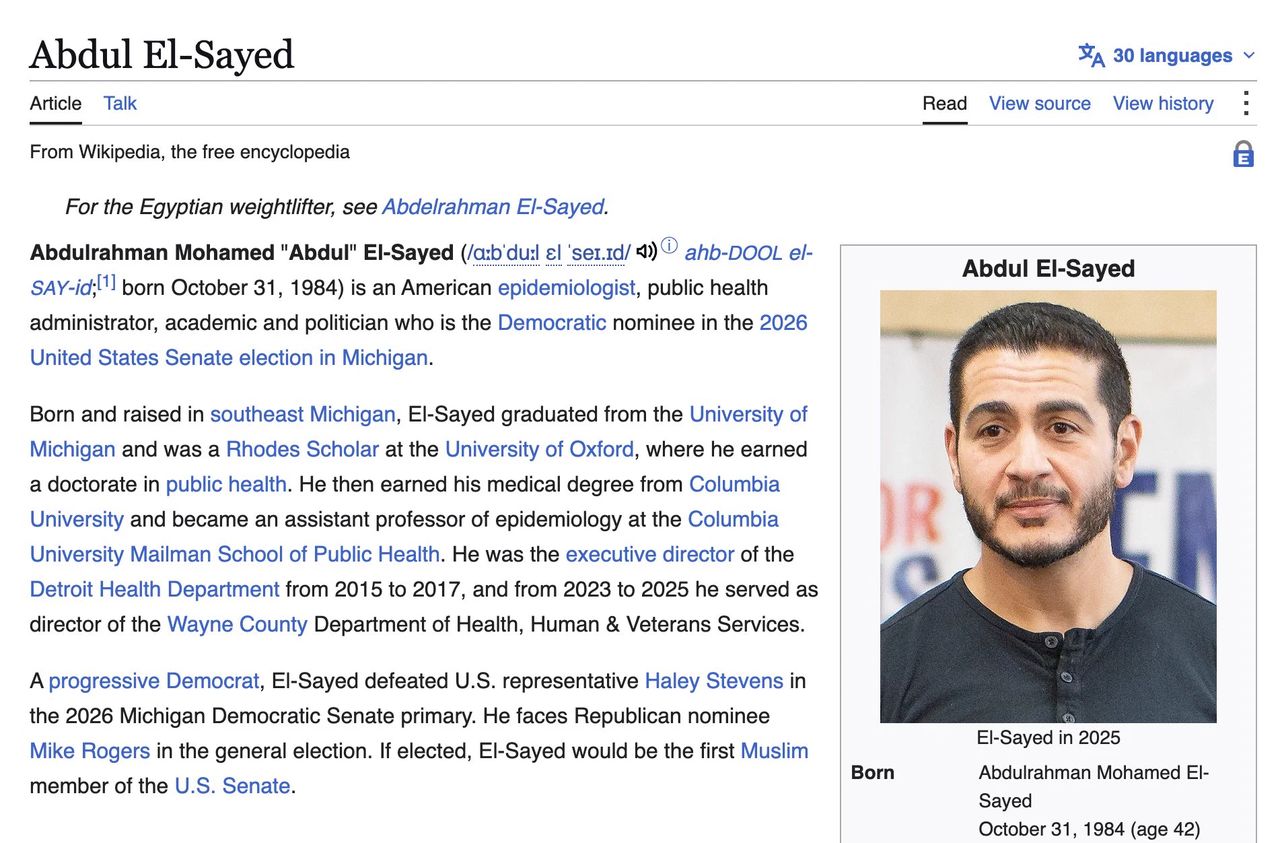
XAshley Rindsberg posted a thread on X on 2 November 2026, the day before the Michigan Senate election, with a screenshot of Abdul El-Sayed's Wikipedia article. The thread lists changes it says one editor made to the page and invites readers to see a pattern of editing rather than a series of ordinary revisions.
“Over the past months, a single Wikipedia editor has been quietly shaping @AbdulElSayed's entry. The editing has been intensive and highly directed. For example: + Hasan Piker controversy got cut down. + Syed's antisemitism problem – deleted. + Harris and Obama endorsements went in. + A line…”
Posted on X by journalist Ashley Rindsberg the day before the November 3, 2026 Michigan Senate election. The thread was later picked up by the New York Post and other outlets; researcher Yehuda Teitelbaum separately tracked the same revisions.
Who posted it
XAccount check
Estimates from public signals — account age, posting pattern, audience — not a judgement of the person behind the account, and separate from whether this post is true.
What stood out
- Account belongs to a real, identifiable person: Ashley Rindsberg, South African-born, US-raised, Israel-based author of 'The Gray Lady Winked' (2021) and, since 2024, senior editor at Pirate Wires.
- Long byline trail in established outlets: LA Review of Books, Daily Beast, HuffPost (2011-2017), Times of Israel, Jerusalem Post, Fox News, The Free Press, Daily Mail, NY Post — evidence of a genuine professional identity, not a sockpuppet.
- Now founder/editor of NPOV (NeutralPOV) Substack and founder/CEO of Alitheum (media-accuracy AI); podcasts, conferences and interviews corroborate the same human operator.
- Posts are on-brand for that identity: Wikipedia-bias investigations, AI/LLM 'information laundering' claims, El-Sayed Wikipedia edit thread (Nov 2026) — content is consistent with his published work.
- Reliability caveats: Slate's Stephen Harrison called his Wikipedia work aimed at 'stoking further outrage for attention'; Molly White rebutted his Charlie Kirk claims; a Medium analysis found the 'terrorist propaganda to Reddit pipeline' piece overstated thin evidence.
- Wikipedia editors disputing his sourcing note 'fringe narratives' and 'demonstrably false' claims about coordinated networks, though some of his Wikipedia reporting was subsequently cited by Berliner Zeitung, Algemeiner, JPost and Jewish Journal.
- MediaBiasFactCheck rates his main outlet Pirate Wires 'Mixed' factuality — opinionated framing and speculative argument rather than consistently well-sourced journalism.
- Electoral/political-adjacent advocacy output (midterm Wikipedia-editing threads) means individual posts should be treated as advocacy journalism, not neutral verification.
- Profile metadata supplied is empty (no bio, followers, creation date) and 'isplatformverified' is false — the real @AshleyRindsberg account is otherwise well known; absence of metadata here is not evidence of inauthenticity.
- No sign of automated or coordinated inauthentic behaviour: no duplicate-content, no burst-cadence indicator observed; amplification (Instapundit, Daily Wire, Erickson) is organic partisan media pickup.
Signals (9)+
- Identity confidence
- High - real journalist with 20+ year public byline history
- Posting cadence
- Unknown (no recent posts supplied)
- Follower ratio
- Unknown
- Notable news coverage
- Yes - Fox News columns, Free Press, Daily Mail, NY Post, Slate and Wikipedia Signpost coverage of his claims; 2025 Dao Prize honorable mention
- Affiliations
- Pirate Wires (senior editor), NPOV/NeutralPOV (founder), Alitheum (co-founder/CEO), prior PragerU/HuffPost/Daily Beast
- Fact check history
- Mixed - outlet rated 'Mixed' factuality by MediaBiasFactCheck; specific stories rebutted by Slate/Molly White and by a Medium fact-check of the Reddit 'terror pipeline' piece; other Wikipedia reporting picked up by mainstream/Israeli outlets
- Content theme
- Media malfeasance, Wikipedia bias, AI/LLM information warfare, Israel-related narratives
- Partisan lean
- Right-leaning / anti-mainstream-media advocacy
- Automation indicators
- None observed
Account checked November 8, 2026, 03:04 UTC
The media
Image✓ What is genuine
The article shown is El-Sayed's genuine Wikipedia page in its pre-general-election state. The claim, though, is carried by the revision history the thread cites, not by the picture.
The tells
- ●●● Strong signal The text matches the real article's pre-election content: biography, the 2026 Democratic Senate nomination, the primary win over Haley Stevens and the race against Mike Rogers.our visual review, checked against reporting and fact-checks
- ●●○ Supporting signal No compositing, mismatched fonts, garbled text or other visual signs of manipulation are evident.our visual review
Synthetic-media detector
Detector not consultedThe media is incidental to the claim; the detector was not needed.
How we checked the media
- Compared the screenshot's text with the article's content as described in reporting and fact-checks.
- Reviewed the image visually for signs of compositing, garbled text or other manipulation.
- Considered whether the claim depended on the screenshot being genuine (it does not; it rests on revision-history data).
Sources
5 sources reviewed- 1Michigan Sen.-elect Abdul El-Sayed's Wikipedia page was whitewashed of controversies by mystery editor before election: sources ↗
New York Post · nypost.comLow reliabilityLean Right; tabloid — corroborateEvidence
Documents the account, byte count, edit dates and specific wording changes.
- 2Did Abdul El-Sayed get his Wikipedia page edited to soften controversial sentences before Michigan Senate election? Larry Sanger responds ↗
The Times of India · timesofindia.indiatimes.comUntiereduntiered — treated as signal only, never decisiveEvidence
Reports that Rindsberg and Teitelbaum separately examined the revision history and quotes Larry Sanger.
- 3El-Sayed's Wikipedia page reportedly sanitized by mystery editor before election ↗
American Wire News · americanwirenews.comUntiereduntiered — treated as signal only, never decisiveEvidence
Quotes the 2 November thread and the edit-timing figures.
- 4Fact-check: Is Abdul El-Sayed a doctor? Fact-checking Mike Rogers in Michigan Senate race ↗
PolitiFact · politifact.comPrimary / fact-checkerIFCN signatory (Poynter)Context
Establishes El-Sayed's medical degree and that he was never licensed, giving context to the June edit.
- 5El-Sayed condemned Michigan synagogue attack. Critics said his other comments appeared to justify it ↗
PolitiFact · politifact.comPrimary / fact-checkerIFCN signatory (Poynter)Context
Establishes the Temple Israel remarks and the criticism, giving context to the deleted paragraphs.
Further reading
- 1New York Post The fullest account of the specific edits and dates, useful for checking the revision history yourself.
- 4PolitiFact Explains El-Sayed's medical training and licence status, which gives context to the June wording change.
- 5PolitiFact Explains the Temple Israel attack remarks and the criticism they drew, the subject of the deleted paragraphs.
The full story
The post did not invent a scandal. It pointed at a real, public trail of edits and asked readers to notice a pattern.
Wikipedia keeps every revision, and the timeline here is tight. An account called CopyleftEverything became the article's top editor, adding more than 15,000 bytes. All but two of its 19 edits fell between October 10 and November 1, 2026. The election was November 3.
The individual changes are easy to check. On June 12, a sentence reading that El-Sayed 'has never been granted a medical license' was changed to 'did not pursue a medical license'. PolitiFact confirms El-Sayed holds a Columbia MD but never completed a residency or obtained a licence — so the new wording is not false, but it is softer. On October 10, 'controversial' came out of Hasan Piker's description. Paragraphs about tensions with Michigan's Jewish community — tied to El-Sayed's criticism of Israel and his remarks after the March 2026 Temple Israel attack — were removed on October 12 and October 31. Some positive material, including the Obama and Harris endorsements, was on the page.
That combination is why the post felt plausible: a cluster of edits, close to a vote, mostly in one direction. But a pattern is not proof of a plan. The account's operator is unknown, and other editors could have reverted or contested the changes. The verified part is the record; the operation is the inference.
Kernel of truth
One account did make a concentrated, mostly one-directional series of edits to El-Sayed's article in the final weeks before the election, and each of those edits is documented in Wikipedia's public revision history.
Timeline
June 12, 2026
An editor changes 'has never been granted a medical license' to 'did not pursue a medical license' on El-Sayed's article. 1New York Post
October 10, 2026
'Controversial' is removed from Hasan Piker's description. 1New York Post
October 12, 2026
First deletion of paragraphs about a Jewish community liaison and tensions with Michigan's Jewish community. 1New York Post
October 31, 2026
Further paragraphs on the same subject are deleted. 1New York Post
November 2, 2026
Ashley Rindsberg posts the thread on X, with researcher Yehuda Teitelbaum having separately tracked the revisions. 3American Wire News
November 3, 2026
Michigan Senate election.
November 7, 2026
New York Post reports the edits, quoting Wikipedia co-founder Larry Sanger calling the exposé 'old-fashioned journalism'. 1New York Post
How it was framed
The specific edits described are real and verifiable, but the post arranges them to support an interpretation — a coordinated 'op' — that the evidence does not establish. The framing does more work than the facts it cites.
- Missing context. The thread lists only the direction of the edits; it does not say who ran the account, and the article is editable and reversible by others.
- Selective evidence. Bullets pick the removals of critical material and the additions of favourable material without noting that the content added, such as the endorsements, is sourced and accurate.
- Emotional language. 'Quietly shaping' and 'intensive and highly directed' frame ordinary-sounding edits as covert.
- Ongoing-threat framing. 'Syed's antisemitism problem – deleted' arranges the edits as an active concealment.
- “Visual proof”. A screenshot of the article is attached so readers see a real page alongside the interpretation.
Posted on X by journalist Ashley Rindsberg on 2 November 2026, the day before the Michigan Senate election. The thread was later reported by the New York Post and other outlets; researcher Yehuda Teitelbaum separately examined the same revision history.
Bias
Leans critical of Democrats and Wikipedia (conservative-leaning framing). The post selects only unflattering, directionally consistent edits to build a whitewash narrative and adds an 'is it an op?' insinuation of coordinated motive. The underlying edits are documented, but the framing is selective and pushes a partisan conclusion about Wikipedia bias.
Bias describes how the post frames its message — the slant of the language, selection and emphasis — and is judged separately from whether the claim is true. A true claim can still be framed with a strong slant.
How we checked
1 min 28 s- 1
Searched for reporting on Rindsberg's Wikipedia-editing thread and on the CopyleftEverything account.
- 2
Searched for whether the editor had been blocked or the edits reverted.
- 3
Searched major fact-checkers for any check of the El-Sayed Wikipedia claims.
- 4
Compared the screenshot's content with the article as described in reporting and fact-checks.
- 5
Reviewed the image visually for signs of manipulation.
✓ Claim checked✓ Media checked✓ Sources checked
Why 75% confidence
HighWe are at HIGH on the central claim because the key facts — the account, the byte count and the edit dates — come from a public revision history that does not depend on any one outlet, and the New York Post's account matches it. The motive claim stays at MODERATE because nothing establishes who runs the account. Our picture of the image rests on visual review and sources; no forensic detector was run, because the screenshot is not what the claim depends on.
Limits. We did not open the article's revision history ourselves in this pass, relying instead on reported diffs, and we did not identify the person or people behind the CopyleftEverything account.
What we don’t know
- Who operates the CopyleftEverything account and whether anyone directed its edits.
- Whether other Wikipedia editors challenged, reverted or discussed these changes at the time.
- The precise dates and sizes of the endorsement additions, which the reporting describes less fully than the deletions.
- Whether Wikipedia or its administrators have made any formal statement on the account.
Spot it yourself
Find the overstatementLooks suspicious, isn’t proof
- The poster is a journalist with a public profile and the post is partisan in tone — that tells you who is talking, not whether the edits happened.
- The attached screenshot proves nothing on its own: anyone can screenshot a Wikipedia page, and the page is editable.
- A tight cluster of edits before an election feels sinister, but editors often work on pages when news makes them relevant.
The actual evidence
- The public revision history: dates, byte counts and exact wording changes, checkable by anyone.
- The New York Post's report naming the diffs and matching them to the revision history.
- PolitiFact's background establishing what the disputed sentences referred to, such as El-Sayed's medical degree and licence status.
- The absence of any Wikipedia statement or fact-check disputing the specific edit record.
- 1
Open the article's revision history before believing the screenshot
On Wikipedia, click 'View history' and read the diffs for the dates cited. You can see the exact before and after wording yourself.
- 2
Check what else the account edited
Click the editor's handle in the history to see their contribution list. Is this a long-standing editor or a new account? Are all edits to one page?
- 3
Separate the edits from the framing
List each factual change. Then ask which sentences in the post are descriptions of those changes and which are inferences about motive.
- 4
Look for the other side of the story
If edits removed critical material, note what was added. Was sourced, accurate content inserted too? That changes how 'whitewashing' reads.
- 5
Ask who could rebut this
If a coordinated operation existed, Wikipedia administrators, other editors or the subject's campaign could respond. Search for a response before accepting the framing.
Takeaway
'The edits are real' and 'there is a coordinated operation' are two different claims. The first can be checked in a public log; the second needs evidence about who was behind the account, not just a pattern in what changed.
Questions people ask
Did one Wikipedia editor really edit Abdul El-Sayed's page before the election?+
Yes. An account called CopyleftEverything became the article's top editor, adding more than 15,000 bytes, and all but two of its 19 edits fell between October 10 and November 1, 2026, days before the November 3 Michigan Senate election. The revision history is public.
Was 'controversial' removed from Hasan Piker's description?+
Yes. On October 10, 2026, the description changed from 'a controversial left-wing Twitch streamer and political commentator' to 'left-wing political commentator'. The change is visible in the page's public revision history.
Were paragraphs about El-Sayed and Michigan's Jewish community deleted?+
Yes. Paragraphs about El-Sayed hiring a Jewish community liaison amid tensions over his criticism of Israel and his remarks after the March 2026 Temple Israel attack were removed on October 12 and October 31, 2026. Calling the subject an 'antisemitism problem' is the poster's wording.
Is it proven that this was a coordinated operation?+
No. The pattern of edits is documented, but nothing in the record shows who runs the account or that anyone coordinated it. Wikipedia is editable and reversible, and other editors can challenge changes. The 'op' framing is an inference about motive, not an established fact.
How can I check a Wikipedia page's editing history myself?+
Open the article on Wikipedia and click 'View history'. You can see each revision's date, the account that made it and the exact before-and-after wording. Clicking an account's name shows everything else it has edited, which helps you judge whether the pattern is unusual.
Go deeper
- Revision history
- Wikipedia's public log of every change to an article, showing who changed what and when, with the exact before-and-after text.
- Diff
- A side-by-side view of two versions of a page that highlights exactly what was added or removed.
- Byte count
- A measure of how much text an editor added or removed; a large positive count means substantial material was inserted.
- False connection
- When the headline, caption or framing doesn't support the content it is attached to.
People also search for
For educators+
- The edits are documented, but the 'coordinated op' is not. Where exactly should a reader draw the line between a pattern and a plan?
- If a Wikipedia article is public and reversible, does that make coordinated editing less harmful, or just harder to see?
- How would you design a check to test the 'op' claim — what evidence would you need that the post does not provide?
About this check
- Platform
- X
- Posted by
- @ashleyrindsberg
- Posted
- November 2, 2026
- Age when checked
- Older post, still live
- Where it spread
- United States
- Audience
- US audience
- Language
- EN
- Status
- ● Post is live
- Verified
- November 8, 2026, 03:06 UTC
- Published
- November 8, 2026, 03:06 UTC
Reach. 8,747 likes (x-syndication, 8 Nov); follow-up thread by @chalavyishmael 4,799 likes; IBTimes UK writeup 7 Nov after El-Sayed's win
This verdict was generated with AI from the sources shown. AI can make mistakes — check the sources before relying on it.
Check anything yourself, in seconds.
Share any social post or video to What the Fact and get the verdict, the confidence, and the receipts.