Was Lula's 10.3 million vote increase in Brazil's 2026 runoff mathematically impossible?
Was Lula's gain of about 10.3 million votes between Brazil's first and second rounds in 2026 'mathematically impossible', as Flávio Bolsonaro claims in a viral video?
False
The 10.3 million-vote gain happened — and normal runoff turnout and vote redistribution explain it.
FALSE. The vote tally is real: Lula rose from 53.88 million votes on 4 October 2026 to 64.26 million on 25 October, about 10.3 million more. But that was not impossible. Turnout rose by about 2.9 million, blank and null ballots fell by about 1.8 million, and 9.3 million first-round votes for eliminated candidates were up for grabs. Brazil's TSE and independent fact-checkers rate the fraud claim false.
 Genuine
Claims
✓ 1 true · ✕ 2 falseThis election result is mathematically impossible and no mathematician, statistics or probability expert, or NASA quantum-computing specialist, could explain Lula's vote growth.12357
“Porque essa eleição matematicamente é impossível acontecer o que aconteceu.”
The claim starts from a real figure and then draws a wrong conclusion from it. TSE data show Lula went from 53.88 million votes to 64.26 million, about 10.3 million more in three weeks. Nothing about that number breaks the rules of a runoff. Abstention dropped from 21.08% to 19.22%, putting roughly 2.9 million more voters into the count. Blank and null ballots fell by about 1.8 million. And some 9.3 million people who voted for eliminated first-round candidates had to choose someone in the runoff. AFP Checamos puts the pool of votes in play at around 14 million — comfortably more than 10.3 million. The decisive point is that both candidates grew: Flávio Bolsonaro himself added about 3.7 million votes. A fraud that only benefits one side would not leave that pattern. Independent scrutiny found no trace of manipulation, and Brazil's own electoral court labels the 'impossible turnaround' false.
Lula increased his vote by more than 10.3 million between the first round and the runoff in 20 days.1248
“o Lula tem mais de 10 milhões e 300 mil votos de um turno para outro em 20 dias”
This part of the statement checks out. The Superior Electoral Court's official count shows Lula at 53,879,538 votes (45.16%) on 4 October 2026 and 64,256,232 (51.79%) on 25 October — a rise of roughly 10.3 to 10.4 million in three weeks. Three independent verification outlets and the court's own published figures agree on the size of the increase, so the number is not in dispute. What is in dispute is what it means. The number being accurate is exactly why the clip travels: it gives the argument a verifiable anchor, and the false inference rides on top of it. A reader checking only the figure would find it confirmed and could easily assume the conclusion was too. The omission that matters is that Flávio Bolsonaro's own vote rose by about 3.7 million (56.1 million to 59.8 million) in the same period.
Lula's win is therefore the product of fraud and the election should not be recognised.146
No evidence of fraud has been produced. Lula won the runoff by about 4.4 million votes, and the PL — Flávio Bolsonaro's own party — recognised the result, as did his running mate and party leadership. International observers attested to the integrity of the vote. The one technical irregularity his camp points to, a two-hour extension of polling hours, affected only about 34,000 ballots, far too few to change a 4.4 million-vote margin. The forensic check is the strongest single piece: an independent second-digit Benford analysis of thousands of municipal returns found no anomaly in either round, which is the kind of pattern a coordinated manipulation would tend to disturb. Against that, the claim rests on incredulity — 'find me a mathematician' — rather than a produced anomaly. A demand for an explanation is not the same as evidence that no explanation exists.
What was posted
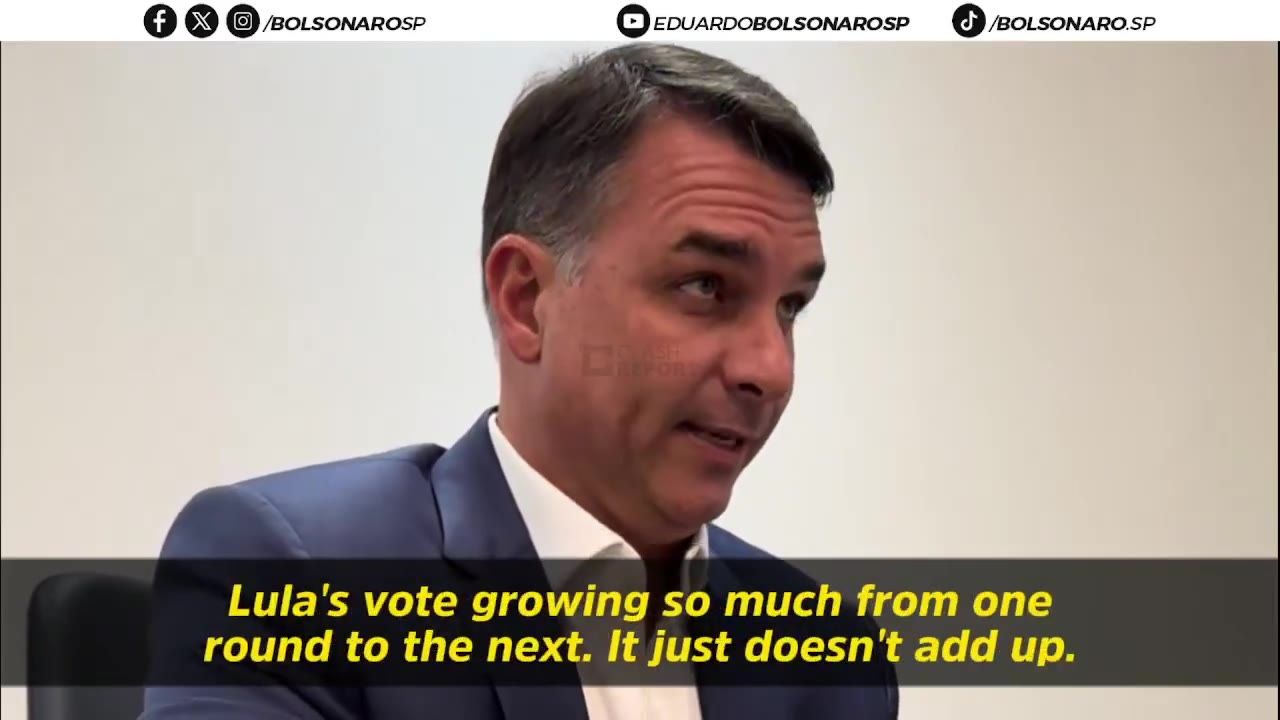
XA video posted on X by the account Clash Report shows Brazilian senator Flávio Bolsonaro giving an interview in which he argues that Lula's vote growth between the first round and the runoff of the 2026 presidential election could not be explained. English subtitles are overlaid on the footage and the clip ends mid-sentence. The post asks viewers to accept that the result is mathematically impossible and therefore not a genuine election outcome.
“Porque essa eleição matematicamente é impossível acontecer o que aconteceu. O Lula ter crescido tanto a sua votação de um turno para o outro. Não tem, se você me encontrar um matemático, um alguém de especialista de estatística, de probabilidade, de cálculo quântico da NASA, que explique como é que essa votação, como é que o Lula tem mais de 10 milhões e 300 mil votos de um turno para outro em 20 dias, ele consegue aumentar tanto a sua votação. Eu vou te dar alguns exemplos muito estranhos que não são, não param de pé, não não tem como explicar a votação do Lula.”
“Because this election is mathematically impossible — what happened can't happen. Lula growing his vote so much from one round to the next. There isn't — if you find me a mathematician, a statistics expert, a probability or quantum-calculation expert from NASA, who can explain how this vote — how Lula has more than 10 million 300 thousand votes from one round to the next in 20 days, how he manages to increase his vote so much. I'll give you some very strange examples that don't hold up, there is no way to explain Lula's vote.” — translated
Posted on X by the account Clash Report with English subtitles. The clip itself was originally published on Flávio Bolsonaro's own social media accounts on the evening of 5 November 2026, per provenance reporting, and later reposted by other accounts.
Who posted it
XAccount check
Estimates from public signals — account age, posting pattern, audience — not a judgement of the person behind the account, and separate from whether this post is true.
What stood out
- Clash Report is an English-language news and analysis website focused on global conflicts, defense, and geopolitics, with a contact address in Bahçelievler, Istanbul, Turkey. (mediabiasfactcheck.com)
- The Twitter account @clashreport joined in May 2015, has 887.2K followers, and 94.6K posts, indicating significant activity and a substantial following. (sotwe.com)
- The account has a low following-to-follower ratio (1 following, 887.2K followers), which is uncommon for personal accounts but typical for news organizations. (sotwe.com)
- The account's bio and recent posts align with the content on the Clash Report website, suggesting consistency in branding and messaging. (sotwe.com)
- The account is not verified on Twitter, which is common for news organizations and does not necessarily indicate inauthenticity. (en.wikipedia.org)
Signals (4)+
- Posting cadence
- High
- Follower ratio
- High
- Notable news coverage
- None found
- Fact check history
- None found
Account checked October 19, 2026, 14:56 UTC
The media
Video✓ What is genuine
The footage is a genuine cut of Flávio Bolsonaro making these statements, published on his own profiles and widely reported by Brazilian outlets; the words in the subtitles match the Portuguese audio. The false part is the argument he makes, not the video.
The tells
- ●●● Strong signal Continuous, coherent interview footage with consistent lighting, framing, skin texture and lip movement across the clip; no jump cuts suggesting splices.our visual review
- ●●○ Supporting signal The speaker's own campaign-style social handles appear across the top of the frame, matching the provenance reporting that he published the clip himself.our visual review
- ●●○ Supporting signal English subtitles are overlaid on the Portuguese audio — an addition, but translation rather than alteration of what is said.our visual review
Synthetic-media detector
Detector not consultedSources settled the claim on their own; the detector was not needed.
How we checked the media
- Reviewed the keyframes frame by frame for continuity of lighting, framing, skin texture and lip movement.
- Compared the on-screen overlays against the provenance of the clip as reported in our sources.
Sources
8 sources reviewed- 1Crescimento de 10 milhões de votos de Lula no 2º turno não é 'impossível'; mobilização é vista como fator de virada ↗
AFP Checamos · checamos.afp.comReputable outletwire — CenterEvidence
Calculates the pool of votes in play in the runoff and rates the claim false.
- 2Campanha de desinformação impulsiona falsa tese de vitória 'matematicamente impossível' de Lula ↗
Estadão Verifica · estadao.com.brUntiereduntiered — treated as signal only, never decisiveEvidence
Reports Lula's 10.3 million and Bolsonaro's 3.7 million gains between rounds and the drop in abstention and blank/null votes.
- 3Aumento de votos a Lula não reflete transferência automática de votos de outros candidatos ↗
Agência Lupa · agencialupa.orgUntiereduntiered — treated as signal only, never decisiveEvidence
Explains that the vote difference does not prove fraud and that Bolsonaro also grew.
- 4Lula wins in Brazil but faces hostile Congress and divided country ↗
BBC News · bbc.co.ukReputable outletCenter; light bias tag (BBC Verify is Tier A)Evidence
Reports the official result of 51.79% to 48.21% from the TSE.
- 5Brazil's vote counts pass the test Flávio Bolsonaro says they failed ↗
The Brazilian Report · newsletters.brazilian.reportUntiereduntiered — treated as signal only, never decisiveEvidence
Provides the independent Benford analysis of some 5,700 municipal returns.
- 6Sem provas, Flávio volta a alegar fraude nas eleições ↗
Poder360 · poder360.com.brUntiereduntiered — treated as signal only, never decisiveContext
Documents that fraud allegations came without proof, that the TSE rejected them and that the PL recognised the result; also anchors the clip's provenance.
- 7Flávio Bolsonaro cita dados já desmentidos pelo Tribunal Superior Eleitoral e volta a contestar a reeleição de Lula ↗
TV Pampa / Jornal O Sul · tvpampa.com.brUntiereduntiered — treated as signal only, never decisiveEvidence
Records the TSE 'Fato ou Boato' statement labelling the impossible-turnaround claim false.
- 8Lula wins Brazil's presidential runoff; Flavio Bolsonaro refuses to concede defeat ↗
Xinhua via Guangming Daily · en.gmw.cnUntiereduntiered — treated as signal only, never decisiveContext
Corroborates the final percentages and first-round split.
Further reading
- 1AFP Checamos The clearest arithmetic walkthrough of why around 14 million votes were available in the runoff.
- 5The Brazilian Report The independent forensic angle — what the vote data look like when tested for manipulation.
- 7TV Pampa / Jornal O Sul Shows the electoral court's own fact-check unit addressing this exact claim.
The full story
The kernel of truth here is a genuine number. Between 4 October and 25 October 2026, Lula's tally rose from 53.88 million to 64.26 million votes. A jump of more than 10 million in three weeks sounds enormous, and if you picture the same electorate voting twice, it looks like millions of people appeared from nowhere or changed their minds at once.
Runoffs do not work like that. In the first round, a large slice of the electorate votes for candidates who then drop out. In 2026 that slice was about 9.3 million people, and in the runoff they had to pick one of the two remaining names. At the same time, abstention fell from 21.08% to 19.22%, adding roughly 2.9 million voters to the count, and blank and null ballots dropped by about 1.8 million — votes that had effectively been thrown away in round one. AFP Checamos put the total pool of votes in play at around 14 million, more than enough to cover a 10.3 million gain.
The detail that undercuts the fraud story is that the gain was not one-sided. Flávio Bolsonaro also added about 3.7 million votes, finishing on 59.8 million. Both candidates grew because the electorate itself grew and because voters who had backed eliminated candidates moved to one of the two survivors.
Brazil's electoral court and independent fact-checkers have rejected the 'mathematically impossible' framing, and an independent forensic review of thousands of municipal returns found no statistical sign of manipulation. The claim survives not because the numbers support it, but because a very large, very real number is easier to share than the arithmetic that explains it.
Kernel of truth
Lula's vote did rise by roughly 10.3 million between the first round and the runoff. The figure is accurate; the conclusion drawn from it is not.
Timeline
October 4, 2026
First round of Brazil's presidential election: Lula 53,879,538 votes (45.16%), Flávio Bolsonaro ahead on the night per first-round reporting. 1AFP Checamos
October 25, 2026
Runoff: Lula wins with 64,256,232 votes (51.79%) to Flávio Bolsonaro's 48.21%, a gain of about 10.3 million for Lula and 3.7 million for Bolsonaro. 4BBC News
October 26, 2026
Estadão Verifica publishes a fact-check rating the 'mathematically impossible' thesis false. 2Estadão Verifica
October 27, 2026
Agência Lupa publishes its fact-check on the vote-transfer claim. 3Agência Lupa
October 28, 2026
The TSE's 'Fato ou Boato' unit labels the impossible-turnaround claim a rumour; coverage reports Flávio Bolsonaro repeating already-refuted data. 7TV Pampa / Jornal O Sul
October 29, 2026
AFP Checamos publishes its fact-check on the 10 million vote increase. 1AFP Checamos
November 5, 2026
Flávio Bolsonaro publishes the interview clip on his own social accounts in the evening; it is later reposted by other accounts. 6Poder360
How it was framed
The video is genuine and the vote figure it cites is accurate, but the post uses that real number to frame a legitimate runoff result as fraud, omitting the turnout rise, the blank and null drop, the eliminated candidates' votes and Bolsonaro's own gain. That is misleading use of true information to frame an election as illegitimate.
- Borrowed authority. 'Find me a mathematician, a statistics expert, a probability expert, even someone from NASA who works with quantum...' — the claim leans on hypothetical credentialed experts instead of producing one.
- Unsourced statistic. The 10.3 million figure is stated without the turnout, blank/null or eliminated-candidate context that explains it.
- Selective evidence. The clip cites only Lula's vote growth and omits that Flávio Bolsonaro gained about 3.7 million votes over the same period.
- Ongoing-threat framing. 'This election was mathematically impossible' presents a completed, certified result as an unresolved wrong.
Posted on X by the account Clash Report with English subtitles. The underlying clip was published on Flávio Bolsonaro's own social media accounts on the evening of 5 November 2026, per provenance reporting, and reposted by other accounts.
Bias
Leans pro-Bolsonaro / election-fraud narrative. The clip is a straight, subtitled push of Flávio Bolsonaro's unfounded fraud narrative, circulated without any counter-context while he urges followers to doubt a certified election result. The quoted figure is accurate but is deployed to imply fraud, and the omission that he himself gained 3.7 million votes is central to the framing.
Bias describes how the post frames its message — the slant of the language, selection and emphasis — and is judged separately from whether the claim is true. A true claim can still be framed with a strong slant.
How we checked
59 s- 1
Searched in Portuguese and English for the claim, using the speaker's own phrase 'matematicamente impossível' and the 10.3 million figure.
- 2
Compared the size and direction of Lula's vote change against Flávio Bolsonaro's own change, using the vote totals reported by the TSE and echoed across verification outlets.
- 3
Gathered the existing fact-checks from AFP Checamos, Estadão Verifica, Agência Lupa and the TSE's 'Fato ou Boato' unit, plus independent reporting on the PL's recognition of the result.
- 4
Reviewed the independent forensic analysis of municipal returns for any statistical anomaly.
- 5
Watched the video frame by frame for continuity and checked the overlay subtitles against the underlying Portuguese audio.
✓ Claim checked✓ Media checked✓ Sources checked
Why 92% confidence
HighHIGH. The finding rests on official vote totals that multiple independent organisations report identically, on the arithmetic of turnout and eliminated candidates that accounts for the full increase, on the symmetry of both candidates gaining, and on a separate forensic review that found no anomaly. Four fact-checking bodies reached the same conclusion independently. There is no competing evidence to weigh.
Limits. We did not re-run the vote-count data ourselves or commission an original statistical analysis; we relied on the published TSE figures as reported and on the independent Benford review. Our media assessment is based on visual review of the clip, not on a forensic detector run.
What we don’t know
- What specific 'very strange examples' Flávio Bolsonaro promised to present later in the interview — the clip cuts off before he gives them.
- Whether the full, unedited interview contains any argument not captured in this excerpt.
- What the two-hour polling extension changed locally, beyond the reported figure of about 34,000 affected ballots.
Spot it yourself
Spot the fakeLooks suspicious, isn’t proof
- The post comes from a third-party aggregator account, not from an official electoral body — but reposting a real clip says nothing about whether its argument is right.
- The English subtitles are an addition to the original Portuguese audio. Translation overlays look like tampering, but here they match what is said.
- The speaker is a losing candidate in the election he is describing. Motive is a reason to check carefully, not evidence by itself.
The actual evidence
- The official TSE count: Lula 53.88 million in round one, 64.26 million in the runoff. The figure is right, so the argument has to be tested on the explanation, not the number.
- The composition of the change: abstention fell from 21.08% to 19.22% (about 2.9 million voters), blank and null ballots fell by about 1.8 million, and around 9.3 million first-round votes for eliminated candidates were in play.
- The symmetry: Flávio Bolsonaro gained about 3.7 million votes himself. Fraud that lifts one candidate would not normally lift both.
- Independent forensics: a second-digit Benford analysis of some 5,700 municipal returns found no anomaly in either round.
- The TSE's own 'Fato ou Boato' unit, plus AFP Checamos, Estadão Verifica and Agência Lupa, all rate the 'impossible' claim false.
- 1
Separate the number from the conclusion
Ask what exactly is being claimed: that the figure is wrong, or that it can't be explained. Here the figure checks out and only the explanation fails, which means you check turnout, not the totals alone.
- 2
Look for the other side's number
In any election-fraud claim, check whether the accuser's own vote also moved. If both candidates gained, the 'one-sided impossibility' argument collapses quickly.
- 3
Find the official count
Go to the electoral authority's published results rather than a screenshot or a clip. Brazil's TSE publishes round-by-round totals, abstention and blank/null figures.
- 4
Check whether fact-checkers have already looked
Search the key phrase in the original language ('matematicamente impossível') plus 'checagem' to surface local verification outlets, which usually have the local data fastest.
- 5
Watch what the argument asks for
A demand — 'find me a mathematician' — is not a finding. Treat requests for hypothetical experts as a signal that no anomaly has actually been shown.
Takeaway
A true number can carry a false conclusion. When a claim is built on a statistic you can verify, verify it — then check whether the explanation for it was left out on purpose.
Questions people ask
Was Lula's 10.3 million vote increase in Brazil's 2026 runoff real?+
Yes. The TSE's official count shows Lula at 53,879,538 votes on 4 October 2026 and 64,256,232 on 25 October — a gain of roughly 10.3 million. The figure is accurate. What is false is the claim that this increase was mathematically impossible or proof of fraud.
How can a candidate gain 10 million votes between rounds?+
Because the electorate changes between rounds. Abstention fell from 21.08% to 19.22%, adding about 2.9 million voters. Blank and null ballots dropped by about 1.8 million. And roughly 9.3 million people who voted for eliminated first-round candidates had to choose one of the two remaining names.
Did only Lula gain votes between the two rounds?+
No. Flávio Bolsonaro also gained about 3.7 million votes, rising to 59.8 million. Both candidates grew because turnout rose and voters for eliminated candidates moved to one of the two survivors. That symmetry is one of the clearest signs the result followed normal runoff mechanics.
What did Brazil's electoral court say about the 'impossible' claim?+
The TSE's 'Fato ou Boato' section stated that it is false that a vote swing in the runoff is impossible or proves fraud. Independent fact-checkers at AFP Checamos, Estadão Verifica and Agência Lupa reached the same conclusion, and a forensic review of thousands of municipal returns found no anomaly.
Does an unexpected jump in a vote count usually mean fraud?+
No. Large swings between rounds are a normal feature of two-round elections, because turnout changes and eliminated candidates' voters redistribute. A jump becomes suspicious when the arithmetic cannot account for it. Here the arithmetic does account for it, and both candidates gained.
Go deeper
- Runoff (second round)
- A second vote held when no candidate wins outright in the first round, usually between the top two, in which voters for eliminated candidates must pick one of the survivors.
- Abstention
- The share of registered voters who do not cast a ballot at all; when it falls, more votes enter the count.
- Blank and null ballots
- Votes that are submitted but not counted for any candidate — left empty or deliberately invalidated — and which therefore reduce the pool of valid votes.
- Benford's law
- A statistical pattern in which the leading or second digits of many real-world number sets are not evenly distributed; analysts use deviations from it as a flag for possible manipulation.
- TSE (Tribunal Superior Eleitoral)
- Brazil's Superior Electoral Court, the body that runs and certifies federal elections and publishes the official vote counts.
People also search for
For educators+
- The clip cites a real number. At what point does a true statistic become misleading — and who is responsible, the speaker or the person who shares the clip?
- If both candidates gained millions of votes, what does that tell you about the fraud explanation? What would a fraudulent pattern look like by comparison?
- The speaker asks for 'a mathematician from NASA' to explain the result. Why is a demand for an expert not the same as evidence?
About this check
- Platform
- X
- Posted by
- @clashreport
- Posted
- November 6, 2026
- Age when checked
- 1–2 days old when checked
- Where it spread
- Brazil
- Audience
- International audience
- Language
- EN
- Status
- ● Post is live
- Verified
- November 8, 2026, 15:02 UTC
- Published
- November 8, 2026, 15:02 UTC
Reach. Primary is a Clash Report repost of Flávio Bolsonaro's video (25 likes per X syndication); Flávio's own post not found in any raw HTML (Pleno News/Terra Brasil embed IG reels INCONCLUSIVE); wide pickup: Terra, Estadão Verifica, Poder360, Pleno, BNews, UOL 5-7 Nov
This verdict was generated with AI from the sources shown. AI can make mistakes — check the sources before relying on it.
Check anything yourself, in seconds.
Share any social post or video to What the Fact and get the verdict, the confidence, and the receipts.