Did Tinubu borrow ₦120 trillion in three years while 16 past leaders borrowed ₦46 trillion in 63 years?
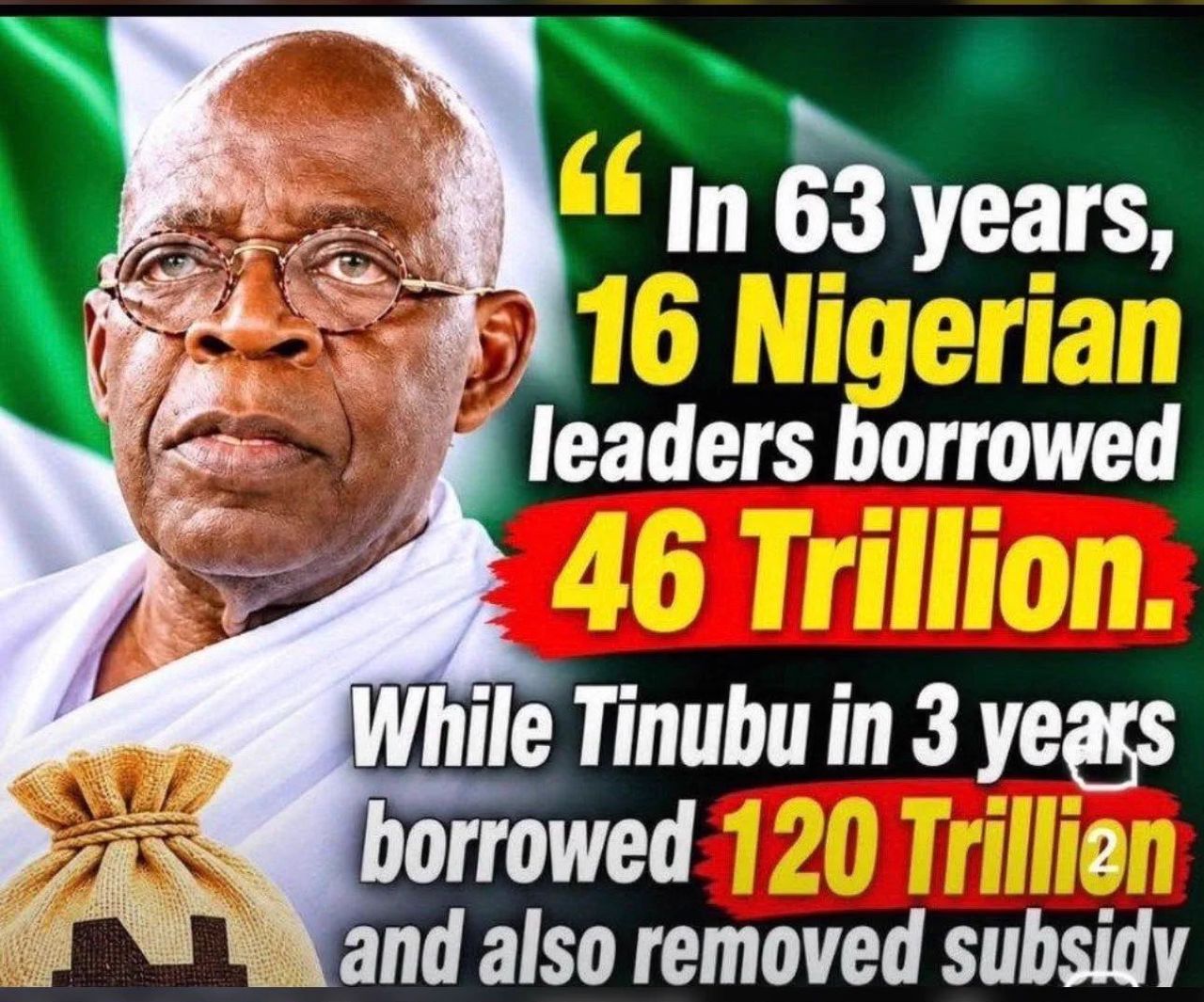
Did President Tinubu borrow ₦120 trillion in three years, while Nigeria's 16 previous leaders borrowed ₦46 trillion in 63 years, as a viral graphic claims?
Misleading
Real debt figures are re-labelled as 'borrowing' and compared across unequal baselines.
Misleading. The ₦46 trillion was Nigeria's total outstanding public debt at the end of 2022 — not the combined borrowing of 16 leaders over 63 years — and official Debt Management Office data do not show ₦120 trillion of new borrowing under President Bola Tinubu. Only the poster's point that Tinubu removed the petrol subsidy is true.
 AI-generated
Claims
✓ 1 true · ✕ 1 falseIn 63 years, 16 Nigerian leaders borrowed a combined ₦46 trillion.12
The ₦46 trillion is a real official number used for the wrong purpose. According to FactCheckAfrica, it is Nigeria's total outstanding public debt as of 31 December 2022 — the stock owed at one moment — not the sum of everything borrowed by 16 administrations since independence in 1960. Those are different measurements: a debt stock is a balance, while cumulative borrowing is a running total, and the poster swaps one for the other. The baseline is further distorted because the end-2022 figure left out roughly ₦22.7 trillion of Central Bank Ways and Means overdrafts, which the presidency says were only formally recognised on the debt books in May 2023. So the comparison understates the earlier debt and presents it as the borrowing record of 63 years. The evidence here comes from the Debt Management Office data as reported by FactCheckAfrica and from the presidency's rebuttal — two origins, not one, which is why we rate this HIGH rather than MODERATE.
Tinubu borrowed ₦120 trillion in three years.2345
This is the number the poster turns on, and no official data support it. Debt Management Office figures reported by Leadership show total public debt at ₦87.38 trillion in June 2023, shortly after Tinubu took office, and ₦166.79 trillion in June 2026 — a naira rise of roughly ₦79 trillion, not ₦120 trillion. More importantly, that rise is not fresh borrowing. BusinessDay reports the June 2026 figure as $120.93 billion, and the presidency says dollar debt moved only from about $113.4 billion to $120.9 billion over the period, roughly $7.5 billion. The gap between the naira and dollar increases is explained by the weaker naira and by accounting changes. The finance minister told the Senate in July 2026 that more than ₦40 trillion came from exchange-rate revaluation and about ₦33 trillion from securitising inherited Ways and Means — neither is new borrowing. The figure is rejected by both the finance ministry and the presidency, and an independent FactCheckAfrica check of the same graphic rated it misleading.
Tinubu removed the fuel subsidy.7
This part of the poster is accurate. In his inaugural address on 29 May 2023, Tinubu said 'fuel subsidy is gone', ending the decades-long petroleum subsidy, as BBC reported. Petrol prices rose sharply within days as the subsidy was withdrawn. The true statement matters to the overall judgement because it anchors the poster in something real and gives the false debt comparison a credible-sounding frame. The technique is common: mix one verifiable fact into an argument so the whole package feels checked. But a true supporting point does not make the surrounding numbers true, and here the two debt claims are the ones the poster is built to push. We rate this element TRUE with HIGH confidence because it rests on the president's own recorded words and on mainstream reporting of the immediate price effect.
What was posted
XA designed political poster on X, not a photograph of any event. It sets a portrait of President Bola Tinubu over a Nigerian flag background, with large slogan text, a quoted-style headline and a money-bag graphic. The caption carries no argument of its own — 'No comment' — leaving the poster to make the claim: that 16 past leaders borrowed ₦46 trillion over 63 years while Tinubu borrowed ₦120 trillion in three years and still removed the petrol subsidy.
“No comment”
Posted on X by the account @Wizarab10. The graphic circulated on Nigerian social media in early November 2026 and was addressed by the presidency on X on 7 November 2026 and by a FactCheckAfrica fact-check published 6 November 2026.
Who posted it
XAccount check
Estimates from public signals — account age, posting pattern, audience — not a judgement of the person behind the account, and separate from whether this post is true.
What stood out
- Handle @Wizarab10 maps to a documented real person: Wisdom Ewere Obi-Dickson ('Sir Dickson'), Delta State-born lawyer, humanitarian and X influencer.
- Account created March 2016 (~10.7 years old as of Nov 2026) with ~815k followers, ~45k following and ~400k posts — consistent with a long-running personal account, not a disposable sock puppet.
- Mainstream Nigerian outlets (Punch, ThisDay, TheCable, New Telegraph, Legit.ng) have interviewed and profiled him; named X Influencer of the Year at the 2025 Pulse Influencer Awards.
- Well-documented fundraising track record (e.g. N700m+ raised per ThisDay, N22m LASU surgery, N30.7m Aunty Esther cancer fund), with public receipts/balance screenshots and stated verification (school portals, Dr Sina for medical cases).
- A 2025 allegation that he diverted N1m from the Aunty Esther fund was retracted and apologised for by the accuser after Wizarab10 rebutted it point by point.
- He also won a defamation suit in 2026 against a user who falsely accused him of rape (non-monetary settlement with published apologies).
- Not platform-verified and the supplied profile metadata (bio, follower count, creation date, sample posts) is empty, so core signals had to be recovered from the web rather than the input.
- Weaknesses as an information source: heavy reliance on unverified viral DMs/tip-offs, engagement-bait posts ('What would make you happy right now?'), sponsored giveaways/paid promos, and partisan political commentary containing loosely sourced figures.
- Recent activity (through Aug 2026) is conversational and hand-written in consistent Nigerian English register — no evidence of automation, spam bursts or coordinated inauthentic behaviour.
Signals (11)+
- Account created
- 2016-03
- Following count
- 45000
- Post count
- 405000
- Real name
- Wisdom Ewere Obi-Dickson
- Notable news coverage
- Punch, ThisDay, TheCable, New Telegraph, Legit.ng, Pulse Influencer Awards 2025
- Fact check history
- No fact-checker debunks of his own claims found; a fund-misappropriation accusation against him was retracted/apologised for; won defamation ruling in 2026
- Posting cadence
- High-volume daily posting, long-form commentary plus viral amplifications
- Content quality
- Mixes verified fundraising accounting with unverified viral anecdotes and opinion; low sourcing discipline on political/economic claims
- Monetisation signals
- Sponsored posts, giveaways, paid promos
- Bot indicators
- None found on X search; consistent stylistic voice and human-scale interaction
- Data gaps
- Input metadata null (bio, followers, creation date, recent posts); all signals derived from third-party sources
Account checked November 8, 2026, 15:03 UTC
The media
Image✓ What is genuine
The face is a recognisable portrait of President Bola Tinubu, and the debt figures quoted are drawn from real official statistics — ₦46.25 trillion of public debt at end-2022 and a rising debt stock. The subsidy removal the poster mentions also really happened.
The tells
- ●●● Strong signal The detector scored the image 0.9996 as AI-generated, with the deepfake score near zero.our detector (Hive v3)
- ●●● Strong signal It is a designed poster, not a photograph: the portrait is cut out and pasted over a flag background, with added slogan text and a money-bag graphic.our visual review
- ●●○ Supporting signal The slogan text, quoted headline and money-bag graphic are layered on top of the portrait rather than part of a single original image.our visual review
Synthetic-media detector
Detector ranThe analysis suspected fabrication, so the detector ran.
Scores are the detector’s estimate for the file as uploaded. A low score does not rule out editing, a spliced caption, or footage shown out of context — those are judged above. Model v3.
How we checked the media
- Ran the image through our AI-generation detector (Hive v3), which scored it 0.9996 for AI-generated content.
- Visually reviewed the layout: a cut-out portrait composited over a Nigerian flag background with slogan text and a money-bag graphic added.
- Checked the graphic's claims against Debt Management Office figures, the finance minister's Senate briefing and the presidency's rebuttal.
Sources
7 sources reviewed- 1FACT-CHECK: Did Tinubu Borrow ₦120 Trillion in Three Years While 16 Previous Leaders Borrowed ₦46 Trillion in 63 Years? ↗
FactCheckAfrica · factcheckafrica.netUntiereduntiered — treated as signal only, never decisiveEvidence
Establishes that ₦46.25 trillion was outstanding public debt at end-2022, not cumulative borrowing, and rates the graphic misleading.
- 2Presidency rejects claims Tinubu borrowed ₦120tn in three years ↗
The Sun Nigeria · thesun.ngUntiereduntiered — treated as signal only, never decisiveEvidence
The presidency's rejection of the ₦120 trillion claim and its point that the end-2022 figure hid about ₦22.7 trillion in Ways and Means.
- 3Nigeria's public debt rises by N14.39trn in one year to N166.79trn ↗
BusinessDay · businessday.ngUntiereduntiered — treated as signal only, never decisiveEvidence
DMO data putting total public debt at ₦166.79 trillion ($120.93 billion) at 30 June 2026.
- 4Nigeria's Debt Stock Grows 90.9% In 3 Years As Borrowing Hits N166.79trn ↗
Leadership Newspapers · leadership.ngUntiereduntiered — treated as signal only, never decisiveEvidence
Debt rose from ₦87.38 trillion in June 2023 to ₦166.79 trillion in June 2026, a 90.9 per cent naira increase.
- 5FG dismisses claims of N80trn borrowing under Tinubu admin ↗
Independent Newspaper Nigeria · independent.ngUntiereduntiered — treated as signal only, never decisiveEvidence
The finance minister's Senate briefing that exchange-rate revaluation and Ways and Means securitisation drove most of the reported increase.
- 6Presidency says claims Tinubu borrowed N120trn in three years untrue ↗
TheNiche · thenicheng.comUntiereduntiered — treated as signal only, never decisiveContext
The presidency's 7 November 2026 statement calling the ₦120 trillion claim untrue and citing a $7.5 billion dollar-debt rise.
- 7Bola Tinubu inauguration: Fuel subsidy removed in Nigeria ↗
BBC · bbc.comReputable outletCenter; light bias tagEvidence
Tinubu declared 'fuel subsidy is gone' in his 29 May 2023 inaugural address, confirming the poster's one accurate point.
Further reading
- 1FactCheckAfrica The independent fact-check that first rated this exact graphic misleading, with the DMO figures laid out.
- 5Independent Newspaper Nigeria The finance minister's Senate briefing explains why the naira debt total rose without equivalent new borrowing.
- 3BusinessDay Details the June 2026 debt stock and its dollar value, which is the key to reading the naira figures correctly.
The full story
Nigeria's debt really has grown fast in naira terms, and that is the kernel of truth the poster exploits. According to Debt Management Office figures reported by Leadership, total public debt stood at ₦87.38 trillion in June 2023 and ₦166.79 trillion in June 2026 — a 90.9 per cent rise. A reader who has seen headlines about soaring debt will find the poster's direction familiar, even though its numbers are wrong.
The gap between the alarming naira figure and the modest dollar figure is where the story lives. BusinessDay reports the June 2026 debt as $120.93 billion, and the presidency says dollar debt rose only from about $113.4 billion to $120.9 billion. The naira total ballooned partly because the currency weakened, so the same dollar debt translates into far more naira. The finance minister told the Senate in July 2026 that more than ₦40 trillion of the reported increase came from exchange-rate revaluation and about ₦33 trillion from securitising inherited Ways and Means overdrafts — accounting changes, not new loans.
The poster also leans on a genuine political moment. Tinubu did remove the petrol subsidy in his 29 May 2023 inaugural address, a decision that raised petrol prices and remains contested. By putting that true, unpopular fact beside false debt numbers, the poster borrows credibility for the false part. The presidency rejected the ₦120 trillion figure on 7 November 2026.
Kernel of truth
Nigeria's public debt stock rose sharply in naira terms after mid-2023, and Tinubu did remove the petrol subsidy — both real. The poster distorts the size and cause of the debt rise.
Timeline
May 29, 2023
Tinubu declares 'fuel subsidy is gone' in his inaugural address, ending the petrol subsidy. 7BBC
June 2023
Nigeria's total public debt stands at ₦87.38 trillion, per DMO data. 4Leadership Newspapers
June 2026
Total public debt reaches ₦166.79 trillion ($120.93 billion), per DMO data. 3BusinessDay
November 6, 2026
FactCheckAfrica publishes a fact-check rating the ₦46 trillion versus ₦120 trillion graphic misleading. 1FactCheckAfrica
November 7, 2026
The presidency publicly rejects the ₦120 trillion borrowing claim. 6TheNiche
How it was framed
Real official debt figures and a real policy decision (subsidy removal) are framed so the reader draws a false conclusion about Tinubu's borrowing. The central numbers are genuine statistics used with the wrong meaning and an unequal baseline, which is misleading framing rather than pure invention.
- “Visual proof”. A cut-out portrait of Tinubu over a Nigerian flag, with large slogan text and a money-bag graphic, presented as a definitive attack poster.
- Selective evidence. The poster compares a ₦46 trillion end-2022 debt stock with a ₦120 trillion borrowing figure, omitting that the first is a balance and the second is not supported by official data.
- Us vs. them. The layout sets '16 leaders' against one sitting president, inviting a past-versus-present comparison.
- Missing context. The poster does not mention exchange-rate revaluation or Ways and Means securitisation, which explain most of the naira debt increase.
Posted on X by @Wizarab10 with the caption 'No comment'. The presidency said the comparison came from opposition-aligned accounts, a characterisation we report but do not adopt as fact.
Bias
Leans anti-Tinubu / opposition-aligned. The graphic is a partisan attack poster contrasting '16 leaders in 63 years' with 'Tinubu in 3 years', a framing that maximises the impression of reckless borrowing by omitting the naira devaluation, the Ways and Means securitisation and the difference between debt stock and new borrowing. The single accurate element (subsidy removal) is used as an aggravating point rather than neutral information.
Bias describes how the post frames its message — the slant of the language, selection and emphasis — and is judged separately from whether the claim is true. A true claim can still be framed with a strong slant.
How we checked
1 min 13 s- 1
Searched for fact-checks and reporting on the '₦120 trillion in three years' claim and the '₦46 trillion in 63 years' comparison.
- 2
Searched for Nigeria's total public debt stock from the Debt Management Office for 2026.
- 3
Compared the poster's figures with DMO debt data reported by BusinessDay and Leadership, the finance minister's Senate briefing, and the presidency's 7 November 2026 statement.
- 4
Checked the subsidy-removal claim against BBC reporting of Tinubu's 29 May 2023 inaugural address.
- 5
Ran the image through our AI-generation detector (Hive v3) and visually reviewed its layout.
✓ Claim checked✓ Media checked✓ Sources checked
Why 86% confidence
HighWe rate the overall verdict HIGH because the two debt claims are contradicted by official Debt Management Office data and by statements from the finance ministry and presidency, and because an independent fact-check reached the same conclusion. The subsidy-removal claim is HIGH confidence because it rests on the president's own recorded words. The figure is not a matter of interpretation; it is a measurement error that official data can settle.
Limits. We could not confirm the original date or context of the portrait used in the poster, and we did not identify who first created the graphic. The presidency's characterisation of the accounts behind it is reported as a claim, not verified by us.
What we don’t know
- Who created the original poster and when it was first published.
- Whether the account that posted it wrote the text or shared an existing graphic.
- The exact date the portrait was taken and whether it was used with permission.
Spot it yourself
Spot the fakeLooks suspicious, isn’t proof
- It is a designed attack poster with a flag background, a money-bag graphic and a slogan — the format is built to persuade, but a slick design proves nothing about the numbers.
- The caption 'No comment' invites you to supply the outrage; the absence of an argument is a stylistic choice, not evidence.
- The portrait looks like a real photograph of Tinubu, which it is; a recognisable face does not make the surrounding claims true.
The actual evidence
- Debt Management Office data: ₦46.25 trillion was total outstanding public debt at 31 December 2022 — a stock, not 63 years of borrowing.
- DMO data reported by BusinessDay and Leadership: debt went from ₦87.38 trillion in June 2023 to ₦166.79 trillion in June 2026, and dollar debt only from about $113.4 billion to $120.9 billion.
- The finance minister's Senate briefing: more than ₦40 trillion of the rise was exchange-rate revaluation and about ₦33 trillion was Ways and Means securitisation, not new loans.
- The presidency's 7 November 2026 rejection of the ₦120 trillion figure, plus an independent FactCheckAfrica fact-check rating the graphic misleading.
- 1
Check what the big number actually measures.
Search the exact figure plus the agency name, e.g. 'Nigeria total public debt stock DMO'. If the source describes a debt stock, it is a balance owed at a date, not the total borrowed over decades.
- 2
Compare like with like.
Ask whether both numbers in the comparison are the same kind of measurement. Here one is a debt stock and the other is a claimed borrowing total, so the comparison is not valid.
- 3
Look at the dollar figure, not just the naira figure.
For countries with volatile currencies, a naira total can rise because the currency fell. Find the dollar value of the debt at both dates to see the real change.
- 4
Find who would have to confirm a borrowing claim.
Borrowing is recorded by the Debt Management Office and discussed by the finance ministry and Senate. If none of them supports the number, treat it as unverified.
- 5
Run a reverse image search on the graphic.
This can show where the image first appeared and whether other fact-checks exist. It cannot by itself prove the numbers right or wrong, so use it alongside the data checks.
Takeaway
A real statistic can be true and still be used to mislead: check what the number measures, whether both sides of a comparison are the same kind of figure, and whether the currency effect is doing the work.
Questions people ask
Did Tinubu really borrow ₦120 trillion in three years?+
No official data supports that figure. Debt Management Office data show total public debt of ₦166.79 trillion in June 2026, up from ₦87.38 trillion in June 2023 — a naira rise of about ₦79 trillion, much of it from exchange-rate revaluation and Ways and Means securitisation rather than new loans. In dollar terms debt rose only from about $113.4 billion to $120.9 billion.
What does the ₦46 trillion figure actually mean?+
It was Nigeria's total outstanding public debt at 31 December 2022, according to the Debt Management Office as reported by FactCheckAfrica. That is a debt stock — the balance owed at one moment — not the cumulative amount borrowed by 16 leaders over 63 years. The poster relabels a balance as a borrowing total.
Did Tinubu remove the fuel subsidy?+
Yes. In his inaugural address on 29 May 2023, Tinubu said 'fuel subsidy is gone', ending the decades-long petrol subsidy. Petrol prices rose sharply within days. This is the one part of the poster that is accurate, which is part of why the whole graphic can feel credible.
Why did Nigeria's debt in naira rise so much if borrowing was modest?+
Because a weaker naira makes the same foreign-currency debt worth more in naira. The finance minister told the Senate in July 2026 that more than ₦40 trillion of the reported increase came from exchange-rate revaluation and about ₦33 trillion from securitising inherited Ways and Means overdrafts. Neither is new borrowing.
Is the poster an AI-generated image?+
Our detector scored it 0.9996 as AI-generated, and it is clearly a designed poster rather than a photograph: a portrait cut out and placed over a flag background with added slogan text and a money-bag graphic. The face is a real portrait, and the debt figures quoted are real statistics — but the poster as a whole is a constructed graphic.
Go deeper
- Public debt stock
- The total amount a government owes at a particular moment, not the total it has borrowed over time.
- Ways and Means
- Central Bank lending to the government to cover short-term budget gaps, which can later be moved onto the official debt books.
- Exchange-rate revaluation
- A change in the local-currency value of foreign debt caused by a shift in the exchange rate rather than by new borrowing.
- Misleading content
- Information that uses real facts in a way that frames an issue or person falsely, so readers draw a wrong conclusion.
People also search for
For educators+
- The poster uses a real debt figure and a real policy decision. Does mixing true facts with a false conclusion make a post more or less deceptive than pure invention? Why?
- If you were the finance minister, what information would you publish to make the debt figures easier for ordinary readers to interpret correctly?
- How would you explain the difference between a debt stock and cumulative borrowing to someone who has never studied economics?
About this check
- Platform
- X
- Posted by
- @wizarab10
- Posted
- November 6, 2026
- Age when checked
- Older post, still live
- Where it spread
- Nigeria
- Audience
- Local audience
- Language
- EN
- Status
- ● Post is live
- Verified
- November 8, 2026, 15:05 UTC
- Published
- November 8, 2026, 15:05 UTC
Reach. Presidency (SA on social media Dada Olusegun) rebutted the claim on 8 Nov; picked up by The Sun, TheNiche, QED, NigerianEye, First Daily 8 Nov. No view counts for the post
This verdict was generated with AI from the sources shown. AI can make mistakes — check the sources before relying on it.
Check anything yourself, in seconds.
Share any social post or video to What the Fact and get the verdict, the confidence, and the receipts.