Did Poland's interior minister fully backtrack on saying the Kraków attacker was 'far right'?
Did Polish Interior Minister Marcin Kierwiński fully backtrack on calling the Kraków gunman far-right and admit he never checked, as viral posts claim?
Misleading
Kierwiński softened and refused to withdraw his remark — the clip itself shows no retraction.
Misleading. Marcin Kierwiński, Poland's interior minister, did not fully retract his 7 November 2026 remark that the Kraków attacker was 'fascinated by far-right ideologies'. In the TVN24 interview from 8 November he defends the wording, says police are still verifying the leads, and insists 'we are not passing any verdicts'. The post inflates a partial walk-back into a full retraction and an admission he never made.
 Genuine
Claims
✓ 1 true · ✕ 2 falseThe Polish interior minister has now fully backtracked over his statement that the Kraków attacker was 'far right'.234
“The Polish Interior Minister has now fully backtracked after announcing the Kraków terrorist was "far right"”
The decisive evidence is the interview itself, reported by several Polish outlets. In the clip Kierwiński says he had stated the far-right motive 'would require verification', that 'the police are looking into these leads', and that 'we are not passing any verdicts'. Radio ESKA reported expressly that the minister does not intend to fully withdraw from his earlier words. What Polish coverage does describe is a partial softening, plus the government spokesman Adam Szłapka distancing himself and saying it would be best to refrain from comment. That is a real walk-back, but it is nothing like the full retraction the caption asserts. The sources here share a lineage — several report the same TVN24 interview — so they count as strong corroboration of the broadcast, not as many independent investigations. A reader should weigh the captured words of the minister over the caption's paraphrase of them.
The minister admitted he didn't even check and said the attacker was 'far right' for no other reason than that he felt like it.4
“Admitting he didn't even check, just said "muh far right" for no other reason than that he felt like it.”
No such admission appears in the clip or in Polish reporting. Kierwiński's account runs the other way: he says the remark rested on preliminary information and 'first leads' from the services, now being checked by police, and that questions about how it would be verified were exactly why he attached the caveat. Critics from PiS and Konfederacja do accuse him of stating an unverified thesis in public — Do Rzeczy's headline even calls it a false claim — but no source reports him saying he consulted nothing or acted on a whim. This claim is the caption's invention rather than a report of anything the minister said. The distinction matters: criticising a politician for speaking too early is legitimate, but putting an admission in his mouth is fabricating a quote.
The Polish interior minister publicly told the media that the Kraków attacker was 'far right'.17
“"Everything indicates that he was fascinated by far-right ideologies"”
On Saturday 7 November 2026, hours after the attack, Kierwiński said at a news conference that 'everything indicates' the perpetrator held very radical views and 'was fascinated by far-right ideologies'. That much is accurate, and the remark travelled: AP reported it and it shaped international coverage of the shooting. The qualifier is the part the post drops. He added that the far-right point would be subject to verification, so he put an unverified framing into the public domain but with an explicit caveat rather than as established fact. Calling this a flat statement to the media overstates it, while denying he said it would be false. The half-right reading is the honest one, and it is also why the later interview is a clarification rather than a U-turn.
The Kraków attacker was fascinated by far-right ideologies.57
This was presented as an investigative indication and has not been substantiated in public. On Monday 9 November the National Prosecutor's spokesman said it was too early to determine motive, that there is no data allowing a categorical assessment, and that no unambiguous ideological symbols were found in the suspect's flat — only a Gadsden flag, which he said is not tied to any extremism. Super Express, cited by Do Rzeczy, reported no ties to right-wing parties or far-right organisations. Reports of left-leaning online traces come from partisan outlets and cut the other way, so they do not settle it either. The moderate band reflects that motive may yet be established as the investigation proceeds; what we can say is that the public record does not currently support the minister's original framing. Watch for the prosecution's eventual conclusion rather than either camp's spin.
Still open: The investigation had not concluded at the time of writing, so the motive remains formally open.
The perpetrator acted alone and held very radical views.16
Police and prosecutors consistently described the suspect as having appeared to act alone, while saying the investigation continues to establish whether anyone else was involved — so 'acted alone' is well supported but not yet final. The 'very radical views' characterisation is a judgement rather than a charge, and the official position is that motive is undetermined. This claim is not what the post is arguing about, but it matters for context: it shows the minister was not inventing everything. Some of what he said on 7 November has held up. The problem the post exploits is that the specific and contested part — the far-right attribution — is the part that remains unproven, and the post swaps a partial, caveated statement for a supposed full surrender.
What was posted
XAn X post shares a clip of a TVN24 interview with Poland's interior minister about the 7 November 2026 Kraków shooting. The caption tells readers the minister 'fully backtracked' after calling the attacker 'far right' to the legacy media, and that he admitted he 'didn't even check'. The clip is presented as proof of that admission.
“The Polish Interior Minister has now fully backtracked after announcing the Kraków terrorist was "far right" to the legacy media. Admitting he didn't even check, just said "muh far right" for no other reason than that he felt like it.”
Posted on X by the account @TRobinsonNewEra, apparently on 9 November 2026. The underlying video is TVN24's 'Fakty po Faktach' interview broadcast on the evening of Sunday 8 November 2026.
Who posted it
XAccount check
Estimates from public signals — account age, posting pattern, audience — not a judgement of the person behind the account, and separate from whether this post is true.
What stood out
- Account is genuinely operated as Tommy Robinson's (Stephen Yaxley-Lennon) main X channel — mainstream outlets (CTV News, BBC, Goulburn Post) quote @TRobinsonNewEra posts directly in 2025-2026 coverage.
- Not a reliable information source: Robinson has a documented history of false claims, including a 2021 libel loss over fabricated allegations about Syrian refugee Jamal Hijazi and an 18-month contempt sentence in Oct 2024 for repeating them.
- 2026 fact-checks directly implicate the account: BBC (Jul 2026) reported it falsely labelled Glasgow man Quoroum Beg an 'invader'/'nonce'; Robinson then blamed 'admins' for the posts, indicating mixed/outsourced authorship.
- France 24 and RTVE (May 2026) documented AI-generated and recycled footage used to inflate turnout at his 'Unite the Kingdom' rally; TF1 (Oct 2026) found the account resharing a 2022 Kurdish-protest video as current French unrest.
- Account was permanently banned by Twitter in March 2018 for hateful conduct, had verification removed in 2017, and was reinstated on X in Nov 2023; profile shows no verification now.
- Posting is frequent and human-driven (roughly 14-15 posts/week, ~2M followers, high engagement), consistent with a real activist's account rather than a bot network — hence low bot probability despite low reliability.
- Known far-right/anti-Islam activist with criminal convictions (assault, fraud, stalking, contempt, public order) and repeated platform bans; treat as a primary source for his own statements, not for factual claims.
Signals (6)+
- Posting cadence
- ~14.5 posts/week (ViralHunt, 90-day sample)
- Platform ban history
- Permanent Twitter suspension Mar 2018; also banned by Facebook, YouTube, Instagram, TikTok 2018-2020
- Notable news coverage
- Extensive BBC, Full Fact, France 24, RTVE, TF1 coverage; US State Department visit reported Feb 2026
- Fact check history
- Multiple: false Glasgow 'filming children' accusation (BBC 2026), miscaptioned 2022 video (TF1 2026), AI/old footage turnout inflation (France 24, RTVE 2026), fake AI photo with Cole Allen (Full Fact 2026)
- Legal history
- 18-month contempt sentence Oct 2024, released May 2025; 2021 libel judgment (£100k) and injunction
- Authorship
- Account reportedly partly run by 'admins' per Robinson's own 2026 statement
Account checked November 10, 2026, 03:01 UTC
The media
Video✓ What is genuine
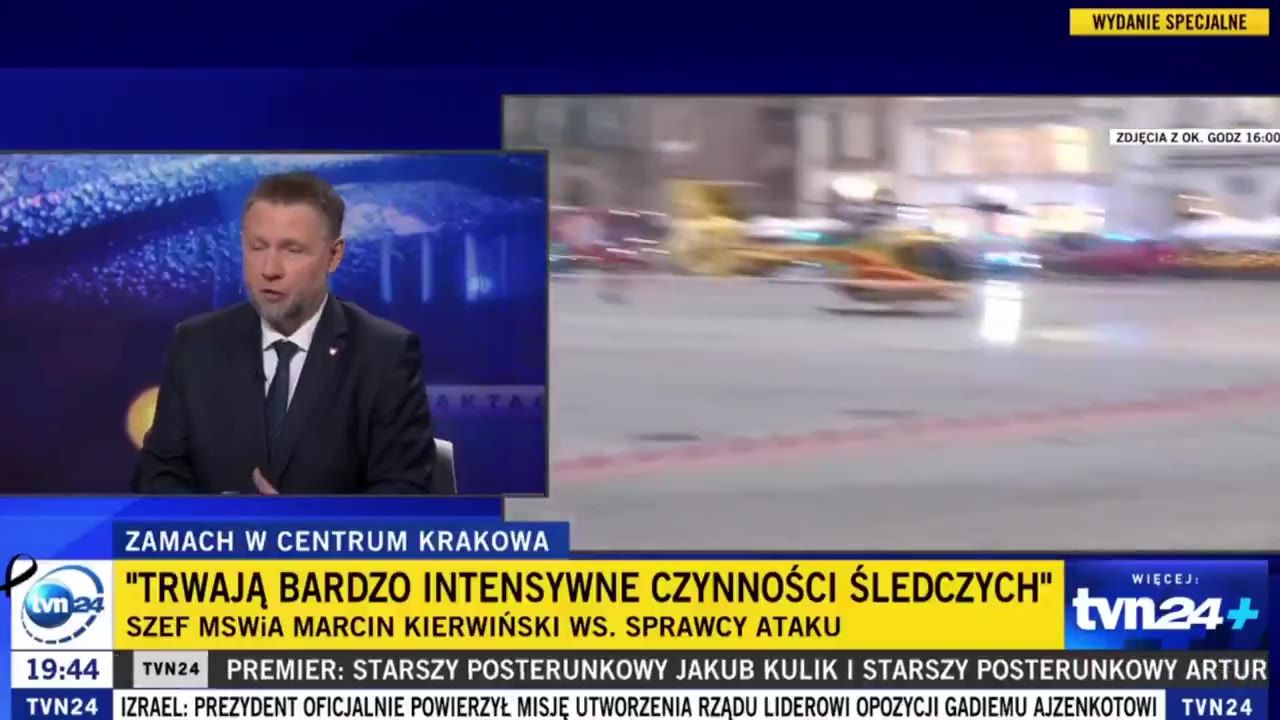
The video is genuine TVN24 footage of Interior Minister Marcin Kierwiński being interviewed on the evening of 8 November 2026. What is not genuine is the caption's description of what he says.
The tells
- ●●● Strong signal TVN24 'Fakty po Faktach' branding, studio layout and a Polish news ticker and time stamp, consistent across the clip.our visual review
- ●●○ Supporting signal Polish on-screen captions ('ZAMACH W CENTRUM KRAKOWA') and split-screen footage of the cordoned Main Square match the attack coverage.our visual review
- ●●● Strong signal The Polish transcript matches the words Polish outlets quote from the interview.our comparison with sources 3, 4 and 7
Synthetic-media detector
Detector not consultedThe media is incidental to the claim; the detector was not needed.
How we checked the media
- Reviewed the keyframes and full clip for TVN24 branding, studio set, on-screen captions and ticker.
- Compared the Polish-language transcript in the clip with how Polish outlets reported the same interview.
- Checked the interview's date and programme against Polish coverage dated 8-9 November 2026.
Sources
7 sources reviewed- 1Polish gunman who killed 6 people in Krakow has 'ultranationalistic' views, authorities say ↗
AP (via WYPR) · wypr.orgUntiereduntiered — treated as signal only, never decisiveEvidence
Quotes Kierwiński's original 7 November news-conference remark and shows it reached international coverage.
- 2Rzecznik rządu o słowach Kierwińskiego o zamachowcu z Krakowa: Warto się wstrzymać ↗
Rzeczpospolita · rp.plUntiereduntiered — treated as signal only, never decisiveEvidence
Reports the government spokesman distancing himself and saying the motive is officially undetermined.
- 3Marcin Kierwiński tłumaczy się ze słów o sprawcy ataku w Krakowie ↗
Radio ESKA · eska.plUntiereduntiered — treated as signal only, never decisiveEvidence
States the minister does not intend to fully withdraw from his earlier words.
- 4Kierwiński tłumaczy się ze słów o zamachowcu i 'prawicowej ideologii' ↗
Onet · wiadomosci.onet.plUntiereduntiered — treated as signal only, never decisiveEvidence
Describes the TVN24 interview in which Kierwiński defends his wording and says 'we are not passing any verdicts'.
- 5Kierwiński mówił o skrajnej prawicy. Prokurator: 'Nie wiem, skąd taka teza' ↗
Tysol · tysol.plUntiereduntiered — treated as signal only, never decisiveEvidence
The National Prosecutor's spokesman says it is too early to determine motive and no unambiguous ideological symbols were found.
- 6Poland's justice minister says investigation into Kraków shooting will aim to establish if the 24-year-old acted alone – Europe live ↗
The Guardian · theguardian.comReputable outletLean Left (AllSides)Context
Reports the investigation into whether the attacker acted alone and the government's partial distancing.
- 7Kierwiński kłamał ws. zamachowca. Tusk nie wyciągnie konsekwencji ↗
Do Rzeczy · dorzeczy.plUntiereduntiered — treated as signal only, never decisiveEvidence
Quotes the minister's own caveat and reports Super Express's finding of no far-right ties.
Further reading
- 4Onet Onet's account of the interview gives the clearest version of the minister's defence.
- 3Radio ESKA Radio ESKA states plainly that he did not intend to fully withdraw from his earlier words.
- 5Tysol The prosecutor's remarks show why the far-right attribution remains unproven.
The full story
The kernel of truth here is that the minister did have to explain himself. On 7 November 2026, hours after a mass shooting in Kraków's Main Square, Marcin Kierwiński told a news conference that 'everything indicates' the 24-year-old perpetrator was 'fascinated by far-right ideologies' — while adding that the point would be verified. The line made headlines in Poland and abroad.
By the next evening he was on TVN24's 'Fakty po Faktach' being pressed on it. He defended the wording as a preliminary investigative hypothesis drawn from leads held by the services, insisted the police were still checking them, and said 'we are not passing any verdicts'. He did not withdraw the claim. Government spokesman Adam Szłapka then distanced himself, saying it would be best to refrain from comment until the services had full information.
On 9 November the National Prosecutor's spokesman said it was too early to determine motive and that no unambiguous ideological symbols had been found in the suspect's flat. So there was a genuine controversy: a senior minister had floated a motive in public before prosecutors would confirm it, and opponents from PiS and Konfederacja seized on it.
That is what makes the post land. There was a retreat, of sorts, and the underlying far-right claim is indeed unproven. The post takes those two real things and stretches them: a partial softening becomes a 'full backtrack', and a caveated statement becomes an admission that he never checked.
Kernel of truth
Kierwiński's far-right attribution was unverified, prosecutors declined to confirm it, and the government did partially distance itself from the remark.
Timeline
November 7, 2026
Mass shooting in Kraków's Main Square. Interior Minister Marcin Kierwiński says 'everything indicates' the perpetrator was fascinated by far-right ideologies, adding the point will be verified. 1AP (via WYPR)
November 8, 2026
In a TVN24 'Fakty po Faktach' interview Kierwiński defends the wording, says police are checking the leads, and declines to withdraw it. Government spokesman Adam Szłapka says it is best to refrain from comment. 4Onet
November 9, 2026
The National Prosecutor's spokesman says it is too early to determine motive and that no unambiguous ideological symbols were found. Super Express reports no far-right ties. 5Tysol
How it was framed
The video is genuine and the minister really was on the defensive, but the caption frames a partial clarification as a full retraction and adds an admission that never happened. Real material is arranged to push a false conclusion.
- “Visual proof”. A genuine TVN24 clip is attached so the caption's paraphrase borrows the authority of the broadcast.
- Emotional language. The mocking phrase 'muh far right' and the claim he said it 'for no other reason than that he felt like it'.
- Us vs. them. The phrase 'to the legacy media' sets the minister against the post's audience.
- Missing context. The caption omits that Kierwiński attached a verification caveat and that he declined to withdraw the claim.
Posted on X by the account @TRobinsonNewEra, apparently on 9 November 2026. The underlying video is TVN24's 'Fakty po Faktach' interview broadcast on the evening of 8 November 2026.
Bias
Leans right-wing / anti-government. The post takes a genuine, authenticated broadcast and reframes it as proof of a fabricated 'far right' smear, adding a mocking paraphrase ('muh far right') and an invented admission that the minister never made. The framing — governments and 'legacy media' invent far-right motives while treating other perpetrators differently — is a signature of the account's wider political narrative rather than neutral reporting.
Bias describes how the post frames its message — the slant of the language, selection and emphasis — and is judged separately from whether the claim is true. A true claim can still be framed with a strong slant.
How we checked
1 min 44 s- 1
Searched Polish and English coverage of the Kraków attack and the minister's remarks, including the term 'wycofał się'.
- 2
Reviewed the TVN24 clip's keyframes, branding and transcript, and compared the transcript with Polish reporting of the same interview.
- 3
Compared the caption's claims with the text of the interview and with reporting by Radio ESKA, Onet, Rzeczpospolita and Do Rzeczy.
- 4
Checked whether any source reported a full retraction or an admission that he had not checked.
✓ Claim checked✓ Media checked✓ Sources checked
Why 78% confidence
HighHIGH: the decisive evidence is the minister's own recorded words, reported consistently by several Polish outlets, and no source supports the retraction claim. The media authenticity assessment rests on our visual review and the sources, not on a detector — we did not run one because the clip's authenticity is not what decides the question.
Limits. The investigation was still open, so the attacker's motive could not be settled. We did not run a forensic detector on the video; it was assessed by visual review and by matching its content to reporting.
What we don’t know
- What the prosecutor's investigation will eventually conclude about the attacker's motive.
- Why the minister chose to name a far-right motive before the services had finished checking it, beyond his own account of preliminary leads.
- Whether the poster watched the full interview or relied on a summary of it.
Spot it yourself
Spot the fakeLooks suspicious, isn’t proof
- The poster is a well-known campaigner with a strong following and a clear viewpoint — that is a reason to check closely, not evidence the clip is wrong.
- The mocking tone and the phrase 'legacy media' signal a slant, but slanted framing is not by itself false.
- The clip is short and the Polish audio is unfamiliar to many English-speaking viewers, which makes it easy to doubt or to accept unquestioningly.
The actual evidence
- The minister's own words in the clip: he says the motive 'would require verification', that 'the police are looking into these leads', and 'we are not passing any verdicts'.
- Radio ESKA's report that he does not intend to fully withdraw from his earlier words.
- The absence of any Polish or international report of him admitting he did not check.
- The prosecutor's 9 November statement, which shows the far-right claim is genuinely unproven — supporting the post's background, not its specific assertion.
- 1
Read the transcript, not just the caption
Auto-translate the clip's audio or subtitles. If the caption says 'full backtrack', look for the sentence where he takes it back. Here there isn't one.
- 2
Check the original-language coverage
Search the minister's name plus the Polish term 'wycofał się' (withdrew). If a real full retraction had happened, Polish outlets would lead with it.
- 3
Separate the disputed part from the settled part
Ask which specific words are contested. Here the far-right attribution is genuinely unproven, but that does not make the retraction claim true.
- 4
Look for the caveat being cut
Officials often attach conditions like 'subject to verification'. Check whether the post quotes them or drops them.
Takeaway
A real controversy is the easiest thing to exaggerate. When a post says someone 'fully backed down', find the sentence where they back down — and check what they actually left standing.
Questions people ask
Did Poland's interior minister fully backtrack on the Kraków attacker 'far right' claim?+
No. In the TVN24 interview Marcin Kierwiński defends the wording, says the far-right motive 'would require verification', that police are looking into the leads, and that 'we are not passing any verdicts'. Radio ESKA reported he did not intend to fully withdraw. The government spokesman distanced himself, which is a partial walk-back, not a full retraction.
Did Kierwiński admit he didn't check before saying the attacker was far right?+
There is no such admission in the clip or in Polish coverage. His account is that the remark came from preliminary leads held by the services, which police were still verifying — which is why he attached a caveat at the time. Critics accuse him of speaking too early, but nobody reports him saying he checked nothing.
What did Kierwiński actually say on 7 November 2026?+
At a news conference hours after the Kraków shooting he said 'everything indicates' the perpetrator held very radical views and 'was fascinated by far-right ideologies', adding that this would be subject to verification. AP reported the remark, and it shaped international coverage of the attack.
Has the attacker's motive been established?+
Not publicly. On 9 November 2026 the National Prosecutor's spokesman said it was too early to determine motive and that no unambiguous ideological symbols had been found in the suspect's flat. Super Express, cited by Do Rzeczy, reported no ties to far-right parties or organisations. The investigation was continuing.
What is 'false context' misinformation?+
It is when genuine material — a real photo, video or quote — is shared with a caption or framing that changes its meaning. Here the TVN24 clip is real, but the caption describes it as a full retraction and an admission, which the footage does not show.
Go deeper
- Backtrack
- To withdraw or reverse a previous public statement; here the post uses it to mean a full retraction, which did not happen.
- False context
- Sharing genuine material with a caption or framing that changes what it means.
- National Prosecutor
- Poland's central prosecution authority, whose spokespeople comment on the status of major investigations.
- Gadsden flag
- A yellow flag with a coiled rattlesnake and 'Don't tread on me', which the prosecutor said is not tied to any extremism.
People also search for
For educators+
- The minister said the far-right motive 'would require verification'. Does attaching a caveat make it acceptable to name a motive in public before prosecutors confirm it?
- The post's background point — that the far-right attribution is unproven — is supported by the prosecutor. Why does a true background point not make the caption's specific claim true?
- How would you check a subtitled clip in a language you do not speak before sharing it?
About this check
- Platform
- X
- Posted by
- @trobinsonnewera
- Posted
- November 9, 2026
- Age when checked
- Under 24 hours old when checked
- Where it spread
- PL
- Audience
- UK & EU audience
- Language
- EN
- Status
- ● Post is live
- Verified
- November 10, 2026, 03:04 UTC
- Published
- November 10, 2026, 03:04 UTC
Reach. 28,188 likes, 556 replies; Human Events and Townhall 9 Nov; prosecutors say motive unknown
This verdict was generated with AI from the sources shown. AI can make mistakes — check the sources before relying on it.
Check anything yourself, in seconds.
Share any social post or video to What the Fact and get the verdict, the confidence, and the receipts.