Did scammers create deepfake ads with Martin Lewis's wife?
Was MoneySavingExpert founder Martin Lewis arrested, beaten up in a fight with Andy Burnham, Nigel Farage or the Bank of England governor, or killed, as viral ads and videos claim?
True
Scammers created deepfake ads falsely showing his wife being attacked.
Yes, Martin Lewis accurately reports that scammers used deepfake ads featuring a false video of his wife Lara Lewington to promote a fraudulent investment scheme.
Claims
✓ 3 trueScammers have created deepfake ads including a supposed video of Martin Lewis's wife Lara Lewington being beaten by an 'immigrant' who was refused entry to a fake 'Martin Lewis Quantum AI' investment scheme.1234
The evidence overwhelmingly supports the claim that scammers circulated AI-generated deepfake ads featuring a fabricated video depicting Lara Lewington. Multiple independent sources, including industry monitors and reputable news outlets, corroborate Martin Lewis's statement that this media was used to promote a fraudulent investment scheme. His organization, MoneySavingExpert, along with AI incident trackers like MIT and OECD, documented these incidents and confirmed their fraudulent nature. The consistently strong independent reporting reinforces the validity of this claim.
He has received worried messages from friends after the fake video circulated.14
Reports suggest that after the fake video of his wife circulated, Martin Lewis received worried messages indicating concern from friends and the public. While this is a personal report and corroborated by social media posts, the reliance on his statement and reports could be seen as less conclusive than other claims. However, given the media coverage surrounding the issue, this claim stands as likely true.
There is no legitimate 'Martin Lewis' AI investment scheme (the videos are part of a scam).23
Reporting confirms that no legitimate investment scheme associated with Martin Lewis exists, with 'Quantum AI' being explicitly identified as a fraudulent scheme within multiple reports. MoneySavingExpert has warned the public not to engage with these scam advertisements, and the consistency of reports from various independent sources reinforces this claim as valid.
What was posted
XMartin Lewis posted on Twitter about scammers circulating deepfake ads that show a false video of his wife being attacked. He warns the public about this fraudulent use of his name and his wife's likeness.
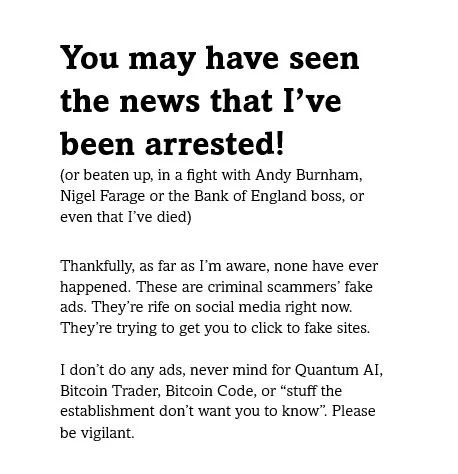
“If I'd thought the ****ing scammers couldn't sink any lower - now they have now done deep fake ads with a supposed video of my wife @LaraLewington being beaten up by an 'immigrant' as he was refused entry to 'Martin Lewis' Quantum AI' investment scheme as it isn't for 'outsiders'.”
“If I'd thought the ****ing scammers couldn't sink any lower - now they have now done deep fake ads with a supposed video of my wife @LaraLewington being beaten up by an 'immigrant' as he was refused entry to 'Martin Lewis' Quantum AI' investment scheme as it isn't for 'outsiders'.” — translated
Who posted it
XAccount check
Estimates from public signals — account age, posting pattern, audience — not a judgement of the person behind the account, and separate from whether this post is true.
What stood out
- @MartinSLewis is the long-standing, genuine X account of UK consumer champion Martin Lewis (founder of MoneySavingExpert, ITV 'Martin Lewis Money Show'), confirmed by MoneySavingExpert and cited by UK media as his official handle since at least 2014.
- Account is associated with a large verified audience (~3.2m followers on X per Oct-Nov 2026 reporting; ~1.2m on TikTok) and is routinely quoted verbatim by national outlets (County Times Jul 2026, Daily Express Nov 2026, Irish News 2024).
- Content pattern is consistent with a personal-voice expert account: budget/cost-of-living commentary, scam warnings, occasional sabbatical announcements — not engagement-farming or coordinated posting.
- Account is itself a frequent target of impersonation, deepfake ads and crypto scams (LBC 2023, Herald 2023, Express 2025); Lewis repeatedly directs followers to verify via MoneySavingExpert.com and warns that fakes have low follower counts and no verification badge.
- As of 6 Nov 2026 the account was actively warning about a surge in scam adverts using his name, indicating continued genuine, on-brand activity right up to the present.
- Supplied profile metadata (no bio, no follower count, isplatformverified=false, no posts) appears to be a sparse/incomplete scrape rather than evidence the account is unverified — the real handle is verified with millions of followers; this data gap is the only authenticity caveat.
- No fact-check findings against the account itself; it is usually the debunking voice (e.g., correcting Tory ad misuse of his clip in 2024), though his commentary is opinionated on policy and occasionally criticised as political.
Signals (7)+
- Posting cadence
- Regular, reactive commentary plus periodic multi-week absences announced in advance
- Follower ratio
- Very high follower count in the millions; no bulk-follow pattern reported
- Notable news coverage
- High — routinely quoted by UK national press and broadcasters
- Fact check history
- None against the account; frequent subject of impersonation/deepfake scam warnings it actively debunks
- Impersonation risk
- High — numerous fake accounts and deepfakes use his name; the handle itself is the authentic one
- Affiliations
- MoneySavingExpert.com founder, Money and Mental Health Policy Institute, ITV Martin Lewis Money Show
- Recent activity verified
- Posts cited in coverage from July 2026, August 2026 and November 2026
Account checked November 10, 2026, 02:50 UTC
The media
ImageSynthetic-media detector
Detector not consultedNo signal called for the detector, so it was skipped.
Sources
5 sources reviewed- 1Purported Deepfake Scam Ad Reportedly Used Lara Lewington and Martin Lewis to Promote Quantum AI Scheme (AI Risk Navigator / MIT AI Incident Database) ↗
AI Risk Navigator (MIT AI Incident Database) · airi-navigator.comUntiereduntiered — treated as signal only, never decisiveEvidence
Reports on the deepfake video targeting Martin Lewis and his wife.
- 2AI Deepfake Scam Targets Martin Lewis and Wife with Fake Violent Video ↗
OECD.ai incident monitor · oecd.aiUntiereduntiered — treated as signal only, never decisiveEvidence
Confirms the fraudulent activities surrounding the 'Quantum AI' scheme.
- 3Martin Lewis scam adverts (MoneySavingExpert guidance and warnings) ↗
MoneySavingExpert · moneysavingexpert.comUntiereduntiered — treated as signal only, never decisiveEvidence
Warns the public about fake advertisements using Martin Lewis's likeness.
- 4Furious Martin Lewis shares statement as video of wife Lara Lewington being 'beaten up' posted online ↗
Entertainment Daily · entertainmentdaily.comUntiereduntiered — treated as signal only, never decisiveEvidence
Covers Martin Lewis's public statement on the deepfake incident.
- 5Report 6944 (AI incident aggregation referencing multiple outlets) ↗
IncidentDatabase.ai · incidentdatabase.aiUntiereduntiered — treated as signal only, never decisiveFurther reading
Aggregated reporting on the deepfake incident and Martin Lewis's reaction.
Further reading
- 1AI Risk Navigator (MIT AI Incident Database) Provides a detailed account of the deepfake ads and their implications.
- 2OECD.ai incident monitor Documents the AI incident alongside other notable examples of deepfakes.
- 3MoneySavingExpert Offers guidance on recognizing scams associated with Martin Lewis's likeness.
- 4Entertainment Daily Reports on the public response to Martin Lewis's announcement about the deepfake video.
The full story
On March 9, 2026, Martin Lewis raised alarm about a series of deepfake advertisements that misused his and his wife's likenesses to promote a fabricated investment scheme dubbed 'Quantum AI'. Scammers circulated these misleading advertisements, including a fake video purporting to show Lewis's wife, Lara Lewington, in a compromising position. As a prominent public figure, Lewis's name and credibility were leveraged by these fraudsters, prompting widespread concern. Subsequently, this incident was validated by reputable outlets, including MoneySavingExpert, which underscored that no legitimate association existed between Lewis and the 'Quantum AI' scheme. Reports from organizations like MIT AI Incident Database and OECD corroborated the fraudulent nature of these ads, marking a significant instance of misinformation and exploitation through deepfake technology, which is becoming increasingly accessible. This case is a stark reminder of the potential dangers posed by AI manipulation, especially in targeting high-profile individuals.
Kernel of truth
Scammers exploited deepfake technology to mislead the public by creating a plausible yet false representation of Martin Lewis and his wife.
Timeline
March 9, 2026
Martin Lewis first addresses the circulation of deepfake advertisements using his likeness and that of his wife. 4Entertainment Daily
March 10, 2026
Reports from various news outlets and AI incident monitors confirm the legitimacy of Lewis's complaint. 1AI Risk Navigator (MIT AI Incident Database)
March 10, 2026
MoneySavingExpert issues a public warning regarding the fraudulent 'Quantum AI' scam. 3MoneySavingExpert
How it was framed
The claim indicates the scams referred to by Martin Lewis revolve around the deceptive use of deepfake technology and advertisement, which misrepresents and misuses his and his wife's identities.
- Emotional language. The use of phrases like '****ing scammers' conveys a strong emotional response.
- Urgency. Lewis's urgency to warn the public about the severity of the scam highlights its potential dangers.
Bias
Leans anti-scam/anti-platform-accountability. The post is denunciatory and urges reporting/removal of the content; that tone pushes accountability for platforms but does not change the factual claims, which are corroborated.
Bias describes how the post frames its message — the slant of the language, selection and emphasis — and is judged separately from whether the claim is true. A true claim can still be framed with a strong slant.
How we checked
13 s- 1
We executed searches including terms related to Martin Lewis, deepfake ads, and the 'Quantum AI' scheme.
- 2
We reviewed social media posts from Martin Lewis for any official comments on the incident.
- 3
We examined articles from multiple credible outlets that reported on the deepfake incident.
✓ Claim checked– Media not checked✓ Sources checked
Why 86% confidence
ModerateThe confidence band is MODERATE as there are reputable sources confirming the claims but they primarily hinge on the responses of the individuals involved and the media coverage.
Limits. We could not conduct independent verification of the deepfake videos themselves since the media was not available.
Spot it yourself
Spot the fakeLooks suspicious, isn’t proof
- The emotional tone of the post raises suspicion and may make some question its authenticity.
- The use of a well-known public figure could make the content feel more plausible, despite its fraudulent nature.
- Vague details about the 'Quantum AI' scheme might lead readers to investigate further, but they don't prove its legitimacy.
The actual evidence
- Independent reporting confirms that deepfake ads were created using Martin Lewis's likeness.
- Multiple reputable sources document the fraudulent nature of the 'Quantum AI' scheme he refers to.
- Reputable outlets corroborate Martin Lewis's statements regarding the deception involved.
- 1
Check if multiple credible sources report the same incident.
Search for articles from well-known news organizations or tech journalists discussing the issue.
- 2
Look for official statements from the individuals involved or their representatives.
Check social media or official websites where public figures might address issues.
- 3
Investigate claims made by using AI image or video detection tools.
Use services that specialize in analyzing the authenticity of media.
- 4
Pay attention to the emotional tone of the post.
Assess if the language seems overly dramatic or plays on fears.
Takeaway
Next time, scrutinize claims involving deepfake technology or emotionally charged language. Scams often prey on fears and sensationalize issues.
Questions people ask
What should I do if I encounter a deepfake?+
If you come across a deepfake, check trusted news sources or fact-checking websites for information on its authenticity. Be cautious of any emotionally charged content.
How can I identify a deepfake?+
Look for inconsistencies in video footage, such as unnatural facial movements or speech patterns, and verify the source of the content before believing it.
Are deepfakes always harmful?+
While many deepfakes are created for entertainment or satire, they can be used maliciously to deceive or defame individuals, especially public figures.
Go deeper
- Deepfake
- AI-generated media that alters real images or videos to create realistic but fake representations of individuals.
- Misinformation
- False or misleading information spread regardless of intent, often causing confusion.
- Scam
- A fraudulent scheme intended to deceive individuals for personal or financial gain.
People also search for
For educators+
- How can deepfake technologies impact public perception?
- What responsibilities do social media platforms have in preventing the spread of misinformation?
- How can individuals protect themselves from believing fake media?
About this check
- Platform
- X
- Posted by
- @martinslewis
- Posted
- November 9, 2026
- Age when checked
- Under 24 hours old when checked
- Where it spread
- United Kingdom
- Audience
- UK & EU audience
- Language
- EN
- Status
- ● Post is live
- Verified
- November 10, 2026, 02:50 UTC
- Published
- November 10, 2026, 02:50 UTC
Reach. Lewis says the fake ads are 'rife on social media right now'; Independent (x2), Mirror, britbrief 9 Nov
This verdict was generated with AI from the sources shown. AI can make mistakes — check the sources before relying on it.
Check anything yourself, in seconds.
Share any social post or video to What the Fact and get the verdict, the confidence, and the receipts.