Is Teddy Riner really running for president of France in 2027?
Did judo champion Teddy Riner really announce he is running for president of France in 2027, or is the viral announcement fake?
True
Riner really is a 2027 presidential candidate — and the glossy studio video is genuinely his.
TRUE. On 9 November 2026, Olympic judo champion Teddy Riner posted a 2 min 37 sec video announcing he is a candidate in France's 2027 presidential election, running without a party. AFP, franceinfo, RTBF, Radio-Canada, L'Équipe and others reported it the same day, and Riner confirmed the video was real and not AI-generated.
 Likely genuine
Claims
✓ 3 trueI am a candidate in the 2027 French presidential election.12357
“Je suis candidat à l'élection présidentielle de 2027”
This rests on a large amount of independent reporting from different newsrooms, not on the video alone. AFP wire copy, carried by RTBF and Radio-Canada, describes a 2 min 37 sec video posted on Riner's social accounts before midday on 9 November 2026 — the same length as the clip here. Franceinfo carries the announcement sentence almost word for word with the same date. L'Équipe adds the detail that the first round falls on 18 April 2027 and the run-off on 2 May. Radio-Canada and Süddeutsche Zeitung, German-language coverage, show the news crossed borders immediately. Riner then did a long written interview with Le Parisien the same day. These outlets share the same underlying event but report it separately: a wire agency, public broadcasters in two countries, a sports daily and a German broadsheet. Nobody disputes the candidacy. What decides it is the match between the post's own text and the quoted announcement now carried across dozens of mastheads, plus the follow-up interview.
It was real, it is not AI — Riner's own clarification of the announcement video.456
“C'était bien réel, ce n'est pas de l'IA”
The doubt here was about production, not about facts: the studio lighting, dark suit, white shirt, flag and bookcase backdrop looked so polished that a senator publicly asked whether the video was a fake. Riner answered the same evening in an Instagram story, saying the announcement was real and not AI. RMC Sport and L'Équipe both reported that statement, which is the decisive piece: it comes from the person best placed to know, and it is documented by two separate outlets. His visual review of the keyframes points the same way — hands, fingers, ring and cufflinks stay consistent from frame to frame, and the reflections on the desk behind him behave as they should. Generative video commonly slips on exactly those details. A long print interview with Le Parisien the same day also showed the candidacy existed outside the video. The main limit is that we did not run a forensic detector; the case was already settled without one.
Still open: No frame-by-frame forensic authentication of the file was carried out; the question was settled by reporting instead.
My life was not spent behind a desk… the work that made France's colours shine on every podium, during the Games.27
“Ma vie, je ne l'ai pas passée derrière un pupitre... ce même travail qui a fait briller les couleurs de la France sur tous les podiums... pendant les Jeux”
This is the part of the speech that is plainly checkable, and it checks out. Riner is a five-time Olympic champion, including individual and team golds at Paris 2024, and an eleven-time world champion. The coverage refers to him as an icon of French sport and notes that he has never held political office — which is also what the line 'my life was not spent behind a desk' is pointing at. Two separate strands support it: his sporting record, which is public and uncontested, and the repeated press description of him as a political newcomer. That second detail matters for readers weighing the speech, because it means the 'no political record' framing in the video is accurate rather than spin. What this does not establish is whether his sporting career qualifies him for office; that is a judgement for voters.
France is collapsing under the weight of debt a little more each day; state authority has disappeared; the street has been left to thugs.2
“La France s'effondre sous le poids de la dette un peu plus chaque jour... l'autorité de l'État a disparu... on a laissé la rue aux voyous”
These sentences are the candidate's political framing, not discrete factual statements we can mark true or false. 'Collapsing' and 'state authority has disappeared' are judgements about how things feel and how serious a situation is; reasonable people can weigh the same figures differently. French public debt has indeed risen over recent years, so the underlying subject is real — but that does not convert the sentence into a checkable number. Readers should treat this passage the way they would treat any campaign speech: as a statement of priorities, not a claim to be verified. The distinction is worth holding onto, because campaign videos deliberately mix verifiable biography with unverifiable diagnosis. Nothing in the coverage we reviewed fact-checks these lines; the reporting focuses on the candidacy itself.
Still open: Whether 'collapsing' is a fair description of France's fiscal position depends on which indicators and timeframe you choose.
What was posted
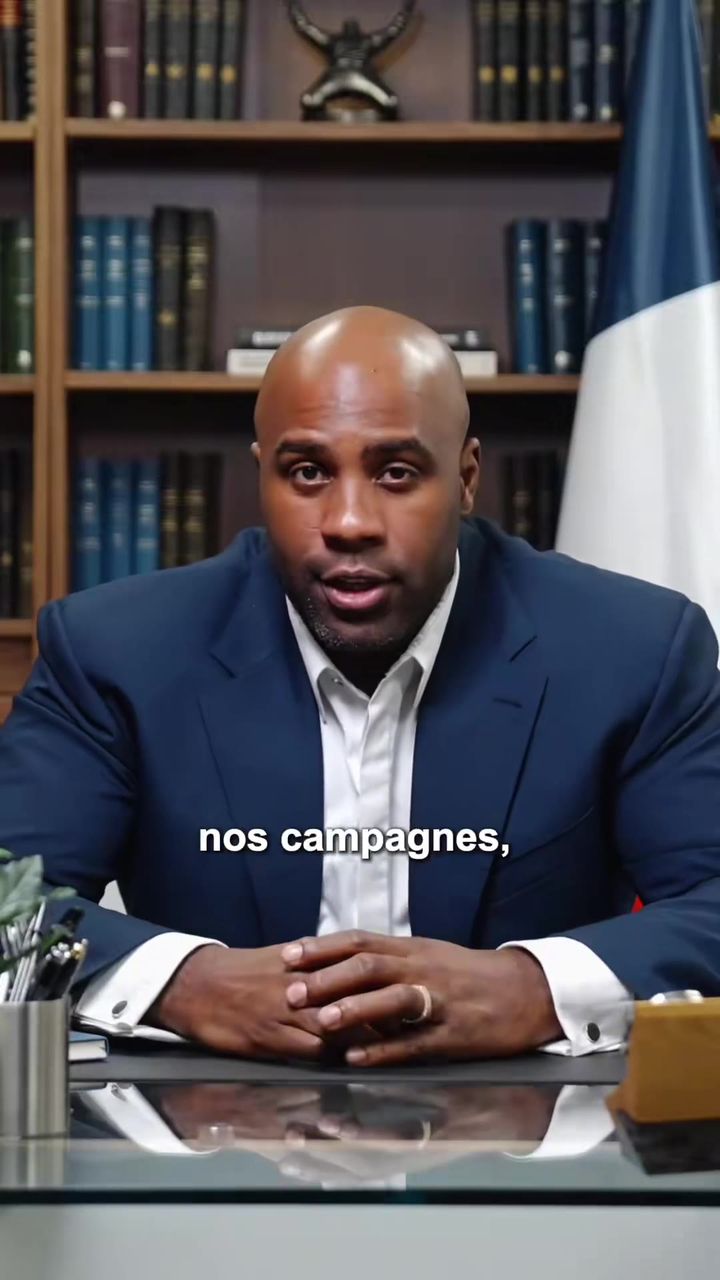
XA video posted on Teddy Riner's own X account on 9 November 2026. Riner sits at a desk in a studio set with shelves and a French flag behind him, speaks straight to camera for about two and a half minutes and declares himself a candidate in the 2027 presidential election. The post asks readers to believe that this is a real candidacy by a man with no party and no political record.
“La résignation n'est pas une option. Face aux difficultés de notre pays, l'heure est venue de prendre ses responsabilités. Je suis candidat à l'élection présidentielle de 2027. #TeddyRiner2027 #Présidentielle2027 #LaFrancequonveut”
“Resignation is not an option. Faced with our country's difficulties, the time has come to take responsibility. I am a candidate in the 2027 presidential election.” — translated
Posted on Riner's own X account shortly before midday on 9 November 2026, according to AFP's account carried by RTBF and others, and followed the same evening by an Instagram story in which Riner said the announcement was real.
Who posted it
XAccount check
Estimates from public signals — account age, posting pattern, audience — not a judgement of the person behind the account, and separate from whether this post is true.
What stood out
- @teddyriner is the long-established official X account of French judoka Teddy Riner — the handle is cited verbatim by AFP, Le Parisien, L'Équipe, EFE, La Provence and dozens of other outlets as the source of his 9 Nov 2026 presidential candidacy announcement.
- X's own newsroom blog (Sept 2013) already referred to '@TeddyRiner' as his account for a Q&A, implying ~13+ years of continuous presence — inconsistent with disposable/sock-puppet accounts.
- His posts are quoted as primary statements and were corroborated by him on Instagram ("c'est bien réel, ce n'est pas de l'IA") after a senator publicly asked whether the announcement was a fake.
- Sparse metadata supplied (no bio, follower count, creation date; isplatformverified=false) is a scraping gap rather than evidence of inauthenticity — mainstream outlets routinely embed posts from this exact handle.
- Account is now a political/campaign channel (party 'La France qu'on veut', #TeddyRiner2027), so its claims about his own plans are first-person primary material but advocacy, not neutral reporting.
- Context: Riner has previously been the target of false death rumours (Mediamass, 2025) and racist/hateful posts after criticising the far right — i.e. he is a victim of disinformation, not a known source of it.
- No recent_posts sample provided, so cadence/coordination signals could not be assessed directly.
Signals (8)+
- Account age basis
- Inferred from press/X-blog references; creation date not supplied
- Posting cadence
- Unknown (empty recent_posts sample)
- Follower ratio
- Unknown on X; cross-platform Instagram ~1.55M followers, following 466 (ratio ~3,300:1) per HypeAuditor, Sept 2026
- Identity confirmation
- Direct quotation by major wire services and French national press; self-confirmation on Instagram
- Notable news coverage
- High — Nov 2026 presidential candidacy announcement covered globally (AFP, EFE, Politico, Le Parisien, L'Équipe, RT, Kan, etc.)
- Fact check history
- No fact-checks against the account itself; subject of debunked death hoax (2025) and initial 'is it AI/fake?' scepticism that he personally rebutted
- Known affiliations
- French judo federation / Olympic athlete; founder of political party 'La France qu'on veut' (2026); no party affiliation declared
- Conflict of interest
- Account now serves his own electoral campaign — self-interested advocacy content
Account checked November 10, 2026, 02:51 UTC
The media
Video✓ What is genuine
The video is Riner's own announcement, posted on his account, and he confirmed the same evening that it was real and not AI-generated.
The tells
- ●●○ Supporting signal Hands, fingers, ring and cufflinks stay consistent across all keyframes, and the polished desk throws reflections that behave as expected.our visual review
- ●●● Strong signal The setting matches what France Inter and AFP describe: dark suit, white shirt, French flag and bookshelf backdrop.France Inter and AFP, via RTBF
- ●●○ Supporting signal The clip's running time is consistent with the 2 min 37 sec video described in the reporting.AFP, via RTBF
- ●○○ Weak signal Heavy studio lighting and shallow focus make the footage look unusually glossy, which is what triggered the AI suspicion in the first place.our visual review
Synthetic-media detector
Detector not consultedSources settled the claim on their own; the detector was not needed.
How we checked the media
- Compared the clip's length and setting with the description in the reporting (2 min 37 sec, seated to camera, dark suit, white shirt, flag and bookcase).
- Read the transcript against the quotes carried by the wire agencies and broadcasters.
- Reviewed the attached keyframes by eye for consistency of hands, fingers, ring, cufflinks and desk reflections.
- Searched for any fact-check or report calling the video synthetic, and for Riner's own response to the AI suspicion.
Sources
8 sources reviewed- 1Teddy Riner candidat à l'élection présidentielle ↗
Franceinfo · franceinfo.frUntiereduntiered — treated as signal only, never decisiveEvidence
Quotes the announcement sentence on X on 9 November, matching the post's caption.
- 2France : "Je refuse de rester spectateur", le champion olympique de judo Teddy Riner annonce sa candidature à la présidentielle ↗
RTBF (AFP) · rtbf.beUntiereduntiered — treated as signal only, never decisiveEvidence
AFP copy describing the 2 min 37 sec video posted before midday.
- 3Des tatamis à l'Élysée? Teddy Riner annonce sa candidature à la présidentielle française ↗
Radio-Canada (AFP) · ici.radio-canada.caUntiereduntiered — treated as signal only, never decisiveEvidence
Carries the direct quote of the declaration for Canadian readers.
- 4"C'était bien réel, ce n'est pas de l'IA", Teddy Riner confirme sa candidature à la présidentielle sans étiquette politique ↗
RMC Sport · rmcsport.bfmtv.comUntiereduntiered — treated as signal only, never decisiveEvidence
Reports Riner's evening statement that the video was real and not AI.
- 5Teddy Riner confirme sa candidature à l'élection présidentielle 2027 : "C'est bien réel, ce n'est pas de l'IA" ↗
L'Équipe · gcp-varnish-prod-www.lequipe.frUntiereduntiered — treated as signal only, never decisiveEvidence
Gives the 2027 election dates and reports the confirmation story on Instagram.
- 6Teddy Riner à la présidentielle : l'ex-ministre de la Santé François Braun fait partie de l'équipe ↗
France Inter / Radio France · radiofrance.frUntiereduntiered — treated as signal only, never decisiveContext
Describes the studio staging and reports a former health minister on his team.
- 7Judo-Olympiasieger Teddy Riner will französischer Staatspräsident werden ↗
Süddeutsche Zeitung · sueddeutsche.deReputable outletLean LeftEvidence
German-language coverage confirming the candidacy crossed borders immediately.
- 8"Battons-nous pour la France qu'on veut": Teddy Riner annonce sa candidature à la présidentielle à travers une vidéo ↗
BFMTV · bfmtv.comUntiereduntiered — treated as signal only, never decisiveContext
Broadcast coverage of the announcement, giving a slightly different stated running time.
Further reading
- 2RTBF (AFP) AFP's report gives the video's exact length and timing, which is the clearest match to the post itself.
- 4RMC Sport Explains the AI suspicion and Riner's own response to it.
- 6France Inter / Radio France Describes the staging in detail, useful for understanding why the video looked so polished.
The full story
Teddy Riner is one of the most recognisable athletes in France: a five-time Olympic judo champion, including individual and team golds at Paris 2024, and an eleven-time world champion. On 9 November 2026, shortly before midday, he posted a two-and-a-half-minute video on his own accounts in which he said he was running for president in 2027.
The staging was deliberate. France Inter described it precisely: dark suit, white shirt, French flag and a bookcase behind him. That is the visual language of a serious political declaration, and it worked as intended — AFP and broadcasters across Belgium, Canada and Germany picked it up within hours, and Riner gave a long interview to Le Parisien the same day covering pensions, net pay, purchasing power and campaign financing.
But the same polish caused a problem. The video looked glossy enough that some public figures, including a senator quoted in the coverage, publicly wondered whether it was AI-generated. So Riner did something unusual for an announcement: that evening he posted an Instagram story saying the announcement was real and not AI. RMC Sport and L'Équipe reported it.
That sequence is the interesting part. The suspicion was not unreasonable — high-production political videos really can be synthetic now — but it was resolved in a way that says a lot about how this kind of doubt should be handled: by going to the person and the platform behind it, not by staring harder at the pixels.
Kernel of truth
A genuine, professionally staged candidacy announcement looked so polished that people suspected it was synthetic — which is why the candidate himself had to say it was real.
Timeline
November 9, 2026
Shortly before midday, Riner posts a 2 min 37 sec video on his X account announcing his candidacy in the 2027 presidential election. 2RTBF (AFP)
November 9, 2026
AFP and other outlets report the announcement the same day, and Riner gives a long interview to Le Parisien on pensions, net pay, purchasing power and campaign financing. 1Franceinfo
November 9, 2026
In the evening, Riner posts an Instagram story saying the announcement was real and not AI, reported by RMC Sport and L'Équipe. 4RMC Sport
April 18, 2027
First round of the French presidential election, with the run-off set for 2 May 2027. 5L'Équipe
How it was framed
The post is a genuine announcement by the person it claims to be from, and its core factual content — the candidacy, the election, the speaker's biography — checks out against broad independent coverage. The remaining lines are political opinion, which we marked separately rather than folding into the verdict.
- Emotional language. "La résignation n'est pas une option", "la France s'effondre", "on a laissé la rue aux voyous".
- Us vs. them. "Ceux qui se lèvent tôt, qui bossent dur, qui respectent les règles n'en peuvent plus de payer pour tout le monde" and "un politicien professionnel qui récite des leçons".
- Ongoing-threat framing. "je crains que demain on doive vivre face à face" and "la rue aux voyous".
- Borrowed authority. He leans on his sporting record: "ce même travail qui a fait briller les couleurs de la France sur tous les podiums".
- “Visual proof”. Seated to camera with a French flag and bookcase behind him, staged to read as a formal national address.
Posted on Teddy Riner's own X account shortly before midday on 9 November 2026. AFP's wire coverage, carried by RTBF and Radio-Canada, treats the announcement as significant national news, and Süddeutsche Zeitung, rated Lean Left by AllSides, carried it for German readers.
Bias
Leans anti-establishment / populist 'ni droite ni gauche' framing. This is a campaign declaration by the candidate himself, deliberately pitched against the political class ('pas du sérail', 'pas les codes', 'la France n'a pas besoin d'un politicien professionnel'), against the two 'extremes' and around themes of insecurity, debt, administrative burden and 'those who work hard'. The slant is the candidate's own political advocacy rather than a media framing.
Bias describes how the post frames its message — the slant of the language, selection and emphasis — and is judged separately from whether the claim is true. A true claim can still be framed with a strong slant.
How we checked
1 min 8 s- 1
Searched for Riner's candidacy in French, and for reporting on the AI-suspicion angle in French and English.
- 2
Compared the post's caption and transcript with quotes carried by the reporting.
- 3
Checked the video's length and setting against AFP's description of the announcement.
- 4
Reviewed the attached keyframes by eye for signs of synthetic generation.
- 5
Looked for any fact-check or report declaring the video fake or the candidacy false.
✓ Claim checked✓ Media checked✓ Sources checked
Why 90% confidence
HighHIGH. Multiple independent newsrooms — a wire agency, public broadcasters in two countries, a sports daily and a German broadsheet — reported the candidacy with matching quotes and format, and Riner personally addressed the AI suspicion. We set media authenticity at likely rather than confirmed only because we did not run a forensic detector; the claim itself does not depend on that, so it stays HIGH.
Limits. We did not run a forensic video detector or examine the original file, and we could not open the underlying pages directly, relying on the search results and reporting we retrieved.
What we don’t know
- Why some public figures suspected AI in the first place beyond the general look of the video.
- Whether Riner's team will publish a full party structure or list of supporters beyond the former health minister reported to be involved.
- Whether he will actually keep competing for the Los Angeles 2028 Olympics as he says he intends to, if voters allow it.
Spot it yourself
Why it looked fakeLooks suspicious, isn’t proof
- It looks too professional and too glossy for a first-time candidate. Production quality tells you about the budget, not about whether the person is real.
- It is a political announcement from a famous athlete with no party. Surprising does not mean fabricated.
- The lighting and shallow focus make the face look slightly unfamiliar. Grading and studio lighting do that to anyone.
The actual evidence
- AFP wire copy described the video's exact length and setting, and Franceinfo carried the same announcement line with the same date.
- Riner himself said the announcement was real and not AI, in an Instagram story reported by RMC Sport and L'Équipe.
- A long Le Parisien interview with him the same day covered pensions, net pay and campaign financing — evidence of a campaign beyond one video.
- Coverage appeared in Belgium, Canada and Germany within a day, from outlets that would not all repeat an unverified stunt.
- 1
Go to the account that posted it
Find the video on the named person's own verified profile, not on a page reposting it. If a candidate announces a run, it will be on their own account.
- 2
Ask what else the person did that day
Genuine announcements leave a trail: interviews, statements, campaign staff. Search the person's name plus the date and look for reporting from more than one outlet.
- 3
Read the wire agencies
Agency copy such as AFP is usually built on direct contact with the person's team. If the wires have it with quotes and a duration, that is strong corroboration.
- 4
Check for a denial or confirmation
Search the person's name with words like 'AI', 'fake' or 'deepfake' in the original language. A subject who has been falsely imitated usually responds quickly.
- 5
Inspect the video's details only as a tie-breaker
Pause on hands and small reflective surfaces. Consistent fingers and reflections argue against a render, but they cannot confirm authenticity on their own — a real video and a good fake can both pass.
Takeaway
A video can look synthetic and still be real, just as it can look ordinary and be fake. Authenticity is settled by who posted it, what the wires report and what the person says — not by how expensive it looks.
Questions people ask
Did Teddy Riner really announce he is running for president in 2027?+
Yes. On 9 November 2026 he posted a 2 min 37 sec video on his own X account declaring himself a candidate in France's 2027 presidential election, with the first round on 18 April 2027. AFP, franceinfo, RTBF, Radio-Canada, L'Équipe and others reported it the same day.
Is the Teddy Riner announcement video AI-generated?+
No. The polished studio look made some people suspect it was synthetic, and a senator publicly asked whether it was a fake. Riner answered that evening in an Instagram story, saying the announcement was real and not AI, as reported by RMC Sport and L'Équipe.
What party is Teddy Riner running for?+
None. The coverage describes him as running without a party label and positioning himself as neither of the left nor the right. He has never held political office, something his speech points to directly when he says his life was not spent behind a desk.
When is the 2027 French presidential election?+
The first round is on 18 April 2027, with the run-off on 2 May 2027, according to L'Équipe's reporting on Riner's candidacy. The campaign he has entered is therefore about five months away from the announcement.
Why do people suspect real political videos are AI fakes?+
Professional political videos are heavily lit, colour-graded and tightly edited, so they can look smoother than everyday footage. Generative tools have improved at faces and voices, so viewers have learned to be wary. The reliable test is not how a video looks but who posted it and whether independent outlets report the same event.
Go deeper
- AI-generated video
- Footage created or altered by a machine-learning model rather than filmed with a camera.
- Wire agency
- A news service such as AFP that gathers reporting and sells it to many outlets, so the same text can appear on several websites at once.
- First round and run-off
- The two-stage French presidential vote, where a second ballot is held between the top two candidates if nobody wins outright.
- Without a party label
- Running as an independent, without the official backing of an established political party.
People also search for
For educators+
- The video looked so professional that people suspected AI. What other signals besides production quality could you use to judge whether a video is real?
- Riner's speech mixes checkable biography with claims like 'France is collapsing'. How would you separate the two if you were fact-checking the whole text?
- If a public figure is falsely accused of faking a video, what is the fairest way for them to respond, and what should newsrooms do in the meantime?
About this check
- Platform
- X
- Posted by
- @teddyriner
- Posted
- November 9, 2026
- Age when checked
- Under 24 hours old when checked
- Where it spread
- France
- Audience
- UK & EU audience
- Language
- FR
- Status
- ● Post is live
- Verified
- November 10, 2026, 02:53 UTC
- Published
- November 10, 2026, 02:53 UTC
Reach. 43,797 likes, 8,938 replies; many users and a senator asked whether it was a fake
This verdict was generated with AI from the sources shown. AI can make mistakes — check the sources before relying on it.
Check anything yourself, in seconds.
Share any social post or video to What the Fact and get the verdict, the confidence, and the receipts.