Did Trump suggest the midterm elections were rigged?
Were the 2026 midterms made dishonest by early-voting 'dumps' and voting machines, as Trump claimed on Truth Social on 9 November?
True, but…
The post is genuine; the election-fraud claims inside it are not supported.
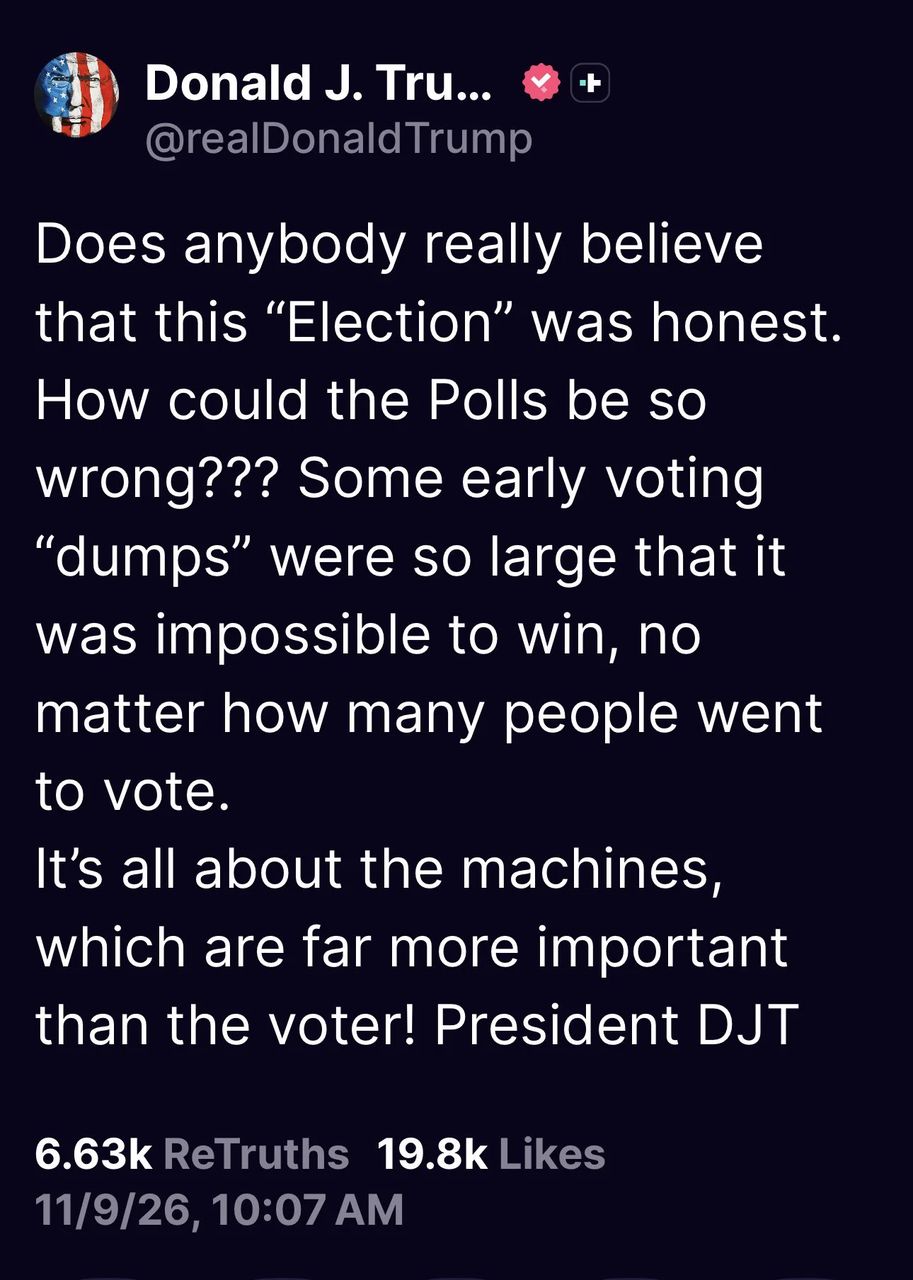
Yes. On 9 November 2026, days after Democrats won the House and Senate, President Donald Trump posted on Truth Social asking whether the election was "honest" and blaming early-vote "dumps" and voting machines. The screenshot reproduces that post accurately. The fraud allegations inside the post are baseless, and election officials raised no major concerns.
Claims
✓ 1 true · ✕ 2 falseDonald Trump now suggests the midterm elections were rigged, questioning whether the 3 November 2026 election was honest and blaming early-vote dumps and voting machines.123
“BREAKING: Trump now suggests the midterm elections were rigged.”
This holds up on two separate points: that the post exists, and that it casts doubt on the result. The New York Times, AFP, USA Today, the Guardian and the Washington Times all quoted the text on the same day, word for word, including the "President DJT" sign-off. That kind of verbatim match across outlets with different owners and different politics is strong evidence the screenshot is a faithful copy rather than a fabrication. The post appeared on 9 November 2026, less than a week after Trump had told the New York Times he was "absolutely willing to accept those results" — which is why coverage framed it as a reversal. Two things are worth keeping apart. The caption's description of what Trump did is accurate. The fraud allegations inside the quoted post are a different question, addressed in the claims below. A reader should weigh the agreement across independent outlets heavily here, and treat any single screenshot on its own with more caution.
"How could the Polls be so wrong???" — implying pre-election polling failed in a way that casts doubt on the result.34
““How could the Polls be so wrong???””
Most public polling before 3 November forecast a Democratic wave, and a Democratic wave is what happened — so the premise that the polls failed is weak to begin with. The direction of the error makes it weaker still. A Pew Research Center analysis cited by the Washington Times found polling averages understated the Democratic margin in 23 of 27 Senate and gubernatorial races, by at least two points, with an average miss of about four. In other words, the polls were too favourable to Republicans, not too favourable to Democrats. AFP and Anadolu both note that a "blue wave" was the widely reported expectation. Confidence is moderate rather than high because this rests on one polling analysis as reported by outlets, not on our own review of the underlying data. What a reader should take away is that "the polls were wrong" and "the polls were wrong in a way that suggests cheating" are different statements, and only the first has support.
Still open: The input gives the Pew findings as reported by outlets; we did not review Pew's methodology directly.
"Some early voting dumps were so large that it was impossible to win, no matter how many people went to vote."38
““Some early voting dumps were so large that it was impossible to win, no matter how many people went to vote.””
Nothing in the record supports this. USA Today reports that election officials across the country did not raise major concerns about early voting or voting machines in the 2026 races — and election officials are the people with access to the counts, the logs and the reconciliation paperwork. AP reporting, summarised by Roya News, found isolated technical problems, including a ballot-acceptance glitch in Westchester County, New York, but nothing on a scale that could account for nationwide outcomes. The claim is also structurally hard to test: "dumps so large" is not a number, a place or a time, so no one can check it against a count. That vagueness is itself a warning sign. The decisive weight here sits with the officials and with AP's on-the-ground reporting, which are independent of each other and of the partisan outlets covering the post.
"It's all about the machines, which are far more important than the voter!" — meaning voting machines were used to swing the results.67
““It’s all about the machines, which are far more important than the voter!””
Two specialist fact-checking organisations looked at the 2026 "vote-switching" claims and found no evidence touchscreen machines were deliberately altering votes. AFP Fact Check traced reported problems to calibration issues and said those are not evidence of widespread fraud. FactCheck.org states plainly that there is no evidence machines are deliberately switching selections. The practical safeguard matters here: in the systems described, almost all voters review a printed paper ballot before their vote is cast, so a mis-tap would show up on paper. That makes a silent, systematic switch much harder to pull off than the post implies. The two fact-checkers are independent of each other, both are signatories to international fact-checking standards, and neither is a partisan outlet defending a result. That combination is why confidence is high despite the technical subject.
What was posted
XA Facebook post sharing a screenshot of a Truth Social post attributed to Donald Trump's verified account. The screenshot text questions whether the election was honest, says early-voting "dumps" made winning impossible regardless of turnout, and blames voting machines. The Facebook caption frames this as breaking news that Trump is now suggesting the midterms were rigged, and repeats one line from the post.
“BREAKING: Trump now suggests the midterm elections were rigged. “How could the Polls be so wrong???””
The Facebook post carries no visible author name, timestamp or engagement figures in the copy we reviewed. The screenshot it shares shows the @realDonaldTrump Truth Social account with its verified badge and flag avatar, and ends with the sign-off "President DJT".
Who posted it
XAccount check
Estimates from public signals — account age, posting pattern, audience — not a judgement of the person behind the account, and separate from whether this post is true.
What stood out
- @mtgreenee is the long-standing personal handle of Marjorie Taylor Greene — a real, high-profile identity (US Rep. for GA-14, 2021–Jan 5 2026; resigned after break with Trump over Epstein files), not a sockpuppet or impersonation.
- Account created ~30 January 2017; ~1.69M followers and roughly 2 posts/day (Junkipedia tracking through Oct 2026) — organic, human-scale cadence, no automated-blast pattern.
- Permanently suspended by Twitter on 2 Jan 2022 for repeated COVID-19 misinformation violations (5th strike); reinstated under Musk in Nov 2022 — an established history of platform policy breaches for false claims.
- Extensive fact-check record: PolitiFact 'Pants on Fire' for weather-control patents (Oct 2024) and Dominion 'vote flipping' in Whitfield County (Oct 2024), plus False rulings on 'pro-pedophile' senators and drag-queen/PBS claims.
- Long history of promoting baseless conspiracy theories (QAnon, 'Jewish space lasers'/Rothschild arson speculation, staged mass shootings, stolen 2020 election) documented by Snopes, PolitiFact, FactCheck.org and McConnell's 'loony lies' statement.
- Since 2026 she has become a prominent Trump critic; her Oct 2026 posts on the Youngstown rally assault and the Epstein files were quoted and contextualised by USA Today, The Hill, Mediaite, Savannah Morning News — indicating the account is the genuine channel she actually posts from.
- Supplied metadata is empty (no bio, follower count, creation date, and isplatformverified=false), so the profile data alone cannot rule out a copycat; identity confirmation comes entirely from external coverage and archives.
- Note: her former congressional handle was renamed @FmrRepMTG, while @mtgreenee remains her main personal account — cross-reference both to avoid misattribution of posts.
- Real person, but unreliable as an information source: high reach without evidentiary sourcing, repeated checkable falsehoods.
Signals (10)+
- Account created
- 2017-01-30
- Followers estimate
- 1690000
- Posting cadence per day
- ~1.8-2.5
- Follower ratio
- High (approx 1.69M followers / 1.93K following)
- Prior platform suspension
- Permanent suspension 2022-01-02 (COVID-19 misinformation), reinstated 2022-11-21
- Fact check history
- Multiple PolitiFact Pants on Fire/False ratings; Snopes and FactCheck.org entries 2020-2025
- Notable news coverage
- AP, CBC, CNN, USA Today, The Hill, Mediaite, Anadolu, Ballotpedia (resignation Jan 2026)
- Affiliation
- Former Republican US Representative, Georgia 14th District; ex-Trump ally turned critic
- Bot indicators
- None observed; no recent post sample provided
- Identity confidence
- High (external confirmation)
Account checked November 10, 2026, 03:00 UTC
The media
Image✓ What is genuine
The screenshot is a faithful reproduction of a real Truth Social post published by @realDonaldTrump on 9 November 2026. The account styling, badge and sign-off are consistent with that post as quoted by multiple outlets.
The tells
- ●●● Strong signal The screenshot's text matches, word for word, the quotes published by the New York Times, AFP, USA Today and Mirror US on the same day, down to the "President DJT" sign-off.our comparison against source reporting
- ●●○ Supporting signal The image shows the @realDonaldTrump Truth Social account with the verified badge and flag avatar.our visual review
- ●○○ Weak signal The screenshot does not display a visible timestamp.our visual review
Synthetic-media detector
Detector not consultedNo signal called for the detector, so it was skipped.
How we checked the media
- Compared the wording of the screenshot against the text quoted by multiple outlets on 9 November 2026.
- Visual review of the screenshot for the account name, verified badge and sign-off.
- Searches for the quoted phrases and for coverage of Trump's midterm statements.
Sources
8 sources reviewed- 1Trump Veers Back Into Claims of Rigged Election ↗
The New York Times · nytimes.comReputable outletLean Left (AllSides) — distinguish news/opinionEvidence
Confirms the post's content and that Trump had earlier said he was willing to accept the results.
- 2Trump returns to US election fraud claims after initial concession ↗
AFP · afp.comReputable outletwire — CenterEvidence
Wire coverage confirming Trump renewed fraud allegations after Democrats swept both chambers.
- 3Trump questions midterm election results after previously accepting outcome ↗
USA Today · usatoday.comReputable outletLean Left/CenterEvidence
Confirms the reversal and reports that election officials raised no major concerns about early voting or machines.
- 4Trump revives familiar complaints about voting machines after another tough election ↗
The Washington Times · washingtontimes.comLow reliabilityRight — partisanEvidence
Carries the Pew analysis on polling error direction, relevant to the misleading polls claim.
- 5Trump questions whether Nov. 3 midterm elections were 'honest' ↗
Anadolu Agency · xn--anadoluajans-d5b.gov.trUntiereduntiered — treated as signal only, never decisiveContext
Notes the pre-election expectation of a Democratic wave; untiered, used as signal only.
- 6Localized voting machine issues are not evidence of widespread fraud ↗
AFP Fact Check · factcheck.afp.comPrimary / fact-checkerIFCN + EFCSN; wire-backedEvidence
Finds machine problems trace to calibration and voter error, not deliberate fraud.
- 7Issues: election fraud — Dispelling Unfounded Claims About Voting Machine Issues ↗
FactCheck.org · factcheck.orgPrimary / fact-checkerIFCN signatory (Annenberg)Evidence
States there is no evidence touchscreen machines deliberately switch votes.
- 8Trump questions legitimacy of US midterm election results ↗
Roya News · en.royanews.tvUntiereduntiered — treated as signal only, never decisiveEvidence
Summarises AP reporting on an isolated ballot glitch with no bearing on the national result.
Further reading
- 1The New York Times The fullest account of the post and of Trump's earlier statement that he would accept the results.
- 6AFP Fact Check Explains why machine glitches are not evidence of fraud, with the calibration detail.
- 7FactCheck.org A second independent fact-check specifically on vote-switching claims.
- 3USA Today Carries the election officials' position on early voting and equipment.
The full story
The kernel of truth is the post itself. Trump did publish this on Truth Social on 9 November 2026, days after Democrats took both the House and the Senate, and it does question whether the election was honest. That is why the Facebook caption is accurate about what happened.
What makes the claim feel plausible is the shape of the argument, not its evidence. Early votes are counted in batches, and in some places those batches arrive later in the night. A viewer watching returns can see a lead shrink or flip without any wrongdoing — the order of counting is not the same as the order of voting. Similarly, touchscreen problems are real events: screens can be miscalibrated, and a voter can tap the wrong spot. AFP Fact Check and FactCheck.org both found such incidents in 2026 and both found no sign they were deliberate or large enough to change a national outcome. Paper ballot review is the safeguard.
Trump had said before the election that he was "absolutely willing to accept those results", according to the New York Times, which is why the reversal drew coverage. AFP described the renewed allegations as baseless. The pattern — contesting a result after a loss — is not new, and the outlets covering it span the political spectrum.
Kernel of truth
Trump genuinely posted on Truth Social on 9 November 2026 questioning the midterms, after Democrats swept both chambers. The post's specific fraud claims have no supporting evidence.
Timeline
November 3, 2026
US midterm elections; Democrats win control of both the House and the Senate. 2AFP
November 9, 2026
Trump posts on Truth Social questioning whether the election was honest, blaming early-vote dumps and voting machines. 1The New York Times
How it was framed
The screenshot is genuine and the caption describes it accurately, but the post it reproduces uses real, ordinary election mechanics — late-counted early votes and machine calibration problems — as evidence of fraud that did not occur. The disorder lives in the framing of real events, not in a faked image.
- Ongoing-threat framing. "it was impossible to win, no matter how many people went to vote" presents an unwinnable contest rather than a specific, checkable incident.
- “Visual proof”. A screenshot of a verified account is offered as the substance of the story, so the reader's attention goes to the image rather than to whether the allegations are true.
- Unsourced statistic. "Some early voting dumps were so large" gives no number, place or date, so the size of the alleged dumps cannot be checked.
- Emotional language. "Does anybody really believe that this Election was honest" and the triple question mark in "How could the Polls be so wrong???".
Posted on Facebook as a share of a Truth Social screenshot. The Facebook copy we reviewed shows no author display name, timestamp or engagement figures. The underlying post is attributed to the @realDonaldTrump account.
Bias
Leans amplifies unsubstantiated election-fraud claims. The post is a straight screenshot of Trump's post dressed up as 'BREAKING' news, with no context noting that his election-fraud allegations are baseless, that polling did not miss in the direction he implies, or that he had accepted the result days earlier. The framing presents an unfounded claim as a breaking development.
Bias describes how the post frames its message — the slant of the language, selection and emphasis — and is judged separately from whether the claim is true. A true claim can still be framed with a strong slant.
How we checked
16 s- 1
Searched for the quoted phrases and for coverage of Trump's midterm statements, including the exact wording "How could the Polls be so wrong" and "early voting dumps".
- 2
Compared the screenshot's text against the versions quoted by multiple outlets published on 9 November 2026.
- 3
Reviewed whether outlets across the political spectrum reported the same wording and the same timing.
- 4
Looked for specialist fact-checking on the 2026 machine and early-voting claims.
- 5
Reviewed the screenshot visually for account name, badge and sign-off.
✓ Claim checked– Media not checked✓ Sources checked
Why 90% confidence
HighConfidence is HIGH because the central claim is confirmed by several independent outlets quoting identical wording on the same day, and because the false sub-claims are addressed by two independent specialist fact-checkers plus official statements. The polling claim is MODERATE because it rests on a Pew analysis as reported by outlets rather than on our own review of the dataset. The media check did not use an automated detector; the assessment rests on our visual review and on the textual match with source reporting.
Limits. We did not open the original Truth Social post, and the screenshot carries no visible timestamp, so timing is established from same-day reporting rather than from the image. We did not review Pew's underlying polling data directly.
What we don’t know
- The exact time of the Truth Social post; reporting places it on 9 November 2026, shortly after 10 a.m. ET, but the screenshot shows no timestamp.
- Who runs the Facebook page that shared the screenshot, and why; the copy we reviewed shows no author name.
- How widely the Facebook post itself was seen or shared; no engagement figures were visible.
Spot it yourself
Find the overstatementLooks suspicious, isn’t proof
- It is a screenshot of a social post rather than a link to the original. Screenshots are easy to fake, but many are also genuine — this one matches same-day reporting word for word.
- The alarmist "BREAKING" framing and the triple question mark. Tone tells you how the poster wants you to feel, not whether the underlying post exists.
- It comes from a social media account rather than a news organisation. That affects how much weight to give the commentary, not whether the quoted post is real.
The actual evidence
- Multiple outlets with different owners and politics — the New York Times, AFP, USA Today and the Washington Times — quoted the same text verbatim on 9 November 2026, including the "President DJT" sign-off.
- Election officials raised no major concerns about early voting or voting machines in 2026, per USA Today.
- AFP Fact Check and FactCheck.org both examined 2026 machine claims and found calibration problems and voter error, not deliberate switching.
- The Pew polling analysis cited by the Washington Times found averages understated the Democratic margin, which undercuts the idea that polls failed against Republicans.
- 1
Check whether the quoted post exists at all
Search a distinctive phrase in quotation marks — here, "How could the Polls be so wrong" — and see if news organisations quote it. If only screenshots carry it, be suspicious.
- 2
Check who would be reporting it if the fraud claim were true
A nationwide scheme to flip both chambers would be covered by every major outlet and by state election offices. Look for those statements specifically, not just for people repeating the claim.
- 3
Separate the post from its contents
Ask two questions in order: did the person say this? And is what they said true? Here the answer to the first is yes and the second is no — a post being real does not make its allegations real.
- 4
Test the numbers
When a claim says votes were "so large" it was "impossible to win", look for a count, a county and a date. If none exist, there is nothing to check and nothing to credit.
Takeaway
A genuine screenshot of a genuine post can still carry a false claim. Verify the quote, then verify the substance — they are two separate checks, and passing the first does not imply passing the second.
Questions people ask
Did Trump really post that the midterm elections were rigged?+
Yes. On 9 November 2026, less than a week after Democrats won the House and Senate, Trump posted on Truth Social asking whether the election was honest and blaming early-vote dumps and voting machines. The New York Times, AFP, USA Today and the Washington Times all quoted the text verbatim the same day.
Is the screenshot of the Truth Social post fake?+
No. The wording matches, word for word, the quotes published by multiple outlets on 9 November 2026, including the "President DJT" sign-off. The image shows the verified @realDonaldTrump account. It is a faithful reproduction of a real post, though it shows no visible timestamp.
Were the 2026 midterms rigged by voting machines?+
No evidence supports that. AFP Fact Check and FactCheck.org both examined 2026 vote-switching claims and found calibration problems and voter error, not deliberate switching. Election officials raised no major concerns about machines or early voting, and paper ballot review acts as a safeguard.
Were the pre-election polls wildly wrong?+
Not in the direction the post implies. Most polls forecast a Democratic wave, which happened. A Pew analysis cited by the Washington Times found polling averages understated the Democratic margin in 23 of 27 Senate and gubernatorial races, meaning the polls were too favourable to Republicans.
Why do early-vote totals sometimes change a lead overnight?+
Early and mail ballots are often counted in batches, and some places report those batches later in the night. A lead can shrink or flip as counting proceeds without anything improper happening. The order votes are counted in is not the same as the order they were cast.
Go deeper
- False context
- When real, unaltered material is shared with a caption or framing that makes it mean something misleading.
- Vote-switching claim
- An allegation that a voting machine recorded a different candidate from the one the voter selected.
- Calibration problem
- A touchscreen registering taps slightly off target, so a selection can land on the wrong option.
- Paper ballot review
- The printed record a voter checks before casting, which allows a mis-tap to be caught and the count audited later.
- Blue wave
- The widely forecast sweep of Democratic victories in the 2026 midterms, which is what the results showed.
People also search for
For educators+
- The caption is accurate about what Trump did, but the post it shares makes claims that are false. How should a reader label something like that — true, false, or something in between?
- If five outlets quote the same post, how many independent facts do we have? What would you need to check the fraud allegations separately?
- Why might a claim that votes were counted in large batches late at night feel convincing to someone watching results come in?
About this check
- Platform
- X
- Posted by
- @mtgreenee
- Posted
- November 9, 2026
- Age when checked
- Under 24 hours old when checked
- Where it spread
- United States
- Audience
- US audience
- Language
- EN
- Status
- ● Post is live
- Verified
- November 10, 2026, 03:00 UTC
- Published
- November 10, 2026, 03:00 UTC
Reach. MTG screenshot post 11,989 likes, 2,151 replies; Mediaite, IBTimes UK, Media Matters 9-10 Nov
This verdict was generated with AI from the sources shown. AI can make mistakes — check the sources before relying on it.
Check anything yourself, in seconds.
Share any social post or video to What the Fact and get the verdict, the confidence, and the receipts.