Did Wyandot County, Ohio's election report show more votes than ballots cast?
Did Wyandot County, Ohio's official 3 November 2026 election report show vote totals that don't add up, with more votes than ballots cast?
True, but…
The numbers really don't reconcile — but the county says mock-election test totals caused it, changing no result.
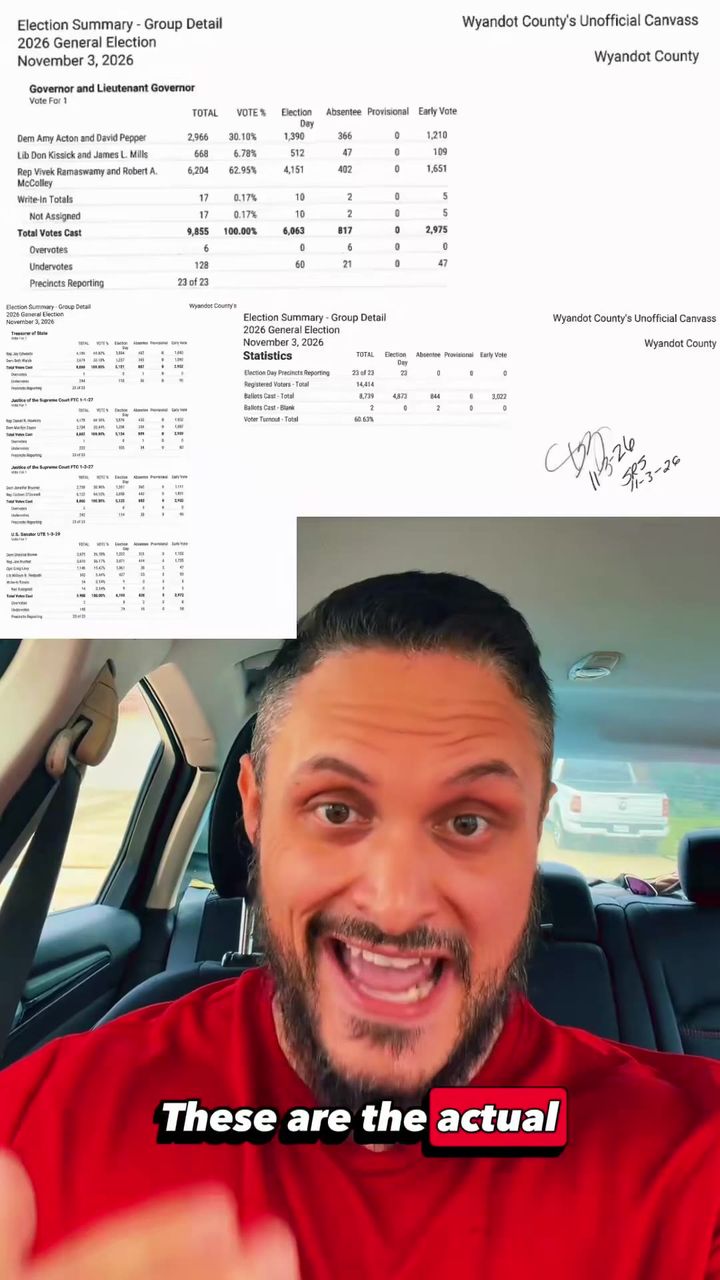
The arithmetic in the video is correct. Wyandot County, Ohio's unofficial November 3, 2026 report shows 8,739 ballots cast but 9,855 votes in the governor's race and 9,988 in the Senate race. The county's elections director confirmed the figures did not reconcile. The Board of Elections later said October 28 mock-election totals were left in one precinct's reporting, changing no outcome.
 Genuine
Claims
✓ 5 trueWyandot County's own report is internally inconsistent: more votes are recorded in several races than the total number of ballots cast, by roughly 1,250 for governor and 1,396 for Senate.1
This is the claim the whole video rests on, and the arithmetic holds. The published unofficial canvass lists 8,739 total ballots cast, yet 9,855 votes in the governor's race and 9,988 in the Senate race — gaps in the range the narration describes. Crucially, the county did not dispute it. Wyandot County Board of Elections Director Darcy Zimmerman told Lead Stories plainly that the numbers do not reconcile and that the office was working with the Ohio Secretary of State to work out why. That on-the-record concession is decisive: a county official confirming the arithmetic removes any need to take the video's word for it. It is also worth noting how thin the sourcing is overall — the figures in the video and the figures in the fact-check trace to the same county document, so this is one primary source plus the county's confirmation, not several independent ones. For the reader, the takeaway is that the arithmetic problem was real and acknowledged, not invented.
Wyandot County's unofficial November 3, 2026 report shows 14,414 registered voters, 8,739 total ballots cast (4,873 Election Day, 844 absentee, 3,022 early) and 60.63% turnout.1
These are the baseline figures the rest of the video's argument is measured against, so it matters that they check out. Lead Stories reproduced the relevant page of the county's published unofficial canvass, and the registered-voter total, the ballots-cast total and its breakdown by voting method all match the narration. The turnout percentage is also internally consistent: 8,739 divided by 14,414 comes to 60.63%. Because the figure is drawn from a primary document rather than from a secondary summary, there is little room for distortion here. A reader can weigh this as settled: whatever else is disputed in this story, the denominator and the ballot total are accurate as quoted.
The governor's race in the same report shows 9,855 votes cast, with 6 overvotes and 128 undervotes.1
This is one of the two race totals at the centre of the arithmetic gap, and it is quoted correctly. Lead Stories verified page 6 of the county's unofficial certification, which shows 9,855 votes cast for Governor — the same figure that appears in the video and in the on-screen document. The overvote and undervote counts are part of how election reporting accounts for every ballot, and they are reported here as the document states them. Because the number comes straight from the county's own page, the check is a direct comparison rather than an inference. What a reader should take from this is narrow but important: the video did not inflate the race figure to manufacture a gap. The gap between this total and the 8,739 ballots cast is real in the published document.
The U.S. Senate race in the same report shows 9,988 votes cast plus 2 overvotes and 145 undervotes, for 10,135.1
The Senate figure is the second race total the video uses to build its case, and it too is quoted accurately. Page 7 of the county's unofficial certification shows 9,988 votes cast in the Senate race, consistent with both the narration and the caption's document. The overvote and undervote counts add up the way the video says they do. As with the governor's race, the value of this check is that it rules out distortion at the quoting stage: the discrepancy the video highlights is present in the county's own published page, not created by selective reading. One document and one fact-check underpin both race figures, so they are not independent confirmations of each other — but each is a faithful transcription of a primary record.
Election officials signed the unofficial certification paperwork attesting the results were valid and accurate.2
The document shown carries a signature dated 11/5/26, and reporting on the certification describes county officials signing the unofficial results. That much is accurate. What the claim leaves out is the word 'unofficial': an unofficial canvass is by design a preliminary tally, released on election night and then reconciled in the official canvass. So the signature attests to the document as submitted, not to a final, error-free count. This is the point in the video where accurate detail and misleading implication pull apart. A reader should weigh the signature as evidence that the document is genuine, not as evidence that its totals were beyond correction — the county's later explanation of the mock-election totals is exactly the kind of reconciliation the unofficial stage allows for.
The discrepancy is an unexplained problem in Ohio's vote counting that the county needs to answer for.12
Timing decides this one. When the video was posted, the county had not yet explained the gap, and the narrator explicitly said he was not claiming fraud — so the call for an explanation was fair at that moment. But the Board of Elections then issued a press release stating that vote totals from an October 28 mock election were inadvertently left in the reporting system for one precinct, which overstated unofficial totals in several races and changed no contest's outcome. That is a mundane data-entry cause, not an unexplained anomaly. The video's factual core survives; its framing as a mystery that officials had signed off without answering does not. The sources here are not fully independent — the syndicated report repeats the same Lead Stories findings — but the county's press release is a direct, attributable statement, and it is decisive.
Still open: The input does not record how the mock-election totals entered the live reporting system, or what safeguards the county has since added.
The numbers came directly from the Wyandotte County election board.13
The substance is right and the name is wrong. The figures come from Wyandot County, Ohio's unofficial certification, published through Ohio's official election reporting system — so the provenance of the numbers is as described. But the narration calls the jurisdiction 'Wyandotte County' throughout, and Wyandotte County is in Kansas. That is a real error in a video whose authority rests on precision, and it is the kind of detail that invites doubt about the rest. It is not, however, evidence of fabrication: the document, the figures and the county's own confirmation all point to Wyandot. A reader should treat the misnaming as a sign of carelessness rather than deceit, and weigh it accordingly — a mistake worth noting, not a reason to dismiss the arithmetic.
What was posted
XA video posted on X shows a man speaking to camera in a car, with screenshots of a county canvass document overlaid. He walks viewers through totals for registered voters, ballots cast and two statewide races, and argues the figures in the same document cannot be reconciled. The caption repeats the alarm and links to what it calls the county's official report.
“🚨🚨 OHIO ELECTION ALERT: THE MATH IS NOT MATHING! 🚨🚨 WHAT THE HELL IS GOING ON IN WYANDOT COUNTY, OHIO?! 🤯🗳️ According to the county’s OFFICIAL November 3, 2026, unofficial election report, these numbers DON’T ADD UP! 📊 OFFICIAL COUNTY NUMBERS: 🗳️ Registered Voters:”
Posted on X by the account @natebige_. The narration repeatedly calls the jurisdiction 'Wyandotte County', which is a county in Kansas; the Ohio county is Wyandot.
Who posted it
XAccount check
Estimates from public signals — account age, posting pattern, audience — not a judgement of the person behind the account, and separate from whether this post is true.
What stood out
- Handle resolves to a real, persistent persona: 'NateBige' / Nathan Bigelow, a conservative political influencer with a long-running Instagram presence (@natebige_, ~59.5K followers, ranked #7 among 'conservative influencers' by HypeAuditor in 2026).
- The same handle has appeared on X since at least 2025-2026 and is quoted by Twitchy and engaged by Grok/community-note style replies, indicating a sustained human-run operation, not a disposable sock puppet.
- Content style is highly templated engagement bait: all-caps '🚨 BREAKING' openers, emoji bullet lists, 'WHAT DO YOU THINK?' closers, 'reportedly' hedging — optimised for virality and platform monetisation rather than verifiable reporting.
- Lead Stories fact-checked an 8 Nov 2026 post of his on Wyandot County, Ohio vote totals; the raw numbers were real (a county error later blamed on leftover mock-election data), but the framing implied fraud and omitted that these were unofficial totals.
- His 5 Nov 2026 Texas 'illegal voting arrests' post roughly matches real OAG/Paxton announcements, but is inflated with unsupported framing ('REMEMBER WHEN THEY TOLD US ILLEGAL VOTING DOESN'T HAPPEN').
- Grok publicly corrected him (Aug 2026) over a COVID/ventilator mortality claim, indicating a pattern of sharing misleading or decontextualised claims.
- History of 'exposing' named individuals (e.g., people who mocked Charlie Kirk's death), which is doxxing-adjacent aggregation rather than journalism.
- No platform verification, and the profile metadata supplied is entirely empty (no bio, no follower count, no creation date, no post sample) — limits confidence and is itself consistent with a low-transparency account.
- No evidence found of coordinated inauthentic networks or automation; the account behaves like a single partisan growth-hacking operator.
Signals (12)+
- Account age note
- Created date not provided; handle is documented in posts and citations from at least Sept 2025 through Nov 2026
- Platform verified
- No
- Cross platform presence
- Instagram @natebige_ (~59.5K followers), X, NewsBreak user profile
- Posting cadence
- High; multiple political posts per day in sample window (Nov 2026)
- Content template score
- High — recurring 🚨 BREAKING / emoji-bullet / 'WHAT DO YOU THINK' format
- Fact check history
- 1 Lead Stories rating (Nov 2026, Wyandot County OH — claim largely accurate but decontextualised); 1 Grok correction (Aug 2026, COVID ventilator claim)
- Notable news coverage
- Lead Stories, Twitchy, HypeAuditor influencer ranking
- Affiliation
- US conservative/right-wing partisan content creator; election-integrity narrative promoter
- Sourcing quality
- Links to official documents in some posts, but uses 'reportedly' and omits context; no editorial standards or corrections policy
- Monetisation incentive
- Likely engagement/revenue-driven (X creator payouts, IG reach)
- Bot indicators
- None strong; templated style is human-authored engagement bait
- Metadata completeness
- None provided by API — profile fields blank
Account checked November 10, 2026, 03:08 UTC
The media
Video✓ What is genuine
The recording itself and the county document it displays. The video is not the thing to doubt here; the question is what the numbers mean.
The tells
- ●●○ Supporting signal Genuine-looking lighting, skin texture and background detail in the car recording, with no sign of compositing or synthetic rendering.our visual review
- ●●● Strong signal The figures visible in the overlaid screenshots match the county's published canvass pages.Lead Stories
Synthetic-media detector
Detector not consultedThe media is incidental to the claim; the detector was not needed.
How we checked the media
- We reviewed the video visually: an ordinary selfie recording of a man speaking in a car, with cropped screenshots of a county canvass overlaid.
- We compared the document text, layout and figures shown on screen with the county pages reproduced in the fact-check.
Sources
3 sources reviewed- 1Fact Check: Wyandot County, Ohio, Unofficial Results DO Show More Votes Than Ballots -- County Confirms Discrepancy ↗
Lead Stories · leadstories.comPrimary / fact-checkerIFCN; strong on viral/AI mediaEvidence
Reproduces the county's unofficial certification pages and records the elections director confirming the numbers do not reconcile, plus the board's press release on mock-election totals.
- 2Fact Check: WRONG Wyandot County, Ohio, Unofficial Results Show More Votes Than Ballots -- Mock Results Left In ↗
Yahoo News (Lead Stories syndication) · yahoo.comUntiereduntiered — treated as signal only, never decisiveEvidence
Confirms the mock-election explanation and that no contest outcome changed, and notes the signature date on the certification.
- 3Wyandot County, Ohio — 2026 Election, Ballot & Results ↗
NewsForce247 · newsforce247.comUntiereduntiered — treated as signal only, never decisiveContext
Confirms Wyandot County, Ohio held its general election on November 3, 2026, and confirms the county's name.
Further reading
- 1Lead Stories The fullest account: it reproduces the county pages and carries the elections director's on-the-record confirmation and the board's press release.
- 2Yahoo News (Lead Stories syndication) Syndicated version that summarises the mock-election explanation and the fact that no outcome changed.
The full story
The kernel of truth is simple: the county's numbers really did not reconcile. On election night, Wyandot County, Ohio published an unofficial canvass for the November 3, 2026 general election that recorded 8,739 total ballots cast, while the governor's race showed 9,855 votes and the Senate race 9,988. The gap was in the published document, and when Lead Stories asked, the county's elections director did not deny it. "You are right, those numbers do not math," Darcy Zimmerman said, adding that the office was working with the Ohio Secretary of State to find out why.
That is why the video's arithmetic felt like a discovery. But an unofficial canvass is not a final count; it is a preliminary tally that is later reconciled. The reconciliation came in a Board of Elections press release: vote totals from an October 28 mock election had been inadvertently left in the reporting system for one precinct. The leftover test figures overstated unofficial totals in several races. No contest's outcome changed.
The story is therefore less dramatic than the video's framing and less benign than a shrug. A reporting error inflated a county's public numbers, a citizen noticed before officials explained it, and the explanation arrived after the post. Both things are true, and the order in which they happened is the whole story.
Kernel of truth
Wyandot County's published unofficial totals genuinely recorded more votes than ballots cast, and the county confirmed the discrepancy before explaining it as mock-election test data left in one precinct's reporting.
Timeline
October 28, 2026
A mock election is held in Wyandot County; its vote totals later end up in the live reporting system for one precinct. 1Lead Stories
November 3, 2026
General election. Wyandot County publishes unofficial results showing 8,739 ballots cast against 9,855 governor votes and 9,988 Senate votes. 1Lead Stories
November 5, 2026
The unofficial certification of results is signed, dated 11/5/26 on the document. 2Yahoo News (Lead Stories syndication)
November 8, 2026
The video is posted on X by @natebige_, arguing the county's figures do not add up. 1Lead Stories
November 9, 2026
The county elections director confirms to Lead Stories that the numbers do not reconcile, and the Board of Elections issues a press release blaming mock-election totals left in one precinct's reporting. 1Lead Stories
How it was framed
The arithmetic is accurate and drawn from a real county document, but the post frames a known, explainable reporting error as an unresolved integrity mystery and invites a fraud inference the county's own explanation does not support. The genuine preliminary document is presented without the context that it is unofficial and subject to reconciliation.
- Emotional language. "THE MATH IS NOT MATHING!", "WHAT THE HELL IS GOING ON", "🤯🗳️"
- Ongoing-threat framing. "the people of Ohio, along with the rest of the nation, needs to know why"
- “Visual proof”. Screenshots of the county canvass pages are overlaid on the video to stand in for the argument.
- Missing context. The narration stresses that officials signed the certification but does not explain that these are unofficial, preliminary totals subject to a later canvass.
- Selective evidence. The video compares race totals to ballots cast but does not address how unofficial totals are reconciled.
Posted on X by the account @natebige_. The narration repeatedly names the jurisdiction 'Wyandotte County', which is in Kansas; the Ohio county is Wyandot. No further information about the account is recorded in our sources.
Bias
Leans election-integrity alarmism / implies vote-count manipulation. The video is factually careful about the figures and says it is 'not saying this proves any kind of fraud', but the alarmist framing ('the math is not mathing', 'what the hell is going on', demands that the county explain itself) packages an acknowledged clerical discrepancy as a scandal and omits that these were unofficial totals subject to canvass correction, inviting a fraud inference.
Bias describes how the post frames its message — the slant of the language, selection and emphasis — and is judged separately from whether the claim is true. A true claim can still be framed with a strong slant.
How we checked
1 min 28 s- 1
We reviewed the video and its caption, and transcribed the figures the narration quotes.
- 2
We ran searches on the Wyandot County discrepancy, the November 3, 2026 canvass, the board's press release and the mock-election explanation.
- 3
We compared the figures in the video with the county pages reproduced in Lead Stories' review of the unofficial certification.
- 4
We checked the county's on-the-record statement to Lead Stories and its subsequent press release.
- 5
We reviewed the video visually for signs of manipulation.
✓ Claim checked✓ Media checked✓ Sources checked
Why 87% confidence
HighHIGH. The decisive facts come from a primary county document and a named county official speaking on the record, and both the arithmetic and the explanation are corroborated. The confidence is not absolute because the syndicated report repeats the same findings rather than adding independent sourcing, and because the mock-election explanation is the county's own account.
Limits. We did not open the county's original document directly; our comparison relies on the pages reproduced by Lead Stories. We did not review the full official canvass that followed. We could not determine how the mock-election totals entered the live system.
What we don’t know
- How the October 28 mock-election totals came to be left in one precinct's live reporting, and whether any safeguard failed.
- Whether the official canvass corrected every affected race total, and by how much each was adjusted.
- Whether the poster saw the county's explanation before or after publishing.
- Whether other precincts or counties had similar leftover test data.
Spot it yourself
Find the overstatementLooks suspicious, isn’t proof
- The alarmist caption in capitals with siren emojis. Tone is a reason to check, not evidence the numbers are wrong.
- The wrong county name in the narration. A careless error, but it does not by itself make the figures false — the document points to Wyandot, Ohio.
- A man in a car reading numbers off a screen. The informal setting says nothing about whether the arithmetic is right.
The actual evidence
- The county's published unofficial canvass really does record 8,739 ballots cast against 9,855 governor votes and 9,988 Senate votes.
- The county's own elections director confirmed the numbers do not reconcile.
- The Board of Elections press release attributed the gap to October 28 mock-election totals left in one precinct's reporting.
- The document is explicitly an unofficial canvass, a preliminary tally subject to reconciliation.
- 1
Find the primary document and read its label
Open the county's published report and check whether it says 'unofficial' or 'official'. The label tells you whether the numbers are final or a working tally.
- 2
Separate the arithmetic from the conclusion
Ask whether the post proves what it implies. Here the arithmetic is right, but 'the numbers do not add up' and 'something is wrong with the count' are different claims.
- 3
Look for the official explanation, not just the official number
Search for a press release or statement from the board of elections, and check its date against the post's date.
- 4
Check the names
A wrong county name is a cue to verify the jurisdiction. Confirm the state and county before accepting the framing.
Takeaway
A claim can be arithmetically correct and still mislead you about what it means. Check whether the numbers are preliminary, and look for the official explanation that arrived after the post.
Questions people ask
Did Wyandot County, Ohio really report more votes than ballots cast?+
Yes. The county's unofficial November 3, 2026 canvass recorded 8,739 total ballots cast, while the governor's race showed 9,855 votes and the Senate race 9,988. The county elections director confirmed the figures did not reconcile. The board later said mock-election totals were left in one precinct's reporting.
What caused the discrepancy in the Wyandot County numbers?+
The Board of Elections issued a press release saying vote totals from an October 28 mock election were inadvertently left in the reporting system for one precinct. That overstated unofficial totals in several races. The board said the error did not change the outcome of any contest.
Did the error change any election results?+
No. The Board of Elections said the inflated unofficial totals did not change the outcome of any contest. The figures were preliminary and subject to the official canvass, which is the stage at which such totals are reconciled.
Is the county called Wyandot or Wyandotte?+
Wyandot County is in Ohio, with its seat at Upper Sandusky. Wyandotte County is in Kansas. The video's narration repeatedly says 'Wyandotte', but the document and the county's statements concern Wyandot County, Ohio.
What does 'unofficial results' mean in an election?+
Unofficial results are preliminary totals released around election night, before the canvass that checks and reconciles them. They can contain reporting errors, which is why officials treat the later official canvass as the authoritative count.
Go deeper
- Unofficial canvass
- A preliminary tally of votes released around election night, before the later official canvass checks and reconciles the totals.
- Overvote
- A ballot on which a voter marks more choices than allowed in a contest, so the contest portion may not be counted.
- Undervote
- A ballot on which a voter leaves a contest blank or marks too few choices for it to count.
- Mock election
- A test or practice run of election equipment and reporting, whose results are not real votes and should not appear in live totals.
- Misleading content
- Information that uses real facts in a way that frames an issue or person unfairly, often by leaving out context.
People also search for
For educators+
- The video's numbers are correct, but its framing invites a conclusion the county disputes. Where exactly does accurate reporting end and misleading framing begin?
- If a citizen spots a genuine error in official data before officials explain it, what should a responsible post include?
- How would you check this claim yourself, and which source would you trust most: the video, the county document or the board's press release?
About this check
- Platform
- X
- Posted by
- @natebige_
- Posted
- November 8, 2026
- Age when checked
- 1–2 days old when checked
- Where it spread
- United States
- Audience
- US audience
- Language
- EN
- Status
- ● Post is live
- Verified
- November 10, 2026, 03:10 UTC
- Published
- November 10, 2026, 03:10 UTC
Reach. 4,825 likes, 227 replies; county confirmed mock-election totals were left in
This verdict was generated with AI from the sources shown. AI can make mistakes — check the sources before relying on it.
Check anything yourself, in seconds.
Share any social post or video to What the Fact and get the verdict, the confidence, and the receipts.