Did Ashley Allison get the Black fatherhood statistic wrong on CNN?
Are Black fathers in the home at a 'disproportionately higher rate than other fathers', as CNN commentator Ashley Allison said?
True
She said it on CNN — the clip is real, but the household statistic she cited is false.
Ashley Allison, a CNN political commentator, said on NewsNight with Abby Phillip on 9 November 2026 that Black fathers are in the household at a disproportionately higher rate than other fathers. She said it — the clip is genuine CNN footage. But Census-based household data contradicts the statistic: about 44% of Black children live without a father in the home, versus roughly 24.5% of Hispanic and 16% of non-Latino white children.
 Genuine
Claims
✓ 2 true · ✕ 2 falseBlack fathers are in the household at a disproportionately higher rate than other fathers.12347
“Black fathers are in the household more at a disproportionate higher rate than other fathers.”
This is the line the whole post turns on, and the evidence against it is direct. Allison said it on air — the wording is identical across Grabien's clip archive, Blaze Media and Townhall, and CNN's own transcript page for 9 November 2026 lists her on the panel. So there is no dispute about whether she said it. What settles the verdict is the underlying number. Census-derived household figures reported in coverage of the segment put the share of Black children living without a father in the home at about 44%, compared with roughly 24.5% for Hispanic children and 16.1% for non-Latino white children. On residence — which is what she said — the ranking runs the opposite way. The likely origin of her error is a separate, real CDC finding: Black fathers who live with their children report more daily caregiving (bathing, dressing, feeding) than white or Hispanic fathers. That study measures involvement among fathers who are present, not whether fathers are present. Treat those as one source only if they trace back to the same study — here the demographic figures come from Census-based data, and the CDC study is a different measurement entirely.
Calling the Black fatherlessness rate the worst of any demographic is a 'stereotype' rather than a fact.1
“That's a stereotype, actually, but you can continue.”
Allison did not just dispute a statistic here; she reclassified a documented pattern as a stereotype. That framing does not survive the data. The same Census-derived figures cited across coverage of the segment place the share of Black children living without a father at the top of the demographic table, not as an anecdote or impression. The point is not new, either: the pattern has been acknowledged by figures including Barack Obama in a 2008 speech. That does not make the label 'stereotype' a lie in every context — stereotypes can contain a kernel of statistical truth and still be used unfairly about individuals. But as a factual rebuttal in this exchange, calling the ranking a stereotype was wrong. The word did real work in the segment: it implied Schilling had invented the pattern, when the pattern is measurable.
The fatherlessness rate in the Black community is the worst out of all the demographics in this country.12
“The fatherlessness rate in the black community is the worst out of all the demographics in this country, unfortunately.”
Schilling's counter-claim is the mirror image of Allison's error, and it checks out. Coverage of the segment reports 44.2% of Black children raised in a household without a father, against 24.5% for Hispanic children and 16.1% for non-Latino white children. Those figures come from Census-based analysis rather than a single partisan outlet, and they are consistent across the write-ups we reviewed. The honest caveat is that 'fatherlessness' is a loose word for a specific measure — a child living in a household without a father present — and different surveys phrase and count it differently. The Townhall write-up, for instance, gives a range of 43-50% for Black children living with their mother only. Ranges are not precision, but no version of the data puts another demographic group above the Black rate. The ranking he described holds.
Still open: Survey wording and year vary between the figures cited (43% to 50% for Black children in mother-only homes); the ranking is stable across them, the exact percentage is not.
Of the ten states with the worst cost of living, nine are Democrat states.
“Out of the top 10 states where cost of living is the absolute worst, nine of them are Democrat states, right?”
This one we could not pin down to a published ranking. Standard state cost-of-living tables are dominated by blue states — Hawaii, California, Massachusetts, New York, Washington, Oregon, Maryland, Connecticut and New Jersey usually sit near the top — with Alaska typically the one Republican-leaning state in the top ten. That shape fits his 'nine of ten' claim. But shape is not a source. Our searches did not surface an independent published ranking that we could cite directly, so this sits at LIKELY_TRUE with low confidence rather than TRUE. Readers should treat it as plausible but unverified: the kind of claim that is probably right, stated with more precision than the evidence we found supports. It is also a side point in the exchange and does not affect the post's central assertion about Allison's statistic.
Still open: Which ranking the speaker had in mind, and from which year.
The Democratic Party takes Black voters for granted.
“They take black voters for granted, period.”
This is an argument, not a measurement. 'Takes voters for granted' is a judgement about political behaviour and intent, and reasonable people with the same facts can disagree about it. No dataset settles it, and we do not treat it as a factual claim to be scored. It belongs in the exchange as the political conclusion Schilling draws, which is why the segment is a debate rather than a report. Our verdict on the post does not depend on whether this opinion is persuasive — only on whether Allison's stated statistic was accurate, and it was not.
What was posted
XAn X post sharing a short clip of a CNN NewsNight with Abby Phillip panel, in which commentator Ashley Allison disputes a guest's claim about Black fatherlessness and asserts that Black fathers are in the home at a higher rate than other fathers. The caption tells readers Allison 'makes up fake statistics on CNN'. The post asks readers to accept both that the exchange happened and that her statistic was invented.
“"I don't think voting in Democrat super majorities has worked out for the Black communities. The fatherlessness rate is way too high." "Woah. Black fathers are in the home at a disproportionately higher rate than other fathers." Ashley Allison makes up fake statistics on CNN.”
Posted on X with a clip of the segment that aired Monday 9 November 2026; the same exchange was clipped and quoted by Grabien, Blaze Media and Townhall.
Who posted it
XAccount check
Estimates from public signals — account age, posting pattern, audience — not a judgement of the person behind the account, and separate from whether this post is true.
What stood out
- Account maps to a real, identifiable person: Thomas Hern, co-founder/partner of Ohio-based conservative marketing firm H&F Strategies and former National Field Director at Turning Point USA (also ex-ACT for America; '30 Most Influential Conservatives Under 30').
- He has a public byline history (Washington Examiner op-eds, Daily Caller column), giving a documented, verifiable identity behind the handle.
- The feed is a high-volume partisan clip-and-commentary account: it reposts CNN/MSNBC/network segments with critical one-line framing, plus culture-war commentary.
- Its posts are routinely embedded as sourcing by right-leaning outlets (Twitchy, RedState, HotAir, Townhall, WCBM, TalkBasket), and some posts draw 200k-900k+ views, indicating real reach rather than a dead/throwaway profile.
- No platform verification, and the supplied profile metadata is empty (no bio, follower count, creation date, or posts), so most basic trust signals cannot be confirmed directly from the profile.
- No fact-checker debunks or misinformation labelling of the account were found, but it is a clearly hyper-partisan amplifier of decontextualised clips rather than a primary or neutral news source.
- Posting style is coherent, conversational and consistent with a single human operator; no evidence of automated or coordinated inauthentic behaviour.
Signals (9)+
- Identity match
- Confirmed offline — Thomas Hern, H&F Strategies / ex-Turning Point USA
- Known affiliations
- H&F Strategies (co-founder); Turning Point USA (former national field director); ACT for America; Washington Examiner contributor; Daily Caller contributor
- Posting cadence
- High volume, near-daily rapid-response clip commentary
- Content type
- Partisan aggregation/commentary on news clips, not original reporting
- Third party embedding
- Twitchy; RedState; HotAir; Townhall; WCBM; Daily Caller
- Engagement scale
- Individual posts up to ~900k views
- Fact check history
- None found specific to the account
- Bias flag
- Hyper-partisan conservative framing; selective/decontextualised clip curation
- Automation indicators
- None observed — consistent human voice and persona
Account checked November 12, 2026, 02:53 UTC
The media
Video✓ What is genuine
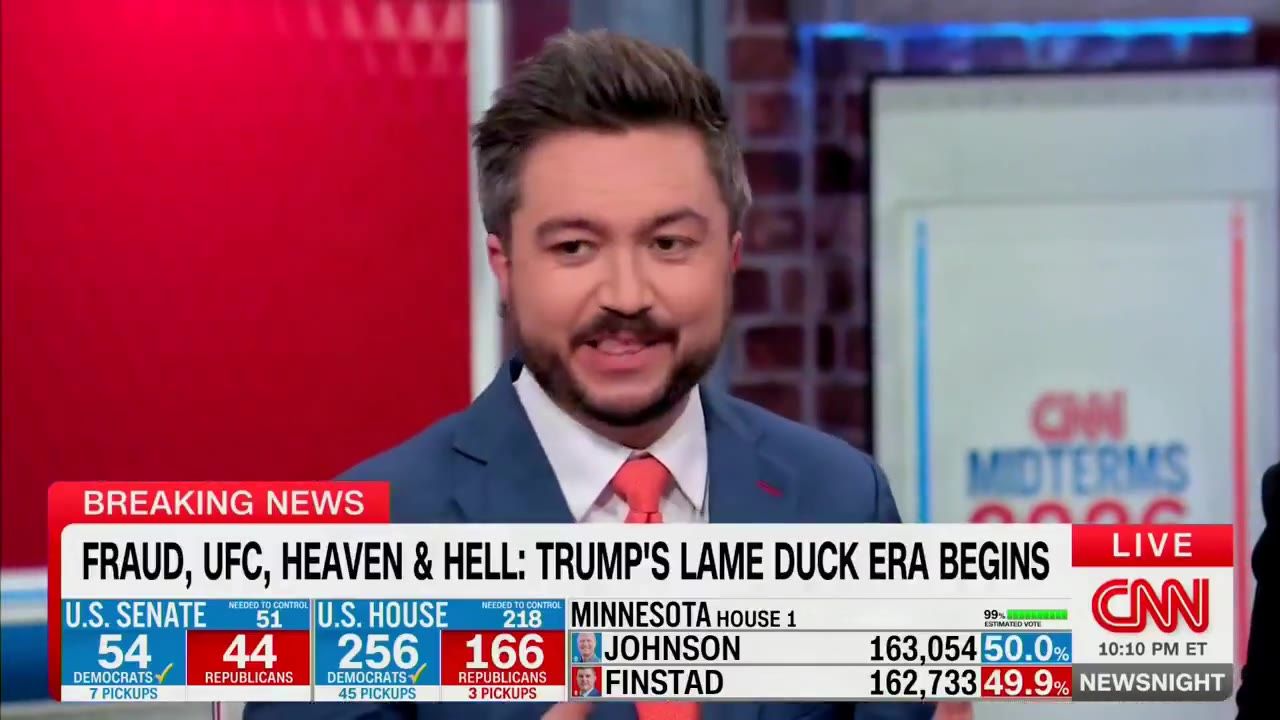
The whole clip. This is authentic CNN broadcast footage of a real panel that aired on 9 November 2026, and Allison's quoted words are hers.
The tells
- ●●● Strong signal Continuous studio set with consistent CNN NewsNight with Abby Phillip chyron styling across frames.our visual review
- ●●● Strong signal Lower-third vote tallies for Alaska Senate, Mississippi Senate, Minnesota House 1 and Alaska governor track the real counts reported that week — AP had Alaska Senate at roughly 48.2% Peltola to 47.9% Sullivan with 75% counted.our visual review, compared with AP and BBC results
- ●●○ Supporting signal Natural facial expressions, coherent camera cuts and stable, correctly spelled on-screen text across frames.our visual review
- ●●● Strong signal The panelists visible (Schilling, Allison, Cornel West on the panel) and the segment itself are documented by CNN's transcript page and clip archives.CNN transcripts and Grabien
Synthetic-media detector
Detector not consultedSources settled the claim on their own; the detector was not needed.
How we checked the media
- Reviewed the keyframes for set, chyron styling, panelists, facial expression and camera cuts.
- Compared the on-screen vote tallies with live 2026 midterm results from AP, NBC and BBC.
- Checked the segment against CNN's transcript page for 9 November 2026 and against clip archives quoting the exchange.
Sources
7 sources reviewed- 1VIDEO: CNN panelist makes mind-numbing claim about black fathers in debate about Democrats ↗
Blaze Media · theblaze.comUntiereduntiered — treated as signal only, never decisiveEvidence
Quotes the exchange and supplies the 44.2 / 24.5 / 16.1 household comparison and the 2008 Obama reference.
- 2A CNN Panelist Just Made Up a Wild Statistic About Fatherhood ↗
Townhall · townhall.comUntiereduntiered — treated as signal only, never decisiveEvidence
Census-based figures for children living with mother only, giving the 43-50% range.
- 3Ashley Allison Accuses Terry Schilling of Stereotyping Black People by Saying They Lead in the 'Fatherless Rate' ↗
Grabien · grabien.comUntiereduntiered — treated as signal only, never decisiveEvidence
Clip archive quoting Allison's line verbatim, establishing what was said.
- 4CNN Transcripts — 9 November 2026 segment (Terry Schilling, Ashley Allison) ↗
CNN · transcripts.cnn.comLow reliabilityBORDERLINE B/C — reporting w/ strong bias tag; opinion is CEvidence
CNN transcript page confirming the 9 November 2026 segment and its panelists.
- 5Alaska U.S. Senate Election Live Results 2026 ↗
AP News · apnews.comPrimary / fact-checkerwire + AP Fact Check (Tier A)Evidence
Live Alaska Senate results matching the broadcast's on-screen tally, supporting that the footage is genuine broadcast.
- 6Live updates: 2026 US midterm elections and results — Democrats win Senate ↗
BBC · bbc.comReputable outletCenter; light bias tagContext
Midterm results context for the broadcast graphics and the week's vote counting.
- 7CDC National Health Statistics Report: Fathers' Involvement With Their Children (2013), as summarised ↗
National Resource Center for Healthy Marriage and Families · healthymarriageandfamilies.orgUntiereduntiered — treated as signal only, never decisiveEvidence
The 2013 CDC finding on fathers' daily involvement that plausibly explains Allison's wording.
Further reading
- 4CNN CNN's own transcript page is the cleanest primary record that the segment and panelists are real.
- 7National Resource Center for Healthy Marriage and Families Explains the CDC finding on fathers' involvement that most likely sits behind the misstated statistic.
- 1Blaze Media Sets out the household figures across three groups alongside the exchange.
- 6BBC Confirms the wider 2026 midterm picture the on-screen tallies belong to.
The full story
There is a real finding buried under this clip, and it is probably where the confusion came from. A 2013 CDC National Health Statistics report on fathers' involvement found that Black fathers who live with their children under five were more likely than white or Hispanic fathers to report daily caregiving — bathing, diapering or dressing their children every day (70%, against 60% for white fathers and 45% for Latino fathers). That is a genuine finding, and it is often cited, fairly, to push back on lazy assumptions about Black fatherhood.
The trouble is that it measures something different from what Allison said on air. The CDC study counts involvement among fathers who are present. Allison's sentence was about whether fathers are in the household at all. On that separate question, the data goes the other way: about 44% of Black children live in a household without a father, against roughly 24.5% of Hispanic children and 16.1% of non-Latino white children. The 2013 study and the household figures are not rivals — both can be true at once, and both are. They answer different questions.
This is why the clip travelled. Viewers who knew the CDC finding heard an echo of something real, and viewers who knew the household figures heard an obvious error. The caption's leap — that Allison 'makes up fake statistics' — goes further than the evidence, because a garbled version of a real study is a mistake, not an invention. The substance, that the statistic she stated is false, holds up.
Kernel of truth
A real 2013 CDC finding that Black fathers living with their children report higher rates of daily caregiving than white or Hispanic fathers — a fact about involvement, not about residence.
Timeline
2008
Barack Obama publicly acknowledges the Black fatherlessness rate in a speech, showing the pattern was already a matter of public record. 1Blaze Media
2013
CDC National Health Statistics report on fathers' involvement finds Black fathers living with young children report more daily caregiving than white or Hispanic fathers. 7National Resource Center for Healthy Marriage and Families
November 9, 2026
Panel airs on CNN NewsNight with Abby Phillip; Allison makes the household claim and Schilling responds. 4CNN
November 9, 2026
Clips of the exchange begin circulating on X, quoted by Grabien, Blaze Media and Townhall. 3Grabien
How it was framed
The clip is genuine and Allison's words are hers, so nothing is fabricated or manipulated. What goes wrong is the caption's leap from 'she stated a statistic that is false' to 'she makes up fake statistics' — it upgrades a demonstrable error into an accusation of invention, and uses a real broadcast as the vehicle.
- Emotional language. The caption's 'makes up fake statistics' characterises Allison's error as invention rather than mistake.
- “Visual proof”. The post leads with a video clip, inviting readers to treat the footage itself as the proof of the caption's accusation.
- Missing context. Nothing in the post mentions the 2013 CDC study on fathers' involvement that her wording resembles, which would explain the error differently.
Posted on X by an account sharing a clip of a CNN NewsNight with Abby Phillip segment that aired 9 November 2026; the same exchange was clipped and quoted by Grabien, Blaze Media and Townhall.
Bias
Leans conservative / anti-CNN. The post is a clipped CNN exchange captioned to portray CNN as airing fabricated statistics, a framing typical of right-leaning media criticism. The core factual thrust holds, but the clip and caption are curated to maximise ridicule of the network and omit the nuance that a real CDC study on father involvement may lie behind the misstated claim.
Bias describes how the post frames its message — the slant of the language, selection and emphasis — and is judged separately from whether the claim is true. A true claim can still be framed with a strong slant.
How we checked
1 min 21 s- 1
Searched for the segment and the participants to locate the exchange and coverage of it.
- 2
Compared Allison's quoted line across the Grabien clip archive, Blaze Media and Townhall to confirm the wording.
- 3
Checked CNN's transcript page for the 9 November 2026 show to confirm the segment and panelists.
- 4
Compared the on-screen vote tallies with AP and BBC live results from the 2026 midterms.
- 5
Reviewed the video frames for set, chyron and visual consistency.
- 6
Searched for the CDC report on fathers' involvement to test whether a real study explained Allison's wording.
- 7
Searched for a dedicated fact-check ruling on the statistic; found none from an IFCN-signatory outlet.
✓ Claim checked✓ Media checked✓ Sources checked
Why 82% confidence
HighHIGH: the clip is documented by CNN's own transcript page and multiple clip archives, and the household figures are consistent across coverage and point the opposite way from Allison's statement. The one soft spot is the cost-of-living claim, which we rated LIKELY_TRUE at low confidence because we found no published ranking to cite.
Limits. No dedicated fact-check from an IFCN-signatory outlet was found, so the demographic verdict rests on Census-based figures as reported in coverage rather than a single primary dataset we retrieved. Our media assessment rests on visual review and source comparison; no synthetic-media detector was run, because the footage was independently documented as broadcast.
What we don’t know
- Which exact survey year and wording underlies the 43-50% range reported for Black children in mother-only households.
- Whether Allison was thinking of the CDC caregiving study or another source when she made the statement.
- Which cost-of-living ranking, if any, the speaker was drawing on.
- Whether the poster checked the statistic before writing the caption.
Spot it yourself
Find the overstatementLooks suspicious, isn’t proof
- The post comes from a partisan account criticising a CNN commentator — a reason to check, not evidence the clip is wrong.
- The caption's angry phrasing ('makes up fake statistics') tells you the poster's view, not whether the underlying event happened.
- A short clipped TV segment can leave out context, but a clip is not fake just because it is short.
- The claim is politically convenient for one side — convenience is never proof of falsity.
The actual evidence
- The clip is genuine: CNN's transcript page for 9 November 2026 lists both panelists, and clip archives quote the exchange word for word.
- Allison's specific statistic — Black fathers in the home at a higher rate than other fathers — is contradicted by Census-based household data.
- A real 2013 CDC finding about caregiving among fathers who live with their children exists and plausibly explains her error as a mix-up rather than an invention.
- Schilling's counter-claim about the fatherlessness ranking checks out against the same data.
- 1
Separate the two questions the post bundles together
Ask 'did she say it?' and 'was it true?' as different questions. Here the answer is yes and no, and the caption collapses them.
- 2
Find the exact wording
Search the speaker's name plus a distinctive phrase, or check the broadcaster's own transcript page. Exact wording tells you what was actually claimed.
- 3
Go to the measurement, not the argument
For a statistic, find who counts it and what they count. 'In the household' is a residence measure; caregiving frequency is a different one.
- 4
Look for a real finding behind a wrong statement
Search the claim plus the name of a plausible study. A garbled version of real research is a common source of confident-sounding errors.
- 5
Check a claim's strongest part, not just its weakest
The caption is overstated, but the core statistic is false. A post can be wrong in tone and right in substance.
Takeaway
When a post mixes a real clip with a hostile caption, score the two separately: the footage can be authentic while the sentence wrapped around it overstates what it proves.
Questions people ask
Did Ashley Allison really say Black fathers are in the household at a higher rate than other fathers?+
Yes. The segment aired on CNN NewsNight with Abby Phillip on 9 November 2026, CNN's own transcript page lists her on the panel, and clip archives quote the line word for word. The question is not whether she said it but whether the statistic is accurate — and it is not.
Is the Black fatherlessness rate the highest of any demographic group?+
Census-based figures reported in coverage of the segment put about 44% of Black children in households without a father, against roughly 24.5% for Hispanic children and 16.1% for non-Latino white children. Different surveys give ranges, but the ranking is consistent: the Black rate is the highest.
Where does the claim about Black fathers being more involved come from?+
A 2013 CDC National Health Statistics report found that Black fathers living with children under five were more likely to report daily caregiving — 70% versus 60% for white fathers and 45% for Latino fathers. That measures involvement among fathers who are present, not whether fathers live in the home.
Does this mean CNN broadcast fake statistics?+
No. A commentator stated a statistic that is contradicted by the data — that is an error on air, not a fabricated broadcast. The clip itself is genuine CNN footage, and CNN's transcript page documents the segment. Calling an incorrect statement 'made up' asserts intent the evidence does not establish.
How can a claim be false if the clip is real?+
Authenticity and accuracy are separate questions. The video faithfully shows what was said; that says nothing about whether what was said is true. Here the footage is genuine and the statistic in it is false, which is exactly why the post's caption and its clip need to be judged apart.
Go deeper
- Household composition
- A count of who lives in a home — for example, a child living with one parent, both parents, or neither.
- Fatherlessness rate
- The share of children living in a household without a father present; different surveys define and measure it slightly differently.
- False connection
- When real content — a genuine clip, photo or quote — is paired with a headline or caption that does not support what the content actually shows.
- Primary source
- An original document or record, such as a broadcaster's own transcript, rather than a later write-up about it.
- IFCN-signatory fact-checker
- An outlet signed up to the International Fact-Checking Network's standards code, often used as a marker of rigorous published rulings.
People also search for
For educators+
- The clip is real and the statistic in it is false. How would you describe this post in one sentence without misleading anyone?
- What is the difference between a study of fathers who live with their children and a study of whether fathers live with their children? Why does that distinction matter here?
- Does calling an error 'making things up' change what a reader believes about the speaker? What evidence would you need to support that stronger claim?
About this check
- Platform
- X
- Posted by
- @thomasmhern
- Posted
- November 10, 2026
- Age when checked
- 1–2 days old when checked
- Where it spread
- United States
- Audience
- US audience
- Language
- EN
- Status
- ● Post is live
- Verified
- November 12, 2026, 02:55 UTC
- Published
- November 12, 2026, 02:55 UTC
Reach. 4.1K likes on @ThomasMHern clip; Blaze article 11 Nov (7.7h before batch)
This verdict was generated with AI from the sources shown. AI can make mistakes — check the sources before relying on it.
Check anything yourself, in seconds.
Share any social post or video to What the Fact and get the verdict, the confidence, and the receipts.