Did Ro Khanna sell Nvidia stock right before Jensen Huang's spy affair scandal?
Did Rep. Ro Khanna sell Nvidia stock right before the Jensen Huang Chinese-spy affair scandal broke?
Misleading
Real sales near the peak, but the insider-trading implication is insinuation, not evidence.
Ro Khanna's household did sell Nvidia shares on 4 September and 7 October 2026, near the stock's record high and before Nvidia's November slump. But the trades, each $1,000–$15,000, were made by his spouse through a third-party-managed trust, Khanna says he does not direct them, he also bought Nvidia earlier in 2026, and no evidence ties the sales to advance knowledge of Jensen Huang's affair scandal.
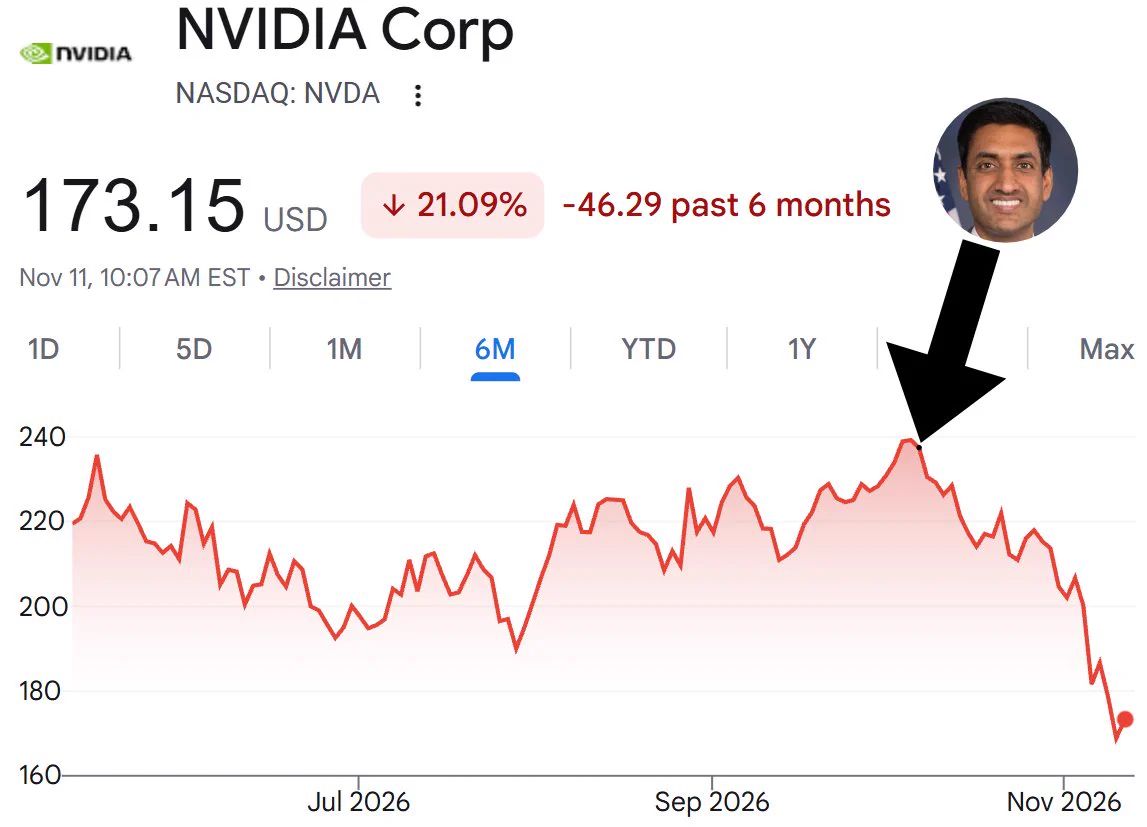 Likely genuine
Claims
✓ 3 trueImplied: Khanna's Nvidia sale shows he traded on advance knowledge of the Huang espionage scandal245
“Well, well, well. Rep. Ro Khanna sold $NVDA right before Nvidia's CEO admitted to having a Chinese spy side piece”
This is the claim the post is built to plant, and nothing in the record supports it. The sales were small − $1,000 to $15,000 each − and were made through a trust set up by Khanna's in-laws and run by a third-party trustee, which Khanna says he does not direct. He also kept buying Nvidia between June and September, so this was not a clean exit at the top. The New York Times had already reported on Alice Huang's alleged intelligence role in October, before the market fell, which undercuts the idea that a congressional household had non-public advance warning. The disclosure filings show timing; they do not show a reason. Social media posts like this one often treat two true facts placed side by side as if the arrangement were itself evidence. It is not. A coincidence of dates is a reason to ask questions, not a finding of insider trading.
Still open: What the third-party trustee's investment instructions actually were, and whether any communication about Nvidia existed between Khanna's office and the trust, is not in the public record.
Nvidia CEO Jensen Huang admitted to a relationship with a woman US intelligence alleges was a Chinese spy123
“Nvidia's CEO admitted to having a Chinese spy side piece”
The core of this is real, but the post compresses two things into one. On 8 November 2026 Huang apologised to staff for an extramarital affair after the New York Times reported that US intelligence had concluded his partner, business executive Alice Huang, was passing information to Beijing. What Huang admitted was the affair. The spy allegation is an intelligence assessment, not his admission. Beijing denies it, and Nvidia says it has no reason to believe secrets were compromised. The board opened an independent investigation. Two independent wire and broadcaster accounts − AP and BBC − corroborate the admission and the board probe, which is why confidence is high. The imprecision matters because 'admitted to having a Chinese spy' turns an allegation into a confession.
Still open: The US intelligence assessment itself has not been published, and the Chinese government denies the allegation.
Rep. Ro Khanna sold Nvidia stock right before Nvidia's CEO admitted the spy affair4678
“Rep. Ro Khanna sold $NVDA right before Nvidia's CEO admitted to having a Chinese spy side piece”
Congressional trading trackers do show Nvidia sales tied to Khanna's household on 4 September and 7 October 2026, each between $1,000 and $15,000. Nvidia closed at a record $239.24 on 6 October and ended 11 November at $173.73, so the sales did land near the top. But 'Khanna sold' overstates who acted: the trades came from a trust managed by a third-party trustee, and Khanna says he does not make them. The small size and the fact that he also bought Nvidia between June and September point to routine portfolio activity. Two commercial trackers (Capitol Trades and Quiver Quantitative) are useful but not independent of the same disclosure filings, so they confirm the dates rather than the motive. The market data is the strongest, independent leg.
Khanna is a member of the House Select Committee on Strategic Competition between the United States and the Chinese Communist Party45
“He's a member of the following: Strategic Competition between the U.S. and the Chinese Communist Party Committee”
This is accurate. Khanna sits on the House Select Committee on the Strategic Competition Between the United States and the Chinese Communist Party, the panel commonly called the China select committee. Reporting on the Nvidia trades also notes that he called for a classified briefing on the Huang matter, which is consistent with that seat. There is no dispute about the membership itself; the question is what the post wants a reader to infer from it. Holding a committee seat is a fact about a lawmaker's job. On its own it says nothing about what he knew about a company CEO's private life or when he knew it.
Khanna is a member of the Taiwan Caucus and the High Tech Caucus5
“He's a member of the following: ... Taiwan Caucus ... High Tech Caucus”
Reporting on the Nvidia trades describes Khanna as belonging to the Taiwan Caucus and the High Tech Caucus, which matches his congressional member listings. Congressional caucuses are informal groups, and membership lists are not always perfectly maintained, but nothing in the record contradicts this. The statement is a low-stakes factual detail. Its role in the post is atmospheric: a list of China- and technology-related affiliations is there to make the surrounding insinuation feel more substantial than the evidence behind it.
What was posted
XA post on X from an account that tracks congressional stock trades pairs a Google Finance price chart of Nvidia shares with a portrait of Representative Ro Khanna and a downward arrow. It lists three China- and tech-related caucuses and committee seats Khanna holds, and asks readers to draw a link between the household's Nvidia sales, the timing of the stock's slide, and Nvidia CEO Jensen Huang's admission of an affair with a woman US intelligence alleges was a Chinese spy.
“Well, well, well Rep. Ro Khanna sold $NVDA right before Nvidia's CEO admitted to having a Chinese spy side piece He's a member of the following: - Strategic Competition between the U.S. and the Chinese Communist Party Committee - Taiwan Caucus - High Tech Caucus Apparently, federal agents infor…”
Posted by @tradewithcong (Trade With Congress), an account that publishes congressional trading disclosures. No engagement figures or posting time were recorded. The full text is truncated in the capture.
Who posted it
XAccount check
Estimates from public signals — account age, posting pattern, audience — not a judgement of the person behind the account, and separate from whether this post is true.
What stood out
- Real, named operation: Jackson Woods, co-founder of congressional-trade tracker Altoneer; X bio links to @altoneer and the account has 1,116 posts.
- Identity is corroborated by a Numerama interview, a Bitcoin.com News podcast appearance (Sep 2026), and citations in BitMart, MoneyCheck, CoinDdak and The Daily Wire.
- Core claims are based on STOCK Act periodic transaction reports; examples such as Ro Khanna's Moderna purchase and Nvidia sales check out against Quiver Quantitative and Capitol Trades.
- Framing is sensational and sometimes partisan: it implies insider trading from timing alone, omits that some Khanna trades sit in an independently managed trust, and uses crude phrasing such as 'Chinese spy side piece'.
- Commercial conflict of interest: the account promotes Altoneer's paid trade-alert service and mixes disclosure facts with 'if you copied' performance hype.
- No fact-checker rulings, impersonation findings or platform suspensions were found; activity is consistent and human-curated rather than bot-like.
Signals (10)+
- Identity
- Jackson Woods, co-founder of Altoneer; Missouri-based
- Posting cadence
- High/regular; 1,116 posts on X
- Follower ratio
- Unknown; third-party tracker shows very rapid follower growth over the past year
- Notable news coverage
- Numerama interview; Bitcoin.com News interview; citations by BitMart, MoneyCheck, CoinDdak, The Daily Wire
- Fact check history
- No fact-checker rulings found
- Sourcing
- STOCK Act periodic transaction reports and public congressional disclosures
- Content risk
- Sensational framing, inference of insider trading from timing, performance claims, promotional tie to paid Altoneer platform
- Prior handle indicated by third party
- @tradewithpelosi
- Platform suspensions
- None found for current X account; operator says earlier Instagram accounts were banned
- Engagement trend
- High but volatile; third-party data shows sharp month-over-month engagement decline
Account checked November 12, 2026, 15:00 UTC
The media
Image✓ What is genuine
The underlying Google Finance NVDA price screen appears to be a real screenshot with internally consistent, market-matching figures. The portrait and arrow are annotation overlays on top of it, not fabricated data.
The tells
- ●●○ Supporting signal The screen quotes $173.15 at 10:07 AM EST on 11 November 2026, consistent with Nvidia's $173.73 close that day.our visual review and source 8
- ●●○ Supporting signal A six-month change of -$46.29 from that level implies a mid-May price near $219, in line with Nvidia's trading range that spring.our visual review
- ●●● Strong signal The chart peak near $240 matches Nvidia's $239.24 record close of 6 October 2026.our visual review and source 8
- ●●● Strong signal The Khanna portrait and the black downward arrow are obvious overlays added to the screen, not part of the price data.our visual review
Synthetic-media detector
Detector not consultedThe media is incidental to the claim; the detector was not needed.
How we checked the media
- Compared the chart's quoted price, six-month change and peak against dated market reporting on Nvidia's record close and 11 November close.
- Visually reviewed the image to separate the underlying price screen from the portrait and arrow added on top.
Sources
8 sources reviewed- 1Nvidia opens probe after report that CEO Jensen Huang was target of foreign intelligence ↗
RNZ · rnz.co.nzUntiereduntiered — treated as signal only, never decisiveEvidence
Reports Huang took full responsibility in his message to staff and that Nvidia opened a probe.
- 2What we know — and what we don't — as Nvidia investigates an alleged spy plot involving its CEO ↗
AP News · apnews.comPrimary / fact-checkerwire + AP Fact Check (Tier A)Evidence
Establishes that Huang admitted an affair and the board investigated a foreign intelligence report, distinguishing the admission from the spy allegation.
- 3Nvidia shares tumble over investigation into Huang's affair with alleged Chinese spy ↗
BBC · bbc.co.ukReputable outletCenter; light bias tag (BBC Verify is Tier A)Evidence
Corroborates the board investigation and the sharp share fall.
- 4Congressional Stock-Trading Ban Advocate Ro Khanna, Spouse Sold Nvidia Shares At Peak Before Spy Scandal Emerged ↗
Asianet Newsable · newsable.asianetnews.comUntiereduntiered — treated as signal only, never decisiveEvidence
Gives the September and October sale dates and amounts and notes Khanna also acquired shares between June and September.
- 5Stock-Trading Ban Crusader Reported Nvidia Sale Before CEO Scandal Broke ↗
The Daily Wire · dailywire.comLow reliabilityRight — partisan commentaryEvidence
Reports Khanna's statement that the household trades come from a trust managed by a third-party trustee, and his committee memberships.
- 6Ro Khanna sold NVIDIA Corporation (NVDA:US) on 2026-05-01 ↗
Capitol Trades · capitoltrades.comUntiereduntiered — treated as signal only, never decisiveEvidence
Provides congressional trade records for Khanna in Nvidia.
- 7NVDA - Congress Trading ↗
Quiver Quantitative · quiverquant.comUntiereduntiered — treated as signal only, never decisiveEvidence
Lists multiple Nvidia purchase and sale records tied to Khanna.
- 8Nvidia stock tanks again today after new affair allegations ↗
The Economic Times · m.economictimes.comUntiereduntiered — treated as signal only, never decisiveEvidence
Supplies the record close and the 11 November close used to verify the chart.
Further reading
- 2AP News AP's explainer sets out clearly what Huang admitted and what remains an unproven intelligence allegation.
- 8The Economic Times Gives the dated price figures behind the chart and the scale of the fall.
- 4Asianet Newsable Reports the sale dates, amounts and the fact that Khanna also bought Nvidia earlier in the year.
The full story
The post works because both halves of it start from true things. Nvidia's shares really did fall hard in November 2026, and a congressional household really did sell near the top.
On 8 November 2026, Nvidia CEO Jensen Huang apologised to staff for an extramarital affair. That came after the New York Times reported that US intelligence had concluded his partner, business executive Alice Huang, was passing information to Beijing. Huang admitted the affair, not the spying allegation; China denies it and Nvidia says it has no reason to believe secrets were compromised. The board opened an independent investigation. Nvidia shares, which had closed at a record $239.24 on 6 October, fell to $173.73 by 11 November.
Separately, congressional disclosures show Nvidia sales tied to Representative Ro Khanna's household on 4 September and 7 October 2026, each worth $1,000 to $15,000. Khanna, who sits on the House select committee on US-China strategic competition, says he does not make the trades himself; they come from a trust set up by his in-laws and run by a third-party trustee. He was also buying Nvidia between June and September, so the household did not exit the stock. The post joins the disclosures to the scandal with a caption and an arrow, and lets the reader supply the conclusion. The dates line up. The inference does not follow from them.
Kernel of truth
The Nvidia sales by Khanna's household near the record high, and Huang's real admission of an affair with a woman US intelligence alleges was a Chinese spy, are both genuine. The post's error is in treating their proximity in time as proof of a connection.
Timeline
September 4, 2026
Nvidia shares are sold through Ro Khanna's household trust, in a $1,000–$15,000 tranche. 4Asianet Newsable
October 6, 2026
Nvidia closes at a record $239.24. 8The Economic Times
October 7, 2026
A second Nvidia sale through Khanna's household trust, again $1,000–$15,000. 4Asianet Newsable
November 8, 2026
Jensen Huang apologises to staff for an extramarital affair; Nvidia's board opens an investigation into reports he was the target of a foreign intelligence effort. 2AP News
November 11, 2026
Nvidia closes at $173.73, about 34% below its record, and the post is published. 8The Economic Times
How it was framed
The post uses real trade disclosures and a real corporate scandal to frame an issue − lawmakers' stock trading − in a way that invites a conclusion the evidence does not support. The connecting work is done by caption and arrow rather than by any demonstrated link between the sales and Huang's affair.
- “Visual proof”. A Google Finance NVDA price chart with a portrait of Ro Khanna and a black downward arrow added over it, presenting market data as if it illustrated his conduct.
- Missing context. The caption says 'Rep. Ro Khanna sold $NVDA' without noting that the trades came from a spouse's third-party-managed trust, or that he also bought Nvidia between June and September.
- Emotional language. The opener 'Well, well, well' and the phrase 'Chinese spy side piece' set a knowing, scandalised tone before any facts are given.
- Us vs. them. The list of China- and technology-related committee and caucus seats is placed directly under the scandal sentence to imply a conflict between his positions and his household's trading.
@tradewithcong is an account that publishes congressional stock-trading disclosures. No engagement data or account history was recorded in the capture, so we make no claim about the account's reach or its record beyond this post.
Bias
Leans critical of members of Congress trading individual stocks (anti-incumbent / reformist). The account exists to spotlight congressional stock trades and frames this disclosure with a knowing 'Well, well, well' and an arrow pinned to Nvidia's record high, inviting the inference that Khanna traded on inside knowledge. It omits mitigating facts: the trades were small, made via a spouse through a third-party-managed trust, and were interspersed with purchases. No counterpoint from Khanna or his explanation is included.
Bias describes how the post frames its message — the slant of the language, selection and emphasis — and is judged separately from whether the claim is true. A true claim can still be framed with a strong slant.
How we checked
1 min 13 s- 1
Searched for reporting on Jensen Huang's admission and the Nvidia board investigation.
- 2
Searched for Ro Khanna's Nvidia stock sale disclosures and for existing fact checks of the insider-trading claim.
- 3
Searched for Nvidia's closing prices around the record high and the November 2026 sell-off.
- 4
Reviewed the image by eye, comparing its quoted price, six-month change and chart peak with dated market reporting.
✓ Claim checked✓ Media checked✓ Sources checked
Why 75% confidence
HighThe MISLEADING headline verdict sits at HIGH confidence because the load-bearing facts are each independently corroborated: Huang's admission by AP and BBC, the sales by two disclosure trackers, and the market move by dated price reporting. The central implied claim is marked MODERATE rather than lower because the absence of evidence is itself well documented − small trades, a managed trust, continued purchases and prior October reporting all cut against the inference.
Limits. We could not open the full X thread, which is truncated in the capture, and we did not obtain the underlying disclosure filings themselves, relying on the trackers' records and reporting. The US intelligence assessment behind the spy allegation has not been published. No media detector was run, because the image is not what the claim depends on.
What we don’t know
- What instructions, if any, the third-party trustee managing the Khanna family trust received regarding Nvidia.
- Whether the household's Nvidia holdings are large enough that the $1,000–$15,000 sales were significant or routine.
- The full text of the post beyond the truncated capture, and how widely it circulated.
- The substance of the US intelligence assessment concerning Alice Huang, which has not been made public and which Beijing denies.
Spot it yourself
Spot the fakeLooks suspicious, isn’t proof
- The account has a point of view. An account that exists to publicise congressional trades has an interest in dramatic examples, but that alone does not make its facts wrong.
- The chart is not a raw screenshot. The portrait and black arrow were added, which can make the whole image look staged, but the underlying price data checks out.
- The caption is heated ('Well, well, well', 'spy side piece'). Alarmist wording is a reason to slow down, not proof the facts are false.
The actual evidence
- The sale dates and amounts are in congressional disclosures and match two independent trade trackers: 4 September and 7 October 2026, $1,000–$15,000 each.
- The trades were made through a trust set up by Khanna's in-laws and run by a third-party trustee; he says he does not make them, and disclosures show he was also buying Nvidia between June and September.
- The New York Times had already reported the Alice Huang allegations in October, before the market reaction, which weakens any 'advance knowledge' story.
- The market figures in the image are independently checkable and accurate, which means the image is not the weak part of the post − the caption's inference is.
- 1
Separate the verified facts from the sentence that draws the conclusion.
Ask which specific words in the post go beyond what the disclosure filings and news reports say. Here, 'sold right before' and the caucus list do the insinuating; the dates alone do not.
- 2
Check who actually made the trade.
Congressional disclosures list a filer, not necessarily the person who placed the order. Look for the trust or account named in the filing and for the lawmaker's own statement on who manages it.
- 3
Look for trades in the other direction.
A single sale near a peak can look prescient. Check whether the same household was also buying the stock in the months before, as Khanna's was between June and September.
- 4
Compare the post's timeline with the public timeline.
Find out when the scandal news first became public. If it was already reported before the sales or the price fall, the 'advance knowledge' story loses its engine.
- 5
For chart images, check the numbers, not the decorations.
Compare the quoted price, the six-month change and the peak against dated market reporting. A real price screen can still carry a misleading caption.
Takeaway
Two true facts placed side by side can still add up to a false story. When a post's punch comes from timing, check who acted, which direction the trades went, and when the news was already public.
Questions people ask
Did Ro Khanna sell Nvidia stock before the Huang scandal?+
Yes, disclosures show Nvidia sales tied to his household on 4 September and 7 October 2026, each $1,000–$15,000. Nvidia closed at a record on 6 October and fell sharply in November. The sales were made through a trust run by a third-party trustee, and Khanna says he does not make the trades himself.
Did Jensen Huang admit his partner was a Chinese spy?+
No. Huang admitted an extramarital affair in a message to staff on 8 November 2026. The spy allegation is a US intelligence assessment reported by the New York Times, not something Huang confessed. China denies it, and Nvidia says it has no reason to believe secrets were compromised.
Is Ro Khanna on the China select committee?+
Yes. Khanna sits on the House Select Committee on the Strategic Competition Between the United States and the Chinese Communist Party, and he called for a classified briefing on the Huang matter. Reporting also places him in the Taiwan Caucus and the High Tech Caucus. Committee membership alone does not show what a lawmaker knew about a CEO's private life.
Why is the post rated misleading if the facts are real?+
Because the facts are arranged to imply a conclusion the evidence does not support. The sales were small, came from a managed trust, and Khanna was also buying Nvidia earlier in the year. The New York Times had already reported the Alice Huang allegations in October. Timing alone is not proof of insider trading.
Can a real stock chart be used to mislead?+
Yes. The NVDA screen here is genuine and its figures match market data, but a portrait, an arrow and a caption turn it into an argument. When you see a chart in a post, check the numbers separately from the claim the post is making about them.
Go deeper
- Congressional disclosure
- A periodic public filing in which members of Congress report their own and their household's stock trades.
- Blind trust
- An arrangement in which investments are managed by an independent trustee so the officeholder does not know or direct the specific trades.
- False connection
- A misinformation type in which real content is paired with a headline, caption or image that the content itself does not support.
- Advance knowledge
- Non-public information about a company or event that could give an investor an unfair trading advantage.
People also search for
For educators+
- The sales and the scandal both happened. What additional evidence would you need before concluding the sales were based on inside information?
- The post says Huang 'admitted' a spy relationship. How does changing one word change what the reader believes happened?
- If a chart's numbers are accurate, does that make the post around it more or less trustworthy? Why might a real screenshot be more persuasive than a fake one?
About this check
- Platform
- X
- Posted by
- @tradewithcong
- Posted
- November 11, 2026
- Age when checked
- Under 24 hours old when checked
- Where it spread
- United States
- Audience
- US audience
- Language
- EN
- Status
- ● Post is live
- Verified
- November 12, 2026, 15:02 UTC
- Published
- November 12, 2026, 15:02 UTC
Reach. 15.1K likes, 706 replies (X syndication, checked 2026-11-12T14:37Z); picked up by Twitchy and Daily Wire 12 Nov
This verdict was generated with AI from the sources shown. AI can make mistakes — check the sources before relying on it.
Check anything yourself, in seconds.
Share any social post or video to What the Fact and get the verdict, the confidence, and the receipts.