Is it true that rejoining the EU would cost £750 million a week?
Would rejoining the EU cost Britain £750 million a week, as the new 'Stay Out' campaign claims in its launch video?
True, but…
Genuine campaign video with real quotes, but a gross projection presented as a settled bill.
The video is the genuine Stay Out launch film from 12 November 2026. Its quotes are accurate, including Andy Burnham's shift from ruling out a rejoin debate to saying he would like Britain back in. But the £750m-a-week figure is a campaign projection of gross contributions that leaves out money spent back in the UK and ignores inflation.
 Genuine
Claims
✓ 2 trueRejoining the EU would cost the UK £750 million a week (£39.3bn a year) in contributions.123
The £750m figure is real and quoted accurately in the video — it is not invented. It comes from Stay Out's own analysis, built on European Commission forecasts for the 2028-2034 budget: contributions at 1.26% of gross national income, doubled pandemic-debt interest, and no return of the Thatcher rebate. The BBC reported the figure but said it had not independently verified the group's maths, which matters. The number is a gross contribution estimate: it leaves out any EU money that would be spent back in the UK, and it compares with a 2016 gross figure without adjusting for inflation. The Times noted both weaknesses. Those are the same structural problems that led the UK Statistics Authority to call Vote Leave's 2016 '£350m a week' claim misleading. So the arithmetic may be defensible as a projection, but the video presents it as a bill. Readers should treat it as the campaign's estimate, not a settled cost.
Still open: No independent fact-checker has yet ruled on the £750m figure itself. The BBC's caveat that it had not verified the maths leaves the campaign's underlying assumptions untested by an outside body.
The bill would be higher than anything the UK has paid before, with no rebate coming back.24
In cash terms £39.3bn does exceed the UK's 2016 gross contribution of £19.1bn, which works out at about £350m a week. The EU's former chief negotiator Michel Barnier has said a new British rebate would be 'off the table', so the 'no rebate' part has a real basis. But the comparison is not like-for-like. It ignores inflation, and after the rebate the UK's 2016 gross contribution was £13.9bn according to the ONS. That means the video's 'more than we've ever paid' framing overstates the real-terms increase. The claim is directionally accurate — costs would likely be higher — but the doubling implied by comparing £750m with £350m is a cash comparison dressed up as a real one.
Andy Burnham promised not to reopen the Brexit question, then said he wants Britain to rejoin the EU.67
Both halves of the contrast are documented in mainstream reporting. In May 2026, while seeking the Makerfield seat, Burnham said: 'I am not proposing that the UK considers rejoining the EU. I respect the decision that was made at the referendum.' In a BBC interview in late September 2026 as Prime Minister, he said he had written that 'I would like to see Britain rejoin in my lifetime' and that 'we could go all the way'. The video's 'before and after' caption matches those two moments. What the video does not show is the qualification Burnham attached — that rejoining is not necessarily the case now. The claim that he shifted position is accurate; the implication that he has committed to rejoining is not supported.
As the EU grows, citizens of every new member would have the right to live and work in Britain with the UK having no say over the numbers.1
This is a fair description of the free-movement rights that would follow full membership on current terms, and EU figures have indicated no return of UK opt-outs. But it assumes accession terms that have not been negotiated. The UK currently has no such arrangement, and Albania and other candidates are years from joining. The video presents it as a certainty — 'every new member's citizens would have the right' — rather than a conditional projection. That is a reasonable campaign argument, but it is not a statement of what would happen tomorrow. The factual base exists; the certainty does not.
Still open: The exact accession timetable for Albania and other candidates is not settled in the input.
A European leader said 'Yes, of course, we need more money' when asked about Britain rejoining the EU.3
Czech Prime Minister Andrej Babiš was reported saying 'Yes of course. We need more money' when asked whether he would support Britain's return to the EU. The Spectator's scene-by-scene description of the launch video confirms the clip is in it. The only sourcing traced is the Daily Express and reposts, so the wording is well attested but thinly covered by mainstream outlets. The clip is genuine, but the video uses one leader's remark to suggest a collective EU motive. That is a framing choice, not a fabrication.
Still open: Only the Daily Express and reposts were traced as sourcing for the Babiš quote; no mainstream wire report appears in the input.
Albania is 'the new Turkey' — a migration threat as the EU enlarges.3
Albania is genuinely an EU candidate in accession talks, and free movement would follow membership, so the factual base exists. But 'the new Turkey' is a rhetorical echo of Vote Leave's 2016 warning about Turkish accession, which never happened. It is campaign framing and prediction rather than a checkable fact. The video uses it to evoke a past warning, not to state a current one. Readers should treat it as an argument, not a finding.
What was posted
XTim Shipman shared a link to his own article alongside the Stay Out campaign's launch video, posted on X. The video is a fast-cut political ad with voiceover, making three headline claims: £750m a week to rejoin, Albania as 'the new Turkey', and Andy Burnham reneging on a pledge not to reopen Brexit. The post asks readers to treat it as breaking news.
“BREAKING: Here's the STAY OUT launch video 🚨£750m a week to rejoin 🚨Albania the 'new Turkey' 🚨Burham reneged on pledge not to reopen Brexit Read my piece on the reincarnation of Vote Leave here:”
Shared by Tim Shipman, political editor of The Sunday Times, with a link to his own article. The video itself is the campaign group Stay Out's official launch film, first published on 12 November 2026.
Who posted it
XAccount check
Estimates from public signals — account age, posting pattern, audience — not a judgement of the person behind the account, and separate from whether this post is true.
What stood out
- @ShippersUnbound is the long-standing, widely-cited Twitter handle of Tim Shipman, political editor of The Spectator (previously Sunday Times political editor and chief political commentator).
- Identity corroborated across many independent sources: Amazon author pages, speaker bureau bios, Muck Rack, Wikipedia, and The Spectator's own author/events pages all point to this exact handle.
- Strong, verifiable professional footprint: author of the 'Brexit quartet' (All Out War, Fall Out, No Way Out, Out), regular Spectator columnist, Coffee House Shots podcaster, and chair of the Parliamentary Press Gallery in 2012.
- Continuously active as of autumn 2026 (Spectator Australia columns dated Sept–Oct 2026; X posts referenced in March 2026 political coverage), indicating a live, maintained account rather than an abandoned or repurposed one.
- Account posts in a personal, conversational voice (conference anecdotes, book launches, jokes) rather than templated or high-frequency automated output — very low bot/coordination signal.
- Credibility caveat: in February 2022 he lost a libel case brought by Baroness Chapman over two 2021 tweets (one deleted), paying damages and costs — a notable accuracy lapse, though an isolated professional-accountability issue rather than evidence of inauthentic behaviour.
- Commentary is partisan-adjacent Westminster insider journalism from a right-of-centre outlet (The Spectator), so opinion/interpretation should be treated as such, but factual scoops are routinely picked up by other outlets.
- Supplied profile metadata (bio, follower count, creation date, verification flag) was empty/null, so grading relies on external corroboration rather than the snapshot itself; a blue-tick status could not be confirmed from the data given.
Signals (8)+
- Identity match
- Confirmed — Tim Shipman, Political Editor, The Spectator
- Posting cadence
- Regular but human-paced; ~42.3K lifetime posts, mixed original commentary and professional promotion
- Follower ratio
- Unknown (metadata absent); high-profile Westminster following implied by press citations
- Notable news coverage
- Frequent — scoops on Mandelson vetting, Starmer/Miliband, Tory and Reform party conferences, cited by Times, Spectator, Muck Rack, podcast networks
- Fact check history
- One documented libel loss (Baroness Chapman, Feb 2022) over tweets, damages paid; no pattern of fabricated claims found
- Affiliations
- The Spectator (political editor, 2026), previously Sunday Times, Daily Mail, Sunday Telegraph, Sunday Express; author published by HarperCollins/William Collins
- Automation indicators
- None found — no bot network, spam, or coordinated-amplification reporting; distinctive personal writing voice
- Metadata completeness
- Very low — bio, follower count, creation date and post sample all null, limiting in-snapshot assessment
Account checked November 15, 2026, 03:11 UTC
The media
Video✓ What is genuine
The video is the genuine Stay Out launch film. The footage is real broadcast and library material, and the quotes it uses, including Burnham's and Babiš's, are accurately presented.
The tells
- ●●● Strong signal Lighting, crowd scale, architecture and stock-footage quality are consistent with ordinary broadcast and library material edited into an ad.our visual review
- ●●● Strong signal The Spectator's description of the launch video matches the scenes exactly, including the voiceover and sign-off.The Spectator
- ●●○ Supporting signal The Burnham clips carry 'Before election' and 'After election' captions and are presented as BBC-derived studio footage.our visual review
Synthetic-media detector
Detector not consultedThe media is incidental to the claim; the detector was not needed.
How we checked the media
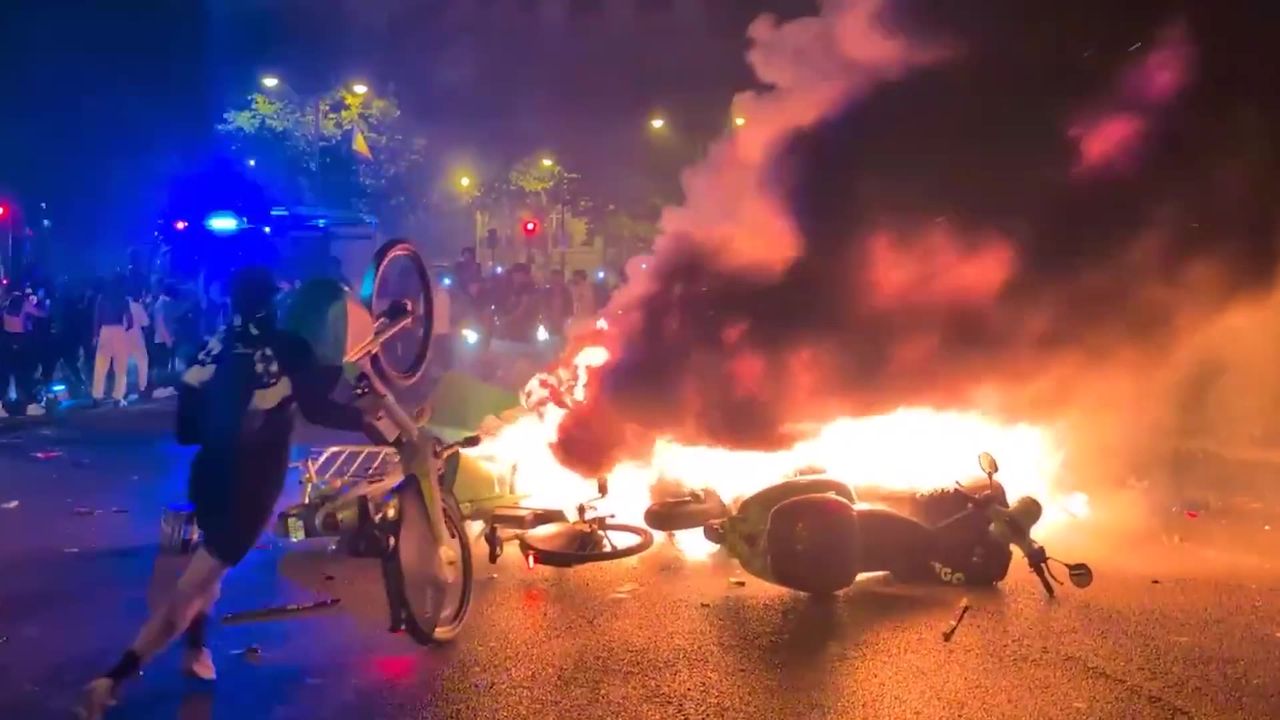
- Reviewed keyframes from the video, which show professional broadcast and library footage: night scenes of street disorder, a currency counter over a £20 note, drone shots of motorway construction, an EU candidate-countries map, aerial footage of a London demonstration, and BBC-derived studio clips of Andy Burnham captioned 'Before election' and 'After election'.
- Compared the scenes with the Spectator's scene-by-scene description of the Stay Out launch video, which matches the voiceover, the Czech leader clip, the Burnham contrast and the 'our money, our priorities' sign-off.
- Checked the video's provenance: it was first published on 12 November 2026 as the campaign's official launch film.
Sources
8 sources reviewed- 1New campaign against EU membership launches ahead of UK-EU summit ↗
BBC · bbc.comReputable outletCenter; light bias tagEvidence
The campaign launch and the £39.3bn / £750m-a-week claim, with the BBC's caveat that it had not independently verified the group's calculations.
- 2Michael Gove backs campaign warning EU return would cost £750m a week ↗
The Times · thetimes.comUntiereduntiered — treated as signal only, never decisiveEvidence
That the estimate is gross, leaves out EU money spent in the UK, and ignores inflation in its 2016 comparison.
- 3Rejoining the EU would cost £750m a week ↗
The Spectator · spectator.comUntiereduntiered — treated as signal only, never decisiveEvidence
A scene-by-scene description of the launch video, confirming it is genuine and includes the Albania warning and the Burnham contrast.
- 4Rejoining EU would cost £750m a week, new campaign claims as Andy Burnham cozies up to Brussels ↗
Daily Mail · dailymail.comUntiereduntiered — treated as signal only, never decisiveContext
That the £750m-a-week figure was the campaign's central claim, as reported by the Daily Mail.
- 5£750m a week to the EU - true cost of Andy Burnham's Brexit betrayal unveiled ↗
Daily Express · express.co.ukLow reliabilityRight — tabloidContext
That the figure applies the European Commission's own 2028 revenue forecasts.
- 6Burnham says rejoining EU among options for Britain: 'We could go all the way' ↗
Politics.co.uk · politics.co.ukUntiereduntiered — treated as signal only, never decisiveEvidence
Burnham's statement that he would like Britain to rejoin in his lifetime and 'we could go all the way'.
- 7Burnham's EU rejoining U-turn ↗
The Spectator · spectator.comUntiereduntiered — treated as signal only, never decisiveEvidence
Burnham's May 2026 statement that he was 'not proposing that the UK considers rejoining the EU'.
- 8No, Andy Burnham has not just announced the UK is rejoining the EU ↗
Full Fact · fullfact.orgPrimary / fact-checkerIFCN + EFCSN; UK charityContext
That Full Fact has debunked separate viral claims that Burnham had already announced the UK was rejoining the EU.
Further reading
- 1BBC The BBC's report on the launch, which includes the caveat that it had not verified the campaign's maths.
- 2The Times The Times analysis of the £39.3bn estimate, including the gross-figure and inflation weaknesses.
- 3The Spectator The Spectator's scene-by-scene description of the launch video, useful for confirming what the video actually contains.
- 6Politics.co.uk Politics.co.uk's report on Burnham's statement that he would like Britain to rejoin, with the full quote.
The full story
The kernel of truth here is that Stay Out is a real campaign group, launched on 12 November 2026, chaired by former Brexit negotiator Oliver Lewis and backed by Lord Gove. Its launch film is exactly what the post says it is. The group timed the launch before Prime Minister Andy Burnham's 20 November Brussels summit on closer EU ties, and it built its central message around a cost estimate: £39.3bn a year, or £750m a week, based on European Commission forecasts for the 2028-2034 budget.
That estimate is not invented. It applies the Commission's own revenue forecasts, assumes contributions at 1.26% of gross national income, doubles pandemic-debt interest, and assumes no return of the Thatcher rebate. The BBC reported the figure but said it had not independently verified the maths. The Times noted two weaknesses: the figure is gross, so it leaves out any EU money spent back in the UK, and the comparison with 2016's £19.1bn ignores inflation. Those are the same structural problems that led the UK Statistics Authority to criticise Vote Leave's 2016 '£350m a week' claim. So the number is a campaign projection presented as a bill.
The Burnham contrast is real. In May 2026 he said he was 'not proposing that the UK considers rejoining the EU'. In a late-September 2026 BBC interview he said he would like Britain to rejoin in his lifetime and 'we could go all the way'. The video shows both moments, though it leaves out his qualification that rejoining is not necessarily the case now. That is why the claim feels plausible: the shift happened, and the campaign is quoting it accurately.
Kernel of truth
Stay Out is a genuine campaign group, its launch video is real, and Andy Burnham did shift from ruling out a rejoin debate to saying he would like Britain back in. The £750m figure is the campaign's own estimate, not a settled bill.
Timeline
May 2026
Andy Burnham says: 'I am not proposing that the UK considers rejoining the EU. I respect the decision that was made at the referendum.' 7The Spectator
September 2026
In a BBC interview as Prime Minister, Burnham says he would like Britain to rejoin the EU in his lifetime and 'we could go all the way'. 6Politics.co.uk
November 12, 2026
Stay Out launches its campaign and this video, claiming rejoining would cost £39.3bn a year (£750m a week). 1BBC
November 20, 2026
Andy Burnham's Brussels summit on closer EU ties is scheduled.
How it was framed
The video is genuine campaign material and its quotes are accurate, but it frames a gross projection as a settled bill and presents a conditional estimate as a certainty. The post also shares it as 'BREAKING' news without the caveats mainstream outlets attached.
- Emotional language. '£750 million a week' and 'Our money, our priorities' — the figure is repeated as a rallying cry.
- “Visual proof”. Night footage of street disorder and a rolling currency counter over a £20 note are used to make the cost feel tangible.
- Missing context. The video gives the gross £750m figure without noting that EU money would be spent back in the UK, or that the 2016 comparison ignores inflation.
- Us vs. them. 'Where does that money go? The roads in Romania while ours fall apart.'
- Borrowed authority. The Burnham clips are BBC-derived studio footage, captioned 'Before election' and 'After election'.
Posted on X by Tim Shipman, political editor of The Sunday Times, with a link to his own article. The video is the official launch film of the Stay Out campaign, first published on 12 November 2026.
Bias
Leans anti-EU / pro-Brexit. The video is an openly partisan campaign advertisement: ominous footage of unrest, a rolling pound-counter, warnings about EU enlargement and migration, and a closing 'Our money, our priorities' slogan. It presents a single side of the argument, uses gross cost figures without net receipts or inflation adjustment, and frames the debate as chaos versus order; no pro-EU or government voice is given space to respond.
Bias describes how the post frames its message — the slant of the language, selection and emphasis — and is judged separately from whether the claim is true. A true claim can still be framed with a strong slant.
How we checked
1 min 21 s- 1
Searched for the Stay Out campaign video and the £750 million a week claim.
- 2
Searched for Andy Burnham's statement 'I would like to see Britain rejoin' to confirm the quote and its date.
- 3
Searched for fact-checks on the £750 million figure from Full Fact and BBC Verify.
- 4
Searched for the Czech leader's 'we need more money' quote about Britain rejoining.
- 5
Reviewed keyframes from the video and compared them with the Spectator's scene-by-scene description.
✓ Claim checked✓ Media checked✓ Sources checked
Why 80% confidence
HighThe verdict is HIGH confidence because the core facts — the campaign's existence, its launch date, the £39.3bn estimate, and Burnham's two statements — are each documented in independent, dated reporting from the BBC, The Times, the Spectator and Politics.co.uk. The caveats on the £750m figure are also documented by the BBC and The Times. The media verdict is AUTHENTIC because the video matches the Spectator's description and the footage is consistent with ordinary broadcast material. We did not run a media detector because the video's authenticity is not pivotal to the claim.
Limits. We did not independently verify the campaign's underlying arithmetic. The BBC explicitly said it had not done so either, and no fact-checker has yet ruled on the £750m figure itself. The Babiš quote is sourced only to the Daily Express and reposts in the input.
What we don’t know
- Whether the campaign's £39.3bn estimate is arithmetically correct on its own assumptions — no independent body has checked it.
- Whether the EU would actually offer the UK the terms the campaign assumes, including no rebate and full free movement.
- The full context of the Babiš quote beyond the Daily Express report.
- Whether Tim Shipman's article added the caveats that the video leaves out.
Spot it yourself
Find the overstatementLooks suspicious, isn’t proof
- The post comes from a partisan campaign and is shared by a political journalist — that tells you the angle, not whether the facts are right.
- The video is fast-cut and alarmist in tone, with dramatic music and night footage — tone is a reason to check, not evidence of falsity.
- The £750m figure sounds too round and too large — but it is a real campaign estimate, not an invented number.
The actual evidence
- The BBC reported the £39.3bn / £750m-a-week claim but said it had not independently verified the group's calculations.
- The Times noted the estimate is gross, leaves out EU money spent in the UK, and ignores inflation when comparing with 2016.
- The Burnham quotes are documented in mainstream reporting: May 2026 ('not proposing') and late September 2026 ('I would like to see Britain rejoin').
- The Spectator's scene-by-scene description matches the video, confirming it is the genuine launch film.
- 1
Find the original source of the number
Search for the campaign name and the figure. If the only source is the campaign itself, treat it as an estimate, not a fact.
- 2
Check whether the figure is gross or net
Look for reporting that says whether money returned to the UK is included. Gross figures overstate the cost.
- 3
Check the comparison year
If the video compares with an old figure, ask whether inflation has been adjusted for. A cash comparison is not a real-terms one.
- 4
Check the quote in full
Search the exact phrase and read the surrounding interview. A qualification can change the meaning of a 'before and after' contrast.
Takeaway
A real campaign can quote real numbers and real quotes and still mislead by leaving out context. Check whether a figure is gross or net, and whether a comparison adjusts for inflation, before you treat it as a bill.
Questions people ask
Is the £750 million a week figure true?+
It is a real campaign estimate, quoted accurately in the video. It is built from European Commission forecasts for the 2028-2034 budget. But it is a gross contribution figure: it leaves out money the EU would spend back in the UK and ignores inflation when comparing with 2016. The BBC said it had not independently verified the maths.
Did Andy Burnham really change his position on rejoining the EU?+
Yes. In May 2026 he said he was 'not proposing that the UK considers rejoining the EU'. In a late-September 2026 BBC interview he said he would like Britain to rejoin in his lifetime and 'we could go all the way'. The video shows both moments, though it leaves out his qualification that rejoining is not necessarily the case now.
Is the Stay Out campaign video real?+
Yes. It is the genuine launch film of the Stay Out campaign group, first published on 12 November 2026. It was reported by the BBC, The Times, the Daily Mail and the Spectator, and the Spectator's scene-by-scene description matches the video.
What is the '£350m a week' comparison?+
In 2016, Vote Leave claimed the UK sent £350m a week to the EU. The UK Statistics Authority called that misleading because it was a gross figure that ignored the rebate and money returned to the UK. The Stay Out figure is a different number but has the same structural weakness: it is a gross projection, not a net bill.
Who is behind Stay Out?+
Stay Out is chaired by former Brexit negotiator Oliver Lewis and backed by Lord Gove. It launched on 12 November 2026, ahead of Prime Minister Andy Burnham's 20 November Brussels summit on closer EU ties.
Go deeper
- Gross contribution
- The total amount a country pays into the EU budget before any money is returned through rebates or spending programmes.
- Thatcher rebate
- A discount negotiated by Margaret Thatcher in 1984 that reduced the UK's annual contribution to the EU budget.
- Real terms
- A figure adjusted for inflation, so it can be compared fairly with a figure from a different year.
- Accession
- The process by which a country joins the European Union, including negotiations over the terms.
- Free movement
- The right of citizens of EU member states to live and work in any other member state.
People also search for
For educators+
- The video uses real quotes from Andy Burnham. Does leaving out his qualification change the meaning of the 'before and after' contrast? How would you present the same contrast fairly?
- The £750m figure comes from the European Commission's own forecasts. Does that make it independent, or is it still the campaign's interpretation? What would you need to check?
- Why might a viewer trust a figure more when it is shared by a political journalist? What responsibility does a sharer have to add context?
About this check
- Platform
- X
- Posted by
- @shippersunbound
- Posted
- November 13, 2026
- Age when checked
- 1–2 days old when checked
- Where it spread
- United Kingdom
- Audience
- UK & EU audience
- Language
- EN
- Status
- ● Post is live
- Verified
- November 15, 2026, 03:13 UTC
- Published
- November 15, 2026, 03:13 UTC
Reach. Launch-video post: 959 likes and 158 replies (X syndication, 15 Nov), up from 125 likes and 11.7K views in the substack capture at 13 Nov 23:55Z. GB News, the Spectator newsletter and Ground News covered the £750m figure on 13-14 Nov.
This verdict was generated with AI from the sources shown. AI can make mistakes — check the sources before relying on it.
Check anything yourself, in seconds.
Share any social post or video to What the Fact and get the verdict, the confidence, and the receipts.