Is everyone at Costco panic-buying for November 17?
Is a nationwide (90-day) blackout set to begin in the US on 17 November 2026, as TikTok videos claim?
Misleading
Real Costco footage, but the framing turns a normal haul into a panic that evidence does not support.
The video is a genuine, ordinary monthly Costco shop, not evidence of panic-buying. Only a routine FEMA/FCC Emergency Alert System test is scheduled for 17 November 2026. The feared 'global blackout' story has no evidence behind it and was rated false or unfounded by PolitiFact, Snopes, BBC News Brasil, RTVE Verifica, CNET and France24.
 Genuine
Claims
✕ 1 falseEveryone at Costco is stocking up / panic-buying in preparation for November 17th17
“everyone is in a panic. What’s happening on November 17th?”
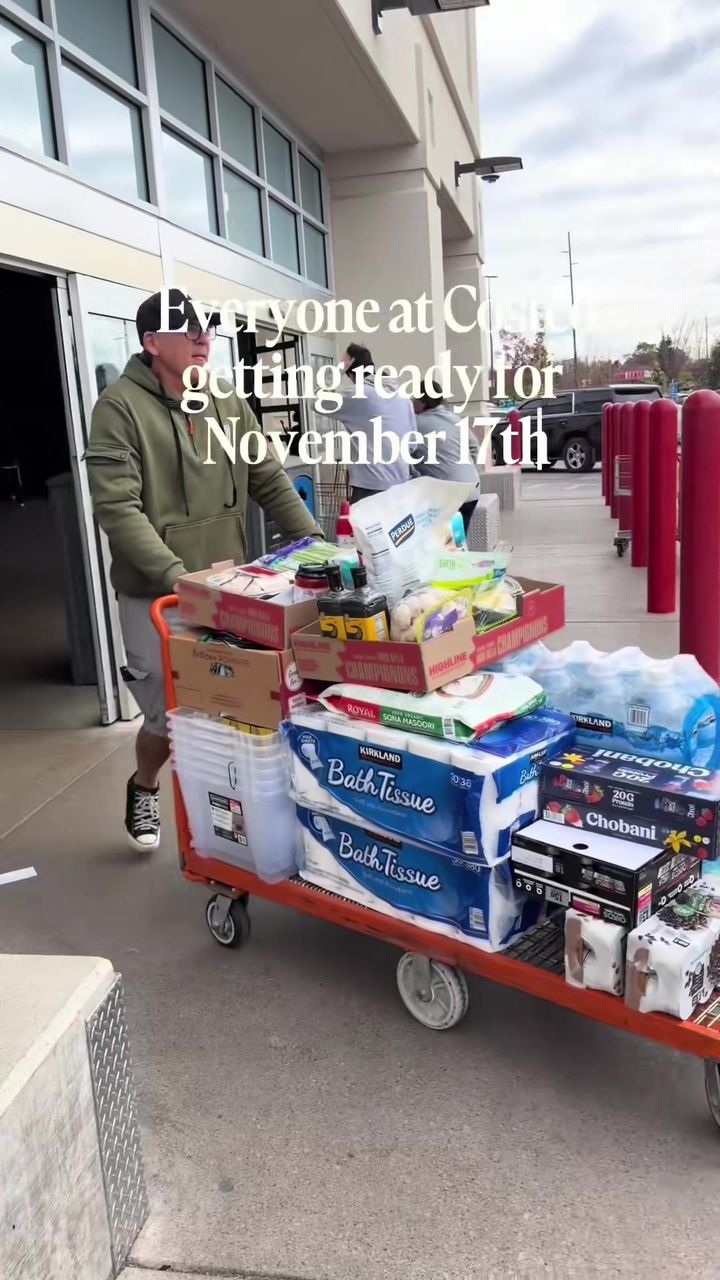
The decisive evidence is the creator's own words. The caption calls this 'our usual monthly haul', which undercuts the on-screen suggestion that the full cart reflects a wider panic. The footage supports that reading: the keyframes show a single overloaded flatbed cart outside a Costco and a bystander with an ordinary cart, not queues, empty shelves or a rush on staples. Some real stocking-up did happen — the Reading Chronicle reported shoppers taking cases of bottled water from a pallet at a Costco in Reading after the UK government's 'Be Ready' campaign, and British bottled-water sales rose 67% year-on-year. But the same reporting said sales data showed shoppers nationally adding emergency supplies to normal baskets rather than panic buying. On 15 November US Homeland Security Secretary Markwayne Mullin said Americans do not need to stockpile. So the trend the post leans on is thin and local, while the framing — 'everyone is in a panic' — is not supported. The independent sources here split between one local paper and one fact-check, so we weigh the creator's caption as the strongest single signal.
Still open: We do not know the location or date of this specific Costco visit, so we cannot say how busy that store was on that day.
Something dangerous is going to happen on November 17, 202612345
“What’s happening on November 17th?”
The only thing scheduled for 17 November 2026 is a routine, legally required test of the US Emergency Alert System, run by FEMA and the FCC at about 2:20 p.m. ET. It is a one-minute message on TV and radio saying 'this is only a test'. It is not sent to phones and requires no action. No government, bank or security agency has announced a blackout or cyberattack on that date. Five outlets checked the rumour separately — PolitiFact, CNET, BBC News Brasil, RTVE Verifica and France24 — and all reached the same conclusion: the 'global blackout' story traces to an unverified social post with no named group, bank or technical detail. Because they worked independently and converged on the same answer, and because the official alert test is documented, we rate this FALSE with high confidence. The rumour also borrowed a 2023 Simpsons episode as 'evidence', though it names no year and makes no real-world prediction.
Still open: We could not identify who first posted the original 'global blackout' claim; fact-checkers describe it only as an unverified social post.
What was posted
TikTokA TikTok video shows a shopper wheeling an overloaded flatbed cart out of a Costco into the car park, filmed on a phone in daylight. CapCut-style text overlays frame the haul as a reaction to a coming event, accompanied by R.E.M.'s 'It's the end of the world as we know it'. The post invites viewers to believe that shoppers are stockpiling because something dangerous is due on 17 November.
“We are just doing our usual monthly haul but everyone is in a panic. What’s happening on November 17th? #CapCut #survivaltips #doomsday #haul #preppertok”
Posted by the TikTok account @nurseglo with the hashtags #doomsday, #preppertok and #survivaltips. The caption itself describes the trip as 'our usual monthly haul'.
Who posted it
TikTokAccount check
Estimates from public signals — account age, posting pattern, audience — not a judgement of the person behind the account, and separate from whether this post is true.
What stood out
- Profile record returned to us is essentially empty — no bio, display name, follower count, creation date or recent posts — so identity, provenance and posting behaviour cannot be verified from platform data.
- Handle matches a consistent cross-platform commercial persona: a link-in-bio page at msha.ke/nurseglo ('Nurse • Entrepreneur • Traveler • Foodie') and an Instagram account @nurseglo_, suggesting a real individual rather than a purely synthetic account.
- The linked bio site is monetisation-first: supplement sales, a 'Member$hip that Pay$' referral-style offer and 'GLP1 flat rate' compounded-weight-loss promotion — a commercial health-marketing funnel, not a source of sourced medical information.
- Naming is ambiguous: a separate UK entity, 'NurseGlo Aesthetics & Wellbeing' (Lymington, nurse prescriber Rayna Stride), shares the brand name, so followers cannot readily tell which 'NurseGlo' they are engaging with.
- No notable news coverage, no fact-checker rulings, no credential or licence verification, and no platform verification badge — claims made by the account would carry little accountability.
- Affiliation with compounded GLP-1 / supplement affiliate marketing places the account in a category regulators (e.g. Swissmedic, FDA) repeatedly flag for exaggerated or unapproved weight-loss claims.
- No evidence of coordinated inauthentic behaviour (no bot-network or engagement-farming coverage found), so bot likelihood is judged low-to-moderate rather than high; absence of posts makes cadence analysis impossible.
Signals (10)+
- Account age notes
- Account_created_at not provided; no indexed creation date found
- Posting cadence
- Unknown — no recent posts supplied
- Recent posts sampled
- 0
- Cross platform presence
- Link-in-bio site msha.ke/nurseglo (indexed Aug 2025) and Instagram @nurseglo_
- Identity resolution
- Weak — no real name, licence number or employer disclosed; brand name shared with unrelated UK aesthetics clinic
- Commercial interest
- Supplement e-commerce, paid membership/referral programme, compounded GLP-1 offers
- Notable news coverage
- None found
- Fact check history
- None found
- Regulatory context
- Compounded GLP-1 and supplement marketing repeatedly flagged by regulators for unapproved/exaggerated claims
- Sourcing of claims
- No citations, no clinical references visible; promotional links only
Account checked November 17, 2026, 14:50 UTC
The media
Video✓ What is genuine
The footage itself: a real smartphone video of a family's large Costco shop, with genuine products and a real car park.
The tells
- ●●● Strong signal Branded packaging is legible and consistent across frames — Kirkland Signature Bath Tissue, Perdue, Chobani, Highline Champions mushrooms and Tundra Artisan romaine.our visual review
- ●●● Strong signal The setting stays coherent: consistent daylight, a parking lot, a legible Ziebart storefront and a bystander with a cart.our visual review
- ●●● Strong signal Our detector scored the footage as not AI-generated (about 0.99999) and not a deepfake (about 0.0017).our detector
- ●●○ Supporting signal The text overlays are CapCut-style additions on top of the footage; they change the framing, not the underlying video.our visual review
Synthetic-media detector
Detector ranThe claim stands or falls on whether the media is real, so the detector ran.
Scores are the detector’s estimate for the file as uploaded. A low score does not rule out editing, a spliced caption, or footage shown out of context — those are judged above. Model v3.
How we checked the media
- Reviewed the video's keyframes for physical plausibility, consistent branding and text, and anatomy.
- Ran an AI-generation and deepfake detector on the footage, which scored it as not AI-generated.
- Compared the on-screen framing with the creator's own caption.
Sources
7 sources reviewed- 1There is no evidence that a US blackout is expected Nov. 17 ↗
PolitiFact / WESH · wesh.comUntiereduntiered — treated as signal only, never decisiveEvidence
Documents the routine FEMA/FCC alert test and the Homeland Security Secretary's statement that stockpiling is unnecessary.
- 2No, the World Won't Shut Down on Nov. 17. What the Blackout Rumors Get Wrong ↗
CNET · cnet.comUntiereduntiered — treated as signal only, never decisiveEvidence
States no federal agency has mentioned a blackout.
- 3De onde surgiu a teoria de que haverá um 'apagão mundial' no dia 17 de novembro — e por que ele é improvável ↗
BBC News Brasil · bbc.comReputable outletCenter; light bias tagEvidence
Traces the rumour to the EAS reminder and a misread 2023 Simpsons episode.
- 4Qué sabemos de un supuesto apagón el 17 de noviembre: una mezcla de hechos tergiversados y videos falsos ↗
RTVE Verifica · rtve.esReputable outletCenter/Lean Left — public serviceEvidence
Finds no evidence of a blackout and identifies AI-manipulated Trump videos used to spread it.
- 5November 17 blackout hoax: How a conspiracy theory went viral around the world ↗
France24 · newsbreak.comUntiereduntiered — treated as signal only, never decisiveEvidence
Describes the blackout story as a hoax built on a routine alert test taken out of context.
- 6'Stock up on food before November 17': why the entire internet suddenly started fearing this date ↗
Tengrinews · en.tengrinews.kzUntiereduntiered — treated as signal only, never decisiveContext
Explains that claims about '17 countries' stockpiling combined unrelated civil-defence advisories from different years.
- 7Costco shoppers seen taking bottled water in Reading ↗
Reading Chronicle · readingchronicle.co.ukUntiereduntiered — treated as signal only, never decisiveEvidence
Reports genuine bottled-water buying at a Costco in Reading while noting sales data showed normal baskets, not panic buying.
Further reading
- 1PolitiFact / WESH The clearest explanation of the FEMA/FCC alert test and the official statement that Americans need not stockpile.
- 4RTVE Verifica The most detailed fact-check, including the AI-manipulated Trump videos that circulated alongside the rumour.
- 3BBC News Brasil Explains where the rumour came from, including the misused 2023 Simpsons episode.
- 7Reading Chronicle Shows what the real stocking-up looked like in Britain and why it was not the same as national panic buying.
The full story
There is a kernel of truth here on both sides, which is exactly why the post felt plausible.
The first kernel is the shopping. In Britain, the government's 'Be Ready' campaign and the EU's 72-hour preparedness guidance prompted genuine stocking-up. The Reading Chronicle reported shoppers taking case after case of bottled water from a pallet at a Costco in Reading, and British bottled-water sales jumped 67% year-on-year. A large family shop with a full cart is not unusual, and in that climate it can look like a trend.
The second kernel is the date. Something really is scheduled for 17 November 2026: a routine, legally required test of the US Emergency Alert System by FEMA and the FCC at about 2:20 p.m. ET. It is a one-minute TV and radio message saying 'this is only a test'. It is not sent to phones and asks nothing of viewers.
Around those two real facts, a story grew that a global cyberattack would trigger a three-month blackout, wipe bank accounts and shut down the internet. Fact-checkers traced it to an unverified late-October social post with no named group, bank or technical detail. Other real events were pulled in — preparedness guidance, a Microsoft outage, an FAA ground stop — and officials said neither of the latter was an attack. Manipulated videos of President Trump 'announcing' a blackout circulated too, some used to push cryptocurrency; RTVE Verifica found those clips used AI-altered audio. The post's question mark does the rest of the work: it invites the viewer to supply the catastrophe.
Kernel of truth
There was some genuine stockpiling after UK and EU preparedness advice, and 17 November 2026 really does carry a routine US emergency-alert test.
Timeline
October 2026
An unverified social post claims a global cyberattack will cause a three-month blackout starting 17 November, prompting stockpiling advice. 3BBC News Brasil
November 15, 2026
US Homeland Security Secretary Markwayne Mullin says Americans do not need to stockpile and calls the panic unfounded. 1PolitiFact / WESH
November 16, 2026
RTVE Verifica publishes its fact-check, finding no evidence of a blackout and identifying AI-manipulated Trump videos in the mix. 4RTVE Verifica
November 17, 2026
Routine FEMA/FCC Emergency Alert System test scheduled for about 2:20 p.m. ET, TV and radio only. 1PolitiFact / WESH
How it was framed
The video is real and unedited, but a routine family shop is framed as evidence of mass panic ahead of a date whose only real event is a routine alert test. The post uses a genuine scene to imply a conclusion the scene does not support.
- Ongoing-threat framing. 'everyone is in a panic' and 'What’s happening on November 17th?' present an unnamed danger as already under way.
- “Visual proof”. The overloaded flatbed cart is offered as the evidence that shoppers are stockpiling.
- Emotional language. The audio lyric 'It's the end of the world as we know it' and the hashtag #doomsday set an alarmist tone.
- Missing context. The post does not mention the FEMA/FCC alert test, the fact that the blackout rumour is unverified, or that the trip is described as routine.
Posted on TikTok by the account @nurseglo, whose caption and hashtags (#doomsday, #preppertok, #survivaltips) place it within the prepper and doomsday content niche. No further information about the account is in our records.
Bias
Leans doomsday/prepper fear-mongering and engagement bait. The clip borrows the chorus of R.E.M.'s 'It's the End of the World as We Know It' and an on-screen 'everyone is getting ready for November 17th' caption to suggest an impending catastrophe, while the creator simultaneously admits it is a normal monthly shop. It adds momentum to a debunked blackout rumour without any of the context that only a routine emergency-alert test is scheduled.
Bias describes how the post frames its message — the slant of the language, selection and emphasis — and is judged separately from whether the claim is true. A true claim can still be framed with a strong slant.
How we checked
1 min 28 s- 1
Ran targeted searches on the 17 November rumour, the Costco panic framing and the wider TikTok trend.
- 2
Reviewed the video's keyframes for physical plausibility, consistent branding and anatomy.
- 3
Ran an AI-generation and deepfake detector on the footage.
- 4
Compared the on-screen framing with the creator's own caption.
- 5
Checked the fact-check record and the FEMA/FCC alert-test schedule through the sources listed.
✓ Claim checked✓ Media checked✓ Sources checked
Why 87% confidence
HighWe rate the headline HIGH confidence because the creator's own caption contradicts the panic framing, the alert test is officially documented, and five independent outlets reached the same conclusion about the blackout rumour. The central claim carries HIGH rather than a lower band because the decisive evidence is the poster's own words, though we note the reporting on real stocking-up rests on a small number of sources.
Limits. We did not open the original pages directly; our reading of the sources comes from the verification record. We could not establish where or when this particular Costco visit took place, so we cannot say how busy that store was.
What we don’t know
- Where and when this specific Costco visit was filmed.
- Who first posted the original 'global blackout' claim that seeded the rumour.
- Whether the poster believed the panic framing or used it for engagement; we found no evidence either way.
Spot it yourself
Spot the fakeLooks suspicious, isn’t proof
- The alarmist audio and #doomsday hashtag make the post feel like a stunt — but tone alone does not tell you whether the footage is real.
- The caption's question mark ('What's happening on November 17th?') looks like bait — but a leading question is not itself a false statement.
- The video is a phone clip with added text overlays, which some readers treat as a sign of fakery — overlays are common and prove nothing about the footage.
The actual evidence
- The creator's own caption calls it 'our usual monthly haul', contradicting 'everyone is in a panic'.
- FEMA and the FCC have a documented, routine alert test on 17 November 2026 — a test, not a blackout.
- Five independent fact-checks (PolitiFact, CNET, BBC News Brasil, RTVE Verifica, France24) found no evidence of a planned blackout.
- Sales reporting from the Reading Chronicle said shoppers were adding supplies to normal baskets, not panic buying.
- The video's branding, anatomy and setting stayed consistent across frames, and our detector scored it as not AI-generated.
- 1
Read the poster's own caption before the overlays.
Here the caption says 'our usual monthly haul'. Creators often undercut their own on-screen claim in the fine print — check for that contradiction first.
- 2
Ask what is actually scheduled for the date.
Search the date plus the agency name. For 17 November 2026, the FEMA and FCC alert test is documented and routine; if a claim implies a catastrophe, the absence of any official announcement is the story.
- 3
Check whether fact-checkers have already looked.
Search the rumour's distinctive phrase plus 'fact check'. Five outlets had already published on this one before the video spread.
- 4
Separate 'some people stocked up' from 'everyone is panicking'.
Look for sales data or reporting on national behaviour, not a single cart or a single store. A local rush is not a national trend.
- 5
Check whether the footage is real before judging the claim.
Pause on branded products and text, and run a reverse image search on a still. Real footage can still carry a false message — authenticity and accuracy are different questions.
Takeaway
A real video with a false caption is harder to spot than a fake one. When a clip claims a trend, check the poster's own wording and what is actually scheduled for the date before you accept the framing.
Questions people ask
Is something happening on November 17, 2026?+
Yes, but nothing dangerous. FEMA and the FCC are running a routine, legally required test of the US Emergency Alert System at about 2:20 p.m. ET. It is a one-minute message on TV and radio saying 'this is only a test', not sent to phones, and it requires no action.
Is the Costco video fake?+
No. The footage is a genuine smartphone video of a real Costco shop, with legible branded products and a consistent setting. Our detector scored it as not AI-generated. What is misleading is the caption framing it as evidence of mass panic.
Are people panic-buying because of the November 17 rumour?+
There was some genuine stocking-up, especially in Britain after the government's Be Ready campaign, where bottled-water sales rose 67% year-on-year and a Costco in Reading saw a water rush. But reporting said shoppers were adding supplies to normal baskets, and the US Homeland Security Secretary said there was no need to stockpile.
Where did the global blackout rumour come from?+
Fact-checkers traced it to an unverified social post in late October 2026 that gave no named group, bank or technical detail. It was amplified by crypto accounts and a misread 2023 Simpsons episode, and AI-manipulated videos of President Trump 'announcing' a blackout circulated alongside it.
How can I tell a real haul video from a staged panic?+
Read the creator's own caption, look for sales data rather than a single cart, and check whether any official announcement exists for the date in question. A real video can carry a misleading message, so check the claim separately from the footage.
Go deeper
- Emergency Alert System (EAS)
- A US system that lets the president and authorities send emergency messages through TV and radio; it is tested regularly, and tests are labelled 'this is only a test'.
- False context
- When genuine footage or images are shared with a caption or framing that changes what they appear to show.
- Deepfake
- Media that has been digitally altered, often with AI, to make someone appear to say or do something they did not.
- Lateral reading
- A verification habit where you leave the post and check what other independent sources say about the same claim.
- Kernel of truth
- The real fact or event that a false or misleading claim is built on or distorts.
People also search for
For educators+
- The video is real but the caption is misleading. Does that make the post 'fake'? How would you describe it to someone who has not seen our analysis?
- The post asks a question rather than making a statement. How does that change the responsibility of the person who posted it?
- What official source could a viewer check to find out what is scheduled for a specific date, and why might that be more reliable than a viral video?
About this check
- Platform
- TikTok
- Posted by
- @nurseglo
- Posted
- November 15, 2026
- Age when checked
- 1–2 days old when checked
- Where it spread
- United States
- Audience
- US audience
- Language
- EN
- Status
- ● Post is live
- Verified
- November 17, 2026, 14:52 UTC
- Published
- November 17, 2026, 14:52 UTC
Reach. PolitiFact (16 Nov) says several TikTok posts claim the blackout, including a manipulated Trump clip; KOCO, Washington Times, NY Post ('Everyone is freaking out over FEMA's EAS test'), France24 and IBTimes covered it; Bluesky trending 'Nationwide emergency alert test' (17 Nov)
This verdict was generated with AI from the sources shown. AI can make mistakes — check the sources before relying on it.
Check anything yourself, in seconds.
Share any social post or video to What the Fact and get the verdict, the confidence, and the receipts.