Did a forensic medicine expert claim on BBC News that Epstein's death was a homicide?
Was Jeffrey Epstein strangled to death rather than dying by suicide, as forensic expert Michael Freeman concluded in a new review?
True, but…
Freeman did make the claim — but it's one unproven reading, contradicted by three official reviews.
The clip is real: forensic scientist Michael Freeman told BBC Newsnight in a November 2026 interview that Jeffrey Epstein's death was a homicide, most likely strangulation from behind. But that is his own non-peer-reviewed interpretation; he never examined the body, and the New York City medical examiner, the FBI and the DOJ Inspector General all concluded Epstein died by suicide by hanging.
Claims
✓ 5 trueJeffrey Epstein's death was the result of a homicide, most likely ligature strangulation from behind, and not suicide.1234
The evidence shows that Michael Freeman, a forensic scientist, did make this claim on BBC Newsnight. But the claim is his own interpretation, based on autopsy photographs and the case file supplied by Epstein's brother Mark. Freeman did not examine the body and his work has not been peer reviewed; it has been rejected for publication. Three official reviews reached the opposite conclusion: the New York City medical examiner who performed the autopsy, an FBI investigation and the DOJ Office of the Inspector General all found suicide by hanging with no evidence of foul play. Other forensic specialists told the New York Times that the neck mark was unusual for a hanging, but they stressed that this does not establish homicide. The decisive point is that Freeman's conclusion is presented as "the only remaining explanation", when it is a contested hypothesis contradicted by the official record.
Still open: Freeman's claim that fingernail marks above the ligature are 'impossible' in a suicidal hanging has not been published in a peer-reviewed journal and is disputed by the original medical examiner.
The medical examiner who performed the autopsy told the DOJ Inspector General that Epstein's injuries were consistent with suicide by hanging and found no defensive wounds.34
The autopsy pathologist, Kristin Roman, told federal investigators that the injuries were more consistent with suicide by hanging than with homicidal strangulation. She cited the absence of debris under the fingernails, no knuckle contusions and no body bruising — findings that would be expected in a struggle. The New York City Office of Chief Medical Examiner and former chief medical examiner Barbara Sampson stand by the suicide determination. This is a direct, on-the-record statement from the official who conducted the autopsy, and it is corroborated by the DOJ Inspector General's review.
Three official reviews — the NYC Medical Examiner's Office, an FBI investigation and the DOJ Office of the Inspector General — concluded Epstein killed himself, with no evidence of foul play.24
This matches the public record. The city medical examiner ruled suicide by hanging in 2019. The FBI found no criminality connected to the death. The DOJ Inspector General's 2023 report found no evidence of foul play. These are official investigations, not opinion pieces, and they all converge on the same conclusion. The BBC presenter raised these findings repeatedly during the interview, which is part of why the interview is a genuine journalistic exchange rather than an unchallenged platform for Freeman's theory.
There was no DNA swabbing of Epstein's body or fingernails, no photograph of the body as it was suspended, and the actual ligature was never recovered.16
New York Times reporting on the autopsy file corroborates these investigative gaps: investigators took no photographs of the body in its hanging position, the cloth sent to the medical examiner was not the noose used, and fingernails were not swabbed for DNA. These are documented shortcomings in the investigation. But they are gaps in evidence, not evidence of homicide. Freeman uses them to argue that the official conclusion is unreliable, but the absence of certain tests does not by itself show that a killing occurred.
The guard who found Epstein did not give an account for about two years after the death.1
Reporting on the case file confirms that the officer who found the body initially declined to speak with investigators and only provided his account roughly two years later. The officer had been under FBI scrutiny for falsifying cell-check records. This fact is part of the context Freeman cites to question the official investigation, and it is accurately reported.
Fingernail marks above the ligature mark are 'impossible' in a suicidal hanging.12
This is an assertion about forensic literature that Freeman has not published in a peer-reviewed journal and that the original medical examiner disputes. No independent authoritative source confirms the absolute claim of impossibility. The word "impossible" is a strong claim that would require strong evidence, and here it rests on Freeman's own unpublished analysis. Readers should treat it as an unverified opinion rather than a settled forensic fact.
Still open: What does the peer-reviewed forensic literature actually say about fingernail marks in hangings versus strangulations?
Epstein had been placed on suicide watch about a month before his death and was taken off it shortly before he died.7
The DOJ Inspector General report and contemporaneous reporting confirm that Epstein was briefly placed on suicide watch in the weeks before his death and later removed from it. This is a documented fact about the circumstances, and it is relevant context for understanding the competing narratives about how he died.
Freeman's analysis was independent and he was not paid by Mark Epstein, who supplied the autopsy files.2
This is Freeman's own account of his arrangement with Mark Epstein. It is reported by news outlets but not independently documented. Multiple outlets do confirm that Freeman was not present at the autopsy and that his findings have not been peer reviewed. Readers should note that the source of the autopsy file is a family member with an interest in the outcome, which does not make the analysis wrong but is relevant to how much weight to give it.
Still open: Was there any formal agreement or payment between Freeman and Mark Epstein?
A text-only post: there was no media to test.
What was posted
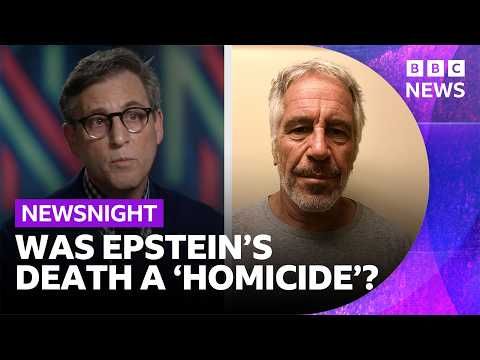
YouTubeA YouTube video reproducing a BBC Newsnight interview with forensic scientist Michael Freeman. In the exchange, Freeman argues that Jeffrey Epstein's autopsy injuries are better explained by homicidal ligature strangulation from behind than by suicidal hanging. The post's headline says Epstein's death was a "homicide", and the video presents the interview as the basis for that claim.
“Epstein death "result of a homicide", claims forensic medicine expert | BBC News”
This is a repost of a broadcast interview; the original BBC Newsnight segment aired around 16 November 2026, and the transcript matches reporting by the New York Times, The Independent, LBC and others.
Who posted it
YouTube@bbcnews
20.3M subscribers · Account 20.6 years old
View the account on YouTube ↗“Breaking news, live updates and in-depth analysis from BBC News journalists around the world. For the latest news, download the BBC News app or visit BBC.com/news”
Account check
Estimates from public signals — account age, posting pattern, audience — not a judgement of the person behind the account, and separate from whether this post is true.
What stood out
- Channel ID UC16niRr50-MSBwiO3YDb3RA matches the long-established official BBC News YouTube channel (created 8 April 2006, ~20.3M subscribers, 33k+ videos) per third-party analytics trackers.
- Platform verification plus 20.3M follower count is consistent with the real BBC News channel; bio points to BBC.com/news and BBC News app, matching known BBC branding.
- Posting pattern (steady daily news clips, BBC Newscast, Global News Podcast, The Global Story) fits a professional newsroom operation rather than automation.
- Titles check out against independent reporting: Andy Burnham's 'Brexit hasn't worked… lost more than we gained' speech (AP, 16 Nov 2026); Robert Pattinson named seventh James Bond (AP/Xinhua/BBC, 15–16 Nov 2026); forensic expert Michael Freeman's homicide claim about Epstein (CBS, NYT, BBC Newsnight, 16 Nov 2026).
- Content is largely attributable to BBC journalists/programmes; clips sometimes frame contested third-party claims (e.g. Epstein 'homicide') in headlines, but the underlying claims are genuinely reported and attributed on air.
- Minor copy-editing slip in one title ('lost more that it gained'); not indicative of impersonation given the verified channel ID.
- No evidence of coordinated inauthentic behaviour, purchased followers, or fact-check flags against the channel itself.
Signals (9)+
- Account created
- 2006-04-08
- Follower ratio assessment
- Organic (matches long-run growth trend, ~100k adds/30d)
- Posting cadence
- Multiple uploads per day, consistent with a 24/7 newsroom
- Content consistency
- High — same programmes and presenters as BBC News broadcast output
- Cross reference accuracy
- All sampled headlines corroborated by AP, Xinhua, CBS, NYT, BBC.com coverage dated Nov 2026
- Notable news coverage
- BBC is a primary source of record cited by other outlets
- Fact check history
- No adverse findings against the channel; BBC Verify is part of same organisation
- Editorial caveat
- Headlines occasionally foreground contested expert claims; attribution appears in the video, not always in titles
- Affiliation
- BBC Global News Ltd / BBC News (UK public broadcaster)
Recent posts from this account
- “Brexit hasn’t worked and Britain lost more that it gained” says Andy Burnham | BBC News32K views
- What is the UK government's plan to create more jobs for young people? | BBC Newscast17K views
- Is stockpiling enough? How the UK can effectively prepare for dangerous threats | BBC News328K views
- Why Israel is being urged to let more aid into Gaza by Trump's Board of Peace | Global News Podcast11K views
- Epstein death "result of a homicide", claims forensic medicine expert | BBC News
Account checked November 17, 2026, 02:57 UTC
Sources
7 sources reviewed- 1Challenging Consensus, Scientist Says Epstein Autopsy Photos Show Homicide ↗
The New York Times · nytimes.comReputable outletLean Left (AllSides) — distinguish news/opinionEvidence
Freeman examined the autopsy file but his work was not peer reviewed and was rejected for publication.
- 2Epstein may have been killed in his New York cell, says leading forensic expert ↗
The Independent · the-independent.comUntiereduntiered — treated as signal only, never decisiveEvidence
The medical examiner's suicide ruling was backed by a DOJ review.
- 3Forensic expert says Jeffrey Epstein's prison death was homicide, not suicide ↗
LBC · lbc.co.ukUntiereduntiered — treated as signal only, never decisiveEvidence
Freeman said the injuries don't match a suicidal hanging.
- 4Forensic expert believes there's evidence Epstein died by homicide ↗
1News · 1news.co.nzUntiereduntiered — treated as signal only, never decisiveEvidence
The autopsy medical examiner told the DOJ Inspector General injuries were more consistent with suicide.
- 5Epstein's death may not have been a suicide, says forensic expert ↗
NewsNation · newsnationnow.comUntiereduntiered — treated as signal only, never decisiveEvidence
Freeman told BBC Newsnight he believed Epstein was strangled.
- 6Forensic expert challenges Epstein's suicide ruling after examining autopsy records ↗
Hindustan Times · hindustantimes.comUntiereduntiered — treated as signal only, never decisiveEvidence
Reporting on investigative gaps: no photos of the body hanging, wrong cloth sent.
- 7Major update on Epstein's death as bombshell new theory emerges - 'Not suicide' ↗
Daily Express · express.co.ukLow reliabilityRight — tabloidEvidence
Barbara Sampson stands by the suicide determination; also mentions suicide watch timeline.
Further reading
- 1The New York Times The New York Times report gives the most detailed account of Freeman's analysis, his source material and the peer-review rejection.
- 41News 1News summarises the medical examiner's official findings and the DOJ Inspector General's backing.
The full story
The headline is not invented. It accurately reports what a forensic scientist said on BBC Newsnight. The interview is real, the quotes are real, and the transcript matches reporting by the New York Times, The Independent, LBC, NewsNation, Stuff and 1News. The post is a genuine clip, not a fabrication.
The claim is also not baseless. Freeman reviewed the autopsy file and photographs, supplied by Epstein's brother Mark, and identified specific details: deep muscular hemorrhage to the left shoulder, facial injuries, and what looked like fingernail marks above the ligature line. He pointed to genuine investigative gaps: no photograph of the body as it was suspended, no DNA swabbing of the fingernails, and the actual ligature never recovered. Those gaps are corroborated by New York Times reporting. That is the kernel of truth: the official investigation had shortcomings, and a credible expert says those shortcomings matter.
But the leap from "the investigation had gaps" to "it was homicide" is where the claim overreaches. The medical examiner who performed the autopsy, Kristin Roman, found injuries consistent with suicide and no defensive wounds. Her office and former chief medical examiner Barbara Sampson stand by that. The FBI and the DOJ Inspector General also found no evidence of foul play. Freeman's work has not been peer reviewed and was rejected for publication. Other forensic specialists called the neck mark unusual but said it does not prove homicide. The claim is a contested interpretation, not a settled fact, and the headline states it as though it were.
Kernel of truth
The official investigation did have documented gaps, and a qualified forensic scientist did conclude, based on the autopsy file, that the injuries are better explained by homicide. That conclusion is disputed and unpublished.
Timeline
August 2019
Jeffrey Epstein is found dead in his cell at the Metropolitan Correctional Center in New York. The New York City medical examiner rules suicide by hanging. 2The Independent
2023
The DOJ Office of the Inspector General issues a report finding no evidence of foul play and backing the suicide determination. 2The Independent
November 16, 2026
Forensic scientist Michael Freeman presents his findings at Middle Temple in London and gives a BBC Newsnight interview claiming Epstein's death was a homicide. 1The New York Times
How it was framed
The post accurately reports what Freeman said but frames his contested, non-peer-reviewed opinion as a definitive finding that Epstein was killed. The selective emphasis on one expert's view, against three official reviews, makes the post misleading about the state of the evidence.
- Borrowed authority. The headline leans on the authority of 'a forensic medicine expert' and the BBC News brand.
- Selective evidence. The headline highlights the homicide conclusion while omitting that the medical examiner, FBI and DOJ all found suicide.
- “Visual proof”. The post presents the interview as direct evidence, using the credibility of a broadcast interview to imply the claim is proven.
The video is a repost of a BBC Newsnight segment. The original broadcast presented Freeman's claim alongside the presenter's challenges about the official reviews, but the headline and framing here strip away that context.
Bias
Leans sensationalised framing of a contested claim. The headline foregrounds the word 'homicide' without noting in the title that the conclusion is a single expert's non-peer-reviewed opinion contradicted by three official investigations. The underlying BBC Newsnight segment itself is adversarial and repeatedly confronts Freeman with the official findings, so the slant is in the packaging rather than the reporting.
Bias describes how the post frames its message — the slant of the language, selection and emphasis — and is judged separately from whether the claim is true. A true claim can still be framed with a strong slant.
How we checked
1 min 6 s- 1
We searched for reporting on Michael Freeman's Epstein homicide claim and the BBC Newsnight interview.
- 2
We reviewed sources including the New York Times, The Independent, LBC, NewsNation, 1News, Hindustan Times and the Daily Express.
- 3
We compared the transcript of the interview with the claims made in the post.
- 4
We checked the official conclusions from the New York City medical examiner, the FBI and the DOJ Inspector General.
✓ Claim checked– Media not applicable✓ Sources checked
Why 82% confidence
HighWe are highly confident that the interview is genuine and that Freeman made the claim. That is confirmed by multiple independent outlets quoting the same exchange. We are moderately confident in the verdict on the central claim (MISLEADING) because the evidence is clear that Freeman's view is contested and not peer reviewed, but the word 'misleading' is a judgment about framing rather than a simple fact.
Limits. We did not review the full autopsy file or the peer-reviewed literature on hanging versus strangulation. We relied on reporting and official statements. We could not independently verify Freeman's assertion that fingernail marks are 'impossible' in a suicidal hanging.
What we don’t know
- What the full peer-reviewed forensic literature says about the specific injuries Freeman cites, particularly the fingernail marks.
- Whether Freeman's analysis will eventually be published or validated by other experts.
- Why the original autopsy was conducted without certain tests (no DNA swabbing, no photographs of the body in situ).
Spot it yourself
Find the overstatementLooks suspicious, isn’t proof
- The claim comes from a single expert, which can look like a lone crank, but it is actually a credentialed forensic scientist speaking on a major broadcaster.
- The topic is highly charged and involves a notorious figure, which can make any claim feel untrustworthy, but that alone does not make it false.
- The headline uses quotation marks around 'result of a homicide', which can look like sensationalism, but it accurately quotes what was said.
The actual evidence
- The medical examiner who performed the autopsy, Kristin Roman, told the DOJ Inspector General that the injuries were more consistent with suicide by hanging and found no defensive wounds.
- Three official reviews — the NYC medical examiner, the FBI and the DOJ Inspector General — all concluded suicide with no evidence of foul play.
- Freeman's analysis has not been peer reviewed and was rejected for publication.
- Freeman never examined the body; he relied on photographs and files supplied by Epstein's brother Mark.
- 1
Check whether the expert's claim is peer-reviewed or just a public presentation.
Look for a journal article or official report. If the only source is a lecture or interview, treat it as a hypothesis, not a finding.
- 2
Ask who did the official investigation and what they concluded.
In this case, the New York City medical examiner, the FBI and the DOJ Inspector General all issued findings. Search for those reports directly.
- 3
See if the post includes the strongest counter-evidence.
The BBC interview included the presenter challenging Freeman with the official reviews, but the headline did not. Look for what is left out.
- 4
Distinguish 'gaps in the investigation' from 'proof of a different conclusion'.
Missing DNA swabs or photographs are reasons to question the investigation, but they do not by themselves show what happened.
Takeaway
A claim can be accurately reported and still be misleading if it presents one expert's unproven opinion as the settled truth. Always ask: what do the official investigations say, and has this expert's work been peer reviewed?
Questions people ask
Did a forensic expert really say Epstein's death was a homicide?+
Yes. Michael Freeman, a forensic scientist, told BBC Newsnight in November 2026 that Epstein's injuries were most consistent with homicidal ligature strangulation from behind. His claim is genuine and widely reported, but it is his own interpretation, not a proven fact.
What do official investigations say about how Epstein died?+
The New York City medical examiner ruled suicide by hanging in 2019. The FBI found no evidence of foul play. The DOJ Office of the Inspector General's 2023 report also found no evidence of foul play and backed the suicide determination.
Why is Freeman's claim considered misleading?+
Because it presents one expert's unpublished, non-peer-reviewed opinion as a definitive finding, while omitting that three official reviews concluded suicide and that other forensic specialists say the evidence does not prove homicide. The headline states the claim without the caveats.
What is peer review and why does it matter here?+
Peer review is when independent experts scrutinise a study before publication. Freeman's analysis has not been peer reviewed and was rejected for publication. That does not make it wrong, but it means the claim has not been independently vetted.
How can I tell if a headline about an expert claim is reliable?+
Check whether the expert's work is peer reviewed, look for official investigations that contradict or support it, and see if the headline includes the strongest counter-evidence. A claim can be accurately quoted but still misleading if it is framed as settled when it is contested.
Go deeper
- Peer review
- The process where independent experts examine a study before it is published to check its methods and conclusions.
- Ligature
- A piece of fabric, cord or rope used to tie or strangle, or to suspend a body.
- Medical examiner
- A medical doctor, often a pathologist, who investigates deaths and determines cause and manner of death.
- Misleading content
- Information that is not false but is framed or selected in a way that gives a false impression.
People also search for
For educators+
- Why might a news headline highlight a dramatic expert claim while downplaying the official conclusion? What effect does that have on readers?
- If an investigation has gaps, does that mean its conclusion is wrong? How should we weigh gaps against positive evidence?
- How would you verify a claim like this yourself? What steps would you take?
About this check
- Platform
- YouTube
- Posted by
- @bbcnews
- Posted
- November 16, 2026
- Age when checked
- Under 24 hours old when checked
- Where it spread
- United States, United Kingdom
- Audience
- International audience
- Language
- EN
- Status
- ● Post is live
- Verified
- November 17, 2026, 02:58 UTC
- Published
- November 17, 2026, 02:58 UTC
Reach. BBC News YouTube clip 114,203 views in ~7h; covered by Metro, Mirror, IBTimes UK (16 Nov)
This verdict was generated with AI from the sources shown. AI can make mistakes — check the sources before relying on it.
Check anything yourself, in seconds.
Share any social post or video to What the Fact and get the verdict, the confidence, and the receipts.