Does The Economist's 2027 cover predict a market crash, an AI cyberattack and a banking crisis?
Does The Economist's 'The World Ahead 2027' cover predict a global stock-market crash, the biggest AI cyberattack in history, bank runs and a Chinese move on Taiwan, as a viral post listing its 'predictions' claims?
Misleading
Real cover, real themes, but the numbered disaster list is the poster's reading, not The Economist's.
The cover is genuinely The Economist's The World Ahead 2027 edition, released on 16-17 November 2026. But the numbered list of disasters in the post is not the magazine's. A stock market collapse, the 'largest AI-driven cyberattack in history' and a banking crisis with bank runs are the poster's additions. The Taiwan and Iran items are stated far more strongly than the magazine does.
 Likely genuine
Claims
✓ 1 true · ✕ 2 falseThe Economist's 2027 cover forecasts a global stock market collapse, the largest AI cyberattack in history, a banking crisis, a Chinese invasion or blockade of Taiwan and a bigger Middle East escalation.13458
“The Economist | Predicciones para 2027 ... 1. Colapso del mercado bursátil global. 2. El ciberataque impulsado por IA más grande de la historia. 3. Crisis bancaria y corridas bancarias. 4. China invade o bloquea Taiwán. 5. Escalada mayor en Oriente Medio.”
The image is real. The interpretation is not. The Economist Group's launch release and independent coverage on 16-17 November 2026 describe ten themes: the post-Trump era, Iran war fallout, record heat, AI acceleration and backlash, bond-market and debt pressure, European populism around Marine Le Pen, Taiwan's sensitive 2027, weight-loss drugs, cheaper space launches and Hollywood reboots. Editor Tom Standage frames these as trends and risks to watch, and the publisher has said the cover is not a prophecy. The decisive evidence is the mismatch between the printed sub-headings and the post's list: banking panic and 'largest cyberattack in history' appear nowhere in the edition, while stock-market collapse replaces the magazine's actual theme of bond-market and AI-debt stress. Outlets in Spanish and Russian note that such disaster lists came from social-media readings, and Austrian fact-checker Mimikama compared the viral lists to the magazine's own text and found them unsupported. Because the artwork is genuine and several themes are close to what the post names, the overall claim is misleading rather than fabricated.
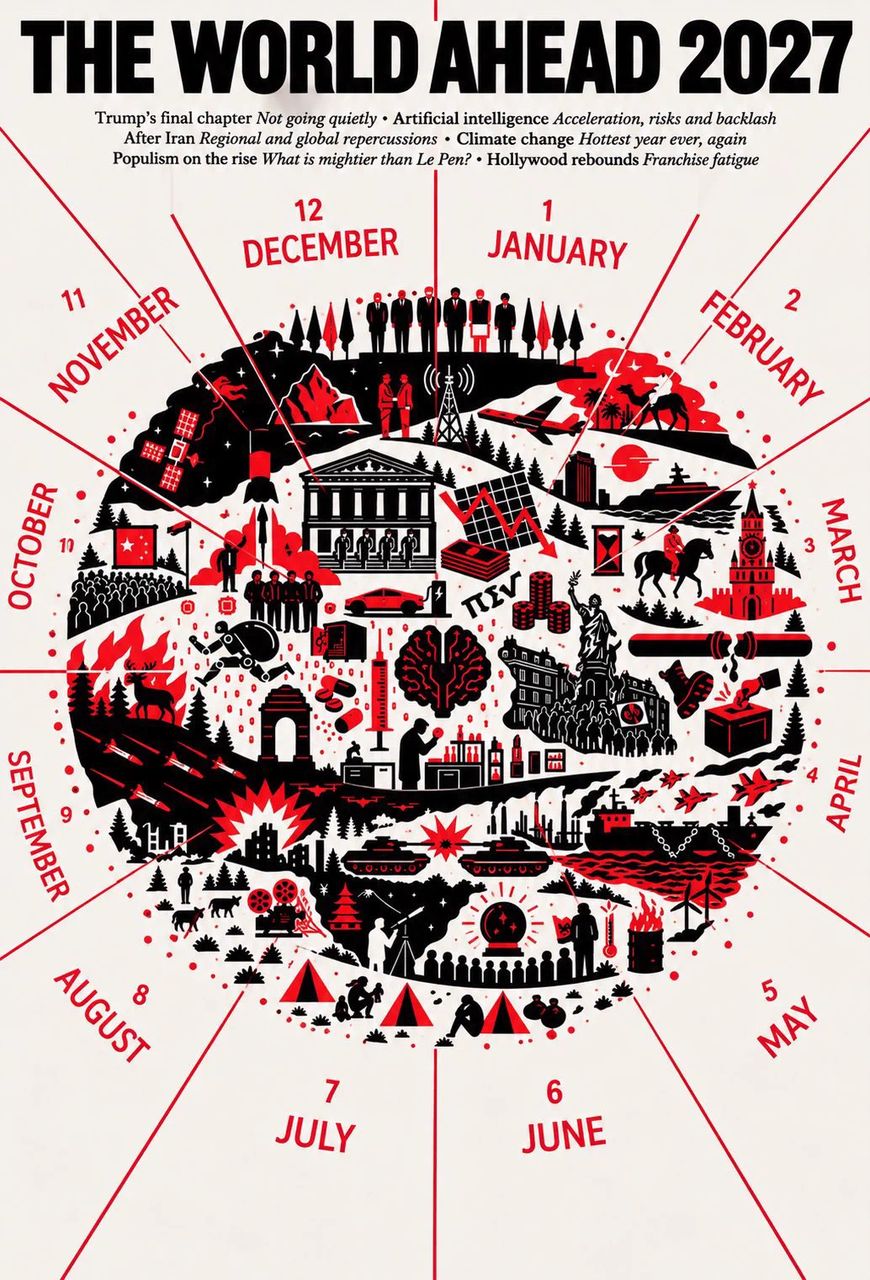
The image is the cover of The Economist's annual The World Ahead 2027 edition.137
“The Economist | Predicciones para 2027 (cover image)”
This part holds. The Economist Group announced The World Ahead 2027 on 16-17 November 2026 with a red, black and white illustrated 'globe' cover by artist Cleon Peterson. The sub-headings printed on the image — Trump's final chapter, AI acceleration and backlash, After Iran, record heat, Le Pen and populism, Hollywood franchise fatigue — match the magazine's published ten themes. The illustrated details also match press descriptions: the Spasskaya tower of the Moscow Kremlin, the Arc de Triomphe, tanks, missiles, satellites, a stock chart, syringes and tents, as listed by Argumenty i Fakty. The ten-month ring around the illustration is a reading aid, not a tell. One caveat keeps this at HIGH rather than absolute: Spanish coverage notes that AI-fabricated Economist 2027 covers circulated before the official release, so a pixel-exact copy cannot be confirmed from the screenshot alone. But every visible element corresponds to the genuine edition, so the image is accurately identified as the real cover.
Still open: We could not verify from the screenshot alone whether the image is a pixel-exact copy of the released file or a reposted reproduction.
The cover predicts a collapse of the global stock market.146
“Colapso del mercado bursátil global.”
The magazine's actual theme is pressure on government bond markets from rising debt, higher inflation and spending on AI infrastructure, plus the risk that heavily indebted AI companies could face a correction. That is a warning about risk, not a forecast of a global stock market collapse. The stock chart in the artwork is an illustration of market themes, not a printed prediction. Coverage in La FM quotes the magazine saying it is not prophecy and that bond markets will be under pressure. The distinction matters because a bond-market stress story and a crash prediction would lead a reader to very different conclusions. The post turns a risk warning into a certainty, which is why this is misleading rather than false: the underlying subject — market stress — is genuinely in the edition, but the scale and certainty in the caption are the poster's own.
The cover predicts the biggest AI-driven cyberattack in history.13
“El ciberataque impulsado por IA más grande de la historia.”
The edition does discuss AI risk. It says increasingly capable AI models could enable a new wave of cyberattacks, which is one reason AI appears among the ten themes. But nothing in the edition claims the 'largest cyberattack in history' is coming. That specific escalation — a superlative, a single predicted event — is the poster's addition, not a reading of the magazine's text. The difference between 'a new wave of AI-enabled cyberattacks' and 'the largest cyberattack in history' is the difference between a trend and a headline-grabbing prophecy. Coverage of the issue, including Excélsior's summary of Standage's themes, describes AI risks in general terms. Because the phrase does not appear in the edition and changes the meaning, we rate this false rather than misleading.
The cover predicts a banking crisis and bank runs.48
“Crisis bancaria y corridas bancarias.”
Banking panic and bank runs are not among the ten themes editor Tom Standage presented. The evidence on this is unusually clear: independent outlets that covered the launch list the themes, and banking panic is not one of them. Russian-language coverage from REN TV explicitly notes that 'banking panic' and similar scenarios came from social-media discussion of the image, not from the magazine's official forecasts. El Universal reports that Austrian fact-checker Mimikama compared the viral prediction lists with the magazine's original text and found the alarmist points unsupported. A banking crisis might feel plausible next to a bond-market stress theme, and that plausibility is likely why the addition spreads. But plausibility is not evidence, and no source in the edition supports it. The claim is therefore false: it is presented as the cover's prediction when it is not the magazine's at all.
The cover predicts that China will invade or blockade Taiwan.15
“China invade o bloquea Taiwán.”
Taiwan is genuinely one of the ten themes, so there is a kernel of truth here. But the reason is specific: 2027 matters because Xi Jinping has been reported to have asked the military to be ready to take the island by then, and because cheap drones and new weapons are shifting military balances. Outlets covering the issue stress that The Economist does not assert China will invade or blockade Taiwan in 2027. Publimetro quotes the point directly: that is not what the magazine is saying. The post turns a reported readiness deadline into a flat prediction of invasion or blockade, which changes a nuanced risk assessment into an event announcement. Because the Taiwan theme is real and the deadline is real, the claim is misleading rather than false — but a reader would come away with a stronger conclusion than the magazine supports.
The cover predicts a further major escalation in the Middle East.16
“Escalada mayor en Oriente Medio.”
The Economist does devote a theme to the aftermath of the 2026 war with Iran, saying its consequences will continue through 2027 and will reshape regional politics, energy flows and fertiliser supply. The printed sub-heading on the cover reads 'After Iran'. So the region is genuinely in the edition, and the Middle East will indeed be shaped by the war's fallout. But 'aftermath' and 'major escalation' are different things. The magazine is examining what follows a war, not forecasting a new, larger one. The post's phrasing overstates a theme that is real. That combination — real subject, stronger conclusion — is why this rates partly true rather than true or false. A reader who wants to understand the Middle East theme would need to read the magazine's own framing, which the post does not provide.
What was posted
XA post on X shares an image of The Economist's red, black and white illustrated cover for The World Ahead 2027 and tells readers what it supposedly predicts. The caption numbers five coming events: a global stock market collapse, the biggest AI-driven cyberattack ever, a banking crisis with bank runs, China invading or blockading Taiwan, and a major escalation in the Middle East. It presents the cover as a warning that 'once again' tells us what is coming.
“The Economist | Predicciones para 2027. Una vez más, esta portada nos está diciendo 😱 1. Colapso del mercado bursátil global. 2. El ciberataque impulsado por IA más grande de la historia. 3. Crisis bancaria y corridas bancarias. 4. China invade o bloquea Taiwán. 5. Escalada mayor en Oriente Medi…”
“The Economist | Predictions for 2027. Once again, this cover is telling us 😱 1. Collapse of the global stock market. 2. The largest AI-driven cyberattack in history. 3. Banking crisis and bank runs. 4. China invades or blockades Taiwan. 5. Major escalation in the Middle East…” — translated
Posted on X by an account using the handle @natalita0333. The caption is a truncated numbered list, cut off mid-word at 'Oriente Medi…'. The post carries no link to The Economist or to any article explaining the cover.
Who posted it
XAccount check
Estimates from public signals — account age, posting pattern, audience — not a judgement of the person behind the account, and separate from whether this post is true.
What stood out
- Profile metadata supplied is empty (no bio, follower count, creation date or posts), so the assessment rests on third-party references to @natalita0333 rather than the profile itself.
- Handle is an established Spanish-language personal account: it was tagged by @Claudiashein in a Nov 2022 tweet thanking allies on women's rights work, and appears in threads with Mexican human-rights group Ayuda Humanitaria Mx and accounts tagged @FNMMX2021 / @FIMiberoAmerica — consistent with a real individual in Mexican feminist/human-rights circles.
- Display name 'Natalita33 🌻' with a sunflower emoji is stable across 2022–2026 references, suggesting a persistent single-operator identity rather than a throwaway/sock account.
- On 17 Nov 2026 the account posted a viral 'The Economist | Predicciones para 2027' thread listing invented predictions (bank runs, CBDC 'reset', new world order, forced vaccinations) read off the magazine's The World Ahead 2027 cover.
- That post was picked up and quoted by Polish conspiracy site nczas.info alongside other conspiracy accounts (@TruthZone, @SilentlySirs); the same cover-reading genre was fact-checked as misleading/AI-fake-adjacent by Mythdetector, AAP FactCheck and Mala Espina in Sept–Nov 2026.
- Content pattern points to genuine-person engagement but weak sourcing: it reinterprets official magazine imagery as hidden elite signalling with no primary sourcing, a known misinformation-amplification behaviour.
- No evidence found of automated posting, fake-follower networks or coordinated inauthentic operation; the account interacts organically with journalists, officials and civil-society accounts.
- Not platform-verified and no notable news coverage of the account itself as an information source — low institutional accountability.
Signals (11)+
- Follower ratio
- Unknown
- Profile completeness
- Minimal/absent (no bio, no posts, no metadata provided)
- Posting cadence
- Active as of 17 Nov 2026 (post within 1 day of assessment), frequency otherwise unknown
- Language
- Spanish (Latin American)
- Political context
- Mexican; overlapping networks with Sheinbaum-aligned and women's-rights/human-rights accounts
- Notable news coverage
- Quoted by nczas.info (Polish conspiracy outlet) for Economist-cover predictions thread
- Fact check history
- Posted a cover-derived 'prediction' list in the same genre debunked by Mythdetector, AAP FactCheck (Sept 2026), Mala Espina (Nov 2026), Reuters
- Amplification pattern
- Part of a cluster of accounts (e.g. @_TruthZone_, @SilentlySirs) posting The Economist 2027 cover conspiracy readings on 17 Nov 2026
- Automation indicators
- None observed
- Coordination indicators
- Same-day thematic clustering with other conspiracy accounts, but no shared-content proof of coordination
- Sourcing quality
- Low — interpretive claims presented without citation to The Economist's own editorial notes
Account checked November 18, 2026, 02:47 UTC
The media
Image✓ What is genuine
The cover itself is genuine. It is The Economist's The World Ahead 2027 edition, illustrated by Cleon Peterson, with the issue's real themes printed on its face. What is not genuine is the numbered disaster list the post attaches to it.
The tells
- ●●● Strong signal The printed sub-headings — Trump's final chapter, AI acceleration and backlash, After Iran, record heat, Le Pen and populism, Hollywood franchise fatigue — match the ten themes The Economist Group and Excélsior describe.our visual review, compared with sources 1, 3 and 7
- ●●● Strong signal The artwork details match press descriptions: the Spasskaya tower, the Arc de Triomphe, tanks, missiles, satellites, a stock chart, syringes, tents and a Cybertruck.Argumenty i Fakty
- ●○○ Weak signal The ten-month ring around the illustration reads as an ordinary magazine reading aid, not a sign of manipulation.our visual review
- ●○○ Weak signal Our media detector returned a borderline AI-likelihood score (0.53), with 0.68 of its image-generator weighting on 'stablediffusion' — around the level where a printed, heavily illustrated cover can trigger a false flag. It was not treated as decisive.our detector
Synthetic-media detector
Detector ranThe claim stands or falls on whether the media is real, so the detector ran.
Scores are the detector’s estimate for the file as uploaded. A low score does not rule out editing, a spliced caption, or footage shown out of context — those are judged above. Model v3.
How we checked the media
- Compared the image's printed sub-headings and illustration details with descriptions of the official cover in The Economist Group's launch release and in independent coverage from Excélsior, Publimetro, Argumenty i Fakty and REN TV.
- Searched for prior fake AI-generated Economist 2027 covers, which El Universal reports circulated before the official launch.
- Ran the WTF media authenticity detector (Hive v3) on the image.
Sources
8 sources reviewed- 1The Economist launches The World Ahead 2027: heralding the post-Trump era, amid upheaval from bond markets and AI ↗
The Economist Group · economistgroup.comUntiereduntiered — treated as signal only, never decisiveEvidence
The Economist Group's launch release establishes the edition's real themes and its framing as trends and risks, not predictions.
- 2The Trump saga's final chapter ↗
The Economist · economist.comReputable outletCenter/Lean LeftContext
The magazine's own article on the Trump chapter confirms one of the themes printed on the cover.
- 3La era post-Trump, Ozempic y riesgos con la IA; los temas que marcarán el 2027 según The Economist ↗
Excélsior · excelsior.com.mxUntiereduntiered — treated as signal only, never decisiveEvidence
Excélsior reports Standage's ten themes and the Cleon Peterson illustration, matching the image.
- 4Portada de The Economist 2027 enciende las redes; ¿qué dicen los usuarios sobre sus "profecías" y símbolos ocultos? ↗
El Universal · eluniversal.com.mxUntiereduntiered — treated as signal only, never decisiveEvidence
El Universal reports Mimikama's comparison of viral lists with the magazine's text and notes earlier AI-generated fake covers.
- 5The Economist reveló su enigmática portada para 2027: estas son las diez predicciones que marcarían el próximo año ↗
Publimetro Colombia · publimetro.coUntiereduntiered — treated as signal only, never decisiveEvidence
Publimetro explains that the magazine does not present the cover as an exact prediction and does not predict a Chinese invasion of Taiwan.
- 6Portada The Economist 2027: Esto advierte sobre el futuro político de Donald Trump ↗
La FM · lafm.com.coUntiereduntiered — treated as signal only, never decisiveEvidence
La FM quotes the magazine's statement that the cover is not prophecy and that bond markets will be under pressure.
- 7The Economist опубликовал обложку-прогноз на 2027 год со Спасской башней ↗
Аргументы и Факты · aif.ruUntiereduntiered — treated as signal only, never decisiveEvidence
Argumenty i Fakty describes the cover's visual elements, which match the image in the post.
- 8The Economist предрек борьбу за наследие Трампа и крах ИИ-компаний в 2027 году ↗
РЕН ТВ · amp.ren.tvUntiereduntiered — treated as signal only, never decisiveEvidence
REN TV notes that 'banking panic' and similar scenarios came from social-media discussion, not official forecasts.
Further reading
- 1The Economist Group The publisher's own launch release, which sets out the edition's real themes and framing.
- 4El Universal Reports how fact-checkers including Mimikama compared the viral lists with the magazine's text.
- 5Publimetro Colombia Explains the Taiwan theme and states clearly that the magazine does not predict an invasion in 2027.
The full story
The kernel of truth here is unusually large. The Economist really did publish The World Ahead 2027 on 16-17 November 2026, and its cover — a red, black and white illustration by Cleon Peterson — really does put a stock chart, tanks, missiles and satellites around a globe ringed with month labels. Editor Tom Standage really did present ten themes for the coming year.
Those themes are the post-Trump era after Democratic midterm gains, the fallout of the war with Iran, record heat, AI acceleration and backlash including cyber risk and AI-company debt, pressure on bond markets, European populism around Marine Le Pen, Taiwan's sensitive 2027 with China's reported readiness deadline, weight-loss drugs, cheaper space launches and Hollywood's franchise reboot. The magazine frames all of this as trends and risks to watch, and it has said plainly that the cover is not a prophecy.
The post did not invent the cover, and it did not invent every subject. Taiwan is a theme. Iran's aftermath is a theme. Market and AI risk are themes. That overlap is what makes the disaster list feel like a decoding. But the list adds a stock market collapse, a single 'largest cyberattack in history', a banking crisis with bank runs, and an invasion prediction that the magazine does not make. Spanish and Russian coverage noted that viral lists of this kind came from social-media readings, and fact-checkers including Mimikama found the alarmist points unsupported by the magazine's own text. A further wrinkle: AI-generated fake Economist 2027 covers circulated before the real launch, so readers had already been primed to treat any '2027 cover' as a puzzle to solve.
Kernel of truth
The cover is real, and the edition does discuss market stress, AI risk, Iran's aftermath and Taiwan. The post inflated those themes into certain disaster predictions and added ones the magazine never made.
Timeline
November 16, 2026
The Economist releases the official The World Ahead 2027 cover, illustrated by Cleon Peterson, with a launch release and cover-dated issue to follow. 1The Economist Group
November 17, 2026
Spanish, Russian and Ukrainian outlets report the ten themes presented by editor Tom Standage, and note that viral disaster readings are social-media interpretations. 3Excélsior
November 17, 2026
Viral 'prediction list' posts spread on X and Instagram, and fact-checkers including Mimikama compare them with the magazine's text. 4El Universal
How it was framed
The image is genuine and several of the subjects the post names really are in the edition, but the post frames trends and risk warnings as a numbered list of certain disasters. It adds points the magazine never made and strengthens others, so a real document is used to support a conclusion it does not contain.
- “Visual proof”. The post presents the magazine cover itself as the evidence — 'esta portada nos está diciendo' — inviting readers to treat the artwork as a decoded message rather than an illustration.
- Emotional language. The caption uses the fearful emoji 😱 and the phrase 'Una vez más' ('Once again'), implying a recurring pattern of doom.
- Borrowed authority. It attributes the list to The Economist, a well-known publication, rather than to the account posting it.
- Missing context. The post does not link to the magazine or mention the ten themes Standage presented; it replaces the edition's framing with its own numbered list.
Posted on X by an account using the handle @natalita0333. The caption is a truncated numbered list cut off at 'Oriente Medi…'. The post carries no link to The Economist or to any explanatory article.
Bias
Leans conspiratorial catastrophism. The post frames a journalistic trend-forecast cover as a coded warning ('once again this cover is telling us'), then presents a numbered catastrophe list mixing real themes with invented ones. That is a classic doom-laden, hidden-message reading of The Economist's annual cover, a genre that has recurred for years and that the magazine itself rejects.
Bias describes how the post frames its message — the slant of the language, selection and emphasis — and is judged separately from whether the claim is true. A true claim can still be framed with a strong slant.
How we checked
1 min 7 s- 1
Searched for The Economist's 'The World Ahead 2027' cover to find the official launch material.
- 2
Searched for the edition's themes and Tom Standage's presentation to compare them with the post's list.
- 3
Searched for Spanish-language coverage and fact-checks of the viral '2027 predictions' lists, including Mimikama's comparison.
- 4
Reviewed the cover image against press descriptions of its artwork and printed sub-headings.
- 5
Ran the WTF media authenticity detector (Hive v3) on the image and weighed the result against the documentary evidence.
✓ Claim checked✓ Media checked✓ Sources checked
Why 85% confidence
HighThe headline verdict is HIGH because the facts are documented by the publisher and by multiple independent outlets in several languages, and because fact-checkers have already compared the viral lists with the magazine's own text. The image being genuine is also strongly corroborated. We stop short of absolute certainty on the pixel-exact provenance of the screenshot, and one claim (Middle East escalation) sits at MODERATE because 'aftermath' versus 'escalation' is a judgement about framing rather than a clean factual test.
Limits. We did not open the live pages ourselves in this pass; we relied on the search results and the recorded source summaries. We could not confirm from the screenshot alone whether the image is a pixel-exact copy of the released file. We did not contact The Economist or the poster.
What we don’t know
- Whether the account that posted the list wrote it themselves or copied it from another viral post.
- Whether a pixel-exact copy of the official cover file was used, or a reposted reproduction.
- How many readers took the numbered list as the magazine's own words rather than the poster's summary.
Spot it yourself
Spot the fakeLooks suspicious, isn’t proof
- The post is anonymous and alarmist, with a 😱 emoji and 'Once again'. A dramatic tone is a reason to check, not proof the content is wrong.
- The caption is cut off mid-word. Sloppiness is common in viral posts, but careful posters can also be wrong.
- The cover is heavily illustrated and stylised. A designed cover is not evidence of manipulation — magazines look like this.
- AI-generated fake Economist 2027 covers circulated before the real launch, which makes any 2027 cover look suspect. That is context, not a finding about this image.
The actual evidence
- The printed sub-headings on the image match the ten themes The Economist Group and independent outlets described on 16-17 November 2026.
- The magazine's own launch material frames the edition as trends and risks, and says it is not a prophecy.
- Banking panic and 'largest cyberattack in history' do not appear in the edition; fact-checker Mimikama compared the viral lists to the magazine's text and found them unsupported.
- Outlets covering the Taiwan theme state explicitly that the magazine does not predict a Chinese invasion or blockade in 2027.
- 1
Find the original publication
Search the magazine's name plus the edition year and look for the publisher's own release or the magazine's site. If a viral post cites a major outlet, that outlet's own page is the first place to check.
- 2
Compare printed words, not vibes
Read the actual sub-headings on the cover or the article's section titles, then compare them with the post's list. Words that appear in the post but not in the source are the tell.
- 3
Ask who would be reporting it
If a major magazine had predicted a banking crisis and an invasion, financial and world desks everywhere would be covering it. Search for that coverage. Its absence matters.
- 4
Check whether the source calls it a prediction
Look for the publisher's own language. 'Trends to watch', 'risks' and 'themes' are not the same as 'will happen'. Quote the source's framing, not the poster's.
- 5
Run a reverse image search
Use a reverse image search to find earlier versions of the cover. If it appears on the publisher's site and in news reports from the launch date, the image is probably genuine — the question then becomes what it means.
Takeaway
A real document can still be made to say something false. When a post claims a famous publication predicted something, check the publication's own words before you check your reaction to the prediction.
Questions people ask
Is The Economist's 2027 cover real?+
Yes. The Economist published The World Ahead 2027 on 16-17 November 2026 with a red, black and white cover illustrated by Cleon Peterson. The printed sub-headings and artwork match the publisher's launch material and independent coverage, so the image in the viral post is the genuine cover.
Does the cover predict a banking crisis and bank runs?+
No. Banking panic and bank runs are not among the ten themes editor Tom Standage presented. Russian coverage noted that those scenarios came from social-media readings, and fact-checkers including Mimikama found the viral lists unsupported by the magazine's own text.
What does the 2027 cover actually say about Taiwan?+
Taiwan is one of the ten themes because 2027 is a sensitive year: Xi Jinping has been reported to have asked the military to be ready to take the island by then. But outlets covering the issue stress that The Economist does not say China will invade or blockade Taiwan in 2027.
Why do people read disaster predictions into The Economist's annual cover?+
The covers are dense illustrations full of symbols, which invites decoding. Some of those symbols really do relate to real themes — markets, AI, Taiwan, Iran — so a list that mixes real themes with invented ones feels convincing. The magazine itself says the cover summarises trends and risks, not events.
Were fake Economist 2027 covers going around?+
Yes. Spanish coverage reports that AI-generated fake Economist 2027 covers circulated before the official release, and fact-checking organisations documented them. That is one reason the viral 'decoded prediction' posts spread quickly, even though the image in this post matches the genuine edition.
Go deeper
- Misleading content
- Genuine information used in a way that frames an issue or person falsely, so the reader draws a wrong conclusion from real material.
- False context
- Genuine content shared with incorrect context — such as a real image paired with a false explanation of what it means.
- The World Ahead
- The Economist's annual future-gazing edition, which sets out themes and risks to watch in the coming year rather than predicting specific events.
- Fact-check comparison
- A method where a fact-checker sets a viral claim side by side with the original source text to see whether the claim is actually supported.
- Reverse image search
- A search that finds where an image has appeared before, helping establish whether it is genuine and where it came from.
People also search for
For educators+
- The post's list includes several subjects that really are in the magazine. Does that make the post more or less misleading? Why?
- If a magazine says a risk is rising, at what point does it become fair to describe that as a prediction? Who decides?
- How would you check this post yourself in under five minutes? What would you search for first?
About this check
- Platform
- X
- Posted by
- @natalita0333
- Posted
- November 17, 2026
- Age when checked
- Under 24 hours old when checked
- Where it spread
- Global, Spain, Germany
- Audience
- International audience
- Language
- ES
- Status
- ● Post is live
- Verified
- November 18, 2026, 02:49 UTC
- Published
- November 18, 2026, 02:49 UTC
Reach. 12,967 likes on the primary post; picked up in German by Mimikama
This verdict was generated with AI from the sources shown. AI can make mistakes — check the sources before relying on it.
Check anything yourself, in seconds.
Share any social post or video to What the Fact and get the verdict, the confidence, and the receipts.