Did Steve Bannon say the US is too close to Gulf states and must review relations with Qatar, Saudi Arabia, Kuwait and the UAE?
Did Steve Bannon say on TV that the US should distance itself from Saudi Arabia, Qatar, Kuwait and the UAE because it no longer needs their oil, as Qatar's ex-PM Hamad bin Jassim says?
True
The clip and caption match Bannon's own words; only his oil premise is oversimplified.
TRUE. In a television interview reposted by Qatar's former prime minister Hamad bin Jassim on 17–18 November 2026, Steve Bannon said the US is 'way too close' to Gulf states and that relations with Qatar, Saudi Arabia, Kuwait and the UAE must be 'totally reviewed'. CNN Arabic and other Arabic outlets reported the same remarks and his reaction.
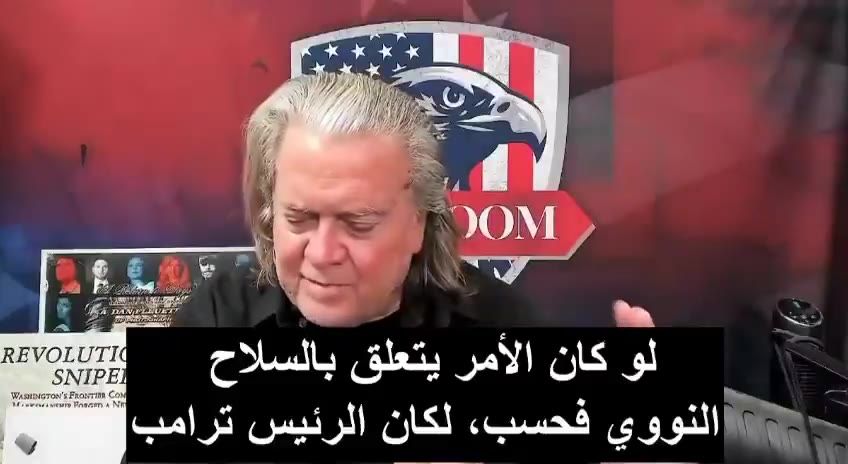 Genuine
Claims
✓ 3 trueSteve Bannon said in a television interview that the United States is too close to the Gulf states (Saudi Arabia, Qatar, Kuwait, UAE) and that the relationship must be reviewed because the US no longer needs their oil and gas.1234
“لم أستغرب ما قاله ستيف بانون في تلك المقابلة التلفزيونية التي دعا فيها إلى أن تنأى الولايات المتحدة بنفسها عن دول الخليج”
The decisive evidence is the clip's own audio. Bannon says he has argued the US is 'way too close to these Gulf Emirates', that the Gulf states want America 'to protect their oil and gas assets', and that the relationship with Qatar, Kuwait, Saudi Arabia and the UAE 'has to be totally reviewed'. That wording matches the caption closely. The clip is a genuine studio interview, not a fabrication: our detector found no sign of AI generation, and the only overlay is Arabic translation text that tracks the English audio. Independent corroboration is strong for this kind of content. CNN Arabic reported the exchange and quoted the same words, and Masrawy, Felesteen and Masdar News did the same. Those outlets are not fully separate — several draw on the same viral clip — so the clip itself is the primary proof, with the news reports as supporting confirmation. A reader should weigh that the quote is established beyond reasonable doubt, while Bannon's energy argument is his own interpretation.
Still open: The exact date and programme of Bannon's interview is not settled; reports point to a January 2026 War Room episode, but the repost that spread it is from November 2026.
The United States no longer needs Gulf oil and gas because it is becoming energy dominant, with supply from Venezuela, the Gulf of Mexico and Guyana.15
“بعد ان غدت اميركا في غير حاجة لنفط تلك الدول، وقد أصبح نفط فنزويلا لديها ونفط خليج”
This is Bannon's premise, repeated in the caption, and it is directionally grounded but oversimplified. The US is the world's largest oil and gas producer and a net petroleum exporter, which gives real weight to the 'energy dominant' framing Bannon uses in the clip. But the claim that America is simply 'in no need' of Gulf oil goes further than the facts support. The US still imports crude from Gulf producers, and the relationship involves military bases and arms sales as well as oil. The sources here report Bannon's argument rather than independently verifying the energy data, so the evidence is enough to show the premise is a real political argument, not enough to treat it as a settled fact. A reader should separate the accurate quote from the simplified economics attached to it.
Still open: The input does not include current import or export figures, so the strength of the 'no longer needs' claim rests on general energy dominance rather than a specific data check.
President Trump 'put it to bed' with Operation Midnight Hammer in a 12-day war rather than a 13- or 14-day war.
This refers to the June 2025 US strike on Iranian nuclear sites during the Israel-Iran war, which ran roughly 12 days. The substance is accurate, but Bannon's framing that the conflict was fully 'put to bed' is his own assessment rather than a neutral description. The input does not include a primary document on the strike timing, so this is supported by the clip's internal consistency rather than an independent record. A reader should treat the factual skeleton as likely correct and the triumphant framing as opinion.
Still open: No primary source in this check confirms the exact length of the war or the operation's formal name.
The relationship with Qatar, Kuwait, Saudi Arabia and the UAE must be 'totally reviewed', and CENTCOM is too close to these states and to the 'Israel first' project.13
This is a policy prescription and a characterisation of US military posture, not a checkable factual statement. Bannon presents it as his own advocacy, saying he expects it to become a theme 'over the next six months'. The clip shows him making the argument directly, so the accurate question is not whether the opinion is true but whether he said it — and he did. A reader should treat the claim as opinion that is accurately reported, not as a factual finding about CENTCOM.
Former Qatari PM Hamad bin Jassim responded that the US is friendly to Gulf states only while it needs them.14
“حمد بن جاسم يرد على تصريح مستشار ترامب الأسبق”
CNN Arabic, Masrawy and other outlets quote his post word for word, including the line that when they need us 'we are good and we are friends', and when they do not, their priorities change. That makes the attribution solid. The quote is his interpretation of US policy, but the fact that he posted it is accurately reported. The sourcing is not fully independent — several outlets are repeating the same post — but the post itself is public and visible, which is the strongest kind of confirmation here.
What was posted
XA post on X sharing a television interview clip of Steve Bannon with Arabic subtitles. The caption recounts Bannon's argument that the US should distance itself from Gulf states because it no longer needs their oil, and asks readers to take it as a warning to Gulf leaders. The clip itself is the evidence offered.
“لم أستغرب ما قاله ستيف بانون في تلك المقابلة التلفزيونية التي دعا فيها إلى أن تنأى الولايات المتحدة بنفسها عن دول الخليج وهي السعودية وقطر والكويت والإمارات التي تريد من أميركا ان تحمي نفطها، بعد ان غدت اميركا في غير حاجة لنفط تلك الدول، وقد أصبح نفط فنزويلا لديها ونفط خليج”
“I was not surprised by what Steve Bannon said in that television interview, in which he called for the United States to distance itself from the Gulf states — Saudi Arabia, Qatar, Kuwait and the UAE — which want America to protect their oil, now that America no longer needs the oil of those countries and has Venezuelan oil and Gulf oil...” — translated
Posted on X by Hamad bin Jassim bin Jaber Al Thani, Qatar's former prime minister. Arabic-language outlets including CNN Arabic, Masrawy and Felesteen reported the post and quoted the caption.
Who posted it
XAccount check
Estimates from public signals — account age, posting pattern, audience — not a judgement of the person behind the account, and separate from whether this post is true.
What stood out
- Handle @hamadjjalthani belongs to Sheikh Hamad bin Jassim bin Jaber Al Thani, Qatar's former foreign minister (1992–2013) and prime minister (2007–2013) — a uniquely identifiable senior public figure, not an anonymous persona.
- Live profile fetch on 19 Nov 2026 returned Arabic first-person commentary matching the exact posts that CNN Arabic, Al-Rai and Al-Jadeed quoted as 'his official account on X' in Oct–Nov 2026; account is active and current.
- The account is a long-established, widely cited primary channel: outlets including CNN Arabic, Al-Quds Al-Arabi, RT Arabic, Doha News and ILNA have quoted @hamadjjalthani tweets continuously from at least 2018 through November 2026.
- Doha News (2021) cited 'more than 380,000 followers' at that time, so the audience is large and organic; content is multi-tweet personal commentary, not high-frequency automated posting.
- Caveat: the supplied metadata is entirely empty (no bio, no follower count, no creation date, no posts, isplatformverified=false), so identity cannot be confirmed from the payload alone — only from external corroboration.
- Caveat: the account is a vehicle for one individual's opinions and political advocacy (Qatar-centric, critical of US/Gulf rivals), not a news organisation; claims should be treated as statements of his views rather than verified facts.
- He is himself a frequent target of fabrication: Marc Owen Jones documented a fake @hamadjjalthani tweet during the May 2020 'Qatar coup' disinformation campaign, so screenshots attributed to this handle should be verified against the live timeline.
- No evidence of coordinated inauthentic operation, bot-network amplification or platform suspension associated with the handle itself.
Signals (7)+
- Posting cadence
- Episodic multi-tweet threads tied to regional events; consistent with a single author drafting commentary
- Follower ratio
- Large organic following (380k+ reported in 2021, likely higher now)
- Notable news coverage
- Quoted by CNN Arabic, Al-Rai (Kuwait), Al-Quds Al-Arabi, RT Arabic, Doha News, ILNA, Al-Jadeed
- Fact check history
- Documented target of fabricated tweets (Marc Owen Jones, May 2020); no fact-checks against his own posts found
- Identity
- Sheikh Hamad bin Jassim bin Jaber Al Thani, former Qatari PM/FM
- Metadata completeness
- None — all profile fields null/empty
- Content type
- Personal political commentary and opinion
Account checked November 19, 2026, 03:03 UTC
The media
Video✓ What is genuine
The interview footage, Bannon's spoken remarks and the response post are all genuine; only the Arabic subtitles were added for translation.
The tells
- ●●● Strong signal The studio set, microphones, lighting and faces stay consistent across frames; the cut to two interviewers at a desk is an ordinary interview edit.our visual review
- ●●● Strong signal The detector scored the video as not AI-generated at 0.99998 and not a deepfake at 0.99979 confidence.our detector
- ●●○ Supporting signal Arabic subtitle text is overlaid on the original English audio and tracks what is being said — standard translation, not fabrication.our visual review
Synthetic-media detector
Detector ranThe claim stands or falls on whether the media is real, so the detector ran.
Scores are the detector’s estimate for the file as uploaded. A low score does not rule out editing, a spliced caption, or footage shown out of context — those are judged above. Model v3.
How we checked the media
- We reviewed the video frames for consistency of setting, people and objects.
- We ran the video through our AI-generation and deepfake detector (Hive v3).
- We compared the clip's audio and subtitle text against the caption and against Arabic-language news reports.
Sources
5 sources reviewed- 1"درس للقادة".. حمد بن جاسم يرد على تصريح مستشار ترامب الأسبق عن "مراجعة أمريكا علاقاتها مع الخليج" ↗
CNN Arabic · arabic.cnn.comLow reliabilityBORDERLINE B/C — reporting w/ strong bias tag; opinion is CEvidence
Reports Hamad bin Jassim's post and quotes Bannon's call to review relations with Gulf states because America has enough oil.
- 2حمد بن جاسم يحذر قادة الخليج من واشنطن: عندما تحتاجنا نكون أصدقاء ↗
Masrawy · masrawy.comUntiereduntiered — treated as signal only, never decisiveEvidence
Reports the same X post attacking Bannon's call to review US relations with Gulf states.
- 3"بن جاسم" يفتح النار على بانون: أميركا تتخلى عن حلفائها عندما تنتفي مصالحها ↗
Felesteen · felesteen.newsUntiereduntiered — treated as signal only, never decisiveEvidence
Reports Bannon called for Washington to distance itself from Saudi Arabia, Qatar, Kuwait and the UAE over oil protection.
- 4ابن جاسم: تصريحات بانون تكشف حقيقة تعامل واشنطن مع حلفائها في الخليج ↗
Masdar News · msdrnews.comUntiereduntiered — treated as signal only, never decisiveContext
Reports the same remarks and dates Bannon's oil comments to a January 2026 War Room episode.
- 5Former Qatari PM Criticizes Steve Bannon's Call for US to Distance Itself from Gulf Countries ↗
AtlasPress · atlaspress.newsUntiereduntiered — treated as signal only, never decisiveContext
English summary of the exchange, including the reference to Venezuelan, Gulf of Mexico and Guyanese oil.
Further reading
- 1CNN Arabic CNN Arabic's report quotes Hamad bin Jassim's post in full and summarises Bannon's remarks, making it the most complete account in this check.
- 4Masdar News Masdar News links Bannon's oil comments to a January 2026 War Room episode, which helps date the original interview.
The full story
The video is real, and so is the reaction it prompted. In a television interview, Steve Bannon argued that the United States is 'way too close' to Gulf states and that relations with Qatar, Kuwait, Saudi Arabia and the UAE must be 'totally reviewed'. Qatar's former prime minister, Hamad bin Jassim, shared the clip and drew a lesson from it: that Washington is friendly to Gulf allies while it needs them and changes priorities when it does not.
That reaction is what made the exchange travel. Arabic-language outlets including CNN Arabic, Masrawy and Felesteen reported the post and quoted it, which is how most readers encountered it. The clip itself is ordinary interview footage from a studio set, with Arabic subtitles added for translation.
The kernel of truth is Bannon's energy argument. The US is the world's largest oil and gas producer and a net petroleum exporter, and his reference to supply from Venezuela, the Gulf of Mexico and Guyana is part of his stated case. That gives the claim a real foothold. But 'energy dominant' is not the same as 'in no need' of Gulf oil: the US still imports crude from Gulf producers, and the alliance involves military bases and arms sales as well as oil. The post works because a genuine, strongly worded quote is attached to a simplified economic claim and a genuine reaction from a senior Gulf figure.
Kernel of truth
The United States is the world's largest oil and gas producer and a net petroleum exporter, so Bannon's 'energy dominant' framing has a real basis — but he overstates it into 'no longer needs' Gulf oil.
Timeline
January 2026
Bannon makes the oil and Gulf remarks in a War Room episode, according to reports cited by Masdar News. 4Masdar News
November 17, 2026
Hamad bin Jassim posts the clip on X with a caption saying he was not surprised and calling it a lesson for Gulf leaders. 1CNN Arabic
November 18, 2026
Arabic-language outlets including CNN Arabic, Masrawy, Felesteen and Masdar News report the post and quote the exchange. 1CNN Arabic
How it was framed
The post accurately quotes Bannon's own words from a real interview and accurately reports Hamad bin Jassim's reaction. The only soft spot is Bannon's oversimplified oil premise, which the caption repeats as his argument rather than as established fact.
- Borrowed authority. The post leans on a senior Gulf figure, Hamad bin Jassim, and a former Trump adviser, Steve Bannon, to give weight to the argument.
- Selective evidence. The caption repeats Bannon's 'no longer needs' oil line without noting that the US still imports Gulf crude and that the alliance involves bases and arms sales.
Posted on X by Hamad bin Jassim bin Jaber Al Thani, Qatar's former prime minister. The post is commentary on a real interview clip, and Arabic-language outlets reported it as his response.
Bias
Leans Gulf/Arab-nationalist critique of US reliability as an ally. The post by Hamad bin Jassim uses a genuine Bannon clip but frames it as proof that Washington abandons allies once their oil is no longer needed, urging Arab leaders to draw a 'lesson'. Bannon's own remarks are strongly slanted toward the America First anti-interventionist camp. Both are advocacy rather than neutral reporting.
Bias describes how the post frames its message — the slant of the language, selection and emphasis — and is judged separately from whether the claim is true. A true claim can still be framed with a strong slant.
How we checked
1 min 7 s- 1
We searched for Bannon's remarks in English and for the Arabic reaction post.
- 2
We reviewed the video frames for visual consistency.
- 3
We ran the video through our AI-generation and deepfake detector.
- 4
We compared the clip's audio and subtitles with the caption and with Arabic-language news reports.
✓ Claim checked✓ Media checked✓ Sources checked
Why 85% confidence
ModerateWe rated the main claim HIGH because the clip's audio itself confirms the quote and several outlets report the same words. The oil premise is rated MODERATE because the input does not include current energy data, so it rests on a general assessment.
Limits. No page text was opened during this check; our comparison relied on search results and the sources listed. The exact date of Bannon's interview could not be pinned down.
What we don’t know
- The exact date and programme of Bannon's interview; reports point to January 2026 but this is not confirmed.
- Whether the Arabic subtitles are a complete and exact translation of everything Bannon said in the full interview.
- Current US import figures for Gulf crude, which would sharpen the 'no longer needs' claim.
Spot it yourself
Why it looked fakeLooks suspicious, isn’t proof
- The clip has Arabic subtitles over English audio, which can look like a doctored video but is ordinary translation.
- It was shared by a political figure with a clear point to make, which raises suspicion but says nothing about whether the clip is real.
- The remarks are blunt and confrontational, which can make people assume they were invented or edited.
The actual evidence
- The clip's own audio matches the caption word for word: 'way too close to these Gulf Emirates', 'protect their oil and gas assets', 'totally reviewed'.
- Our detector found no sign of AI generation or deepfake manipulation in the video.
- CNN Arabic and several Arabic-language outlets independently reported the same quotes and the same reaction post.
- 1
Listen to the audio, not just the subtitles.
Play the clip and check whether the spoken English matches the translated text; if the subtitles drift or add words, treat that as a warning sign.
- 2
Check whether the quote was reported elsewhere.
Search the key phrase in both English and Arabic; if a major outlet like CNN Arabic reports the same words, the quote is far more likely to be real.
- 3
Separate the quote from the argument built on it.
Ask whether the post is reporting what someone said or endorsing the claim inside it; here the quote is accurate but the oil premise is oversimplified.
- 4
Look at the set and the edit.
Real interview footage has consistent lighting, microphones and cuts; sudden jumps or blurring around the mouth can point to manipulation.
Takeaway
A real quote can still carry an oversimplified argument, so check the words and the reasoning separately.
Questions people ask
Did Steve Bannon really say the US is too close to Gulf states?+
Yes. In a television interview, Bannon said the US is 'way too close to these Gulf Emirates' and that relations with Qatar, Kuwait, Saudi Arabia and the UAE 'has to be totally reviewed'. CNN Arabic and other outlets reported the same words, and the clip's audio matches the caption.
Did Hamad bin Jassim post this clip?+
Yes. Qatar's former prime minister shared the clip on X on 17–18 November 2026 with a caption saying he was not surprised and calling it a lesson for Gulf leaders. CNN Arabic and Masrawy quoted the post in full.
Is the Bannon video AI-generated or edited?+
No. Our detector scored it as not AI-generated at 0.99998 confidence and not a deepfake at 0.99979. The only addition is Arabic subtitle text over the original English audio, which is standard translation.
Is it true the US no longer needs Gulf oil?+
Only partly. The US is the world's largest oil and gas producer and a net petroleum exporter, which supports Bannon's 'energy dominant' argument. But the US still imports crude from Gulf producers, and the alliance involves military bases and arms sales as well as oil.
What is 'false context' and does this post use it?+
False context means genuine content presented with a misleading framing. This post does not do that: the clip is real and the caption accurately reports what was said. The only weakness is that Bannon's oil premise is simplified, which is an overstatement rather than false context.
Go deeper
- Deepfake
- A video or audio clip that has been artificially altered, often with AI, to make someone appear to say or do something they did not.
- Net petroleum exporter
- A country that exports more oil and petroleum products than it imports overall, even if it still imports some crude.
- False context
- Genuine content that is presented with misleading information about when, where or why it was made.
- CENTCOM
- The US military command responsible for operations in the Middle East and Central Asia.
People also search for
For educators+
- The clip is real, but the oil argument inside it is oversimplified. How should a reader report on a post like this without either endorsing or dismissing it?
- Several Arabic outlets reported the same clip. Does that make the quote more reliable, or are they effectively one source?
- If a political figure shares a real clip to make a point, what should a reader check before accepting the point?
About this check
- Platform
- X
- Posted by
- @hamadjjalthani
- Posted
- November 17, 2026
- Age when checked
- 1–2 days old when checked
- Where it spread
- QA, SA, AE, United States
- Audience
- International audience
- Language
- AR
- Status
- ● Post is live
- Verified
- November 19, 2026, 03:05 UTC
- Published
- November 19, 2026, 03:05 UTC
Reach. 2,414 likes (X syndication); CNN Arabic, Arabi21 coverage
This verdict was generated with AI from the sources shown. AI can make mistakes — check the sources before relying on it.
Check anything yourself, in seconds.
Share any social post or video to What the Fact and get the verdict, the confidence, and the receipts.