Is there going to be a National Grid outage on 19 November 2026?
Did National Grid warn that a major blackout would hit large parts of the UK on Thursday 19 November 2026 from 4pm?
True
National Grid's own notice is accurate: the blackout poster is a hoax and no outage is expected.
No. A viral poster warning of a major UK blackout starting at 4pm on Thursday 19 November 2026 is fake. National Grid said on 16 November 2026 that the post was false and no outage was expected. Full Fact rated the warning false, and the link printed on the fake poster leads to an error page on National Grid's own website.
 Genuine
Claims
✓ 2 trueA social media post claiming there will be a National Grid outage on Thursday 19 November 2026 is false, and no outage is expected.1234
The decisive evidence is the grid operator speaking in its own name. National Grid said publicly on 16 November 2026 that it was aware of a false social media post naming 19 November 2026, that no outage was expected, and that people should disregard it. Full Fact says it confirmed this with National Grid directly and rated the viral 'major blackout' infographic false. News organisations across the spectrum and regions — The Independent, The Herald and a Newsquest regional title — carried the same statement, so the rebuttal does not rest on a single outlet. That matters because sources can share one origin: several outlets quoting one press statement are corroboration of what National Grid said, not separate proof from the grid itself. Here the company is the authority on its own network, and no grid operator, regulator or government body announced a national power cut for that date. With the date now upon us, nothing in dated coverage points to an announced or occurring national outage, only routine local faults.
The viral warning poster circulating online contains a website link that does not work (a sign it is not genuine).12
Two independent descriptions of the poster agree on this detail. Full Fact and The Independent both report that the web address printed on the fake infographic leads to a 'page not found' error on National Grid's website. That is a useful tell but not a perfect one: broken links happen on real material too when pages move, and a working link would not by itself have made the poster real. What settles it is the combination — a dead link on the operator's own domain, plus the operator denying the notice exists. We did not open the printed URL ourselves in this check; we rely on the two published accounts that did, which is why the finding stands on corroboration rather than on our own click.
Still open: We did not run the printed URL ourselves; that detail rests on the two published accounts.
What was posted
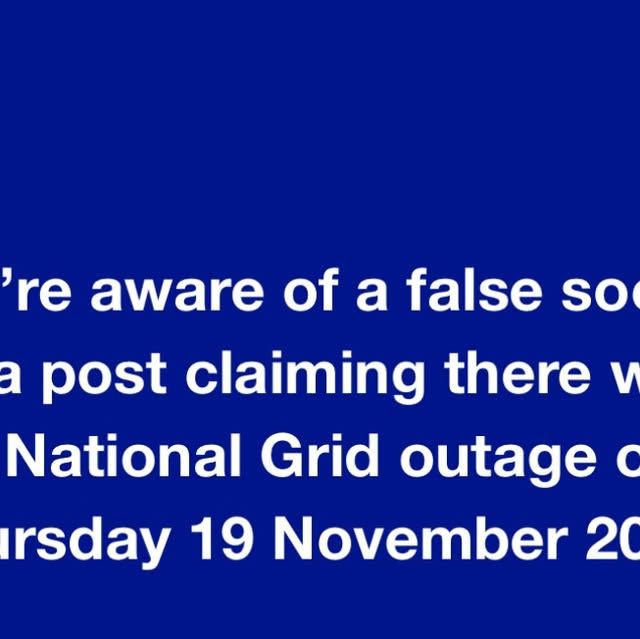
InstagramThis is not the fake warning itself. It is National Grid's official Instagram post of 16 November 2026, a plain text notice on a dark background that tells followers a circulating claim of a National Grid outage on Thursday 19 November 2026 is false. It reassures readers that no outage is expected, asks them to report the post to platforms and directs them to official channels.
“We’re aware of a false social media post claiming there will be a National Grid outage on Thursday 19 November 2026. There is no outage expected. Please disregard the post and report misinformation to social media platforms. Check our official channels for accurate information. For updates on our local electricity distribution network in the Midlands, South West England and South Wales, please follow @gridcustomersuk”
Posted by the verified @nationalgriduk account, where the post had drawn about 19,000 likes and 540 comments.
The media
Image✓ What is genuine
The notice is National Grid's own statement, published on its verified account and confirmed to Full Fact. No manipulation of the image is indicated.
The tells
- ●●○ Supporting signal The notice contains no photograph, chart or synthetic imagery — it is a plain text card, so there are no generative artefacts to look for.our visual review
- ●●● Strong signal The wording matches, word for word, the statement National Grid gave to Full Fact and that multiple outlets quoted.Full Fact and The Independent
Synthetic-media detector
Detector not consultedSources settled the claim on their own; the detector was not needed.
How we checked the media
- Reviewed the image visually: it is plain sans-serif text on a dark background, with no photographic or synthetic content to examine.
- Compared the wording with the statement National Grid gave to Full Fact and with the text carried by news outlets.
Sources
6 sources reviewed- 1Fake National Grid warning about 'major blackout' shared online ↗
Full Fact · fullfact.orgPrimary / fact-checkerIFCN + EFCSN; UK charityEvidence
Rates the viral 'major blackout' warning false and confirms National Grid said no outage was expected.
- 2National Grid forced to respond to UK power outage rumours ↗
The Independent · independent.co.ukReputable outletLean LeftEvidence
Reports National Grid's response and that the poster's printed link returns a 404 error.
- 3National Grid issues statement over UK power outage rumours circulating online ↗
The Herald · heraldscotland.comUntiereduntiered — treated as signal only, never decisiveEvidence
Reports National Grid calling the post false and saying no outage is expected on 19 November.
- 4National Grid responds to 'blackout' claims ↗
Plymouth Live · plymouthherald.co.ukUntiereduntiered — treated as signal only, never decisiveContext
A regional outlet reporting National Grid was not expecting an outage that week.
- 5No evidence that a U.S. blackout is expected Nov. 17 ↗
PolitiFact · politifact.comPrimary / fact-checkerIFCN signatory (Poynter)Further reading
Separately rates a related US blackout rumour for 17 November false.
- 6Is there going to be a blackout on 19 November? ↗
PreparedBritain · preparedbritain.co.ukUntiereduntiered — treated as signal only, never decisiveContext
Summarises the answer to whether a blackout is due on 19 November, citing National Grid's statement.
Further reading
- 1Full Fact Full Fact's ruling shows the sourcing behind the false rating, including its direct contact with National Grid.
- 2The Independent The Independent explains the poster's history and the dead link on the fake notice.
- 5PolitiFact PolitiFact's separate ruling on the US 17 November rumour shows how similar blackout hoaxes travelled at the same time.
The full story
The post most people saw was not this one. It was an infographic styled to look like an official National Grid notice, warning that a 'major blackout' would begin at 4:00 PM on Thursday 19 November 2026 because of a 'critical fault' in the national grid. It was shared tens of thousands of times.
That design choice is the heart of the story. A power cut is a concrete, frightening, time-stamped threat, and a notice that borrows the look of a utility company asks readers to trust the format rather than check the source. The apostrophe-free confidence of an official notice does a lot of work: it reads like something a press office would put out.
Two details gave it away. The web address printed on the poster resolves to a 'page not found' error on National Grid's own site, which is not how a company publishes its own alerts. And on 16 November 2026 National Grid said plainly that the post was false and no outage was expected, asking people to report it. Full Fact rated the warning false after confirming that with the company, and The Independent, The Herald and regional titles reported the same statement.
There was never a national emergency behind it. Only routine local faults were reported — scattered cuts in Greater Manchester and Lancashire attributed to separate underground cable faults. A real national blackout would have produced saturation coverage from grid operators, regulators and broadcasters. That silence is part of the evidence.
Kernel of truth
The rumour may have borrowed plausibility from a separate, unrelated claim about a US blackout on 17 November, which PolitiFact also rated false, and from ordinary local power cuts.
Timeline
November 16, 2026
National Grid publicly states the viral post about a 19 November outage is false and no outage is expected; Full Fact rates the warning false. 1Full Fact
November 16, 2026
The Independent, The Herald and a regional Newsquest title report National Grid's statement. 2The Independent
November 19, 2026
The date named in the hoax arrives; no announced or occurring national outage is reported.
How it was framed
The post at the centre of this check is genuine — National Grid's own notice — but the content it reacts to is a fabricated notice dressed as an official alert. The fabricated infographic is the primary disorder; the operator's rebuttal is accurate and is what we rated.
- Borrowed authority. The fake poster styles itself as a National Grid notice about a 'critical fault' in the national grid, borrowing the company's authority.
- Urgency. The warning gives a precise start time: 4:00 PM on Thursday 19 November 2026.
- Ongoing-threat framing. It frames a 'major blackout' as imminent, giving readers a deadline to act on.
The assessed post was published by the verified @nationalgriduk Instagram account on 16 November 2026 and had drawn about 19,000 likes and 540 comments.
Bias
The post is a straightforward public-information notice from the grid operator rebutting a viral rumour; it makes no political argument and pushes no agenda beyond directing users to official channels.
Bias describes how the post frames its message — the slant of the language, selection and emphasis — and is judged separately from whether the claim is true. A true claim can still be framed with a strong slant.
How we checked
34 s- 1
Searched for National Grid's response to the 19 November 2026 outage claim, and for live and dated coverage of any UK national outage that day.
- 2
Searched fact-checking outlets, including Full Fact and PolitiFact, for rulings on the National Grid and related blackout claims.
- 3
Compared the wording of the image with the statement National Grid gave to Full Fact and with the text carried by news outlets.
- 4
Reviewed the image visually; our media detector was not run because the claim was resolved independently.
✓ Claim checked✓ Media checked✓ Sources checked
Why 90% confidence
HighHIGH: the grid operator denied the claim in its own name, an established fact-checker confirmed that directly with the company, and several independent outlets carried the same statement. The absence of any credible coverage of a national outage for the named date reinforces it.
Limits. We did not open the printed URL ourselves, nor did we run the media detector; the link detail rests on Full Fact and The Independent. The day itself was still underway, so a future event cannot be ruled out in principle.
What we don’t know
- Who created the original 'major blackout' infographic, and why.
- How many people saw the fake poster before National Grid responded.
- Whether the poster's creator intended a hoax or copied and adapted something they found.
Spot it yourself
Why it looked fakeLooks suspicious, isn’t proof
- A scary, time-stamped warning about a blackout. Alarming content is a reason to check, not proof of falsity — real emergencies do happen.
- A slick, official-looking graphic. Good design proves nothing either way; hoaxes can look professional and real notices can be plain.
- Circulation in screenshots rather than from a link to the source. Screenshots strip out the account and date, but that is a sharing habit, not evidence of a fake.
The actual evidence
- National Grid said in its own name, on its verified channels on 16 November 2026, that the post was false and no outage was expected.
- Full Fact confirmed that statement directly with National Grid and rated the viral warning false.
- The web address printed on the fake poster returns a 'page not found' error on National Grid's own site.
- No grid operator, regulator, government body or broadcaster announced a national outage for 19 November 2026 — coverage a real emergency would have generated everywhere.
- 1
Ask who would be reporting this if it were true.
A national blackout would dominate every broadcaster, regulator and government channel within minutes. Search for the date plus 'National Grid' and see whether anyone other than the poster is saying it.
- 2
Find the operator's own channel.
Go to National Grid's verified accounts and website rather than the screenshot. If a notice is real, it will be there.
- 3
Test the links on the notice.
Type the printed web address into a browser yourself. A dead link on the company's own domain is a strong warning sign — though a working link alone does not prove a notice is real.
- 4
Read past the headline to the fact-checks.
Search the claim plus 'Full Fact'. Established fact-checkers publish their sourcing, so you can see whether they spoke to the company directly.
Takeaway
Official-looking notices carry no authority until you trace them to the organisation's own channel. The strongest check is not how the notice looks but whether the organisation it names will stand behind it.
Questions people ask
Is there a National Grid outage on 19 November 2026?+
No. National Grid said on 16 November 2026 that a social media post claiming an outage on Thursday 19 November 2026 was false and that no outage was expected. Full Fact rated the viral warning false. Only routine local faults were reported, not a national outage.
Was the National Grid blackout poster real?+
No. The poster was styled like an official National Grid notice but was not issued by the company. The web address printed on it returns a 'page not found' error on National Grid's site, and the company publicly denied the notice and asked people to report it.
Why do fake utility notices spread so widely?+
A power cut is a concrete, frightening threat with a precise time attached, and official-looking design borrows the authority of the company named. People share the warning to protect others, which spreads it further before any check takes place.
How can I check a power cut warning myself?+
Go to the operator's verified accounts and website rather than the screenshot, search the date and company name for coverage from recognised outlets, and test any printed link yourself. If the organisation has not published the notice, treat it as unconfirmed.
Was the US blackout claim on 17 November related?+
It was a separate claim. PolitiFact rated the US rumour about a 17 November blackout false as well. The two circulated around the same time, which may have made each feel more plausible, but they concerned different countries and dates.
Go deeper
- False context
- When genuine material is shared with information that misrepresents what it is or when it was made.
- Fabricated content
- Material invented from scratch and presented as if it were real.
- Borrowed authority
- Borrowing the look, logo or tone of a trusted organisation to make a claim seem official.
- 404 error
- The 'page not found' message a website returns when a web address does not exist or has moved.
- Corroboration
- Independent confirmation of a claim from more than one source.
People also search for
For educators+
- If several news sites all report the same company statement, how many independent sources do you really have?
- What makes an official-looking graphic persuasive, and what would you check before sharing one?
- Why might a fake national warning spread faster than a true local power cut?
About this check
- Platform
- Age when checked
- Older post, still live
- Where it spread
- United Kingdom
- Audience
- UK & EU audience
- Language
- EN
- Status
- ● Post is live
- Verified
- November 19, 2026, 02:58 UTC
- Published
- November 19, 2026, 02:58 UTC
Reach. Poster shared 'tens of thousands of times' on Facebook and Instagram (Full Fact); National Grid denial on X 1.7K likes; covered by Independent, Metro, Sun
This verdict was generated with AI from the sources shown. AI can make mistakes — check the sources before relying on it.
Check anything yourself, in seconds.
Share any social post or video to What the Fact and get the verdict, the confidence, and the receipts.