Did Donald Trump fall asleep during Xi Jinping's speech at the APEC summit in China?
Does a video show Donald Trump falling asleep during Xi Jinping's speech at the APEC summit in Shenzhen, China, or was he reading papers as the White House says?
True, but…
Real footage of Trump's eyes closed for 10-12 seconds. 'Falls asleep' is an interpretation, not proof.
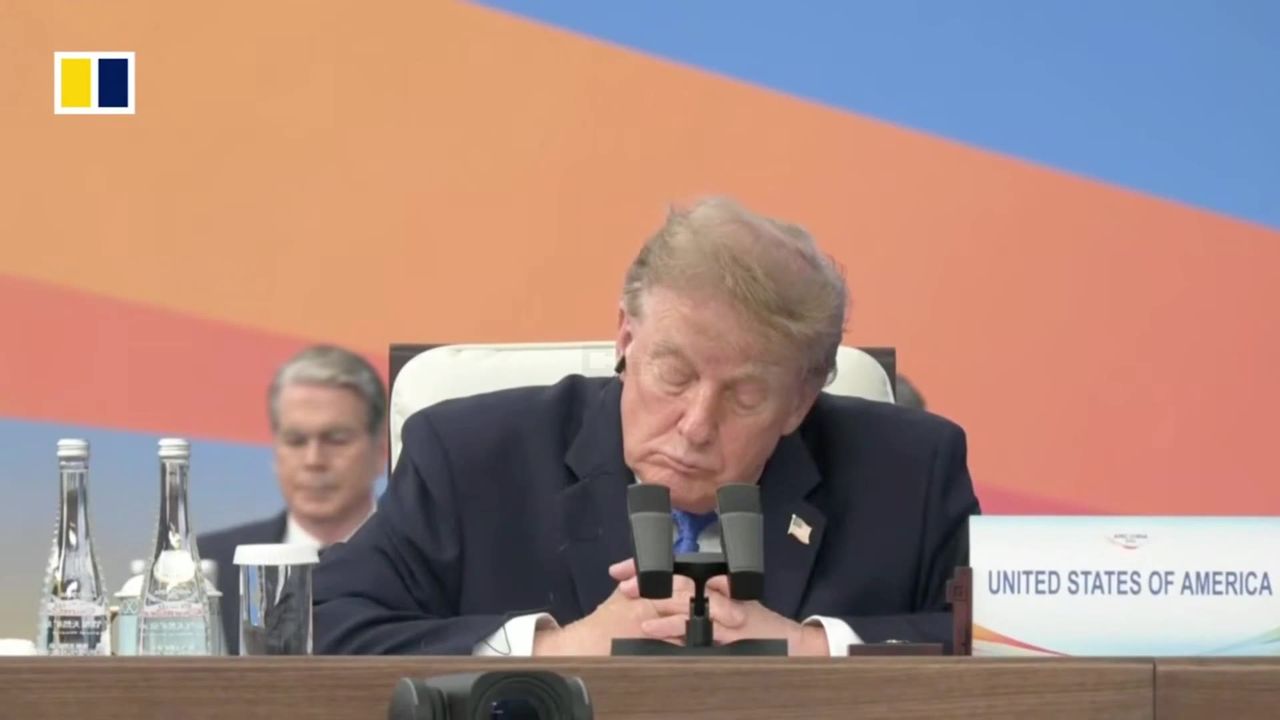
The video is real CNN broadcast footage from the APEC leaders' meeting in Shenzhen, China, on 18-19 November 2026. It shows Donald Trump with his eyes closed for about 10-12 seconds while Xi Jinping spoke. Whether he was actually asleep isn't established: most outlets say he 'appeared' to doze off, and the White House denies it.
 Genuine
Claims
✓ 2 trueDonald Trump sat with his eyes closed for roughly 10-12 seconds while Xi Jinping spoke at the APEC leaders' meeting in Shenzhen, before the camera cut to Mark Carney taking notes.1234
This is the part of the post that holds up, and it is settled by the footage itself. CNN, which broadcast the clip, published the same sequence, and outlets in several countries describe identical details: Trump seated, hands clasped, head slightly down, eyes shut for around 10 to 12 seconds, then a clean cut to Mark Carney writing notes at the Canada seat. The video in the post matches those descriptions frame for frame; it is not a composite or an edit. The sources are not fully independent of each other, since most are reporting the same CNN broadcast rather than filming the summit themselves. That is why we lean on what the broadcast shows rather than on how many outlets repeated it. Where reporters differ is the date, some placing the moment on 18 November and others on 19 November, the two days of the summit. That discrepancy does not affect the substance: the sequence happened at the Shenzhen plenary and the clip is genuine.
Trump actually fell asleep during the speech.137
Closed eyes are documented; sleep is not. The footage shows a short excerpt, and CNN Indonesia's account of the shot, as cited in our record, notes that it lasted about 12 seconds and that Trump's eyes lifted at one point. A person can be awake with their eyes shut, and someone who is genuinely asleep usually gives more than one visual cue across a longer stretch. Most newsrooms chose hedged language, 'appears to doze off', which signals the limit of what a camera can tell you. Against that, White House communications director Steven Cheung called the claim 'Fake News' and said Trump was looking at papers in front of him with his eyes moving back and forth; officials have described similar moments before as blinking. The denial is a statement from an interested party, not independent evidence, but it has not been contradicted by anything in the clip. So the post's central visual claim is solid while the word 'asleep' goes one step past it.
Still open: The full uncut broadcast feed was not reviewed, so we cannot say what Trump's posture or eye movements were before and after the excerpt.
The setting was the APEC summit in China, with Xi Jinping delivering the address.56
The setting is the easiest part to confirm and it matches everything in the clip. The 33rd APEC Economic Leaders' Meeting was held in Shenzhen, China, on 18-19 November 2026. Trump arrived on 18 November and the leaders' plenary session took place on the morning of 19 November. The audio in the posted video is Xi's address on open trade and investment, which is the theme described in coverage of the session, and the nameplates visible in the footage identify the United States and Canada seats. An international summit of this size is covered by pooled cameras and reported by newsrooms from many countries, so the location and speaker are not in serious dispute. A reader can weigh this as settled context: the post is not mislabelling an unrelated event, which is a common way real clips get reused.
What was posted
XA post on X sharing a short broadcast clip from the APEC leaders' meeting in Shenzhen, China. The camera holds on Donald Trump with his hands clasped and head slightly down while Xi Jinping speaks, then cuts to Canadian Prime Minister Mark Carney taking notes. The post tells readers the footage shows Trump asleep on the world stage.
“EMBARRASSING on the world stage: Donald Trump falls asleep during the APEC summit in China”
Posted on X by the account 'Republicans against Trump', a partisan critic of the president. The post went out the same day CNN aired and published the same clip, and it was then quoted by outlets including HuffPost and The Independent.
Who posted it
XAccount check
Estimates from public signals — account age, posting pattern, audience — not a judgement of the person behind the account, and separate from whether this post is true.
What stood out
- Long-running anonymous rapid-response account (@RpsAgainstTrump, 'Republicans against Trump'), active since January 2020 with a large, highly engaged following and a Bluesky/Substack mirror ('Republicans Against Trumpism', ~300K followers).
- Identity is misrepresented: X's account-location disclosure in November 2025 showed the account is run from Austria, not by US Republicans, prompting 'foreign psyop' accusations; no named owner or organisational affiliation is disclosed.
- Pattern of amplifying unverified and fabricated media: posted AI-generated fake audio of Donald Trump Jr (Feb 2025, deleted with a correction after being caught), an old Gaza video misrepresented as India-Pakistan airstrikes (May 2025), an AI-generated 'Kuwaiti man confronting US pilot' photo (March 2026, rated fake by Snopes) and an apparently AI-generated Trump New Mexico video (Sept 2026).
- Content is largely human-curated partisan commentary and clip aggregation, not obviously automated — the voice, timing and editorial judgment read as a person or small team rather than a bot farm.
- Despite low reliability on breaking/viral content, its posts are routinely embedded by mainstream outlets (Rolling Stone, Yahoo News, VilaWeb, Sky News Arabia) when quoting Trump or officials directly, giving it real agenda-setting reach.
- No platform verification badge, and no bio/follower data supplied in the metadata, so trust must rest on external reporting rather than platform signals.
Signals (9)+
- Account created
- 2020-01
- Disclosed location
- Austria (per X account-location disclosure, Nov 2025)
- Follower scale
- Large (Bluesky mirror ~300K; X following in the hundreds of thousands to millions)
- Posting cadence
- Very high, rapid-response/aggregation
- Notable news coverage
- Frequently quoted/embedded by mainstream outlets
- Fact check history
- Multiple false/AI-generated posts (Don Jr AI audio 2025, India-Pakistan video 2025, Kuwait pilot AI image 2026, New Mexico AI video 2026); some deleted after correction
- Affiliation
- Unaffiliated with any official Republican organisation; separate from Republican Accountability Project/Republicans Voters Against Trump
- Anonymity
- Anonymous operator, disclosed foreign (Austrian) location
- Partisanship
- Strongly anti-Trump, progressive-adjacent framing under a 'Republican' brand
Account checked November 19, 2026, 14:45 UTC
The media
Video✓ What is genuine
The footage is genuine broadcast video from the APEC leaders' plenary in Shenzhen, showing the real US and Canada seats, the real speaker and the real attendees. Nothing in it was synthesised.
The tells
- ●●● Strong signal Our detector scored the clip as not AI-generated at 0.99999, with an AI-generated score of 0.00014 and a deepfake score of about 0.022.our detector
- ●●● Strong signal The cut from Trump's seat to Mark Carney at the Canada nameplate matches the sequence described by outlets that aired the same footage.our visual review
- ●●○ Supporting signal Lighting, skin texture, hand anatomy and the background of the plenary hall are coherent throughout.our visual review
- ●●○ Supporting signal The audio is Xi's address on free and open trade and investment, matching coverage of the session.our visual review
Synthetic-media detector
Detector ranThe claim stands or falls on whether the media is real, so the detector ran.
Scores are the detector’s estimate for the file as uploaded. A low score does not rule out editing, a spliced caption, or footage shown out of context — those are judged above. Model v3.
How we checked the media
- Reviewed the video frame by frame, including the cut from Trump to Mark Carney.
- Ran our synthetic-media detector (Hive) on the clip.
- Searched for the same broadcast footage as published by outlets that aired it.
- Compared the audio against descriptions of Xi Jinping's remarks at the session.
Sources
7 sources reviewed- 1Trump closes his eyes during Xi speech | CNN Politics ↗
CNN · edition.cnn.comLow reliabilityBORDERLINE B/C — reporting w/ strong bias tag; opinion is CEvidence
CNN aired and published the same clip and described Trump appearing to doze off during Xi's speech.
- 2'Embarrassing': Trump Appears To Fall Asleep While Xi Speaks During APEC Summit ↗
HuffPost · huffpost.comLow reliabilityLeft — partisan digitalEvidence
Describes the roughly 10-second stretch and the cut to Mark Carney taking notes.
- 3Trump is mocked for 'falling asleep' during meeting with world leaders in China ↗
The Independent · independent.co.ukReputable outletLean LeftEvidence
Hedged reporting of the moment and the White House communications director's 'Fake News' response.
- 4Trump appears to fall asleep as President Xi delivers speech ↗
Daily Mail · dailymail.comUntiereduntiered — treated as signal only, never decisiveEvidence
Independent description of plenary footage from Shenzhen showing Trump appearing to nod off.
- 5Trump appears to doze off during Xi Jinping's speech at APEC summit in China — video ↗
The New Voice of Ukraine · english.nv.uaUntiereduntiered — treated as signal only, never decisiveContext
Places the summit in Shenzhen on 18-19 November and reports CNN's characterisation of the moment.
- 6APEC summit: Xi, Trump and Putin gather in Shenzhen, China ↗
DW · dw.comReputable outletCenter — independent public intl broadcasterContext
Confirms the dates, location and attendees of the 18-19 November 2026 APEC summit.
- 7Ο Λευκός Οίκος για το βίντεο που δείχνει τον Τραμπ να αποκοιμιέται ενώ μιλάει ο Σι: «Fake news, διάβαζε έγγραφα» ↗
NewsIT · newsit.grUntiereduntiered — treated as signal only, never decisiveEvidence
Records the White House denial and the claim that Trump was reading documents.
Further reading
- 1CNN The broadcast original from the outlet whose cameras carried the plenary, with CNN's own framing of the moment.
- 3The Independent Shows how a mainstream outlet hedged the claim and reported the White House denial in the same piece.
- 7NewsIT The full White House response as reported, useful for weighing the official account against the footage.
- 6DW Background on the Shenzhen summit itself, including dates and the leaders attending.
The full story
The moment behind this post is unremarkable on its face: a camera at a long plenary session held on a seated world leader while another leader spoke. Summit cameras do this constantly, and the resulting clips are often short, silent and easy to read in whatever direction the viewer already leans.
What made this one travel is the contrast built into the cut. The broadcast holds on Trump with his hands clasped and head slightly down, eyes closed for around 10 to 12 seconds, then cuts to Canadian Prime Minister Mark Carney writing notes. One image shows a leader apparently disengaged; the other shows a colleague attentive. That pairing, not any single frame, is what people reacted to, and it was already in the pool feed before the post added the words 'EMBARRASSING on the world stage'.
The kernel of truth is real and was widely reported: Trump's eyes were shut on camera during Xi Jinping's address in Shenzhen. Outlets across the political spectrum ran the clip and mocked it, while hedging with 'appears'. The White House pushed back the same way it has before, with a communications director calling the claim fake and saying the president was reading documents in front of him.
So the post is best understood as a partisan caption placed on genuine footage at the edge of what the footage can show. The eyes were closed. The sleep is an inference.
Kernel of truth
Broadcast cameras at the Shenzhen APEC plenary did show Donald Trump with his eyes closed for around 10 to 12 seconds while Xi Jinping spoke, and the clip is real.
Timeline
November 18, 2026
Trump arrives in Shenzhen for the APEC Economic Leaders' Meeting, which runs 18-19 November. 6DW
November 19, 2026
At the leaders' plenary, broadcast cameras show Trump with his eyes closed for about 10-12 seconds while Xi Jinping speaks on open trade and investment. 1CNN
November 19, 2026
CNN airs and publishes the clip at 06:25 GMT; the 'Republicans against Trump' post follows the same day. 1CNN
November 19, 2026
White House communications director Steven Cheung calls the sleep claim 'Fake News', saying Trump was looking at papers. 7NewsIT
How it was framed
The footage is genuine and correctly labelled as the APEC summit in Shenzhen, so it is not fabricated or manipulated. The stretch is interpretive: a short clip of closed eyes is presented as proof that Trump 'falls asleep', a conclusion the footage alone cannot carry and that the White House disputes.
- Emotional language. The caption opens with 'EMBARRASSING on the world stage'.
- Us vs. them. The 'world stage' framing contrasts Trump with the other leaders at the summit, reinforced by the cut to Mark Carney taking notes.
- “Visual proof”. The post leans entirely on the clip of Trump with his eyes closed rather than any written evidence.
Posted on X by 'Republicans against Trump', an account whose name signals organised opposition to the president. It was published the same day CNN aired the clip and was quoted by HuffPost and The Independent.
Bias
Leans anti-Trump. The post comes from the partisan account 'Republicans against Trump', which selects and labels a real broadcast moment with the loaded framing 'EMBARRASSING on the world stage'. The underlying footage is genuine, but the presentation is advocacy aimed at mocking the president, and it omits the White House's explanation and the fact that he reopened his eyes.
Bias describes how the post frames its message — the slant of the language, selection and emphasis — and is judged separately from whether the claim is true. A true claim can still be framed with a strong slant.
How we checked
56 s- 1
Searched for coverage of Trump at the APEC summit and the specific video, using terms including 'Trump falls asleep APEC summit video'.
- 2
Searched for the summit itself to confirm the dates and location, and for fact-checking of the footage's authenticity.
- 3
Compared the posted clip with the broadcast footage as published by CNN and with descriptions in other outlets.
- 4
Reviewed the video visually, including the cut to Mark Carney and the visible nameplates.
- 5
Ran our synthetic-media detector on the clip.
- 6
Checked the audio against descriptions of Xi Jinping's remarks at the session.
- 7
Recorded the White House response as reported by NewsIT.
✓ Claim checked✓ Media checked✓ Sources checked
Why 84% confidence
HighWe rate the headline HIGH confidence because the footage itself, the broadcast original and multiple independent descriptions line up. The narrower question of whether Trump was actually asleep carries only MODERATE confidence, reflected in the PARTLY_TRUE verdict on that claim, because a short clip cannot establish sleep and the White House disputes it.
Limits. We did not review the full uncut plenary feed, so we cannot describe Trump's posture or eye movements outside the excerpt. We could not reach the original poster or verify anything beyond the public record.
What we don’t know
- Whether Trump was asleep at any point during the speech, as opposed to resting his eyes or looking down.
- How long the full broadcast held on Trump before and after the excerpt that circulated.
- What documents, if any, were in front of Trump, as the White House says.
- Whether the poster knew the limits of the clip when adding the word 'asleep'.
Spot it yourself
Spot the fakeLooks suspicious, isn’t proof
- The account name 'Republicans against Trump' signals a partisan critic. That is a reason to check carefully, not evidence the video is fake.
- The all-caps 'EMBARRASSING on the world stage' is editorial framing. Loaded wording can sit on top of completely true footage.
- The clip is short and cuts away quickly. Brevity limits what you can conclude, but it does not by itself mean anything was staged.
The actual evidence
- The same footage was broadcast and published by CNN, the outlet whose cameras carried the plenary, and matches the clip frame for frame.
- Multiple outlets in different countries describe the same sequence, including the cut to Mark Carney taking notes.
- Our synthetic-media detector scored the clip as not AI-generated at 0.99999.
- The audio matches Xi Jinping's address on open trade and investment as described in coverage of the session.
- 1
Find the broadcast original
Search for the summit and the leader's name plus the word 'video'. If a mainstream outlet aired the plenary, its version is the reference point to compare against.
- 2
Check what the caption adds
Watch the clip and list only what you can see. Closed eyes for a few seconds is visible. Being asleep is not, so treat that as the poster's claim and look for reporting that addresses it.
- 3
Look for the cut
Note where the camera moves to another person. Cuts can create a contrast the broadcast never intended as a comment, and the timing of a cut tells you how much of the moment you are actually seeing.
- 4
Look for the official response
When a claim concerns a public figure at a public event, the office usually responds. Search the person's name plus 'statement' or the spokesperson's name to see whether a denial exists and what it says.
- 5
Separate detection from interpretation
A tool can tell you whether footage is synthetic. It cannot tell you whether the person in it was asleep, bored or reading. Those need reporting, not a detector.
Takeaway
Genuine footage can still carry a claim it does not support. Check whether the doubt is about the video or about the sentence placed on top of it.
Questions people ask
Is the video of Trump with his eyes closed at APEC real?+
Yes. It is genuine broadcast footage from the APEC leaders' plenary in Shenzhen, China, on 18-19 November 2026. CNN aired and published the same clip, and our detector scored it as not AI-generated. The video shows Trump with his eyes closed for roughly 10 to 12 seconds while Xi Jinping spoke.
Did Trump actually fall asleep during Xi Jinping's speech?+
That is not established. The footage shows closed eyes for a short stretch, and most outlets described him as appearing to doze off rather than confirming sleep. The White House says he was looking at papers and his eyes were moving. A short clip cannot settle whether someone was asleep.
Why does the post cut to Mark Carney?+
That cut was in the broadcast itself, not added by the poster. The camera moved from Trump's seat to Canadian Prime Minister Mark Carney writing notes. The contrast between the two shots is part of why the clip spread, even though the cut was a routine camera change during a long plenary.
Does a real video mean the caption is accurate?+
No. Authentic footage can be paired with a caption that goes further than the images allow. Here the location, speaker and closed eyes are accurate, while 'falls asleep' is an interpretation. Checking a post means checking both the media and the words around it.
What is APEC?+
APEC is the Asia-Pacific Economic Cooperation forum, where leaders from Pacific Rim economies meet to discuss trade and investment. The 33rd APEC Economic Leaders' Meeting was held in Shenzhen, China, on 18-19 November 2026, with Xi Jinping addressing the session on open trade.
Go deeper
- Pool footage
- Video shot by one camera crew and shared with many news organisations covering the same event, which is why so many outlets air identical clips.
- False context
- When genuine images or video are shared alongside information that misrepresents what they show or mean.
- Synthetic media detector
- A tool that estimates, from patterns in the file, whether an image or video was made or altered by AI.
- Hedged language
- Wording such as 'appears to' or 'seemingly' that signals a newsroom is describing what it can see rather than asserting a conclusion.
People also search for
For educators+
- The footage shows closed eyes for about 10 to 12 seconds. What else would you need to see before saying confidently that someone was asleep?
- Why might newsrooms write 'appears to doze off' instead of 'fell asleep', and what does that choice communicate to readers?
- If a post contains real footage but an overstated caption, how should a reader describe it: true, false or something in between?
About this check
- Platform
- X
- Posted by
- @rpsagainsttrump
- Posted
- November 19, 2026
- Age when checked
- Under 24 hours old when checked
- Where it spread
- United States
- Audience
- US audience
- Language
- EN
- Status
- ● Post is live
- Verified
- November 19, 2026, 14:46 UTC
- Published
- November 19, 2026, 14:46 UTC
Reach. RpsAgainstTrump video ~39.8K likes; quoted by Newsom press office (18.4K likes) and George Conway (9.6K); WH spokesman Steven Cheung called it 'Fake News'; covered by HuffPost, Daily Beast, Mediaite, Newsweek
This verdict was generated with AI from the sources shown. AI can make mistakes — check the sources before relying on it.
Check anything yourself, in seconds.
Share any social post or video to What the Fact and get the verdict, the confidence, and the receipts.