Would Medicare for All lower health costs from $5.3 trillion to $4 trillion?
Would Medicare for All lower US health spending from $5.3 trillion to $4 trillion, as Rep. Ro Khanna claims?
True, but…
Real study, real numbers — but a single unvetted preprint, rounded down and stated as fact.
Partly. The $5.3 trillion to $4 trillion figure comes from a real 2026 Yale and University of Maryland medRxiv preprint, but that paper is not peer reviewed and the saving is $4.24 trillion, not $4 trillion. CBO modelling puts the annual change anywhere from about −$700 billion to +$300 billion. Ro Khanna's caption states the most optimistic number as settled fact.
 Genuine
Claims
✓ 1 trueMedicare for All would lower national health costs from $5.3 trillion to $4 trillion a year.1238
“Medicare for All would lower costs from $5.3 trillion to $4 trillion”
The figures are not invented. A 2026 preprint by researchers at Yale and the University of Maryland, Baltimore, posted on medRxiv, models US national health expenditure at $5,278.6 billion in 2024 and $4,237.4 billion under single payer — a fall of about 19.7 percent. That maps closely onto the post's $5.3 trillion and $4 trillion. Two things stop the claim being simply true. First, the source is a preprint that has not been peer reviewed, so it is one research team's model, not settled science, and the post presents it without that caveat. Second, the figure is rounded down: the paper's own number is $4.24 trillion. The decisive comparison is with the Congressional Budget Office, which has modelled single-payer scenarios and found total national health spending could change by roughly minus $700 billion to plus $300 billion a year. So the saving may be real, but it is genuinely contested, and the post cites only the most favourable end of the range. A pending X Community Note makes the same peer-review point, but a crowd-sourced note is a signal, not a decisive source on its own.
Still open: The preprint has not been peer reviewed, so its methods have not been independently vetted. We did not open the full CBO modelling assumptions.
Medicare for All is one of the best anti-inflationary, pro-growth and pro-business policies the nation could adopt.
“one of the best anti-inflationary, pro growth, and pro business policies the nation could adopt”
This is a characterisation, not a fact that can be checked. Economists disagree sharply about the macroeconomic effects of moving to single payer — on prices, wages, investment and business costs — and the post offers no model or source to back the ranking. Calling something 'one of the best' policies is a value judgement about priorities as much as an economic forecast. It sits alongside the cost figure but does not depend on it, and no amount of evidence would turn it into a true-or-false statement. We label it opinion rather than false because it is clearly framed as advocacy, and we note only that the post does not supply the modelling that would make the economic half of the sentence arguable on evidence. That absence is worth noticing, but it is not proof the economics are wrong.
You can't pay for Medicare for All — at $47 trillion, when we still aren't addressing the debt we're carrying, you can't.67
“At $47 trillion, when we still aren't addressing the debt that we're carrying, you can't.”
Emmer's $47 trillion is a real published number, not a made-up one. The White House Council of Economic Advisers' report 'The Real Cost of Socialism in America' attributes about $47.4 trillion in added federal cost over a decade to single payer, and the American Action Forum reaches a similar figure. CMS Administrator Mehmet Oz repeated the $47 trillion number on Fox News. But it is a high-end, contested estimate from one side of the argument. The Committee for a Responsible Federal Budget puts the added federal cost at roughly $20–40 trillion depending on how the plan is designed, and no independent scorer treats $47 trillion as the single correct answer. The jump from 'this is expensive' to 'you can't pay for it' is a political judgement about taxes and priorities, not an arithmetic result. So the number is grounded; the conclusion drawn from it is a position.
Medicare for All is 'government-only health care' that would be sold to families who are happy with their insurance.
“I don't know how he thinks that he's going to be able to sell this government-only health care to families that are happy with their insurance.”
On the structure, Emmer's description holds. Single-payer legislation would replace private insurance with one government plan, so 'government-only health care' is a fair, if loaded, summary of the model. The second half is softer. Whether families are 'happy' with their coverage is a subjective gloss rather than a checkable claim, though surveys have consistently found most insured Americans rate their own coverage positively — which is why the line lands. That mix is why we rate it likely true rather than simply true: the institutional fact is accurate, the sentiment is rhetoric. Readers should notice that both halves of the sentence do persuasive work. 'Government-only' emphasises state control; 'families that are happy' turns an abstract design question into a personal loss. Neither is false, and neither is neutral.
What was posted
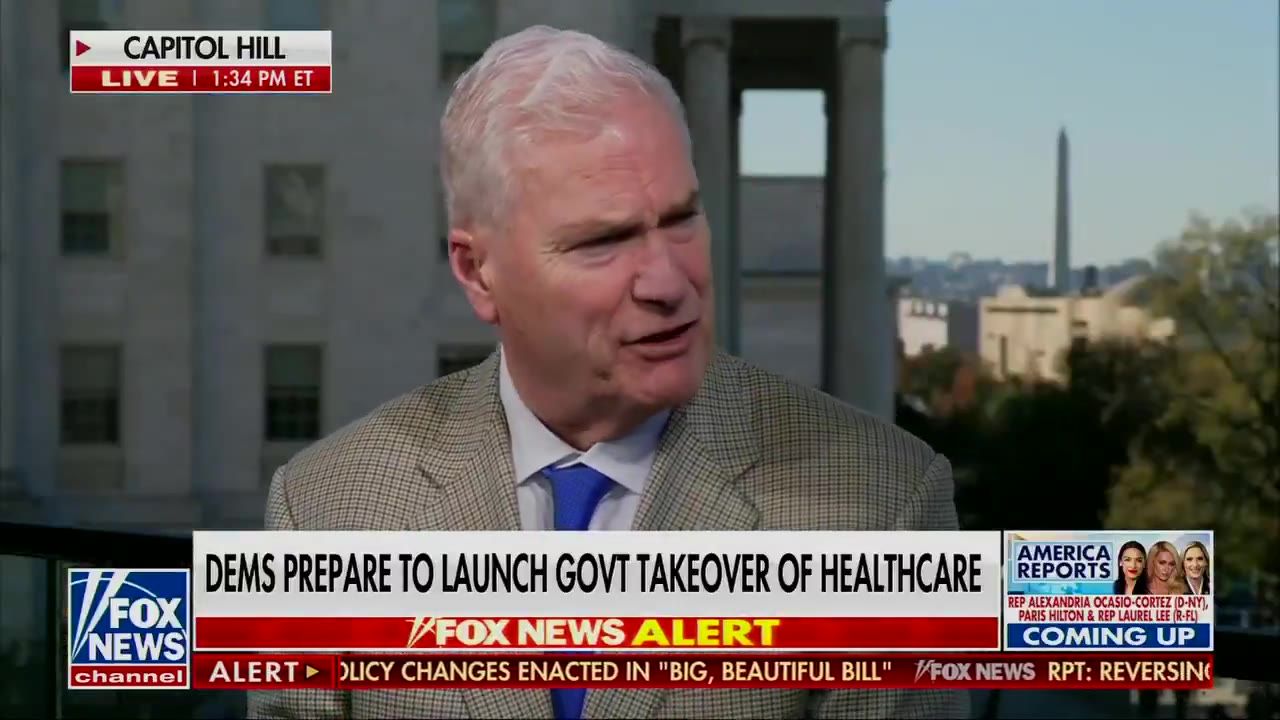
XRo Khanna, a Democratic member of the House, posted a short Fox News clip on X showing House Majority Whip Tom Emmer attacking Medicare for All on cost grounds. The caption above the clip asserts that the policy would cut national health spending from $5.3 trillion to $4 trillion a year and calls it one of the best anti-inflationary, pro-growth and pro-business policies available. The clip itself is genuine broadcast footage; the checkable claim sits in the caption.
“Medicare for All would lower costs from $5.3 trillion to $4 trillion and is one of the best anti-inflationary, pro growth, and pro business policies the nation could adopt.”
Posted on X at a moment when Democrats are promoting Medicare for All ahead of Congress changing hands in January 2027 and House Republicans are campaigning against it on cost. A crowd-sourced X Community Note is pending on the post. The same Emmer exchange was posted by Fox News' own account and by journalist Aaron Rupar around 16 November 2026.
Who posted it
XAccount check
Estimates from public signals — account age, posting pattern, audience — not a judgement of the person behind the account, and separate from whether this post is true.
What stood out
- @RoKhanna is the long-standing personal/political X account of U.S. Rep. Ro Khanna (D, CA-17), in Congress since 2017 and serving his fifth term — identity confirmed by his official house.gov, campaign site, podcast bios and press citations of his tweets.
- Official office uses the separate handle @RepRoKhanna; both are consistently cited by media (Telegraph India, OrissaPOST, Axios/Elk Grove News, 2026), indicating a genuine established account rather than a spoof.
- Account is a primary source for his own statements and endorsements (e.g. Oct 2026 posts backing Abdul El-Sayed, Mai Vang, Angie Nixon), and press quotes tweets matching this handle.
- Fact-check record is typical of a partisan elected official, not a disinformation operation: PolitiFact has only ~6 checks total, including 'Half True' (Feb 2025 Medicare telehealth cut claim) and 'Misleading' (Check Your Fact, 2023 national-debt claim); a Community Note is pending on a 2026 Medicare-for-All savings claim sourced to a non-peer-reviewed Yale preprint.
- No evidence of coordinated inauthentic behaviour, bot amplification or fake-account reports; treat as an authentic account whose claims should still be verified as political advocacy.
- Profile metadata is sparse (no bio, followers, creation date, and isplatformverified=false) — a scraping gap rather than evidence of inauthenticity, since the handle is well documented as verified in practice.
- Posting patterns are consistent with a sitting member of Congress (mix of floor work, endorsements, media appearances, some staff-managed posts).
Signals (9)+
- Account type
- Verified public figure / sitting U.S. Representative
- Identity confirmation
- House.gov directory, rokhanna.com, podcast bios, press citations
- Official handle distinction
- @RepRoKhanna (official) vs @RoKhanna (personal, same person)
- Known affiliations
- Democratic Party, CA-17, progressive caucus; 2020 Sanders campaign co-chair
- Fact check history
- PolitiFact: Half True (2025 Medicare telehealth), Misleading (2023 debt attribution); Community Note pending on 2026 Medicare-for-All savings claim
- Notable news coverage
- Frequent mainstream coverage in 2026 (Epstein files push with Massie, West Bank trip controversy, 2026 endorsements)
- Posting cadence
- Unknown (no recent posts supplied)
- Follower ratio
- Unknown (null metadata)
- Bot amplification evidence
- None found
Account checked November 20, 2026, 02:58 UTC
The media
Video✓ What is genuine
The whole clip. It is real Fox News broadcast footage of a real Tom Emmer interview, reposted without manipulation.
The tells
- ●●● Strong signal The outdoor 'Capitol Hill / LIVE 1:34 PM ET' box, the 'America Reports' coming-up panel and the lower-third adding Emmer's name stay consistent while the ticker text advances coherently frame to frame.our visual review
- ●●● Strong signal Faces, skin texture, lighting and the background (Washington Monument, buildings) show no generative or compositing artefacts.our visual review
- ●●○ Supporting signal The audio matches Emmer's known voice and manner.our visual review
- ●●● Strong signal Fox News' own account and Aaron Rupar posted the same exchange around 16 November 2026, confirming the segment aired.Fox News and Aaron Rupar, per sources 4 and 5
Synthetic-media detector
Detector not consultedThe media is incidental to the claim; the detector was not needed.
How we checked the media
- Reviewed the video's keyframes frame by frame for visual consistency.
- Examined the on-screen broadcast elements — location box, programme panel, lower-third and ticker — for continuity.
- Compared the audio against Emmer's known voice and manner.
- Cross-checked the segment against Fox News' own post of the exchange and journalist Aaron Rupar's clip, both from around 16 November 2026.
- We did not run a synthetic-media detector; this assessment rests on visual review and the source checks above.
Sources
8 sources reviewed- 1Projected economic gains and lives saved under universal healthcare in the United States (preprint) ↗
medRxiv · medrxiv.orgLow reliabilityprimary but NOT peer-reviewed — VERIFYEvidence
The $5,278.6 billion to $4,237.4 billion projection and the fact the paper is a non-peer-reviewed preprint.
- 2A $47 Trillion Price Tag and Seven-Month Waits: The True Cost of 'Medicare for All' ↗
PJ Media · pjmedia.comUntiereduntiered — treated as signal only, never decisiveEvidence
Confirms Khanna's figure rests on the Yale and University of Maryland preprint and links it to the $47.4 trillion counter-estimate.
- 3We've Heard This Before: Ro Khanna Claims Medicare for All Will Save Us Trillions ↗
Townhall · townhall.comUntiereduntiered — treated as signal only, never decisiveEvidence
Reports the pending Community Note and the CBO's federal cost range.
- 4Fox News post of the Tom Emmer healthcare segment ↗
Fox News (X) · x.comUntiereduntiered — treated as signal only, never decisiveEvidence
Confirms the Fox News segment with Emmer aired and was posted by Fox News itself.
- 5Aaron Rupar clip of Emmer: 'How do you pay for Medicare for All? You can't.' ↗
X · x.comUntiereduntiered — treated as signal only, never decisiveEvidence
An independent journalist's clip of the same exchange, corroborating the broadcast.
- 6The DSA welcomes you to the $47 trillion waiting room ↗
The Hill · thehill.comReputable outletCenterEvidence
Documents the CEA report's $47.4 trillion single-payer figure.
- 7Dr. Oz warns Medicare for All would cost $47 trillion, force care rationing ↗
Florida's Voice · flvoicenews.comUntiereduntiered — treated as signal only, never decisiveEvidence
Shows Oz repeating $47 trillion and notes independent estimates of $20–40 trillion.
- 8Fact-check — X Community Notes (crowd-sourced, not an IFCN signatory) ↗
X Community Notes (crowd-sourced, not an IFCN signatory) · x.comUntiereduntiered — treated as signal only, never decisiveContext
The pending Community Note's summary of the CBO spending range.
Further reading
- 1medRxiv The primary source behind the $5.3 trillion to $4 trillion figure — read the abstract and the preprint labelling for yourself.
- 6The Hill Explains where the $47.4 trillion Republican estimate comes from and what it covers.
- 7Florida's Voice Shows the $47 trillion figure being used publicly and notes the wider $20–40 trillion range.
The full story
The fight over Medicare for All is unusual because neither side in this exchange invented its headline figure. Both are quoting published modelling, and the argument is over which model to trust and how to describe it.
On the pro side, the kernel of truth is a 2026 preprint by researchers at Yale and the University of Maryland, Baltimore. It models a US single-payer system and estimates national health expenditure would fall from $5,278.6 billion in 2024 to $4,237.4 billion — a drop of about 19.7 percent — while averting roughly 62,900 deaths a year. Those are arresting numbers, and they are why the claim feels solid. What the caption leaves out is that the paper sits on medRxiv, has not been peer reviewed, and its figure is $4.24 trillion, not $4 trillion. It is also the optimistic end of a wide range: the Congressional Budget Office's single-payer scenarios put the annual change in total national health spending anywhere from roughly minus $700 billion to plus $300 billion, with federal costs rising $1.5–3 trillion a year.
On the other side, Emmer's $47 trillion is equally real. The Council of Economic Advisers and the American Action Forum both produced figures near $47.4 trillion in added federal cost over a decade, and CMS Administrator Mehmet Oz has repeated the number. Independent estimates span roughly $20–40 trillion, so $47 trillion is the top of the range rather than a consensus.
The context explains the heat. Democrats are promoting the plan as Congress prepares to change hands in January 2027, and House Republicans are campaigning against it on cost. Each side is amplifying the number that suits it.
Kernel of truth
A real 2026 Yale and University of Maryland preprint does project national health spending falling from about $5.28 trillion to about $4.24 trillion under single payer — but it is not peer reviewed, and independent scorers find a much wider range of outcomes.
Timeline
November 16, 2026
The Fox News interview with House Majority Whip Tom Emmer airs; Fox News' own account and journalist Aaron Rupar clip the exchange the same day. 4Fox News (X)
November 17, 2026
Ro Khanna reposts the clip with a caption claiming Medicare for All would cut costs from $5.3 trillion to $4 trillion.
January 2027
Congress is due to change hands, with Medicare for All a live campaign issue on both sides.
How it was framed
The video is genuine, but the caption attaches a contested, non-peer-reviewed saving estimate to it as settled fact, and the clip itself shows an opponent attacking the policy rather than making the case for its savings. The numbers are real; the framing implies more certainty than the underlying evidence supports.
- “Visual proof”. A real Fox News broadcast clip lends the post the authority of a television news segment, even though the clip shows an opponent of the policy, not evidence for the savings.
- Unsourced statistic. 'lower costs from $5.3 trillion to $4 trillion' — precise figures given with no study named, no link, and no mention that the source is a preprint.
- Borrowed authority. The broadcast chyrons and Fox News branding sit behind the caption, borrowing television news credibility for the poster's own numbers.
Posted on X by Ro Khanna, a Democratic member of the House who supports Medicare for All. The clip was originally broadcast by Fox News and was also posted by Fox News' own account and by journalist Aaron Rupar around 16 November 2026. A crowd-sourced Community Note is pending on the post.
Bias
Leans pro-Medicare for All in the caption; anti-single-payer in the embedded Fox News framing. The post's own caption asserts a contested single-study savings figure as fact and pairs it with favourable adjectives, a progressive pro-single-payer framing. The embedded Fox News segment carries the opposite slant, introduced under the chyron 'Dems prepare to launch govt takeover of healthcare', loaded language that reframes a coverage expansion as a seizure of the health system. The result is duelling partisan spin rather than a neutral presentation.
Bias describes how the post frames its message — the slant of the language, selection and emphasis — and is judged separately from whether the claim is true. A true claim can still be framed with a strong slant.
How we checked
1 min 5 s- 1
Searched for the origin of the $5.3 trillion and $4 trillion figures and traced them to the Yale and University of Maryland medRxiv preprint.
- 2
Searched for the $47 trillion figure cited in the clip and traced it to the Council of Economic Advisers and American Action Forum estimates.
- 3
Searched for previous fact-checks of Khanna's claim, which surfaced the pending Community Note and the CBO comparison.
- 4
Searched for the Emmer Fox News segment to confirm when and where it aired.
- 5
Reviewed the video frame by frame for visual consistency, then cross-checked it against Fox News' own post and Aaron Rupar's clip of the same exchange.
✓ Claim checked✓ Media checked✓ Sources checked
Why 70% confidence
ModerateWe are at MODERATE confidence, not HIGH, because the central claim rests on a preprint that has not been peer reviewed and on independent estimates that diverge widely. The underlying figures are well documented in both directions, which rules out LOW, but the size of the saving is genuinely contested rather than settled.
Limits. We did not open the full CBO modelling assumptions, nor the full preprint methodology. We did not run a synthetic-media detector; the authenticity call rests on visual review and independent posts of the same segment.
What we don’t know
- How much the preprint's estimate would change under peer review, or whether reviewers would accept its assumptions.
- Which specific CBO scenario the −$700 billion to +$300 billion range belongs to and how it compares plan by plan.
- Whether the pending Community Note will be rated helpful and shown on the post.
- Whether the final legislative design of Medicare for All would resemble the model the preprint assumes — the cost depends heavily on what is actually written into a bill.
Spot it yourself
Find the overstatementLooks suspicious, isn’t proof
- The post comes from a politician who supports the policy. That is a reason to check the numbers, not evidence they are wrong.
- The clip is a news segment from an outlet with a known editorial lean. Reposting it proves nothing either way about the caption's figures.
- The caption is confident and precise — '$5.3 trillion to $4 trillion'. Precision is not proof; a precise number can still be the optimistic end of a range.
- A Community Note is pending. Community Notes are crowd-sourced, not a verdict, and a pending note is neither proof nor refutation.
The actual evidence
- The primary source: the Yale and University of Maryland medRxiv preprint gives $5,278.6 billion falling to $4,237.4 billion — real, but not peer reviewed.
- The CBO's modelling puts the annual change anywhere from about −$700 billion to +$300 billion, which is a far wider range than the caption implies.
- The preprint's own figure is $4.24 trillion, so the caption rounded down in the direction that helps its case.
- On the other side, the CEA and American Action Forum figures do support Emmer's $47 trillion, but independent estimates span roughly $20–40 trillion.
- The video itself is authentic, confirmed by Fox News' own post and a second journalist's clip from the same day.
- 1
Ask what study the number comes from — then go and find it.
Search the exact figures in quotes plus a keyword like 'study'. A real figure usually traces to a named paper, report or agency within a minute or two.
- 2
Check whether the source is peer reviewed and who published it.
A medRxiv or SSRN listing marked 'preprint' has not been vetted by independent experts. Say so when you share it, and note that a preprint is one team's model.
- 3
Compare with the independent scorer rather than only the favoured one.
Look for the Congressional Budget Office or another non-partisan body. Here the CBO range (−$700B to +$300B a year) is much wider than the single number in the caption.
- 4
Do the same on the other side before you share a rebuttal.
Emmer's $47 trillion is a real CEA figure, but independent estimates run $20–40 trillion. Quoting only the top of a range is the same move whichever side makes it.
- 5
Check whether the video is what it claims to be.
Look for consistent broadcast elements — location box, programme name, ticker — and check whether the outlet or another journalist posted the same clip. A reverse image search or a look at the account's other posts can help.
Takeaway
A real number from a real study can still mislead if it is the most favourable end of a contested range and the study has not been vetted. Before you share, find the source, check whether it is peer reviewed, and ask what the independent scorer says.
Questions people ask
Does Medicare for All really save $1.3 trillion a year?+
The saving comes from a 2026 Yale and University of Maryland medRxiv preprint, which projects national health spending falling from $5,278.6 billion to $4,237.4 billion — about $1.04 trillion, not $1.3 trillion. The paper has not been peer reviewed, and CBO modelling finds the annual change could range from about −$700 billion to +$300 billion. The saving is plausible but not settled.
Is Tom Emmer's $47 trillion figure real?+
Yes. The White House Council of Economic Advisers' report 'The Real Cost of Socialism in America' and the American Action Forum both put added federal cost near $47.4 trillion over a decade, and CMS Administrator Mehmet Oz has repeated the number. But it is a high-end estimate: the Committee for a Responsible Federal Budget puts the range at roughly $20–40 trillion depending on design.
Is the Fox News video in the post real?+
Yes. Our visual review found a continuous, internally consistent Fox News broadcast, with matching location box, programme panel and ticker, and audio consistent with Emmer's voice. Fox News' own account and journalist Aaron Rupar posted the same exchange around 16 November 2026, confirming the segment aired.
What is a preprint, and why does it matter?+
A preprint is a research paper posted publicly before independent experts have reviewed it. It can be valuable and often becomes peer-reviewed work later, but it has not been vetted, so its methods and conclusions should be described as one team's findings rather than established fact. The $5.3 trillion to $4 trillion saving comes from a preprint.
Why does each side quote such different numbers?+
They are answering different questions with different models. One asks how much total national health spending would change; the other asks how much extra the federal government would spend. A plan can lower total spending while raising federal costs, because the government takes over payments now made by employers and households. Each side quotes the figure that supports its argument.
Go deeper
- Preprint
- A research paper posted publicly before independent experts have reviewed and approved it.
- Peer review
- The process where independent experts in the field check a study's methods and conclusions before publication.
- Single payer
- A health system where one entity, usually the government, pays for everyone's care, replacing private insurers.
- Congressional Budget Office (CBO)
- The non-partisan federal agency that estimates the cost and economic effects of legislation.
- Community Note
- A crowd-sourced context note added by X users to a post, which is rated for helpfulness before being shown.
People also search for
For educators+
- The post and the clip both cite real published numbers. What makes one framing more misleading than the other, if anything?
- If a preprint and a peer-reviewed study disagree, how much weight should a reader give each — and how should a politician describe a preprint when making a case?
- Total national health spending can fall while federal costs rise. How would you explain that distinction to someone who only saw this post?
About this check
- Platform
- X
- Posted by
- @rokhanna
- Posted
- November 18, 2026
- Age when checked
- 1–2 days old when checked
- Where it spread
- United States
- Audience
- US audience
- Language
- EN
- Status
- ● Post is live
- Verified
- November 20, 2026, 03:00 UTC
- Published
- November 20, 2026, 03:00 UTC
Reach. 2,321 likes, 1,685 replies (X syndication, 2026-11-20); Twitchy pickup with many quote posts incl. Marc Goldwein (CRFB)
This verdict was generated with AI from the sources shown. AI can make mistakes — check the sources before relying on it.
Check anything yourself, in seconds.
Share any social post or video to What the Fact and get the verdict, the confidence, and the receipts.