Did Andy Burnham say the EU deal will add up to 0.5% of GDP to the UK economy?
Will Burnham's UK-EU deal add 0.5% to GDP (about £17bn a year)?
True, but…
He said it, and the number is official — but it is 'up to' 0.5% by 2040.
Yes. At the EU-UK summit press conference in Brussels on 20 November 2026, Prime Minister Andy Burnham said the UK Treasury estimated the deal would add up to 0.5% to UK GDP, about £17 billion. That matches the government's own announcement. The catch: it is 'up to' 0.5% by 2040, not an immediate annual gain.
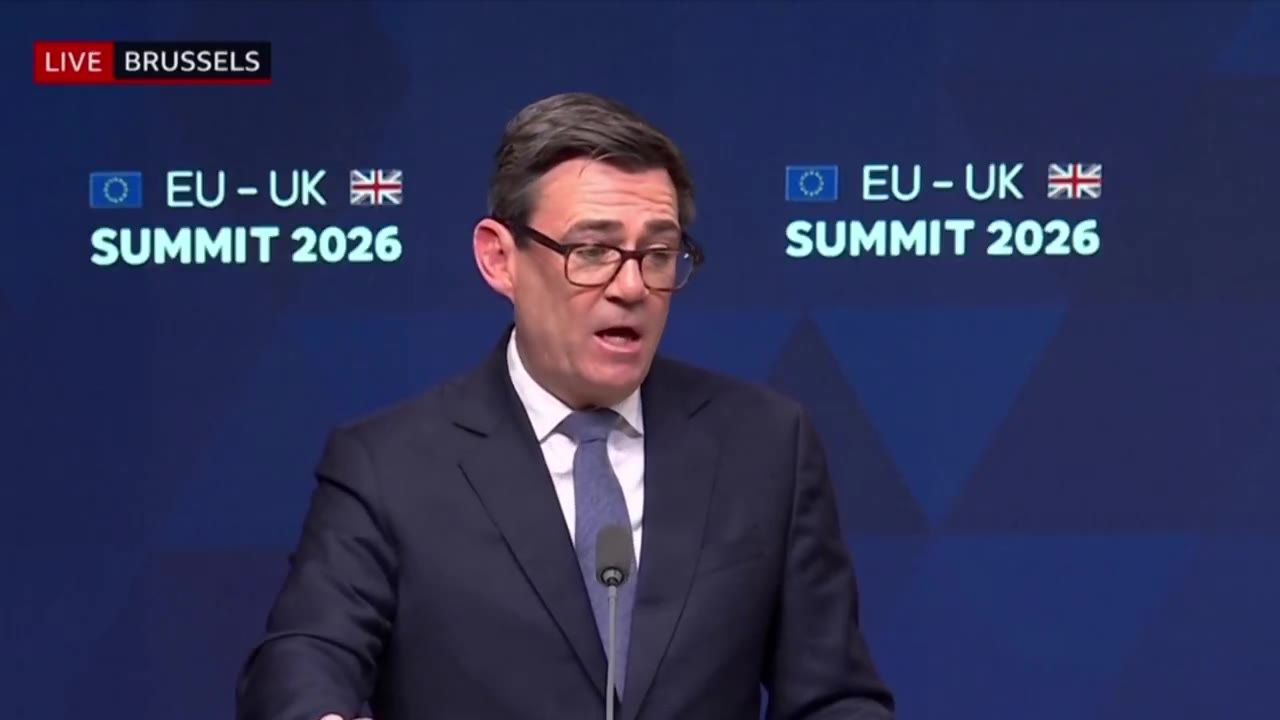 Genuine
Claims
✓ 2 trueThe UK Treasury has said the deal struck at the summit will add up to 0.5% to UK GDP, a £17 billion boost to the British economy3456
“The Chancellor of the Exchequer is here today and he has confirmed today that the UK Treasury has said that the deal struck here will add up to 0.5 percent to UK GDP. That is a £17 billion boost to the British economy.”
This is the claim the headline rests on, and it holds. Two independent directions of evidence meet. First, the government's own announcement states the package 'could add up to 0.5% to UK GDP by 2040 – equivalent to around £17 billion a year'. That is the same figure Burnham attributes to the Treasury, so the number and its source are not invented. Second, Bloomberg published a clip of the same news conference in which Burnham says, word for word, that the UK Treasury has said the deal will add up to 0.5% to UK GDP and that this is a £17 billion boost. AP's report from Brussels and PA-sourced coverage carried by the Herald put the same figure in the same frame. The sources are not fully independent — the government announcement and Burnham's words share one origin, the Treasury estimate — but the footage independently proves he said it, and the official document independently proves the estimate exists. What a reader should weigh is not whether the number is real, but what it measures; that is the subject of the next claim.
The 0.5% / £17 billion gain would arrive within this parliament as a straightforward annual boost367
The number is real; the framing around it is where care is needed. The government's own wording is hedged twice over: the package 'could add up to 0.5%' to GDP 'by 2040'. That is a best-case ceiling reached fourteen years out, and it is a one-off step up in the level of GDP rather than a recurring annual growth rate. The underlying deals mostly phase in from 2028, with youth-scheme arrivals targeted for 2030, so the benefit builds slowly rather than landing at once. Analysis published by AInvest makes exactly this point: 'up to' means best case, 'by 2040' means the gain arrives after more than a decade, and 0.5% is a level shift. The Lords EU committee also noted that the estimates exclude costs and that no full impact assessment had been published. So a viewer who hears '£17 billion boost' and pictures money arriving this year has been given a misleading impression by omission — not by any false number. The clip itself supplies no date and no 'up to', which is why this claim sits at partly true rather than true.
Still open: The input does not give the full impact assessment or the cost side of the estimates, so we cannot say how the net figure compares with the gross 0.5%.
It is the single biggest growth measure we could take in this parliament7
“It is the single biggest growth measure that we could take in this parliament and I am proud that we have been able to reach this agreement.”
This is a political judgement, not a statistic, and it cannot be checked the way a number can. Burnham is ranking his own policy against alternatives that were never pursued, which is an argument about priorities rather than a measurable fact. Commentators have noted that the 0.5% is small next to the OBR's assumed 4% long-run hit from the trade agreement, which is a relevant scale comparison — but it does not settle the ranking claim either, because the comparison is between a one-off deal estimate and a long-run scenario. We mark it opinion rather than false or true: a reader can agree or disagree with the ranking while accepting that the underlying figure exists. What matters for the fact-check is that the opinion is clearly signalled as a characterisation ('I am proud', 'we could take'), not dressed up as a Treasury number. Treat it as rhetoric, weigh it as rhetoric.
The National Farmers' Union says agriculture exports from Britain to the EU have fallen by over 30% in the last decade78
“The National Farmers Union says that agriculture exports from Britain to the European Union have fallen by over 30 percent in the last decade.”
This checks out, with one small looseness of wording. The NFU's own published statement says UK agri-food exports to the EU have declined by 32.5% since 2019, based on HMRC data. The government's explainer repeats the same 32.5% figure. So the substance — a fall of more than 30%, attributed to the NFU — is accurate and traceable to the body he names. The only imprecision is calling a comparison running from 2019 'the last decade'; that stretches the period slightly, though not enough to change the point. Because the NFU is the named source and its own publication carries the number, this is close to a primary-source confirmation rather than a second-hand attribution. Readers should note what the number does and does not cover: it is agri-food exports specifically, not all UK exports, and it is a decline measured from a 2019 baseline rather than a claim about the cause. Burnham uses it to argue the deal can help reverse the trend, which is a policy argument sitting on top of a real statistic.
What was posted
XA short video clip posted on X by the account Politics UK, captioned as something to watch, showing Prime Minister Andy Burnham speaking at a press conference. In it he attributes the 0.5% of GDP and £17 billion figures to the UK Treasury and calls the deal the single biggest growth measure available in this parliament. The post asks viewers to take the clip as proof of what he said and what the deal is worth.
“🚨 WATCH: Andy Burnham says the EU deal will add up to 0.5% of GDP to the UK economy”
Posted by Politics UK, an aggregator-style account that shares political broadcast clips. The clip is a cut of the summit news conference; it carries no on-screen date for the 2040 horizon or the word 'up to' framing in its caption.
Who posted it
XAccount check
Estimates from public signals — account age, posting pattern, audience — not a judgement of the person behind the account, and separate from whether this post is true.
What stood out
- @PolitlcsUK is the real, long-standing Politics UK account (handle uses a lower-case 'l' in place of the 'i' purely because 'PoliticsUK' was taken) — not a lookalike/impersonation clone.
- Account created September 2021; bought by Bailey Nash-Gardner in June 2022 (aged 17); grew from ~30k followers in Feb 2023 to ~500k by Aug 2026, with 20k+ posts.
- Operated by a small human team (3–4 volunteer admins shifting ideas on WhatsApp); Politico EU profile, LinkedIn page, own website and hiring page all corroborate it is an organisation, not an automated persona.
- Widely treated as a legitimate news source: mainstream outlets such as La Nación cite its posts directly, and Cabinet ministers give it interviews, though critics call it 'parasitic' for repackaging other outlets' reporting with little attribution.
- Documented accuracy failures: an August 2026 false 'Larry the Cat has died' post (retracted within hours, blamed on a hacked single source) and a November 2024 Community Note flagging its Ukraine 'troop deployment' framing as missing crucial context.
- Its own corrections page concedes errors arise from writing tweets 'as fast as possible'; one 2025 case saw it delete a correct tweet after a government denial.
- Governance/transparency concern: founder-owner Bailey Nash-Gardner is a former Conservative activist and, since May 2026, a Reform UK councillor, while the account markets itself as 'impartial coverage' — fuelling bias allegations (e.g. labelling candidates 'the Muslim independents').
- Growth and posting cadence look organic (~4.5 posts/week tracked, ~22k avg engagement per post), with no evidence of coordinated inauthentic amplification.
Signals (11)+
- Account created
- 2021-09
- Handle note
- PolitlcsUK = stylised spelling of Politics UK; not an impersonation of a different account
- Follower count estimate
- 514000
- Posting cadence
- ~4.5 posts/week tracked; bursty rapid-fire breaking-news posting
- Ownership
- Politics News Group Ltd / Bailey Nash-Gardner (founder-director, no editorial role claimed)
- Owner political affiliation
- Former Conservative activist and aide to MP Andrew Rosindell; elected Reform UK councillor May 2026
- Notable news coverage
- Politico EU profile (Aug 2025); The National and The Canary coverage of owner's Reform affiliation (May 2026)
- Fact check history
- Aug 2026 false Larry the Cat death report (retracted same night); Nov 2024 Community Note on Ukraine deployment framing; 2025 deleted-tweet episode
- Corrections policy
- Public corrections page exists (about.politicsuk.com/corrections)
- Follower ratio
- ~514k followers / ~747 following — healthy ratio
- Content type
- News aggregation (copying/repackaging other outlets' reporting, often with thin attribution)
Account checked November 21, 2026, 14:49 UTC
The media
Video✓ What is genuine
The footage is the genuine broadcast record of the summit news conference. The setting, date, speakers and words are real; what is missing is the qualifier about 2040, which was in the speech but not in the post's caption framing.
The tells
- ●●● Strong signal Our detector returned an AI-generated score of about 0.0001 and a deepfake score of about 0.015, with 'not AI generated' at 0.99999.our detector
- ●●● Strong signal The backdrop reads 'LIVE BRUSSELS — EU-UK SUMMIT 2026' and the caption strap is dated Brussels, 20 November 2026, matching the confirmed summit.our visual review
- ●●○ Supporting signal The podium line-up — Burnham alongside von der Leyen and Costa — and the stable lighting and microphones are consistent with normal pool coverage of a leaders' press conference.our visual review
- ●●● Strong signal The words in the clip match Bloomberg's recording of the same news conference word for word.Bloomberg
Synthetic-media detector
Detector ranThe claim stands or falls on whether the media is real, so the detector ran.
Scores are the detector’s estimate for the file as uploaded. A low score does not rule out editing, a spliced caption, or footage shown out of context — those are judged above. Model v3.
How we checked the media
- Reviewed keyframes from the clip for setting, on-screen graphics and consistency.
- Compared the spoken words with Bloomberg's clip of the same news conference.
- Checked the backdrop, podium line-up and caption strap against the confirmed summit date and venue.
- Ran the clip through our AI-generation and deepfake detector.
Sources
8 sources reviewed- 1EU-United Kingdom summit, 20 November 2026 ↗
European Council · consilium.europa.euPrimary / fact-checkerprimary/official source (by domain)Context
Confirms the EU-UK summit took place on 20 November 2026 and what it covered.
- 2EU-UK summit - Brussels 20 November ↗
EEAS · eeas.europa.euPrimary / fact-checkerprimary/official source (by domain)Context
Confirms the date, venue and participants of the summit in advance.
- 3'Costs cut': Prime Minister secures deal with EU ... worth up to £17 billion per year ↗
GOV.UK · gov.ukUntiereduntiered — treated as signal only, never decisiveEvidence
The government's own announcement containing the 0.5% by 2040 and around £17 billion a year figures.
- 4Burnham Says UK-EU Deal Adds £17 Billion Economic Boost ↗
Bloomberg · bloomberg.comReputable outletfinancial wire — Center/Lean LeftEvidence
Bloomberg's clip quoting Burnham making the Treasury attribution and the £17 billion figure word for word.
- 5UK and EU agree deals on trade and youth movement, pledging to rebuild ties after Brexit ↗
AP News · apnews.comPrimary / fact-checkerwire + AP Fact Check (Tier A)Evidence
AP's Brussels report recording Burnham putting the figure at 0.5%, up from 0.4% previously.
- 6EU deal will bring £17bn economic boost a year, says Burnham ↗
The Herald (PA) · heraldscotland.comUntiereduntiered — treated as signal only, never decisiveEvidence
PA-sourced reporting confirming Burnham framed the figure as Treasury analysis suggesting up to 0.5% of GDP by 2040.
- 7Britain's £17 Billion EU Reset Is a 2040 Number ↗
AInvest · ainvest.comUntiereduntiered — treated as signal only, never decisiveEvidence
Explains the qualifiers — best case, 2040 horizon, one-off level shift — and provides scale context.
- 8NFU says investment in agri-food attachés is vital to rebuilding markets ↗
NFUonline · nfuonline.comUntiereduntiered — treated as signal only, never decisiveEvidence
The NFU's own statement that UK agri-food exports to the EU have declined by 32.5% since 2019.
Further reading
- 3GOV.UK The primary document behind the number — read the exact wording of the 2040 horizon and the £17 billion equivalent.
- 4Bloomberg Bloomberg's recording of the same news conference lets you compare the clip's words with an independent version.
- 7AInvest A clear breakdown of what 'up to', 'by 2040' and a one-off level shift mean in practice.
- 8NFUonline The NFU's own statement behind the 32.5% export figure Burnham cites.
The full story
The kernel of truth here is solid: the UK and EU did hold their second post-Brexit summit in Brussels on 20 November 2026, and the Prime Minister did stand in front of the cameras and put a number on the deal. The European Council's own summit page and the EEAS preview confirm the date and the participants, and AP reported from Brussels the same day.
The deal itself covered agri-food checks, linking emissions trading schemes, and a Youth Experience Scheme for 100,000 young people each way, with most of it phasing in from 2028. The government's announcement put the prize at 'up to 0.5% to UK GDP by 2040 – equivalent to around £17 billion a year'. That is where the clip's number comes from. It is a real Treasury estimate, not a figure invented for social media.
The distortion is quieter than a fake. The caption says the deal 'will add up to 0.5% of GDP', which sounds like a near-term annual gain. The speech itself said 'up to' and the official document said 'by 2040'. Two hedges, both easy to drop when a clip is cut for social media. Add that the gain is a one-off step up in the level of GDP rather than a recurring growth rate, and that the deals build slowly, and the honest headline is more modest than the one the post implies.
Kernel of truth
The Prime Minister did say the Treasury estimated the deal would add up to 0.5% to UK GDP, around £17 billion, at the Brussels summit on 20 November 2026.
Timeline
November 20, 2026
The second EU-UK summit is held in Brussels, with Costa and von der Leyen welcoming Prime Minister Andy Burnham. 1European Council
November 20, 2026
At the summit press conference Burnham says the Treasury estimates the deal will add up to 0.5% to UK GDP, a £17 billion boost, and calls it the biggest growth measure available this parliament. 4Bloomberg
November 20, 2026
The government publishes its announcement putting the package at up to 0.5% of GDP by 2040, around £17 billion a year. 3GOV.UK
2028
Most of the agreed deals are due to begin phasing in. 7AInvest
2030
Youth Experience Scheme arrivals are targeted to begin. 7AInvest
2040
The horizon by which the up-to-0.5% GDP estimate is projected to be reached. 3GOV.UK
How it was framed
The footage and the quote are genuine, but the post's caption frames a best-case figure reached by 2040 as a straightforward gain from the deal, dropping the 'up to' and the date. That is real information used to frame the policy in a more favourable light than the full statement supports, rather than anything fabricated or altered.
- Missing context. The caption says the deal 'will add up to 0.5% of GDP' without the 2040 horizon or the fact that it is a one-off level shift, both of which were in the speech and the official announcement.
- “Visual proof”. The post leads with '🚨 WATCH' and a broadcast clip, inviting viewers to treat the footage itself as the proof of the claim.
- Borrowed authority. The quote leans on 'the UK Treasury has said', wrapping the estimate in official authority.
- Emotional language. The 🚨 emoji and 'WATCH' framing signal urgency and significance before any caveat appears.
Posted on X by Politics UK, an account that shares political broadcast clips. The post carries no visible date for the summit or for the 2040 horizon in its caption.
Bias
Leans pro-government / pro-EU-closer-ties. The clip is an unedited slice of the Prime Minister's own post-summit press conference, so it presents his pro-deal framing and cost-of-living benefits without any counterpoint from critics such as Reform UK or the Conservatives who called it a betrayal of Brexit. The account simply amplifies the government message.
Bias describes how the post frames its message — the slant of the language, selection and emphasis — and is judged separately from whether the claim is true. A true claim can still be framed with a strong slant.
How we checked
58 s- 1
Searched for the summit and its date, and checked the European Council and EEAS pages confirming the Brussels meeting on 20 November 2026.
- 2
Searched for the specific 0.5% and £17 billion figures and compared them with the government's own announcement.
- 3
Searched for the NFU export figure named in the clip and compared it with the NFU's own publication.
- 4
Searched for commentary on the 2040 horizon and the meaning of the estimate.
- 5
Reviewed keyframes from the video and compared the spoken words with Bloomberg's clip of the same news conference.
- 6
Ran the clip through our AI-generation and deepfake detector.
✓ Claim checked✓ Media checked✓ Sources checked
Why 90% confidence
HighWe are highly confident because a primary government document and independent wire footage agree on both the words and the numbers. The moderate band on the timing claim reflects that the qualifiers come from the same official estimate rather than a separate independent analysis, and that no full impact assessment was available to us.
Limits. We did not obtain the full impact assessment or the cost side of the Treasury estimate, so we cannot quantify the net effect. We also found no existing published fact-check of this specific clip.
What we don’t know
- What the full impact assessment says, including the costs the headline estimate leaves out.
- Whether the post's author knew about the 2040 horizon when writing the caption.
- How the £17 billion a year equivalent is calculated and over what period it is averaged.
- Whether other cuts of the same clip circulated with the qualifiers included.
Spot it yourself
Find the overstatementLooks suspicious, isn’t proof
- The 🚨 emoji and 'WATCH' urgency framing. Aggregator accounts use this style for all sorts of clips, real and misleading alike.
- The account is an aggregator rather than the broadcaster or the politician's own account. That tells you nothing about whether the clip is real.
- The clip is short and cut. Brevity is how social video works; it is a reason to go looking for the full version, not evidence of fakery.
- The quote sounds convenient for the government's case. A claim being useful to one side is not proof it is wrong.
The actual evidence
- The government's own announcement uses the same numbers but with the qualifiers 'could add up to 0.5% … by 2040'. The number is real; the framing in the post is not the whole sentence.
- Bloomberg's clip of the same news conference matches the words in this video, confirming the footage is genuine and the quote is not stitched together.
- The summit date, venue and podium line-up are confirmed by the European Council, the EEAS preview and AP's report from Brussels.
- Our detector scored the clip as not AI-generated (about 0.0001) with a deepfake score of about 0.015 — the video is genuine broadcast material.
- 1
Find the full sentence, not the clip
Search the exact phrase plus the speaker's name. Here, the official announcement and wire reports carry the whole line, including 'up to' and 'by 2040'.
- 2
Ask what date the number belongs to
A figure described as a gain by a future year is not the same as a gain now. Look for a year in the official document.
- 3
Check whether it is a level or a rate
0.5% of GDP as a one-off step up is different from 0.5% annual growth. Official documents often say which; social captions usually do not.
- 4
Compare the clip with another recording of the same event
If a wire service or broadcaster has its own video of the same speech, the words should match. If they do not, that is the real red flag.
- 5
Look for the cost side
Estimates that give only benefits are half the picture. Check whether an impact assessment exists and what it leaves out.
Takeaway
A true quote can still mislead if the qualifiers are cut. When a post turns a document into a headline, go back to the document's exact wording — especially the small words 'up to' and the year attached to the number.
Questions people ask
Did Andy Burnham really say the EU deal adds 0.5% of GDP?+
Yes. At the EU-UK summit press conference in Brussels on 20 November 2026 he said the UK Treasury had confirmed the deal would add up to 0.5% to UK GDP, a £17 billion boost. The clip is genuine broadcast footage and the words match other recordings of the same event.
Is the £17 billion figure accurate?+
It comes from the government's own announcement, which says the package could add up to 0.5% to UK GDP by 2040, equivalent to around £17 billion a year. So the number is official rather than invented — but it is a best-case estimate with a long horizon, not money arriving this year.
What is missing from the clip?+
Two qualifiers. The gain is 'up to' 0.5%, meaning a best case, and it is projected for 2040 rather than now. It is also a one-off step up in the level of GDP, not a recurring annual growth rate, and the deals mostly phase in from 2028.
Why does a genuine clip still count as misleading?+
Because the caption drops the context that changes what the number means. The footage is real and the quote is accurate, but a viewer who sees only 'will add up to 0.5% of GDP' comes away with a different impression from someone who reads the official document.
What is the general lesson about video clips of politicians?+
A real clip can still mislead through what it leaves out. When a video turns a document into a headline, find the full sentence and the year attached to the number before sharing it.
Go deeper
- GDP
- Gross domestic product — the total value of goods and services a country produces, used as a measure of the size of its economy.
- Level shift
- A one-off step up in the size of the economy, as opposed to a permanently faster rate of growth.
- Best case ('up to')
- A ceiling on an estimate — the most favourable outcome in the range, not the expected or guaranteed one.
- Agri-food exports
- Food and agricultural products sold abroad, the category the NFU figure refers to.
- Deepfake detector
- A tool that analyses media for signs it was generated or altered by AI; here it scored the clip as not AI-generated.
People also search for
For educators+
- The clip's words are accurate but its caption is not the whole story. Where should we draw the line between a fair summary and a misleading one?
- If a government publishes a best-case estimate, who is responsible for making sure the horizon and caveats travel with the number — the speaker, the platform, or the audience?
- How would you explain the difference between '0.5% of GDP by 2040' and '0.5% annual growth' to someone who has never studied economics?
About this check
- Platform
- X
- Posted by
- @politlcsuk
- Posted
- November 20, 2026
- Age when checked
- Under 24 hours old when checked
- Where it spread
- United Kingdom
- Audience
- UK & EU audience
- Language
- EN
- Status
- ● Post is live
- Verified
- November 21, 2026, 14:51 UTC
- Published
- November 21, 2026, 14:51 UTC
Reach. Clip of Burnham's claim 1.8K likes; disputed by Jenrick ('total BS', 2K likes) and Tice ('deliberately deceived', 1.9K likes) after No10 said full 0.5% not until 2040 (Chris Hope, GB News); widely reported £17bn figure
This verdict was generated with AI from the sources shown. AI can make mistakes — check the sources before relying on it.
Check anything yourself, in seconds.
Share any social post or video to What the Fact and get the verdict, the confidence, and the receipts.