Did four young people die and 82 end up in intensive care from fake vapes in Germany?
Did the Tagesschau report a state of emergency over counterfeit vapes in Germany, with four young people dead and 82 in intensive care?
False
No such deaths or ICU cases exist, and the Tagesschau breaking-news packaging is fabricated.
No. A TikTok video styled as a Tagesschau "Eilmeldung" claims four young people died and 82 are in intensive care in Germany from counterfeit vapes. NDR, which makes ARD-aktuell, told Correctiv the clip is not authentic; the Federal Ministry of Health said it has no information about such deaths or intensive-care cases. The footage is unrelated material stitched together.
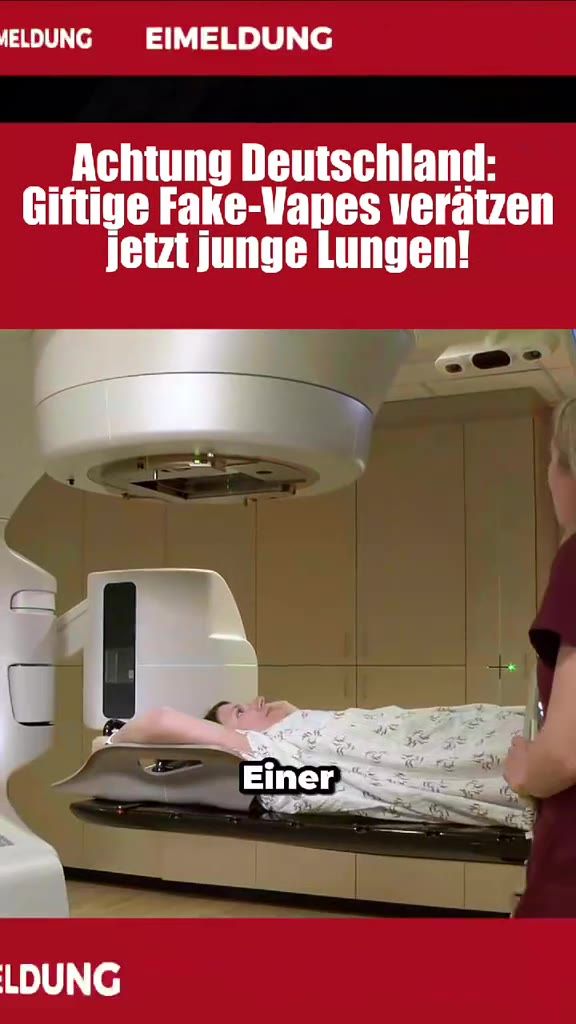 Edited
Claims
✕ 6 falseFour young people died of respiratory arrest after vaping ultra-cheap counterfeit e-cigarettes.12
“Vier junge Menschen sind nach einem plötzlichen Atemstillstand verstorben, weil sie ultra-billige E-Zigaretten gedampft hatten.”
The decisive point is not that the story is thin on detail but that the institutions that would know say it did not happen. The Federal Ministry of Health told Correctiv it has no information about increased deaths or intensive-care treatment connected with counterfeit vapes. If four young people had died in a single wave, that would be a national health story; German wires, public broadcasters and local outlets would have covered it within hours. Our own searches for such coverage returned only near-identical reposts of this clip. The nearest real German cases are much smaller and different in kind: two deaths in Bavaria in March 2026 linked to self-mixed liquids containing the synthetic opioid etodezitramid, not to counterfeit nicotine vapes bought at kiosks. Those cases are real and serious, but they do not support a nationwide wave of four deaths. A reader should weigh that the ministry statement and the absence of any independent reporting point the same way, while the only source for the death toll is the video itself.
82 people are currently fighting for their lives in intensive care units because of fake vapes.1
“Aktuell kämpfen schockierende 82 Personen auf den Intensivstationen um ihr Leben.”
There is no record of 82 intensive-care patients. The Health Ministry told Correctiv it has no information about increased intensive-care treatment connected with counterfeit vapes. A surge of that size would show up in hospital statements, regional health authorities and reporting on emergency capacity; none exists. Our searches for German coverage of such a surge returned nothing beyond reposts of this clip. The number 82 functions rhetorically as a shocking figure, but it has no traceable origin. The sources here are not fully independent: the ministry statement and Correctiv's reporting come through the same fact check, and the absence of coverage is our own observation. But when a claim of this scale leaves no footprint in any official or media record, the reasonable conclusion is that the figure was invented for the video rather than drawn from a real hospital count.
Hospitals and doctors are sounding the alarm over an 'absolute state of emergency' in emergency rooms caused by a wave of fake vapes.13
“In unseren Notaufnahmen herrscht absoluter Ausnahmezustand.”
No official warning or hospital statement describes such an emergency. Authorities have warned about illegal vapes and about synthetic drugs in vapes, including the Bavarian State Criminal Police Office in March 2026 and the North Rhine-Westphalia office in 2025, and those warnings are real. But none of them matches a nationwide emergency declaration over counterfeit nicotine vapes, and none describes emergency rooms in an "absolute state of emergency." The video borrows the language of a public health alert without any agency behind it. The sharpest way to see this is to ask who is speaking: the narration says doctors and clinics are raising the alarm, but names no hospital, association or authority. A real alert of that kind would come with a named body, a date and a statement you could check. Here the alarm exists only in the voiceover.
The video is based on a Tagesschau breaking-news report.1
This is the most cleanly settled claim in the case because the broadcaster itself answered. NDR, which produces ARD-aktuell, told Correctiv the clip is not authentic ARD-aktuell content. That is a direct denial from the organisation whose branding is being used, not an inference from the visuals. The visual details line up with it: the presenter shown, Judith Rakers, left Tagesschau in 2024, the ARD/HD logo is mirrored, and the on-screen banner reads "Eimeldung" rather than "Eilmeldung." A real breaking-news graphic would not misspell its own label or flip its logo. Our visual review confirms the composited packaging, and the NDR statement makes the conclusion independent of any single visual tell. Readers should note the order of weight here: the broadcaster's denial settles it, and the misspelling and mirrored logo are corroboration rather than the proof on their own.
A 20-year-old apprentice from Frankfurt bought such a vape and hours later lay in intensive care with acute lung failure.1
“Ein 20-jähriger Azubi aus Frankfurt kaufte eine solche Dose. Nur Stunden später lag er mit akutem Lungenversagen auf der Intensivstation.”
No hospital, police force or media outlet reports any such case in Frankfurt, and Correctiv found none. The anecdote has the shape of a real human-interest story, with an age, a city and a job, but none of those details can be traced to a source. That is a common feature of fabricated health scares: specific-sounding personal details create the impression of reporting while making the story harder to check at a glance. The decisive evidence is again the absence of any record where one would exist. A 20-year-old in acute lung failure in Frankfurt would be treated in a named hospital and would almost certainly surface in local reporting or a police or fire-service statement. None exists. The story sits only inside the video, which is the same source making the wider claim.
A heated Bundestag dispute between Chancellor Merz and Alice Weidel has broken out over demands for stricter customs controls on vapes.5
“Im Bundestag ein heftiger Streit zwischen Kanzler Merz und Alice Weidel entbrennt, weil schärfere Zollkontrollen gefordert werden.”
This is the claim with the clearest kernel of truth, which is why it is rated MODERATE rather than HIGH. Merz and Weidel did clash sharply in the Bundestag, and that is documented. But the clash came in the September 2026 budget debate, over migration, energy, Russia policy and debt, not over customs controls on vapes. No vape-related parliamentary row is documented. The video takes a real political confrontation and swaps in a topic that fits its health-scare narrative. The evidence rests on a single dpa-sourced report, which is why the confidence is lower than for the other claims: we are relying on one account of what the debate covered. Still, the mismatch is clear enough to call the specific claim false. A reader should treat this as a reminder that fabricated posts often anchor themselves in genuine events to borrow credibility.
Still open: We did not open the full debate record; the finding on the debate's topics rests on the dpa-sourced report.
Fake vapes are sold for around six euros at kiosks and on the street, and cheap batteries heat carcinogenic substances such as arsenic and lead that 'corrode' the lungs.14
“Diese Fake-Vapes werden für gerade einmal 6 Euro an jedem Kiosk oder auf der Straße verkauft ... Arsen, Blei und giftige Lösungsmittel, die die Lunge buchstäblich verätzen.”
The pieces of this claim that are documented are real. Cheap illegal vapes are sold at kiosks, late-night shops and online in Germany, and the North Rhine-Westphalia criminal police and customs have warned about illegal liquids and counterfeit e-cigarettes, with illegal products found in about 20 percent of inspected kiosks. Heavy metals including lead and arsenic have been detected in e-cigarette aerosol in some studies. What the video does is stretch those facts. The framing that such products literally "corrode" the lungs, and that this is a newly exploding nationwide wave of poisoning, is not supported by the sources: the documented warnings concern illegal products and manipulated liquids, not mass heavy-metal poisoning. This is rated MISLEADING with MODERATE confidence because the underlying facts are partly true and partly extrapolated, and the line between documented risk and invented crisis is exactly where the post misleads.
Still open: The input does not cite the specific studies on heavy metals in e-cigarette aerosol, so we cannot confirm which products or studies the video is drawing on.
What was posted
TikTokA German-language TikTok video posted by @broquizy, built to look like a public-broadcaster breaking-news segment. It shows a presenter at a Tagesschau-style desk, a red "EIMELDUNG" banner and hospital and vape-shop footage. A narrator claims four young people died of respiratory arrest after vaping ultra-cheap counterfeit e-cigarettes and that 82 people are fighting for their lives in intensive care, and urges viewers to comment on whether they still buy at kiosks.
“#nachrichten #eilmeldung #aktuell #deutschland #politik”
“#news #breakingnews #current #germany #politics” — translated
Posted on TikTok by the account @broquizy using hashtags that mimic news labelling. Correctiv documented the same fabricated clip circulating on TikTok and Facebook before 20 November 2026, with one TikTok post reaching about 1.8 million views; the original uploader could not be reached for comment.
Who posted it
TikTokAccount check
Estimates from public signals — account age, posting pattern, audience — not a judgement of the person behind the account, and separate from whether this post is true.
What stood out
- No web footprint whatsoever for the handle 'broquizy' — repeated exact-phrase searches return only fuzzy false positives (Brittany Broski, random quiz sites).
- Direct fetch of tiktok.com/@broquizy returned no usable content, so bio, follower count and post history could not be independently confirmed.
- Provided metadata is entirely empty: no display name, bio, follower count, creation date or recent posts — zero behavioural evidence to assess.
- Account is not platform-verified.
- Handle pattern ('bro' + 'quiz') matches the naming convention of quiz/engagement-farm and 'participation bait' accounts, which are frequently low-effort or automated.
- No fact-checker coverage, no notable news coverage, and no known affiliation found — the profile cannot be corroborated as a genuine individual or organisation.
- Absence of posts means bot probability cannot be confirmed from behaviour alone; automation risk is inferred from naming pattern and total lack of verifiable identity.
Signals (8)+
- Posting cadence
- Unknown — no posts supplied or retrievable
- Web footprint
- None found
- Notable news coverage
- None
- Fact check history
- None
- Metadata completeness
- 0 of 6 fields populated
- Handle pattern risk
- Elevated (quiz/engagement-bait naming convention)
- Search queries run
- "broquizy" TikTok; broquizy tiktok.com/@broquizy; "broquizy"; broquizy quiz account scam OR giveaway OR reported; "broquizy" instagram OR youtube OR twitter
- Evidence confidence
- Low — assessment driven by absence of evidence, not positive findings
Account checked November 21, 2026, 14:52 UTC
The media
Video✓ What is genuine
The individual scenes are real footage from other sources, and the vape shops, tobacco-market reporting and radiotherapy images exist in their own right. The manipulation lies in stitching them together and overlaying fake Tagesschau-style breaking-news graphics.
The tells
- ●●● Strong signal The breaking-news banner is misspelled: "EIMELDUNG" instead of "Eilmeldung".our visual review, corroborated by Correctiv
- ●●● Strong signal The ARD/HD logo is mirrored, which a broadcaster's own graphics package would not do.our visual review, corroborated by Correctiv
- ●●○ Supporting signal The presenter shown, Judith Rakers, left Tagesschau in 2024, so she would not front a current broadcast.Correctiv
- ●●● Strong signal NDR, which produces ARD-aktuell, told Correctiv the clip is not authentic ARD-aktuell content.NDR via Correctiv
- ●●○ Supporting signal The scenes are unrelated real material stitched together — footage from a 2022 US lung-cancer radiotherapy video, a 2025 Bosnian TV report on the tobacco black market, vape-shop shelves and a stock anatomical animation.Correctiv
- ●○○ Weak signal Our detector scored the footage as 0.9999 not AI-generated, meaning the images themselves are real — the manipulation is in assembly and branding, not generation.our detector
Synthetic-media detector
Detector ranThe claim stands or falls on whether the media is real, so the detector ran.
Scores are the detector’s estimate for the file as uploaded. A low score does not rule out editing, a spliced caption, or footage shown out of context — those are judged above. Model v3.
How we checked the media
- Ran our AI-generation detector on the video; it scored the footage as overwhelmingly not AI-generated, which rules out wholly synthetic video but says nothing about editing.
- Visually reviewed the news packaging and compared it with NDR's statement to Correctiv that the clip is not authentic ARD-aktuell content.
- Checked the on-screen graphics: the banner reads "EIMELDUNG" and the ARD/HD logo is mirrored.
- Reviewed the assembled scenes against Correctiv's description of where the footage comes from.
Sources
5 sources reviewed- 1Tiktok-Video zu Todesfällen wegen gefälschter Vapes ist gefälscht ↗
Correctiv · correctiv.orgPrimary / fact-checkerIFCN + EFCSN; German nonprofitEvidence
Documents the fabricated breaking-news packaging, NDR's denial of the ARD-aktuell branding, and the Health Ministry's statement that it has no information on such deaths or intensive-care cases.
- 2Vape-Schock in Bayern: Zwei Tote nach Konsum gefährlicher Drogen ↗
Rosenheim24 · rosenheim24.deUntiereduntiered — treated as signal only, never decisiveEvidence
Establishes the only documented German deaths linked to manipulated vapes: two Bavaria cases involving etodezitramid.
- 3Bayerisches LKA warnt vor lebensgefährlichen Substanzen in illegalen Vapes ↗
Verband des eZigarettenhandels (VdeH) · vd-eh.deUntiereduntiered — treated as signal only, never decisiveContext
Shows that documented warnings concern life-threatening substances in illegal vapes, not a nationwide emergency over counterfeit nicotine products.
- 4Immer mehr Fake-Liquids und sogar K.o.-Tropfen in angesagten Vapes ↗
Express · express.deUntiereduntiered — treated as signal only, never decisiveContext
Establishes the real problem with illegal liquids and counterfeit e-cigarettes, including illegal products in about 20 percent of inspected kiosks.
- 5Rededuell im Bundestag: Weidel attackiert Merz in Generaldebatte scharf ↗
Schwarzwälder Bote (dpa) · schwarzwaelder-bote.deUntiereduntiered — treated as signal only, never decisiveEvidence
Establishes that the Merz–Weidel Bundestag clash happened in the September 2026 budget debate, not over vape customs controls.
Further reading
- 1Correctiv The original fact check that documented the fabricated Tagesschau packaging, NDR's denial and the Health Ministry statement.
- 4Express Reporting on the real warnings from NRW police and customs about illegal vapes, which the video distorted into a crisis.
- 2Rosenheim24 Covers the genuine Bavaria deaths linked to etodezitramid-laced vapes, the real event behind the scare narrative.
The full story
The video is not built on nothing. Germany does have a real problem with illegal vapes. The North Rhine-Westphalia criminal police and customs have warned about illegal liquids and counterfeit e-cigarettes, and inspectors found illegal products in about 20 percent of the kiosks they checked. That warning is documented and serious.
There is also a real and more alarming case. In March 2026, Bavarian authorities reported two deaths linked to manipulated vapes containing the synthetic opioid etodezitramid, along with several severe poisonings. That is a genuine public health warning, but it involves self-mixed or laced liquids, not a wave of ultra-cheap nicotine vapes poisoning people in emergency rooms.
The political detail has a kernel of truth too. Chancellor Merz and Alice Weidel did clash sharply in the Bundestag, in the September 2026 budget debate over migration, energy, Russia policy and debt. The video keeps the confrontation and swaps the subject to customs controls on vapes.
So the post works by blending real warnings, a real tragedy in Bavaria and a real political fight into a single invented crisis. It then wraps the story in the look of a Tagesschau breaking-news report, a format German viewers recognise instantly. The borrowed branding does most of the work: it turns a collection of unrelated facts and stock footage into something that feels official. The lesson is that plausibility is not the same as truth. A story can be built almost entirely from real ingredients and still be false, because the falsehood sits in the connections between them.
Kernel of truth
Germany has documented problems with illegal vapes, including two deaths in Bavaria in March 2026 involving liquids laced with a synthetic opioid, and Merz and Weidel did clash in the Bundestag in September 2026 — but not over vapes.
Timeline
2025
The North Rhine-Westphalia criminal police and customs warn about illegal liquids and counterfeit e-cigarettes; about 20 percent of inspected kiosks were selling illegal products. 4Express
March 2026
Bavarian authorities report two deaths and several severe poisonings linked to manipulated vapes containing the synthetic opioid etodezitramid. 2Rosenheim24
September 2026
Chancellor Merz and Alice Weidel clash sharply in the Bundestag budget debate over migration, energy, Russia policy and debt. 5Schwarzwälder Bote (dpa)
November 20, 2026
Correctiv publishes its fact check finding the TikTok vape video fabricated, with NDR denying the ARD-aktuell branding. 1Correctiv
How it was framed
The deaths, the 82 intensive-care patients, the Frankfurt apprentice and the vape debate in the Bundestag are all invented, and the post is dressed up as a Tagesschau breaking-news report using a broadcaster's branding without its involvement. The real footage and the real political clash are used to support a story that never happened.
- Emotional language. "Schock in Deutschland", "absoluter Ausnahmezustand", "schockierende 82 Personen", "kämpfen ... um ihr Leben".
- Borrowed authority. A Tagesschau-style desk, an "EIMELDUNG" banner and an ARD/HD logo are used to imply a public-broadcaster report.
- “Visual proof”. Hospital, vape-shop and anatomy footage is edited to look like evidence accompanying the claims.
- Urgency. The breaking-news format and the hashtag "#eilmeldung" present the story as happening now.
- Selective evidence. A real Merz–Weidel clash and real warnings about illegal vapes are kept, while their actual context is dropped and replaced.
Posted on TikTok by the account @broquizy, which uses a hashtag set (#nachrichten, #eilmeldung, #aktuell, #deutschland, #politik) that mimics news labelling. Correctiv documented the same fabricated clip circulating on TikTok and on Facebook before 20 November 2026; one TikTok post reached about 1.8 million views. The original uploader could not be reached for comment.
Bias
Leans sensationalist anti-vaping alarmism / engagement farming. The clip adopts the visual language of a public-broadcaster breaking-news bulletin, uses fabricated death and ICU figures, an invented Frankfurt victim and an invented parliamentary row, and ends with a polarising call to action in the comments. The packaging is engineered for shock and shares rather than for accuracy.
Bias describes how the post frames its message — the slant of the language, selection and emphasis — and is judged separately from whether the claim is true. A true claim can still be framed with a strong slant.
How we checked
1 min 4 s- 1
Ran searches for German coverage of deaths and intensive-care cases from fake vapes, and for a Merz–Weidel Bundestag row over vape customs controls.
- 2
Reviewed Correctiv's fact check, which documented the fabricated Tagesschau packaging and reported NDR's denial and the Health Ministry's statement.
- 3
Ran our AI-generation detector on the video to test whether the footage was synthesised.
- 4
Visually reviewed the news graphics, the presenter and the assembled scenes.
- 5
Checked the real political clash against a dpa-sourced report to see what the debate actually covered.
✓ Claim checked✓ Media checked✓ Sources checked
Why 92% confidence
HighThe verdict is HIGH because an official broadcaster denial and a ministry statement point the same way, and no independent reporting exists for any of the central claims. The one claim rated MODERATE is the Bundestag row, because it rests on a single report and the underlying clash did happen, just over different topics.
Limits. We did not open the full Bundestag debate record, so the finding on the debate's topics rests on the dpa-sourced report. We also could not establish who first uploaded the clip; the original uploader was unreachable.
What we don’t know
- Who created the original fabricated clip and when it was first uploaded.
- Why the account @broquizy posted it, and whether it was copied from another source.
- Which specific studies the video draws on for its claims about arsenic and lead in vape aerosol.
Spot it yourself
Spot the fakeLooks suspicious, isn’t proof
- An anonymous TikTok account rather than a news organisation — this is a reason to check, not evidence the story is false.
- Alarmist tone and shocking numbers. Sensational framing is a warning sign, but real public-health stories can be alarming too.
- A slick, professional-looking news set. High production quality proves nothing either way; what matters is whether the broadcaster actually produced it.
The actual evidence
- NDR, which makes ARD-aktuell, told Correctiv the clip is not authentic ARD-aktuell content — a direct denial from the organisation whose branding is used.
- The Federal Ministry of Health said it has no information about increased deaths or intensive-care treatment tied to counterfeit vapes.
- No media reports exist for four deaths or 82 intensive-care patients, though such an event would be covered immediately.
- The visuals contain clear compositing tells: the banner reads "EIMELDUNG" rather than "Eilmeldung", the ARD/HD logo is mirrored, and the presenter left the programme in 2024.
- The footage is unrelated material stitched together, including a 2022 US radiotherapy video and a 2025 Bosnian TV report on the tobacco black market.
- 1
Ask who would be reporting this if it were true.
Four deaths and 82 intensive-care cases would lead every German news outlet. Search for the story on public broadcasters and major wires; if only reposts of one clip appear, treat it as unconfirmed.
- 2
Go to the broadcaster's own channels.
Check the Tagesschau and ARD-aktuell websites and accounts for the report. A breaking-news segment that appears nowhere on the broadcaster's own platforms is a strong sign it was never broadcast.
- 3
Inspect the on-screen graphics closely.
Read the banner letter by letter and look at logos. Misspellings and mirrored logos are signs of compositing. Also ask whether the presenter is someone who still works on that programme.
- 4
Check the official health authority.
For a claimed health emergency, look for a statement from the federal or regional health ministry or a named hospital association. An alarm with no named body behind it is a warning sign.
- 5
Reverse-search a distinctive frame.
Pause on hospital or street scenes and run a reverse image or video search. If the footage turns up in an unrelated report from another country or year, it has been reused out of context.
Takeaway
A post can be built almost entirely from real ingredients — real footage, real warnings, a real political fight — and still be false, because the lie sits in how they are connected. Check the connections and the source, not just whether the pieces look real.
Questions people ask
Did four young people really die from fake vapes in Germany?+
No. The Federal Ministry of Health told Correctiv it has no information about increased deaths connected with counterfeit vapes, and no media outlet reports four such deaths. The only documented German deaths linked to manipulated vapes are two Bavaria cases from March 2026 involving liquids laced with the synthetic opioid etodezitramid.
Is the Tagesschau vape video real?+
No. NDR, which produces ARD-aktuell, told Correctiv the clip is not authentic ARD-aktuell content. The banner is misspelled as "EIMELDUNG", the ARD/HD logo is mirrored, and the presenter shown, Judith Rakers, left Tagesschau in 2024.
Are 82 people in intensive care because of counterfeit vapes?+
There is no record of 82 intensive-care patients. The Health Ministry said it has no information about increased intensive-care treatment linked to fake vapes, and no hospital statement or news report describes such a surge. The figure appears only inside the video.
Are illegal vapes a real problem in Germany?+
Yes, but smaller than the video suggests. The North Rhine-Westphalia criminal police and customs have warned about illegal liquids and counterfeit e-cigarettes, finding illegal products in about 20 percent of inspected kiosks, and Bavarian authorities reported two deaths from etodezitramid-laced vapes in March 2026.
What is imposter content?+
Imposter content is material that impersonates a genuine source, such as a news organisation or official body. Here, the video copies the look of a Tagesschau breaking-news report to make invented claims appear to come from a trusted broadcaster.
Go deeper
- Eilmeldung
- German for "breaking news" — an urgent news alert, the label the fabricated clip imitates while misspelling it as "Eimeldung".
- ARD-aktuell
- The ARD joint editorial team that produces Tagesschau and other public-broadcaster news programmes, and which NDR said did not make this clip.
- etodezitramid
- A synthetic opioid found in some manipulated vapes linked to two deaths in Bavaria in March 2026.
- imposter content
- Material that impersonates a genuine news organisation or official source to borrow its credibility.
- reverse image search
- A search that finds where an image or video frame has appeared elsewhere online, useful for spotting reused footage.
People also search for
For educators+
- The video uses some real facts, such as documented illegal vape sales and a real Merz–Weidel clash. Why does including real facts make a false story more convincing, and how can you tell where the truth ends and the invention begins?
- If you saw this clip on TikTok, what two or three checks would you run before sharing it, and where would you look for each?
- Why might someone trust a video more because it looks like a Tagesschau report, and what responsibility do broadcasters have when their branding is misused?
About this check
- Platform
- TikTok
- Posted by
- @broquizy
- Posted
- November 14, 2026
- Age when checked
- Older post, still live
- Where it spread
- Germany
- Audience
- UK & EU audience
- Language
- DE
- Status
- ● Post is live
- Verified
- November 21, 2026, 14:54 UTC
- Published
- November 21, 2026, 14:54 UTC
Reach. TikTok page shows 1.8M plays, 49K shares, 26.2K likes (21 Nov); Correctiv (20 Nov) says several channels spread it, 1.8M views on this post alone
This verdict was generated with AI from the sources shown. AI can make mistakes — check the sources before relying on it.
Check anything yourself, in seconds.
Share any social post or video to What the Fact and get the verdict, the confidence, and the receipts.