Did the government just release Bigfoot files, including a 1982 Forest Service footprint investigation?
Did the government just release secret 'Bigfoot files' it had hidden for 40 years?
True, but…
The files and the quote are real; the caption leaves out the biologist's conclusion that it was probably not Bigfoot.
Yes, with caveats. The USDA published three Forest Service 'Bigfoot/Sasquatch Records' on 15 October 2026. One documents a June 1982 inquiry into tracks about 15 inches long in Washington's Mill Creek Watershed, photographed and cast in plaster. A biologist did write the prints 'appear very natural', but he concluded they were probably not made by Bigfoot.
 Likely genuine
Claims
✓ 3 true · ✕ 1 falseThe government just released 'Bigfoot files' including a 1982 Forest Service investigation134
This part holds up. The US Department of Agriculture posted three 'Bigfoot/Sasquatch Records' from the US Forest Service archive on 15 October 2026. The release was first reported by The Washington Post and then covered by Fox News, the New York Post, The Independent, KIRO 7 and others in the days before this post. That spread matters: the outlets are not all tracing back to a single chain of aggregation, and two of them (Fox News and the New York Post) sit on the opposite side of the political spectrum from The Independent, so the core fact of a document release is not something one outlet's framing can manufacture. A document release is also the easiest kind of claim to test, because the files either exist in an agency's public records or they don't. Here, they do. What the release does not do is confirm that Bigfoot exists — the agency said it could neither confirm nor deny the creature's existence, and the files are historical case records, not findings.
In 1982 the Forest Service examined 15-inch footprints in the Washington woods and made plaster casts245
The released file documents exactly this. It covers an inquiry in the Mill Creek Watershed, in the Washington portion of the Umatilla National Forest, into tracks described as roughly 15 inches long and 7 inches wide. The record includes colour photographs and plaster casts of several prints. Two details make this solid rather than merely repeated: the measurements are consistent across outlets that wrote up the file separately, and the physical artefacts (photographs and casts) are the kind of thing a case file would contain, not something a headline would invent. The caption's phrasing — 'sent a team into the Washington woods' — is a loose but fair description of a Forest Service inquiry. Where readers should be careful is the leap from 'the government investigated' to 'the government found something'. An investigation into a report is not a confirmation of what was reported. The file records that tracks were found, measured and cast; it does not record a creature.
Their own biologist said the prints looked natural125
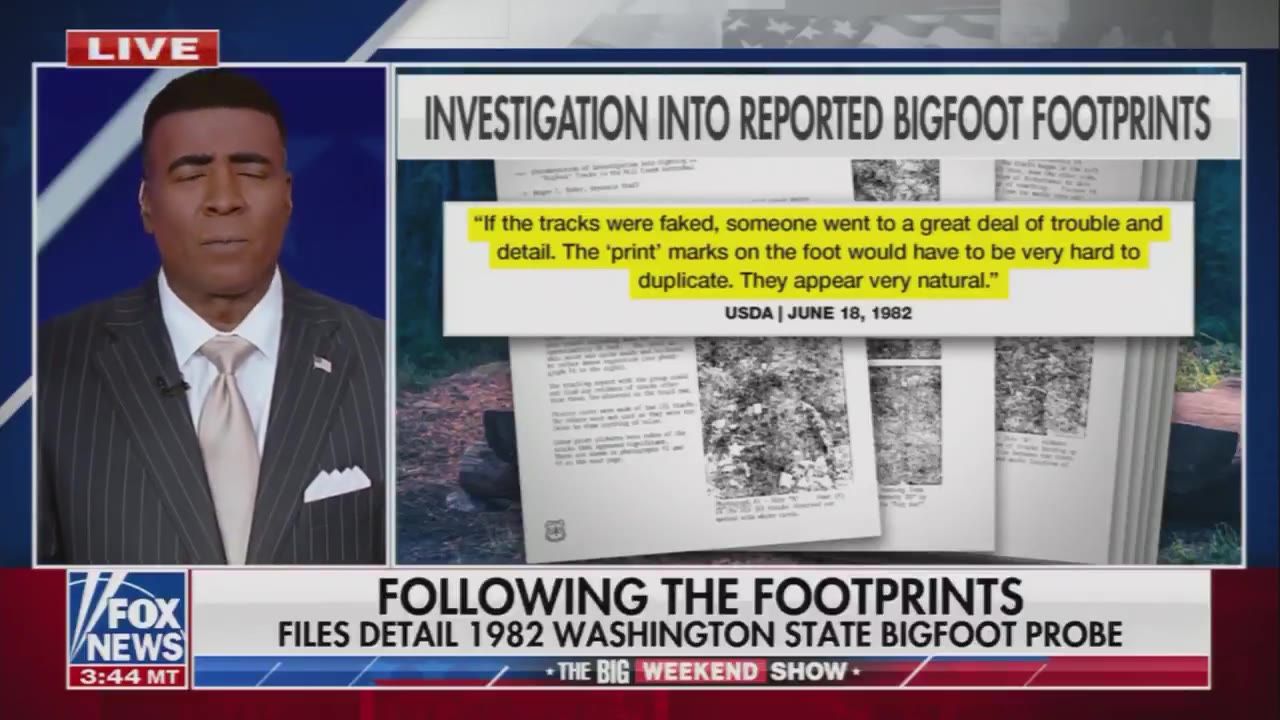
The quote is genuine. Wildlife biologist Rodney L. Johnson wrote that if the tracks were faked, 'someone went to a great deal of trouble and detail', and that the print marks 'would have to be very hard to duplicate. They appear very natural.' The caption reproduces that line accurately. The problem is where it stops. Johnson's memo goes on to give his actual conclusion: the tracks were, in his opinion, made by 'something other than a 300 pound plus two footed being'. Reporting on the file also notes his scepticism, including that the stride of the tracks did not change with the slope, which is not how a walking animal behaves. A Border Patrol tracker's memo in the same material described the tracks as 'a very clever attempt to perpetrate a hoax'. So the sentence quoted is true and the impression it creates is the opposite of what the biologist concluded. This is selective quotation rather than invention, and it is the single biggest reason the post needs a caveat.
A 1942 letter reveals the government has been tracking Bigfoot for decades36
The Montana material is real but is described inaccurately by the panel. It is a six-page account written in 1980 by a private citizen, Leo T. Kinney, describing encounters he placed in the 1940s — dated variously to 1941, 1942 and 1949-50 across retellings. It is not a 1942 letter, and it is not a government record of tracking. It is a citizen's account that ended up held in agency files. The distinction matters because the panel's framing turns a stored anecdote into a decades-long federal programme. Our confidence here is moderate rather than high: the sources agree on what the document is, but the date slippage in the retellings means we describe the range rather than pin a single year. A reader should treat 'the government has been tracking Bigfoot for decades' as an interpretation layered onto the file, not a fact stated in it.
Still open: The exact year of the encounters Kinney described varies across tellings, so we report a range rather than a single date.
Officials looked into a footprint in Montana in 200346
The third released file is a 2003 clipping from the Clark Fork Valley Press about tracks reportedly found in Sanders County, Montana. It is a newspaper article, not a record of a federal investigation. The panel's phrasing — 'officials looked into a footprint in Montana in 2003' — collapses two different things: a local news report and an agency inquiry. Nothing in the inputs shows federal officials examining that Montana case in 2003. This claim is a good example of how a broadcast conversation can drift: each retelling compresses the material a little further until a clipping becomes an investigation. Because the underlying document genuinely exists and genuinely dates from 2003, the error is one of description rather than fabrication, which is why we rate it partly true at moderate confidence.
There are at least 6,000 Bigfoots and 'that's a known fact'7
This line comes from the panel's banter, relayed second-hand from a Bigfoot hunter via Griff Jenkins, and the segment's own tone makes clear it is a joke. It is still false as stated. There is no established population figure for a creature whose existence is unverified, and no method exists to count one. The released files do not confirm Bigfoot's existence, and the agency itself said it could neither confirm nor deny it. We rate confidence moderate rather than high not because the number is doubtful — it plainly is not a known fact — but because treating a comic aside as a checkable claim is itself a judgement call. Readers should take the joke as a joke and not as a data point about wildlife populations.
What was posted
XA post on X sharing a broadcast clip from Fox News's 'The Big Weekend Show', in which a panel discusses newly released federal records about Bigfoot. The caption urges readers to laugh at the news that the Forest Service sent a team into Washington woods in 1982 to examine 15-inch footprints and made plaster casts, then begins to quote the agency's biologist. The post asks readers to accept that the government has now released its 'Bigfoot files'.
“🚨 LMAO! They just dropped the government's BIGFOOT FILES. I'm not kidding. The Forest Service sent a team into the Washington woods in 1982 to examine 15-inch footprints. They made plaster casts and everything. Here's the best part. Their own biologist said the prints looked”
Posted on X by the account Gunther Eagleman. The attached clip is a reposted Fox News broadcast segment; no posting date or engagement figures were recorded in our inputs.
Who posted it
XAccount check
Estimates from public signals — account age, posting pattern, audience — not a judgement of the person behind the account, and separate from whether this post is true.
What stood out
- Gunther Eagleman is a conservative political commentator known for unfiltered rants on politics, culture wars, and current events. (shapes.inc)
- He has a significant following on X (formerly Twitter), with 1.7 million followers as of September 2026. (thedailybeast.com)
- Eagleman has been involved in notable incidents, including a 'swatting' event in March 2025, where a false report led to a large police response at his home. (speed-program.com)
- He has been subject to fact-checking, with claims about his endorsement of Trump being debunked. (article.wn.com)
- Eagleman has been involved in controversies, including a 'swatting' incident in March 2025, where a false report led to a large police response at his home. (speed-program.com)
Signals (4)+
- Posting cadence
- Frequent
- Follower ratio
- 1700000
- Notable news coverage
- Yes
- Fact check history
- Yes
Account checked October 25, 2026, 03:15 UTC
The media
Video✓ What is genuine
The broadcast itself: a real Fox News panel segment with its original graphics, and the USDA document imagery shown on screen.
The tells
- ●●● Strong signal Coherent, continuous Fox News 'The Big Weekend Show' studio set, with consistent chyrons, a LIVE bug and a running clock advancing from 3:44 to 4:47 MT.our visual review
- ●●○ Supporting signal On-screen USDA document imagery and social-media handles appear in the frames, matching the subject being discussed.our visual review
- ●●○ Supporting signal No compositing seams, morphing graphics, warped faces or garbled on-screen text in the reviewed frames.our visual review
- ●●○ Supporting signal The segment corresponds to a Fox News article on the same USDA release published around 19-20 November 2026.Fox News
Synthetic-media detector
Detector not consultedThe media is incidental to the claim; the detector was not needed.
How we checked the media
- Reviewed the keyframes from the clip for visual signs of manipulation.
Sources
7 sources reviewed- 1USDA releases decades of Bigfoot files, including 1982 Forest Service investigation in Washington state ↗
Fox News · foxnews.comLow reliabilityRight (AllSides); partisan — signal onlyEvidence
Confirms the 15 October 2026 release date and the 1982 Mill Creek Watershed investigation.
- 2Trump admin quietly releases government's Bigfoot files: 'Very uneasy feeling' ↗
New York Post · nypost.comLow reliabilityLean Right; tabloid — corroborateEvidence
Quotes Rodney Johnson's memo, including the 'appear very natural' line and his conclusion against a 300-pound biped.
- 3Trump's Forest Service has been quietly releasing secret case files - on Bigfoot ↗
The Independent · independent.co.ukReputable outletLean LeftEvidence
Confirms the release and describes the three records, including the 1980 nature of the Montana account.
- 4Is he real? U.S. Forest Service releases documents from Bigfoot investigations ↗
KIRO 7 News Seattle · kiro7.newsUntiereduntiered — treated as signal only, never decisiveEvidence
Corroborates the track measurements from local Seattle-area reporting.
- 5Bigfoot files: Wildlife biologist who examined footprints in 1982 thought it was hoax despite appearing 'very natural' ↗
Hindustan Times · hindustantimes.comUntiereduntiered — treated as signal only, never decisiveEvidence
Details Johnson's scepticism, including that the stride did not change with slope.
- 6Enthusiasts question why Trump team is releasing Bigfoot case files ↗
The Independent · independent.co.ukReputable outletLean LeftEvidence
Characterises the released set as a 1980 hunter account, a skeptical 1982 investigation and a 2003 newspaper article.
- 7US Forest Service Releases Historical Bigfoot Files, 1982 Investigation Describes 'Very Uneasy Feeling' ↗
Arab Times · arabtimesonline.comUntiereduntiered — treated as signal only, never decisiveEvidence
States that the documents do not establish Bigfoot's existence.
Further reading
- 2New York Post Reproduces the 1982 memo's wording in full, including the conclusion the caption leaves out.
- 5Hindustan Times Explains why the biologist doubted the prints despite calling them natural.
- 3The Independent Gives the clearest account of what each of the three released records actually is.
- 4KIRO 7 News Seattle Local Washington coverage of the 1982 investigation with the track measurements.
The full story
The kernel of truth here is simple: the government did publish Bigfoot case files, and one of them really is a 1982 Forest Service investigation in Washington state.
The US Department of Agriculture posted three 'Bigfoot/Sasquatch Records' from the Forest Service archive on 15 October 2026. The headline file, titled 'Sighting of Bigfoot Tracks in the Mill Creek Watershed', documents a June 1982 inquiry into tracks around 15 inches long and 7 inches wide in the Washington portion of the Umatilla National Forest. Officers photographed the tracks and made plaster casts of several prints.
Wildlife biologist Rodney L. Johnson examined them and wrote that faking them would have taken 'a great deal of trouble and detail' and that the print marks 'appear very natural'. He also concluded they were made by something other than a 300-pound two-footed being, and a Border Patrol tracker's memo called them 'a very clever attempt to perpetrate a hoax'.
The other two files are thinner than the coverage suggests: a 1980 account by a Montana resident describing 1940s encounters, and a 2003 local newspaper clipping. The agency said it could neither confirm nor deny Bigfoot's existence.
So why did this travel? Because the first half of the story is genuinely funny and genuinely surprising — a federal agency, plaster casts, a 15-inch foot — and because the most quotable line in the file happens to be the one that sounds like endorsement. Trim the paragraph after 'appear very natural' and you have a story that shares like a joke and persuades by accident.
Kernel of truth
The USDA did publish three Forest Service Bigfoot records on 15 October 2026, and one documents a real 1982 inquiry into roughly 15-inch tracks in Washington state, with photographs and plaster casts.
Timeline
1980
Montana resident Leo T. Kinney writes a six-page account of encounters he places in the 1940s; it later appears among the released Forest Service records. 3The Independent
June 1982
The Forest Service investigates reported Bigfoot tracks in the Mill Creek Watershed of Washington's Umatilla National Forest, photographing and casting prints about 15 inches long. 1Fox News
2003
The Clark Fork Valley Press publishes an article about tracks reportedly found in Sanders County, Montana. 6The Independent
October 15, 2026
The USDA posts three 'Bigfoot/Sasquatch Records' from the US Forest Service archive, first reported by The Washington Post. 1Fox News
November 19, 2026
Fox News and other outlets cover the release; a 'Big Weekend Show' segment discusses the files. 1Fox News
How it was framed
The files, the 1982 investigation and the quoted sentence are all genuine. The post adds a false frame around them — that the release amounts to the government dropping its 'Bigfoot files' with a biologist endorsing the prints — by stopping the quote before his conclusion. The panel's loose dating of the Montana material compounds the misleading framing without inventing anything.
- Missing context. The caption ends at 'Their own biologist said the prints looked' — stopping before Johnson's conclusion that the tracks were probably not made by Bigfoot.
- Emotional language. '🚨 LMAO! They just dropped the government's BIGFOOT FILES.' and 'Here's the best part.'
- “Visual proof”. 'They made plaster casts and everything' — physical artefacts offered as weight for the story.
- Borrowed authority. 'Their own biologist' — the agency's own expert presented as backing the claim.
- Selective evidence. The 1942 letter and 2003 Montana items are cited without noting they are a 1980 citizen account and a newspaper clipping rather than federal investigations.
Posted on X by the account Gunther Eagleman, sharing a clip of Fox News's 'The Big Weekend Show'. Fox News is rated Right by AllSides; ratings describe outlets, not this post, and are treated as signal only. No posting date or engagement data was recorded.
Bias
Leans light-entertainment framing favourable to the Trump administration's document releases. The segment is comedic morning-show banter that frames the release as a transparency win ('thanks to the Trump administration... we're actually now learning about possible Bigfoot sightings') while treating the creature itself with open skepticism; there is no strong political slant beyond that framing.
Bias describes how the post frames its message — the slant of the language, selection and emphasis — and is judged separately from whether the claim is true. A true claim can still be framed with a strong slant.
How we checked
50 s- 1
Searched for coverage of the USDA/Forest Service Bigfoot records release and the 1982 Washington footprint investigation.
- 2
Compared the caption's quoted line against reporting that reproduces biologist Rodney Johnson's memo in full.
- 3
Checked what each of the three released records actually is — an investigation, a citizen account, a newspaper clipping.
- 4
Reviewed keyframes from the clip for signs of visual manipulation and compared the segment against Fox News's own coverage of the release.
✓ Claim checked✓ Media checked✓ Sources checked
Why 85% confidence
HighHigh confidence on the core claims: the release date, the 1982 investigation, the measurements and the quoted sentence are confirmed across outlets that rarely agree politically, and the quote is reproduced from the memo itself. The two Montana items are rated moderate because the sources agree on what the documents are but the retellings differ on dating and on whether an inquiry took place. The 6,000 figure is rated moderate because it is plainly a joke being checked as a claim.
Limits. We did not open the USDA's posted records in their original form; our reading of the file contents rests on reporting that quotes them. No synthetic-media detector was run, because the clip's authenticity does not decide the claim. And we did not verify whether any of the tracks were ever conclusively identified.
What we don’t know
- Whether the original tracks were ever identified — the file records opinions, not a resolution.
- The exact year of the encounters described in the 1980 Montana account, which retellings place anywhere from 1941 to 1950.
- Whether the panel's remarks were scripted or improvised; we can describe what was said, not why.
Spot it yourself
Find the overstatementLooks suspicious, isn’t proof
- The post is jokey and uses a siren emoji and 'LMAO' — tone tells you how the poster feels, not whether the facts are right.
- It comes from a partisan-leaning account and a partisan-leaning broadcaster. That is a reason to check, not a finding.
- A truncated caption ending mid-sentence ('the prints looked') looks sloppy, but plenty of accurate posts get cut off by platform limits.
- The subject is Bigfoot, which many readers will dismiss on sight. Ridicule is not evidence either way.
The actual evidence
- The USDA's own posted records: three 'Bigfoot/Sasquatch Records' published on 15 October 2026, matching the claim's core.
- The 1982 file's contents — tracks about 15 inches by 7 inches, photographs, plaster casts in the Mill Creek Watershed.
- The full text of biologist Rodney Johnson's memo, which contains both the quoted line and his conclusion that the tracks were not made by a 300-pound biped.
- A Border Patrol tracker's memo in the same file calling the tracks 'a very clever attempt to perpetrate a hoax'.
- The nature of the two other files: a 1980 citizen account and a 2003 newspaper clipping, not federal investigations.
- 1
Find the document itself, not just the quote
When a post quotes an official, search the agency's name plus the document title. Here the phrase 'Sighting of Bigfoot Tracks in the Mill Creek Watershed' leads to coverage that describes the whole memo, not one line of it.
- 2
Read one paragraph past the pull-quote
Ask what the person quoted concluded. In this case the sentence after the quote reverses the impression the quote gives.
- 3
Check what each item in a list actually is
For each document named, ask: who wrote it, when, and is it an agency record or something the agency merely stored? A clipping and an investigation are different things.
- 4
Compare outlets that don't share a politics
Here Fox News and the New York Post reported the release alongside The Independent and a Seattle station. Agreement across outlets that usually disagree is stronger than repetition within one.
- 5
Separate 'the government looked into it' from 'the government found it'
An investigation records a report. Look for any line where the agency states a conclusion about the subject itself — here, that it could neither confirm nor deny Bigfoot's existence.
Takeaway
A quote can be word-for-word accurate and still mislead you, if it stops before the speaker's conclusion. Always find out what the person quoted decided, not just what they noticed.
Questions people ask
Did the government really release Bigfoot files?+
Yes. On 15 October 2026 the US Department of Agriculture posted three 'Bigfoot/Sasquatch Records' from the US Forest Service archive. They cover a 1982 footprint investigation in Washington state, a Montana resident's account of 1940s encounters written in 1980, and a 2003 Montana newspaper clipping. The release was first reported by The Washington Post.
What did the Forest Service find in 1982?+
A team looked into tracks in the Mill Creek Watershed of Washington's Umatilla National Forest, roughly 15 inches long and 7 inches wide. They photographed the prints and made plaster casts. Biologist Rodney Johnson wrote that the prints appeared 'very natural' if faked, but concluded they were made by something other than a 300-pound two-footed being.
Did a government biologist say the Bigfoot prints were real?+
No. Johnson said faking them would have taken 'a great deal of trouble and detail' and that they 'appear very natural'. But he concluded the tracks were probably not made by Bigfoot, and noted the stride did not change with the slope. A Border Patrol tracker's memo called the tracks a clever hoax attempt.
Is there a 1942 letter proving the government tracked Bigfoot for decades?+
No. The Montana document is a six-page account written in 1980 by a private citizen, Leo T. Kinney, describing encounters in the 1940s. It is not a 1942 letter and not evidence of a federal tracking programme — it is a citizen's account held in agency files.
Does this mean Bigfoot is real?+
No. The files are historical case records of reports, not findings. The agency said it could neither confirm nor deny Bigfoot's existence, and reporting on the release states the documents do not establish it. An investigation into a sighting is not proof of what was sighted.
Go deeper
- USDA
- The US Department of Agriculture, the federal department that includes the US Forest Service.
- Plaster cast
- A hardened plaster copy made from a mould of a footprint, used to record its shape and size.
- False context
- When genuine content — a real document, quote or image — is presented with a misleading frame around it.
- Selective quotation
- Quoting part of what someone said in a way that leaves out the part that changes the meaning.
- Primary document
- An original record such as a memo, letter or case file, as opposed to a news report about it.
People also search for
For educators+
- The caption quotes a real sentence exactly. At what point does accurate quoting become misleading?
- The panel says 'officials looked into a footprint in Montana in 2003', but the item is a newspaper clipping. How does a document change as it passes from person to person in a conversation?
- If a government agency publishes historical case files, what should a reader assume they prove — and what should they not?
About this check
- Platform
- X
- Posted by
- @gunthereagleman
- Posted
- November 22, 2026
- Age when checked
- Under 24 hours old when checked
- Where it spread
- United States
- Audience
- US audience
- Language
- EN
- Status
- ● Post is live
- Verified
- November 22, 2026, 15:02 UTC
- Published
- November 22, 2026, 15:02 UTC
Reach. GuntherEagleman post 2,659 likes, 201 replies (syndication, 22 Nov); MEAWW 22 Nov
This verdict was generated with AI from the sources shown. AI can make mistakes — check the sources before relying on it.
Check anything yourself, in seconds.
Share any social post or video to What the Fact and get the verdict, the confidence, and the receipts.