Did the Philippines agree to buy 100% of its farm products and energy from the US?
Has the Philippines agreed to buy 100% of its farm products and energy from the United States starting January 1, replacing suppliers like Brazil, as Trump claimed?
False
Trump's remarks are real, but the Philippines never agreed to buy 100 percent of anything.
FALSE. Trump did say this at a White House press conference on 20 November 2026, and the Manila Bulletin headline reflects his words. But no such deal exists. The White House fact sheet from the 18 November Manila visit promises only 'increased' Philippine purchases, with no 100 percent figure and no January 1 deadline. President Marcos and Philippine cabinet officials said no commitment to buy all farm products or energy from the US was made.
Claims
✓ 3 true · ✕ 2 falseThe Philippines agreed to buy 100 percent of its agricultural products from US farmers starting January 1.4578
“You buy 100% of your agriculture from January 1st from our farmers... they're going to buy 100% of their agricultural products from the United States of America.”
No such commitment exists in any official document or statement. The White House fact sheet issued on 18 November 2026, two days before Trump's press conference, described the Manila visit as aiming to eliminate the US trade deficit through 'increased Philippine imports of American energy and agricultural products.' It stated no 100 percent figure and no January 1 deadline. President Marcos, speaking in Shenzhen, said the talks were about diversifying the Philippines' food and energy sources, and that nothing was discussed about buying all of Manila's requirements from Washington. Philippine Energy Secretary Sharon Garin said the country has not committed to sourcing all its energy and agricultural needs from the US because negotiations are ongoing. Ambassador Jose Manuel Romualdez said nothing was signed. The evidence is decisive because it comes from the official document and from the Philippine officials who would have been party to any deal. The president's own account is contradicted by his counterpart and by his own administration's fact sheet. These are not competing sources of equal weight; they are the parties to the alleged agreement.
Still open: What specific import increases, if any, were discussed in the closed meetings between the two governments? The public record describes intentions, not numbers.
The Philippines will stop buying energy from the Middle East and buy 100 percent of its energy from the United States.46
“They're going to buy 100% of their energy from us, not from the Middle East.”
Marcos described the energy discussions as an effort to diversify the Philippines' sources, not to replace Middle Eastern suppliers entirely. He said the details were still being worked out. Energy Secretary Sharon Garin told reporters the Philippines has not committed to sourcing all of its energy needs from the US and that negotiations are ongoing. The White House fact sheet mentioned 'increased' energy imports without any exclusivity clause. There is no signed agreement, no published figure and no deadline. The decisive point is that both the Philippine president and the Philippine energy secretary, who would manage any supply shift, describe an ongoing negotiation rather than a completed commitment. A full replacement of Middle Eastern crude would also be a massive logistical and diplomatic change that would be visible in contracts, shipping data and official statements. None of that exists.
Still open: Exactly how much US energy the Philippines might commit to importing, and on what timeline, is not public.
The Philippines buys about 20 percent of its energy from the US and most of the rest from the Middle East.3
“They buy 20% from us... Where do you buy your energy? So we buy it from the Middle East.”
The Philippines imports nearly all of its crude oil and relies on the Middle East for the bulk of it, which fits Trump's broad description of the country's energy sourcing. The claim is plausible and consistent with reporting on Philippine energy imports. The precise 20 percent US share, however, is not independently confirmed in the coverage we reviewed. That figure may come from a specific trade statistic not reproduced in the articles we read. We rate the general picture as likely true but the exact number as unverified. Readers should treat the 20 percent figure as an approximation that requires a check against Philippine or US trade data before being quoted as fact.
Still open: What is the exact US share of Philippine energy imports? The coverage reviewed does not provide a source for the 20 percent figure.
The Philippines was buying a lot of its farm products from other countries, including Brazil, much more than from the United States.2
“The Philippines were buying a lot of their farm product from other countries, including Brazil, much more than bought from us.”
Philippine imports from Brazil in the previous year were about $1.84 billion, 86 percent of it meat, according to Brazil's agriculture ministry as cited by the Inquirer. That made the Philippines a top Southeast Asian market for Brazilian pork. This supports Trump's broader point that Brazil supplies a substantial share of Philippine farm imports, particularly meat. The claim is rated likely true rather than confirmed because the comparison to US farm imports is not fully quantified in the coverage we reviewed. We cannot say from the available sources exactly how the US share compares with Brazil's. What is clear is that Brazil is a major supplier of agricultural goods to the Philippines, especially meat, and that this part of Trump's remarks was not invented.
Still open: How does the US share of Philippine farm imports compare with Brazil's in the same period? The coverage gives the Brazil figure but not a directly comparable US figure.
Brazil would not come to the Philippines' aid in a conflict with China, so Manila should not buy from Brazil.3
“Is Brazil going to help them in case they get into a little skirmish with China? I don't think so.”
This is a rhetorical and geopolitical assertion rather than a checkable factual claim. Brazil has no mutual defence treaty with the Philippines, which is a matter of public record. But whether Brazil would or would not assist Manila in a hypothetical future conflict cannot be verified, because it has not happened and no government can commit on Brazil's behalf. The statement is an opinion about strategic reliability, used to argue that the Philippines should buy American. It may be a reasonable argument or a flawed one, but it is not the kind of claim that a fact-checker can mark true or false. We rate it opinion so that readers can see it is a judgment, not a finding.
Malaysia and the Philippines agreed to use US technology and services for their cloud infrastructure.7
“The Philippines and Malaysia agreed to use US technology and service for their cloud infrastructure.”
The White House fact sheet for the Manila visit describes an agreement to build out Philippine sovereign cloud infrastructure using American technology, with defence cloud contracts worth about $100 million. That supports the Philippines element of the claim. The Malaysia element was not verified in the coverage we reviewed. We rate the claim likely true rather than confirmed because half of it, the Malaysia portion, lacks supporting documentation in our sources. The cloud infrastructure detail matters because it shows that real agreements were discussed during the visit. It also shows how a genuine element can sit alongside a false one in the same speech, which is a common pattern in misleading content.
Still open: Did Malaysia separately agree to use US cloud technology, and if so what are the terms? The coverage reviewed does not confirm the Malaysia element.
A text-only post: there was no media to test.
What was posted
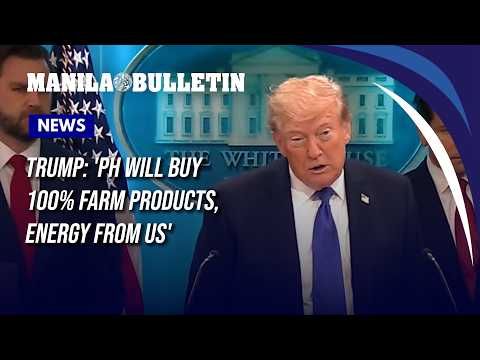
YouTubeA Manila Bulletin YouTube video and headline reporting remarks by US President Donald Trump at a White House press conference on 20 November 2026. The clip shows Trump recounting that he told Philippine President Ferdinand Marcos Jr. the Philippines would buy 100 percent of its agricultural products from US farmers starting January 1, and 100 percent of its energy from the US instead of the Middle East. The headline presents the claim as a settled fact rather than a statement by Trump.
“Trump claims Philippines to buy 100% of farm products, energy from US”
Published by the Philippine outlet Manila Bulletin as a video report. The headline matches Trump's account of his own remarks; the outlet's copy describes the White House agreement differently, as a commitment to increase Philippine imports.
Who posted it
YouTube@manilabulletin1900
1.3M subscribers · Account 13 years old
View the account on YouTube ↗“The official YouTube channel of the Manila Bulletin. Updated daily with the latest top news and breaking news. Visit our website at http://mb.com.ph Facebook: https://www.facebook.com/manilabulletin Twitter: https://www.twitter.com/manilabulletin Instagram: https://instagram.com/manilabulletin Tiktok: https://www.tiktok.com/@manilabulletin”
Account check
Estimates from public signals — account age, posting pattern, audience — not a judgement of the person behind the account, and separate from whether this post is true.
What stood out
- Channel is the verified official YouTube presence of Manila Bulletin, a Philippine broadsheet founded in 1900; bio links to mb.com.ph and its other verified social accounts.
- Channel created 28 Nov 2013 with ~1.33M subscribers, ~29,400 videos and ~497M lifetime views — consistent, years-long institutional footprint rather than a fresh sock-puppet account.
- Third-party analytics (vidIQ, HypeAuditor, SubSub) independently match the handle, channel ID (UC5664f6TkaeHgwBly50DWZQ) and subscriber count, and show organic low-rate growth (tens to hundreds/day), not a spike pattern.
- Recent uploads (PAGASA weather advisories, lotto draw results, PNP/transport news, VP Sara trial coverage) match the outlet's known daily news cadence and beat structure.
- Content includes proper attribution in headlines (e.g., '— PAGASA') and standard news-agency phrasing; no sensationalist or unverifiable claim framing observed.
- The outlet has previously been targeted by fake 'Manila Bulletin' graphics and impostor accounts, and has issued public advisories — so the brand is frequently spoofed, but this channel is the genuine one.
- Caveat: Media Bias/Fact Check rates Manila Bulletin 'Left-Center' with 'Mixed' factual reporting (pro-government lean, no failed fact checks); one 2022 tsek.ph critique flagged a misleading Twitter-survey infographic, i.e. editorial/accuracy weaknesses rather than inauthenticity.
- Very high upload volume (~300+ videos/month incl. Shorts) is normal for a newsroom operating multiple bulletin/lotto/weather streams, not indicative of automation.
Signals (12)+
- Account created
- 2013-11-28
- Platform verification
- Yes
- Subscriber count
- 1330000
- Video count
- 29397
- Total views
- 497152807
- Posting cadence
- ~300+ uploads/month (daily news, weather, lotto results, livestreams)
- Follower ratio
- N/a (news org, 1.33M subs vs ~497M views)
- Third party verification
- VidIQ, HypeAuditor, SubSub, SponsorRadar all confirm same channel ID and handles
- Notable news coverage
- Legacy national broadsheet founded 1900; cited by Rappler/AFP as an outlet whose name is spoofed by fake-news purveyors; official statements referenced by gov't portals (DA)
- Fact check history
- MBFC: Left-Center, Mixed factual, no failed fact checks; tsek.ph (2022) flagged misleading Twitter poll infographic
- Cross platform consistency
- Bio links to mb.com.ph, facebook.com/manilabulletin, twitter.com/manilabulletin, instagram, tiktok
- Engagement pattern
- Normal long-tail distribution (single-digit views on newly published clips, hundreds of thousands on viral political clips)
Recent posts from this account
- 22 passengers, crew rescued after motor banca loses propulsion off Palawan1 views
- Amihan, ITCZ to bring scattered rains over parts of PH — PAGASA205 views
- Lotto Draw Results, November 21, 2026 | Grand Lotto 6/55, Lotto 6/42, 6D, 3D, 2D58 views
- Air Niugini flight makes emergency landing at Davao Int'l Airport396 views
- Lotto Draw Results, November 20, 2026 | Ultra Lotto 6/58, Mega Lotto 6/45, 4D, 3D, 2D4.7K views
Account checked November 22, 2026, 02:58 UTC
Sources
9 sources reviewed- 1Trump claims Philippines to buy 100% of farm products, energy from US ↗
Manila Bulletin · mb.com.phUntiereduntiered — treated as signal only, never decisiveContext
The Manila Bulletin report establishes that Trump made the remarks and that the outlet's own copy describes the agreement as increased imports.
- 2Trump claims PH to buy 100% farm, energy goods from US; Marcos clarifies ↗
Inquirer.net · globalnation.inquirer.netUntiereduntiered — treated as signal only, never decisiveEvidence
The Inquirer reports Marcos's clarification that the arrangements were not commitments to buy all Philippine requirements from the US, and provides the Brazil import figures.
- 3Trump claims PH agreed to US-only import deals ↗
Inquirer.net · globalnation.inquirer.netUntiereduntiered — treated as signal only, never decisiveEvidence
The Inquirer reports on Philippine energy dependence on the Middle East, supporting the plausibility of that part of Trump's account.
- 4'Philippines to buy 100% of farm products, energy from US' ↗
The Philippine Star · philstar.comUntiereduntiered — treated as signal only, never decisiveEvidence
The Philippine Star quotes Marcos saying nothing was discussed about buying all of Manila's requirements from Washington.
- 5PBBM clarifies Trump claim that PH to buy all agri, energy goods from US ↗
Manila Standard · manilastandard.netUntiereduntiered — treated as signal only, never decisiveEvidence
Manila Standard reports that the White House fact sheet did not specify 100 percent agricultural sourcing.
- 6Disclose '100%' deal with Trump ↗
Daily Tribune · tribune.net.phUntiereduntiered — treated as signal only, never decisiveEvidence
The Daily Tribune quotes Energy Secretary Sharon Garin saying the Philippines has not committed to sourcing all its energy and agricultural needs from the US.
- 7Trump claims 100% US farm, energy deal as Marcos hedges ↗
Malaya Business Insight · malaya.com.phUntiereduntiered — treated as signal only, never decisiveEvidence
Malaya Business Insight reports that the White House fact sheet made no mention of an exclusive import commitment or a January 1 deadline, and describes the cloud infrastructure agreement.
- 8Trump says US has concluded 'very big trade deal' with Philippines ↗
Reuters via Astro Awani · international.astroawani.comUntiereduntiered — treated as signal only, never decisiveEvidence
Reuters via Astro Awani reports that Manila described only an understanding on economic cooperation and that Ambassador Romualdez said nothing was signed.
- 9美向菲律賓提供防務協助 川普:菲同意向美採購農產品、能源 ↗
中央社 CNA · cna.com.twUntiereduntiered — treated as signal only, never decisiveContext
CNA reports Trump's account of asking Manila to buy 100 percent of its agriculture and energy from the US, confirming the remarks were made.
Further reading
- 7Malaya Business Insight Malaya Business Insight reports on the White House fact sheet and its absence of an exclusivity clause, making it the clearest single source on what was actually agreed.
- 8Reuters via Astro Awani Reuters via Astro Awani carries the Philippine ambassador's statement that nothing was signed, which is the strongest single rebuttal of a completed deal.
- 4The Philippine Star The Philippine Star quotes Marcos directly saying nothing was discussed about buying all of Manila's requirements from Washington.
The full story
The kernel of truth here is that Donald Trump stood at a White House press conference on 20 November 2026 and said the words attributed to him. The Manila Bulletin video is genuine reporting of a real event. Trump really did describe telling President Marcos that the Philippines would buy 100 percent of its farm products from American farmers starting January 1, and 100 percent of its energy from the US rather than the Middle East. He really did mention Brazil and China, and he really did call Marcos 'Prime Minister' rather than president.
The problem is that what Trump described does not match what was agreed. Two days earlier, on 18 November, the White House issued a fact sheet about the Manila visit. It talked about eliminating the US trade deficit through 'increased' Philippine imports of American energy and agricultural products. It contained no 100 percent figure and no January 1 deadline. When Marcos spoke to reporters in Shenzhen, he said the discussions were about diversifying the Philippines' food and energy sources, not replacing them. He said nothing was discussed about buying all of Manila's requirements from Washington. Energy Secretary Sharon Garin said no such commitment had been made and negotiations were ongoing. Ambassador Romualdez said nothing was signed.
So the false claim did not come from a fabricated video or a fake headline. It came from a real politician overstating a real but much narrower agreement, and a real news outlet reporting his words without immediately testing them against the official record. That combination is why the claim spread: it had a genuine event behind it, a genuine headline, and a genuine transcript.
Kernel of truth
Trump did make these remarks at a real White House press conference on 20 November 2026, and the Philippines and US did discuss increased farm and energy imports during Marcos's 18 November visit. The 100 percent figure and the January 1 deadline were Trump's characterisation, not the agreed terms.
Timeline
November 18, 2026
White House fact sheet on Marcos's Manila visit commits only to 'increased' Philippine imports of US energy and agricultural products, with no 100 percent figure and no January 1 deadline. 7Malaya Business Insight
November 20, 2026
Trump tells a White House press conference that the Philippines agreed to buy 100 percent of its farm products and energy from the US starting January 1. 9中央社 CNA
November 21, 2026
Manila Bulletin publishes its video report carrying the headline 'Trump claims Philippines to buy 100% of farm products, energy from US'. 1Manila Bulletin
How it was framed
The video, the transcript and the headline are genuine: Trump really did make these remarks at a real press conference. The falsehood lies in presenting his description of a deal as if it were the deal itself. The official record and the Philippine government describe a much narrower agreement to increase imports, so the 100 percent framing is genuine content placed in a false context. It is also misleading because it uses a real statement to frame the US-Philippines relationship as an exclusive arrangement that does not exist.
- Borrowed authority. The headline presents the claim as fact ('Philippines to buy 100%') rather than attributing it to Trump's own account, lending it the authority of a news report.
- “Visual proof”. The video format and transcript excerpt function as apparent proof of what was said, which it is, but not of whether what was said is true.
- Emotional language. Trump's phrasing 'you buy 100%... not 90, not 95' and 'if they don't, then they have problems' uses emphatic repetition and threat language to make the deal sound absolute.
- Us vs. them. The remarks frame Brazil and the Middle East as unreliable suppliers and the US as the only dependable partner: 'Is Brazil going to help them in case they get into a little skirmish with China?'
- Missing context. Neither the headline nor the clip references the White House fact sheet of 18 November or Marcos's clarification, which describe increased imports rather than exclusive supply.
Published on YouTube by Manila Bulletin, a Philippine newspaper, as a video report of Trump's 20 November 2026 press conference. The outlet's own copy describes the White House agreement as a commitment to increase Philippine imports, while the headline repeats Trump's 100 percent figure.
Bias
Leans uncritical amplification of a contested presidential claim. The headline reproduces Trump's '100 percent' framing without the Philippine government's rebuttal, although the article body does note that the White House fact sheet omitted any 100 percent commitment and that Marcos said details remained to be settled.
Bias describes how the post frames its message — the slant of the language, selection and emphasis — and is judged separately from whether the claim is true. A true claim can still be framed with a strong slant.
How we checked
1 min 10 s- 1
Searched for coverage of Trump's 20 November 2026 remarks and the Manila Bulletin report to establish what was said and when.
- 2
Searched for the White House fact sheet and official statements from the 18 November Manila visit to establish what was agreed.
- 3
Searched for statements by President Marcos and Philippine cabinet officials clarifying the scope of the discussions.
- 4
Searched for fact-checks from major outlets on the 100 percent claim; none were found.
- 5
Compared the official record with Trump's account to determine which claims were supported, contradicted or unverifiable.
✓ Claim checked– Media not applicable✓ Sources checked
Why 88% confidence
HighWe rated the central claim FALSE with HIGH confidence because the official White House fact sheet and the Philippine president and cabinet officials all contradict the 100 percent figure and the January 1 deadline. The evidence is not a single source or a partisan interpretation; it is the document and the counterpart government. The only element keeping this from being a simple fabrication is that Trump did make the remarks, which is why the classification is false context rather than fabricated content.
Limits. We did not open the full text of every article or access Philippine or US trade databases directly. We could not verify the exact 20 percent US energy share or the Malaysia cloud element. No visual media was submitted, so there was nothing to assess for manipulation.
What we don’t know
- What specific import volumes or percentages, if any, were discussed in private between the two governments.
- Whether the Philippines has made any informal political commitment to increase US energy or farm imports beyond what is in the public record.
- The exact source of Trump's 20 percent US energy figure.
- Whether the Malaysia cloud infrastructure element of the claim is accurate.
- Whether Manila Bulletin or other outlets issued corrections or clarifications after publishing the headline.
Spot it yourself
Spot the fakeLooks suspicious, isn’t proof
- The headline uses a round, absolute number ('100%') that sounds like a sales pitch rather than a trade term. That is a reason to check, but not proof of falsity; real deals sometimes do use round figures.
- The clip is a politician speaking, not a signed document or a joint statement. That makes it worth checking, but politicians do sometimes announce real agreements in speeches.
- The source is a foreign news outlet reporting on a US president's remarks. That is not disqualifying; it is a reason to look for the official record.
- Trump calls Marcos 'Prime Minister', which is the wrong title. This is an error, but it does not by itself prove the trade claim is false.
The actual evidence
- The White House fact sheet of 18 November 2026 describes 'increased' Philippine imports, with no 100 percent figure and no January 1 deadline.
- President Marcos said nothing was discussed about buying all of Manila's requirements from Washington, and described the talks as diversification.
- Energy Secretary Sharon Garin said the Philippines has not committed to sourcing all its energy and agricultural needs from the US.
- Ambassador Romualdez said nothing was signed between the two countries.
- 1
Look for the official document, not just the speech
When a leader announces a deal, search for the joint statement, fact sheet or signed text from the same visit. Here the White House fact sheet from 18 November is the key document, and it does not contain the 100 percent figure.
- 2
Check what the other government says
The Philippines is a party to the alleged deal. Search for statements from President Marcos and Philippine cabinet officials. If they describe a different arrangement, the announcement is at least overstated.
- 3
Distinguish what was said from what was agreed
A video can prove that a person said something. It cannot prove that what they said is true. Ask: is this a record of a statement or a record of an agreement? Here it is the former, presented as the latter.
- 4
Look for a signature or a published figure
Real trade commitments usually come with documents, percentages, timelines and implementing agencies. The absence of all four is a signal to treat the claim as an announcement, not a fact.
Takeaway
A genuine video of a real person saying something is not evidence that what they said is true. Always separate the authenticity of the recording from the accuracy of the claim it carries.
Questions people ask
Did Trump actually say the Philippines would buy 100% of its farm products and energy from the US?+
Yes. At a White House press conference on 20 November 2026, Trump said he told President Marcos that the Philippines would buy 100 percent of its agricultural products from US farmers starting January 1, and 100 percent of its energy from the US instead of the Middle East. The video is genuine. The question is whether the deal he described exists.
Did the Philippines agree to buy 100% of its farm products from the US?+
No. The White House fact sheet from the 18 November 2026 Manila visit committed only to 'increased' Philippine imports of American agricultural products. It contained no 100 percent figure and no January 1 deadline. President Marcos said nothing was discussed about buying all of Manila's requirements from Washington.
What did Marcos say about Trump's claim?+
Marcos said the discussions were about diversifying the Philippines' food and energy sources, not replacing suppliers. He said nothing was discussed about buying all of Manila's requirements from the United States. His account is consistent with the White House fact sheet, which described increased imports rather than exclusive supply.
Is it true that the Philippines buys most of its energy from the Middle East?+
Broadly yes. The Philippines imports nearly all of its crude oil and relies on the Middle East for the bulk of it. Trump's claim that the US supplies about 20 percent is plausible but not independently confirmed in the coverage we reviewed. The general picture of Middle East dependence is supported.
Why does it matter if a politician exaggerates a trade deal?+
Trade announcements affect markets, diplomatic expectations and public trust. When a claim of a 100 percent commitment spreads without correction, it can shape how people understand their country's sovereignty and alliances. The correction here comes from the official record and from the other government, which is the most reliable check available.
Go deeper
- Fact sheet
- An official document issued by a government summarising an agreement or policy, often used to state what was actually committed to.
- False context
- When genuine content, such as a real video or quote, is presented with misleading information about what it means or what it proves.
- Sovereign cloud infrastructure
- Cloud computing systems built and controlled within a country's own legal and security framework, often using foreign technology but under national control.
- Trade deficit
- The gap between what a country imports and what it exports; a trade deficit means imports are worth more than exports.
- Mutual defence treaty
- A formal agreement between countries to come to each other's defence if attacked, such as the US-Philippines Mutual Defense Treaty.
People also search for
For educators+
- If a video shows a politician saying something, does that prove the thing they said is true? What else would you need?
- Why might a news outlet publish a headline that repeats a politician's claim without immediately checking it? What pressures might journalists face?
- How would you verify a trade deal claim using official documents and statements from both governments?
About this check
- Platform
- YouTube
- Posted by
- @manilabulletin1900
- Posted
- November 21, 2026
- Age when checked
- Under 24 hours old when checked
- Where it spread
- Philippines, Brazil, United States
- Audience
- International audience
- Language
- EN
- Status
- ● Post is live
- Verified
- November 22, 2026, 02:59 UTC
- Published
- November 22, 2026, 02:59 UTC
Reach. YouTube views at 22 Nov ~02:35Z: Manila Bulletin 43,374 (22h); SBT News 151,340 (1d); Conversa Geografica 105,092 (11h); UOL 88,914; CNN Brasil 70,276 (13h); TV5 4,533. Covered by Philstar (22 Nov), Inquirer, Manila Bulletin, Daily Tribune, Bilyonaryo (21 Nov). Strong Brazil pickup (agribusiness ang
This verdict was generated with AI from the sources shown. AI can make mistakes — check the sources before relying on it.
Check anything yourself, in seconds.
Share any social post or video to What the Fact and get the verdict, the confidence, and the receipts.