Is the video of giant waves hitting Gordon's Bay real?
Does a viral video show powerful ocean waves surging over the beachfront at Gordon's Bay, South Africa?
False
AI-generated footage, not real flooding at Gordon's Bay in November 2026.
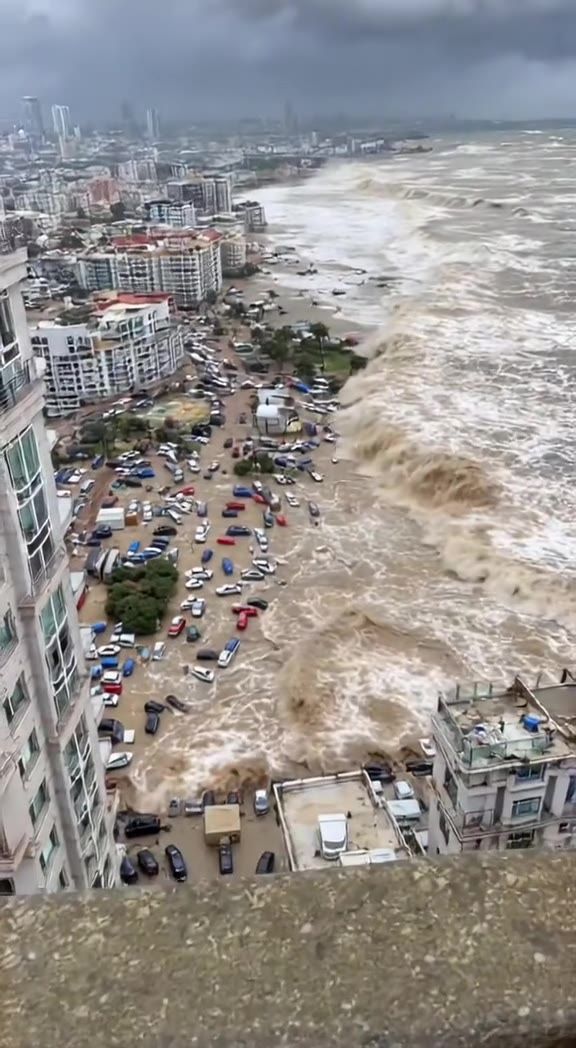
The video is AI-generated. Lead Stories fact-checked this exact clip — the unwatermarked TikTok upload by @._._._._940 on 20 November 2026 — and found it synthetic; an earlier upload carried TikTok's 'Contains AI-generated media' label. No credible reports exist of such waves at Gordon's Bay, South Africa, in November 2026.
 AI-generated
Claims
✕ 2 falseThe video shows powerful ocean waves surging over the beachfront at Gordon's Bay, South Africa, flooding coastal streets and buildings in November 2026.12
This exact clip — the unwatermarked TikTok version posted by @....940 on 20 November 2026 — was fact-checked by Lead Stories and rated AI-generated. The earlier upload of the same footage carried TikTok's 'Contains AI-generated media' label. Fact-checkers found no reports from established outlets of waves of this kind at Gordon's Bay in November 2026. Gordon's Bay did see powerful high-tide waves on 16 September 2023, but that event was far less destructive and genuine footage of it does not match this scene. The decisive evidence is the fact-check naming this exact asset plus the platform's own AI label. The sources are not fully independent — Lead Stories and the other fact-checks all trace back to the same clip — but the platform label and the absence of any credible real-world reporting make the conclusion strong.
The footage is a real recording made from a balcony of a genuine coastal flooding event.14
The scene is synthetic. Lead Stories identified tell-tale errors: vehicles sitting on top of what appear to be residential buildings, a beachfront packed with cars but completely empty of people, and water pooling around buildings without causing any structural damage. The clip's 15-second length matches the Sora generation limit that AFP documented for the same genre of fake tsunami videos. Our own AI detection tool also scored the video as highly likely AI-generated. Together these three lines of evidence — visual errors, runtime, and forensic detection — point the same way. The visual anomalies alone might be dismissed as compression artefacts, but combined with the platform label on the earlier upload and the detector result, the conclusion is firm.
What was posted
TikTokA short TikTok video posted by the account @._._._._940 on 20 November 2026 shows an enormous wave surging over a beachfront and coastal streets, apparently filmed from a high balcony. The post carries no caption naming a location, so the footage travels with whatever context reposts add. Reposts on other platforms labelled it 'powerful ocean waves' at Gordon's Bay, South Africa.
The TikTok upload has no caption or text overlay naming a place. Later reposts added a 'BNS Media' watermark and a Gordon's Bay caption, including a Threads post on 23 November 2026.
Who posted it
TikTokAccount check
Estimates from public signals — account age, posting pattern, audience — not a judgement of the person behind the account, and separate from whether this post is true.
What stood out
- Profile is a bare shell: no display name, no bio, no follower count, no account creation date and no posts visible in the sample — only an obfuscated punctuation-and-digits handle ('....940').
- The handle is directly identified by Lead Stories (fact check, 22 Nov 2026) as the TikTok account that posted the source clip of the viral 'powerful waves at Gordon's Bay, South Africa' video on 20 Nov 2026.
- That clip was AI-generated — it carried TikTok's 'Contains AI-generated media' label on the original upload — yet the account distributed it without the BNS Media watermark or caption, stripping the context that would have signalled its synthetic origin.
- The footage was subsequently re-shared (e.g. @thebnsmedia on Threads, 23 Nov 2026) as real coastal-flooding news, and multiple outlets (Lead Stories, Roya News, Azteca Baja California, AOL/France Info) reported it as a fake that amassed millions of views.
- French-language coverage describes the TikTok origin account as 'specialising in misleading images of natural disasters' — i.e. a synthetic-disaster engagement-farming account, not an eyewitness or news source.
- No news coverage, verification, institutional affiliation or named human identity exists for this handle; its only traceable footprint is a debunked AI video.
- Anonymised handle plus zero profile metadata plus stripped-watermark synthetic content is a textbook low-transparency, high-reach amplification account.
Signals (7)+
- Posting cadence
- Unknown; at least one high-reach upload on 2026-11-20
- Profile completeness
- None (no display name, bio, avatar data or follower count provided)
- Handle style
- Obfuscated (repeated periods and underscores plus digits) — typical of throwaway/rotating accounts
- Fact check history
- Named as the originating uploader in a Lead Stories fact check (2026-11-22) and in Roya News / AOL coverage of the same AI tsunami clip
- Notable news coverage
- Yes — international coverage of the fake Gordon's Bay wave video
- Content red flags
- AI-generated video of a natural disaster presented without AI disclosure context; removed third-party watermark (BNS Media) before reposting; single viral clip reached 10M+ views, was reposted as real news, then deleted elsewhere
- Final take
- Not a credible information source; likely an anonymous AI-content/engagement-farming account rather than a real person or organisation.
Account checked November 24, 2026, 15:05 UTC
The media
Video✓ What is genuine
Gordon's Bay did experience high-tide wave damage on 16 September 2023, but that real event was far less destructive and its footage does not match this clip.
The tells
- ●●● Strong signal Vehicles appear on top of what look like residential buildings.Lead Stories
- ●●● Strong signal The beachfront is full of cars but completely empty of people.Lead Stories
- ●●○ Supporting signal Water pools around buildings without causing any visible structural damage.Lead Stories
- ●●○ Supporting signal The clip runs exactly 15 seconds, matching the Sora generation limit.AFP Factual
- ●●● Strong signal Our detector scored the video at 0.9998 probability of being AI-generated.our detector
Synthetic-media detector
Detector ranThe claim stands or falls on whether the media is real, so the detector ran.
Scores are the detector’s estimate for the file as uploaded. A low score does not rule out editing, a spliced caption, or footage shown out of context — those are judged above. Model v3.
How we checked the media
- Ran the video through our AI detection tool, which scored it 0.9998 as AI-generated.
- Reviewed the footage visually for physical inconsistencies.
- Compared the clip's details and runtime with the Lead Stories fact-check and AFP's documentation of similar fake tsunami videos.
Sources
5 sources reviewed- 1Fact Check: FAKE Video Shows 'Powerful Waves' Hitting Gordon's Bay, South Africa -- It Is AI-Generated ↗
Lead Stories · hoax-alert.leadstories.comPrimary / fact-checkerIFCN; strong on viral/AI mediaEvidence
Fact-checks this exact unwatermarked TikTok upload as AI-generated and lists the visual tells.
- 2Afrique du Sud : quand l'IA invente un tsunami ↗
Yahoo News (Aurélien Devernoix) · fr.news.yahoo.comUntiereduntiered — treated as signal only, never decisiveEvidence
Describes the same balcony clip as AI-generated and notes the real Gordon's Bay event was less destructive.
- 3"Unbelievably realistic": AI-generated tsunami in South Africa garners millions of views ↗
Roya News · en.royanews.comUntiereduntiered — treated as signal only, never decisiveContext
Reports that the AI-generated tsunami video drew millions of views.
- 4Imágenes de una supuesta ola gigante que impacta en Japón están creadas con inteligencia artificial ↗
AFP Factual · factual.afp.comReputable outletwire — CenterEvidence
Documents the 15-second Sora generation limit used to identify similar fake tsunami clips.
- 5¡Impactante video muestra una ola gigante cubriendo una ciudad costera de Sudáfrica! ↗
Azteca Baja California · tvaztecabajacalifornia.comUntiereduntiered — treated as signal only, never decisiveContext
Notes visual anomalies consistent with AI generation in the same clip.
Further reading
- 1Lead Stories The primary fact-check naming this exact TikTok upload and detailing the visual errors.
- 2Yahoo News (Aurélien Devernoix) French-language coverage that places the clip in context and contrasts it with the real 2023 event.
- 4AFP Factual AFP's documentation of the 15-second Sora limit for similar fake tsunami videos.
The full story
The kernel of truth here is that Gordon's Bay, a coastal town near Cape Town, really does sit at the mercy of the sea. On 16 September 2023 a powerful spring high tide sent waves over the beachfront and caused damage. That event was widely covered and is the reason a video of water surging into coastal streets feels plausible to anyone who knows the area.
The clip itself, however, is not from that event. It first appeared on TikTok on 20 November 2026, posted by the account @....940 with no caption naming a place. An earlier upload of the same footage carried TikTok's 'Contains AI-generated media' label. Reposts later added a 'BNS Media' watermark and a caption placing the scene at Gordon's Bay, and from there it spread on X and Threads as if it were real.
The visuals are convincing at first glance — muddy water, panicked framing from a balcony — but they fall apart on inspection. Cars sit on rooftops. The beach is full of vehicles yet utterly empty of people. Water gathers around buildings without knocking anything down. The 15-second length matches the Sora generation limit that AFP documented for the same wave of fake tsunami clips.
What makes this kind of post travel is not the footage alone but the gap it fills. People expect disasters to be filmed and shared, and a town with a real history of flooding supplies the context the fake clip lacks.
Kernel of truth
Gordon's Bay did suffer high-tide wave damage on 16 September 2023, but that event was far less destructive than the AI-generated clip implies.
Timeline
September 16, 2023
A powerful spring high tide causes wave damage at Gordon's Bay, South Africa. The real event is far less destructive than later fake footage suggests. 1Lead Stories
November 20, 2026
The unwatermarked AI-generated clip is posted on TikTok by @._._._._940. An earlier upload of the same footage carried TikTok's 'Contains AI-generated media' label. 1Lead Stories
November 23, 2026
The clip is reposted with a 'BNS Media' watermark and a Gordon's Bay caption on Threads, spreading the false context further. 1Lead Stories
How it was framed
The footage is entirely AI-generated and was made to look like a real coastal disaster. It then circulated with a false location caption, turning a synthetic clip into an apparent news event. The combination of fabricated imagery and misleading context makes it both fabricated and falsely contextualised.
- “Visual proof”. The post relies entirely on dramatic footage of water surging over a beachfront, with no caption or text overlay naming a location.
- Missing context. The TikTok upload has no caption, no date and no location, so reposts can attach any place or time to it.
- Borrowed authority. Later reposts added a 'BNS Media' watermark, lending the clip the appearance of a news source.
Posted on TikTok by the account @._._._._940 on 20 November 2026. The same footage was later reposted on Threads and X with a Gordon's Bay caption and a 'BNS Media' watermark.
Bias
Leans sensationalist disaster engagement-bait. There is no political slant, but the clip is engineered for shock and reach: an apocalyptic, hyper-real wave scene posted without location, date or context by an account that reposts viral disaster material.
Bias describes how the post frames its message — the slant of the language, selection and emphasis — and is judged separately from whether the claim is true. A true claim can still be framed with a strong slant.
How we checked
1 min 14 s- 1
We ran targeted searches in English and Spanish for coverage of the claimed event and for fact-checks of the clip.
- 2
We opened and read the Lead Stories fact-check that names this exact unwatermarked TikTok upload.
- 3
We opened French-language coverage that described the same clip and the real Gordon's Bay event.
- 4
We ran the video through our AI detection tool, which returned a 0.9998 score for AI-generated.
✓ Claim checked✓ Media checked✓ Sources checked
Why 90% confidence
HighWe rate this HIGH confidence. A recognised fact-checker examined this exact asset, the platform itself had labelled an earlier upload as AI-generated, our detector agreed, and no credible outlet reported the claimed event. The only limitation is that all the fact-checks trace to the same clip, so they are not fully independent of one another.
Limits. We could not identify who originally generated the footage or when it was first created, only when it was uploaded to TikTok. We also could not verify the identity or intent of the account @._._._._940.
What we don’t know
- Who originally created the AI-generated clip and with which tool.
- Whether the account @._._._._940 knowingly posted synthetic footage or shared it in good faith.
- How many times the clip was viewed or shared before fact-checkers identified it.
Spot it yourself
Spot the fakeLooks suspicious, isn’t proof
- The clip is short and dramatic — plenty of real disaster footage is too.
- It spreads without a clear source — real footage often goes viral before anyone credits it.
- The scene looks chaotic and muddy — that is what real floods look like.
- A watermark like 'BNS Media' appears on some versions — watermarks can be added by anyone and prove nothing on their own.
The actual evidence
- Our AI detection tool scored the video at 0.9998 probability of being AI-generated.
- Lead Stories fact-checked this exact clip and found impossible details: cars on rooftops, an empty beachfront, water causing no structural damage.
- An earlier TikTok upload of the same footage carried the platform's 'Contains AI-generated media' label.
- The 15-second runtime matches the Sora generation limit AFP documented for similar fake tsunami videos.
- No credible news outlet reported such waves at Gordon's Bay in November 2026.
- 1
Look for impossible details in the scene.
Pause the video and check whether objects make physical sense — cars on roofs, people missing from a crowded beach, water that does not damage buildings. AI often gets these details wrong.
- 2
Search for the clip's earliest upload.
Use keywords like 'Gordon's Bay wave video' or the account name. If the earliest version has no location caption, the place name was added later and may be wrong.
- 3
Check whether any established outlet reported the event.
A wave of this size hitting a coastal town would be covered by local and international news. If you find only social reposts, that is a strong warning sign.
- 4
Run the video through a reverse-image or video search tool.
Tools like InVID or a frame-by-frame reverse image search can show whether the clip first appeared with an AI label or on an account known for synthetic content.
Takeaway
Dramatic footage of a disaster is not proof of a disaster. Before you share, check whether the earliest version names a real place and whether any credible outlet has reported the same event.
Questions people ask
Is the Gordon's Bay wave video real?+
No. Lead Stories fact-checked this exact clip and found it AI-generated. The earlier TikTok upload carried the platform's 'Contains AI-generated media' label, and the visuals contain impossible details such as cars on rooftops. No credible outlet reported such waves at Gordon's Bay in November 2026.
Did Gordon's Bay ever have a real giant wave?+
Yes, but not like the video. Gordon's Bay experienced high-tide wave damage on 16 September 2023. That real event was far less destructive than the AI-generated clip suggests, and genuine footage of it does not match this scene.
How can you tell the video is AI-generated?+
There are several signs. Vehicles appear on top of buildings, the beachfront is full of cars but empty of people, water pools without causing structural damage, and the clip is exactly 15 seconds long, matching the Sora generation limit. Our detection tool also scored it 0.9998 as AI-generated.
Why do people share fake disaster videos?+
Dramatic footage spreads quickly, and a real history of flooding at Gordon's Bay makes the clip feel plausible. Short videos with no captions are easy to repost with a new location, so the same synthetic scene can be attached to any coastal town.
What does 'Contains AI-generated media' mean on TikTok?+
It is a label TikTok applies to posts it has identified as containing AI-generated content, either through detection or because the uploader disclosed it. The label is not proof of intent, but it is a strong signal that the footage is not a real recording.
Go deeper
- AI-generated video
- Footage created by a computer model rather than filmed with a camera, often designed to look realistic.
- False context
- When genuine or synthetic content is shared with a caption, location or date that misrepresents what it actually shows.
- Sora
- An AI video generation tool that produces short clips, with a documented maximum length of 15 seconds at the time of the AFP fact-check.
- Spring high tide
- A particularly high tide that occurs around the new and full moon, when the sun and moon's gravitational pull align.
People also search for
For educators+
- Why might a fake video of a wave at Gordon's Bay feel believable even after you know it is AI-generated?
- If a platform applies an AI label to an earlier upload, what responsibility does a later reposter have to check?
- How would you verify a disaster video before sharing it?
About this check
- Platform
- TikTok
- Posted by
- @._._._._940
- Posted
- November 20, 2026
- Age when checked
- Older post, still live
- Where it spread
- South Africa
- Audience
- Local audience
- Language
- EN
- Status
- ● Post is live
- Verified
- November 24, 2026, 15:06 UTC
- Published
- November 24, 2026, 15:06 UTC
Reach. 11.7M plays, 197.1K likes, 11.6K shares on the TikTok; Threads repost 23 Nov
This verdict was generated with AI from the sources shown. AI can make mistakes — check the sources before relying on it.
Check anything yourself, in seconds.
Share any social post or video to What the Fact and get the verdict, the confidence, and the receipts.