Did Arizona's official results show zero ballots cast in Pinal, Yavapai and Gila counties?
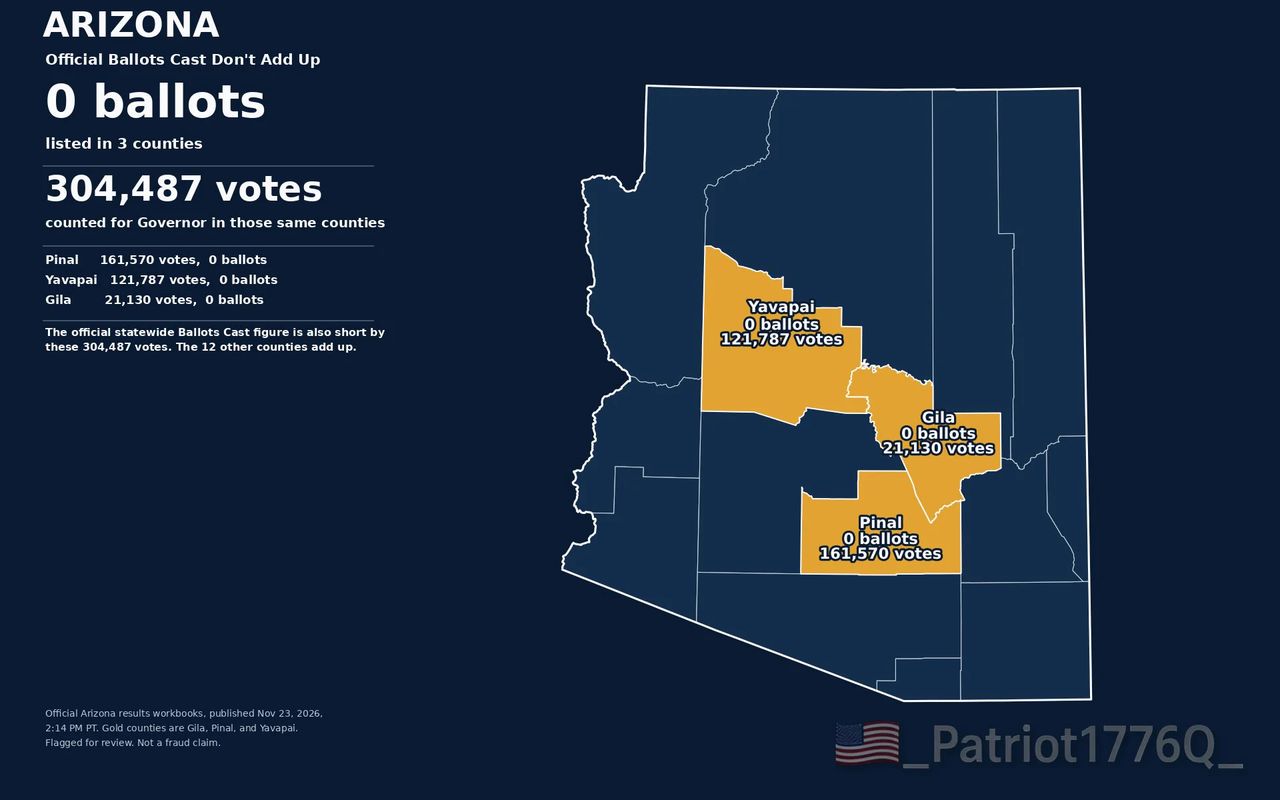
Do Arizona's official 2026 results show zero ballots cast for governor in Pinal, Yavapai and Gila counties despite 304,487 votes counted there?
False
A blank 'ballots cast' field was misread as three counties where nobody voted.
FALSE. Arizona's certified canvass of the 3 November 2026 general election, signed 23 November 2026, records ballots cast in all three counties — Pinal alone lists 161,571 — with 121,877 in Yavapai and a statewide total of 2,608,915. The 'zero' is a blank field in a data export, not an absence of voters.
 Genuine
Claims
✓ 1 true · ✕ 3 falseArizona's official results show zero ballots cast for Governor in Pinal, Yavapai and Gila counties.123
This is the claim everything else rests on, and the primary documents settle it. Pinal County's official canvass, hosted by the Arizona Secretary of State, states 'Ballots Cast - Total 161,571' out of 291,682 registered voters — 55.39% turnout — broken down into early, election-day and late-early ballots. That is not a county where nobody voted. Public radio reporting on the signed statewide canvass gives Yavapai 121,877 ballots from 175,542 registered voters (69.43% turnout). Lead Stories reached the same conclusion after checking the canvass. The decisive evidence is the county's own certified return, a primary document signed by county officials: it cannot show zero ballots and 161,571 at the same time. The corroborating sources are independent of each other — an official PDF, a public radio report and a fact-check — so this is not one outlet repeating another. A reader should weigh the signed canvass far above a chart of unspecified provenance.
Those three counties counted 304,487 votes for Governor (Pinal 161,570; Yavapai 121,787; Gila 21,130).14
The vote totals in the graphic are broadly right, which is what makes the post feel convincing. AP's county results table shows about 160,202 votes in Pinal, 120,610 in Yavapai and 20,877 in Gila at 99% counted, and final certified numbers run slightly higher — Pinal's canvass records 161,571 ballots cast. So the figures on the right-hand side of the chart correspond to real returns. We rate this LIKELY_TRUE rather than TRUE because we compared rounded, near-final counts rather than reproducing every figure exactly, and the graphic's own numbers differ by a few hundred votes from the published tallies. The important point for readers: a post can contain accurate numbers and still draw a false conclusion from them. Correct totals next to a misread blank field look like proof of a discrepancy.
Still open: The graphic's exact per-county vote figures differ by a few hundred from published near-final counts; we did not reproduce every digit.
The official statewide 'Ballots Cast' figure is short by these 304,487 votes.13
If the post were right, the state total would be missing roughly 304,000 ballots. It isn't. The certified statewide canvass accounts for 2,608,915 ballots cast out of 4,374,827 registered voters, a turnout of 59.63%, and that total includes the returns from Pinal, Yavapai and Gila. The arithmetic works: county returns add up to the state figure. The claim depends on treating a blank cell in a workbook export as a zero, then subtracting that imagined zero from a total that already contains the real number. That is not a discrepancy in the data; it is a discrepancy between the data and the chart. One source carries this — public radio's report on the signed canvass — but it is reporting an official document, and the Pinal canvass independently confirms the same pattern at county level.
The apparent 'zero ballots / 304,487 votes' discrepancy shows Arizona's 2026 Governor results cannot be trusted.12
The leap from a blank field to 'cannot be trusted' does not survive contact with the documents. The zero is an unpopulated cell in a results workbook export — a formatting or export artefact — not a record that no ballots were cast. The county canvasses and the signed statewide canvass all record ballots, turnout and vote totals that reconcile with each other. We also searched for any established outlet reporting a genuine discrepancy of this kind and found none; an error of this size in a certified statewide count would be reported immediately by outlets across the political spectrum. Our searches turned up the opposite: a fact-check and public radio reporting that describe a coherent count. Treating an empty cell as a finding is the error here, and the conclusion built on it inherits that error.
What was posted
XAn X post shares a chart of Arizona counties with Yavapai, Gila and Pinal highlighted, presenting figures for votes cast for Governor alongside a 'ballots cast' column showing zero. The caption tells readers the state's official results 'don't add up' and asks how three counties could record 304,487 votes with zero ballots.
“🚨 NEW: Arizona's official results don't add up. Three counties show ZERO ballots cast for Governor. But the same official file counts 304,487 votes in those counties. Pinal. Yavapai. Gila. Zero ballots. 304,487 votes. How?”
Posted on X by an account using the handle @_Patriot1776Q_. The graphic's footer cites Arizona results workbooks dated 23 November 2026, the day the statewide canvass was signed.
Who posted it
XAccount check
Estimates from public signals — account age, posting pattern, audience — not a judgement of the person behind the account, and separate from whether this post is true.
What stood out
- Anonymous partisan aggregator persona ('Patriot', US-flag bio quote) with no named owner, no verification, and no institutional affiliation — authenticity as a source depends entirely on self-curation.
- Account created October 2022 (~4.1 years old) and extremely high-volume: 78.1K tweets, ~50+/day average, consistent with a full-time human news-aggregation operation rather than a dormant or purely scripted account.
- Follower/following of ~34.6K/8.5K (ratio ~4:1) is organic-looking for a mid-tier political account; no evidence found of purchased followers or bot-network amplification.
- Strong sourcing habit on video content: viral clips (Richneck bodycam, Las Vegas police shooting, Albuquerque shooting) are posted with explicit credit to originating outlets such as The Virginian-Pilot/Daily Press, and were subsequently picked up by RedState, Twitchy, Instapundit and foreign outlets.
- However, the account manufactures its own election-integrity memes (watermarked charts) that independent fact-checkers have repeatedly rated false: Lead Stories (10 Nov 2026) debunked multi-state 'more registered voters than adult citizens' claims; Snopes (14 Nov 2026) rated the Texas 97-county meme false; MEAWW reached the same conclusion.
- Its misleading election charts were widely re-shared on Instagram, GETTR, Weibo, Tumblr and forums, showing it functions as a primary source of viral election-fraud misinformation, not merely an amplifier.
- Sensational crime content is often framed with racial/ Political cues and decontextualised ('Who is responsible?'), a pattern associated with engagement farming.
- No evidence of automation tooling, duplicate-account networks, or coordinated inauthentic behaviour; human voice, replies and retweets are present, so bot probability is moderate-to-low rather than high.
- Handle ('1776Q') and branding carry QAnon-adjacent signalling, but no direct Q-drop content was found in the sample.
Signals (10)+
- Account created
- 2022-10
- Posting cadence
- ~78,100 tweets total; roughly 50+/day
- Following count
- 8500
- Follower ratio
- 4.07
- Identity disclosure
- Anonymous persona
- Notable news coverage
- Content regularly cited/embedded by RedState, Twitchy, Instapundit, The New American, Gateway Pundit-affiliated sites and international outlets
- Fact check history
- Lead Stories, 2026-11-10: voter registration vs adult citizens claims false/unreliable (CO, VA, MD, NJ); Snopes, 2026-11-14: Texas 97-county registered-voter meme rated false; MEAWW, 2026-11-15: same Texas claim rated false
- Content type
- Breaking-news/viral video aggregation plus original election-integrity memes
- Sourcing quality
- Mixed: credits original outlets for video, but self-produced statistical charts are methodologically flawed
- Political orientation
- Strong pro-Trump/right-wing partisan
Account checked November 26, 2026, 03:04 UTC
The media
Image✓ What is genuine
The county vote totals behind the chart are real, and the underlying Arizona canvass documents it cites exist and are public. The problem is how a blank field in a data export was interpreted, not the image itself.
The tells
- ●●○ Supporting signal The image is a purpose-built data chart, not a photograph: dark background, Arizona county outline, three counties highlighted, clean typeset numbers.our visual review
- ●●○ Supporting signal County shapes and their relative positions on the outline are accurate, and the text renders correctly with no compositing artefacts.our visual review
- ●●● Strong signal The vote totals shown match published county results closely, which is why the graphic reads as credible.our visual review, checked against AP county results
Synthetic-media detector
Detector not consultedSources settled the claim on their own; the detector was not needed.
How we checked the media
- Reviewed the graphic by eye: layout, typesetting, county shapes and relative positions.
- Compared the figures shown in the graphic against the Pinal County canvass and published county results.
Sources
4 sources reviewed- 1Pinal County November 3, 2026 General Election Official Canvass (PDF) ↗
Arizona Secretary of State · apps.azsos.govPrimary / fact-checkerprimary/official source (by domain)Evidence
Pinal County's certified canvass records 161,571 ballots cast from 291,682 registered voters, 55.39% turnout.
- 2Fact Check: Pinal, Yavapai And Gila Counties DO Show Ballots Cast In Arizona's 2026 Governor's Race -- Official Canvass Confirms ↗
Lead Stories (via NewsBreak) · local.newsbreak.comUntiereduntiered — treated as signal only, never decisiveEvidence
A fact-check found the counties do show ballots cast in the governor's race per the official canvass.
- 3Yavapai and Coconino counties lead Arizona in midterm voter turnout ↗
KNAU (Arizona Public Radio) · knau.orgUntiereduntiered — treated as signal only, never decisiveEvidence
Reporting on the signed statewide canvass gives Yavapai 121,877 ballots and a statewide total of 2,608,915.
- 4Arizona Governor results 2026 ↗
AP News · apnews.comPrimary / fact-checkerwire + AP Fact Check (Tier A)Evidence
AP county results show vote totals close to those in the graphic, confirming the numbers themselves are roughly accurate.
Further reading
- 1Arizona Secretary of State The clearest single piece of evidence: the county canvass that directly contradicts the 'zero ballots' claim.
- 3KNAU (Arizona Public Radio) Puts the three counties in context with statewide totals and turnout figures.
- 2Lead Stories (via NewsBreak) An independent fact-check that reached the same conclusion from the official canvass.
The full story
Arizona certified its 3 November 2026 general election on 23 November 2026. The signed statewide canvass records 2,608,915 ballots cast out of 4,374,827 registered voters — 59.63% turnout — and it includes returns from every county, Pinal, Yavapai and Gila among them.
Those same results are also published as data files that people can download and sort. In a spreadsheet, an empty cell and a zero can mean very different things, and a column can be left unpopulated in one export while the votes themselves sit in another. Read a blank 'ballots cast' field as a zero, line it up beside a column of real vote totals, and you get exactly the picture the post presents: hundreds of thousands of votes and no voters.
The numbers on the right of the chart are close to the real returns, so the chart looks like a careful piece of work. That is what gives it force. The error is not in the vote totals; it is in the assumption that an empty cell is a finding about voters rather than a gap in a file.
Election results are published at several levels — county canvasses, a statewide canvass, downloadable workbooks — and those versions are not always formatted identically. Discrepancies between a workbook export and a certified return are common and mundane. A genuine shortfall of 304,487 ballots in a certified statewide count would be a major story, reported immediately by outlets of every political persuasion. It was not, because the ballots are there.
Kernel of truth
The county vote totals in the graphic are broadly accurate, and a field in an exported results workbook was indeed blank — but blank meant unpopulated, not zero voters.
Timeline
November 3, 2026
Arizona holds its general election, including the race for Governor. 3KNAU (Arizona Public Radio)
November 23, 2026
The statewide general election canvass is signed, the same date the post's graphic cites for its source files. 2Lead Stories (via NewsBreak)
November 24, 2026
Posts circulate on X claiming official results show zero ballots cast in Pinal, Yavapai and Gila counties despite 304,487 votes.
How it was framed
The post takes genuine artefacts — real county vote totals and a blank field in a results export — and frames them as evidence of an election discrepancy that does not exist. Nothing was fabricated; the numbers are largely right and the files are real. The falsehood is in the interpretation laid over them.
- “Visual proof”. A clean chart of Arizona counties with three counties highlighted and 'ZERO' set beside a large vote figure, inviting readers to see the discrepancy for themselves.
- Emotional language. The caption opens with a siren emoji and 'NEW' in capitals, and closes with the one-word question 'How?'
- Missing context. The post never mentions that the statewide canvass exists, was signed, and records ballots cast — the document that resolves the question.
- Selective evidence. Real county vote totals are shown next to a blank field, while the counties' certified ballot counts are left out.
Posted on X by the account @_Patriot1776Q_. The graphic's footer cites Arizona results workbooks dated 23 November 2026. We found no information in our records about the account's identity or history.
Bias
Leans election-denial / pro-Republican voter-fraud insinuation. The graphic and caption are built to imply that Arizona's certified 2026 Governor result (a Democratic win) rests on ballots that were never cast, using a formatting artifact in a results file and a rhetorical 'How?'. No context is given that the counties' canvasses record ballots cast, and the account is a QAnon-styled partisan persona.
Bias describes how the post frames its message — the slant of the language, selection and emphasis — and is judged separately from whether the claim is true. A true claim can still be framed with a strong slant.
How we checked
59 s- 1
Read the post and identified its central claim: zero ballots cast in three named counties.
- 2
Searched for the official Arizona results and the counties named.
- 3
Opened and reviewed a fact-check of the claim in full.
- 4
Compared Pinal County's official canvass figures and public radio reporting on the statewide canvass against the chart's numbers.
- 5
Checked whether any established outlet reported a genuine discrepancy of this size, and found none.
- 6
Reviewed the image by eye to confirm it is a data graphic and to compare its figures with published results.
✓ Claim checked✓ Media checked✓ Sources checked
Why 87% confidence
HighHIGH: the county's own signed canvass, a primary document, contradicts the claim outright, and independent public radio reporting on the statewide canvass gives a total that reconciles. A primary document plus an independent report, pointing the same way, is about as solid as it gets.
Limits. We did not open the original workbook export the post's footer cites, so we describe the blank field as an export artefact based on the fact that the certified canvasses record ballots cast. We did not identify the person behind the account.
What we don’t know
- Which specific workbook export the graphic used, and why that field was blank in it.
- Who runs the @_Patriot1776Q_ account, and whether they made the chart themselves or copied it.
- Whether the graphic's exact per-county vote figures were taken from a certified file or an earlier near-final count.
Spot it yourself
Spot the fakeLooks suspicious, isn’t proof
- The alarmist tone and siren emoji. A breathless caption is a reason to slow down, not evidence the claim is wrong — official findings are sometimes surprising.
- The anonymous-looking account handle. Who posted it does not decide whether the numbers are right.
- The slick chart design. A polished infographic is neither proof nor disproof; bad claims come in good design.
The actual evidence
- Pinal County's official canvass states 161,571 ballots cast — a primary document that directly contradicts 'zero'.
- The signed statewide canvass records 2,608,915 ballots cast, enough to include all three counties, so there is no 304,487-ballot hole.
- No established outlet reported any such discrepancy, coverage a real gap of that size would have triggered within hours.
- The chart's vote totals are roughly accurate, showing the problem is interpretation, not invented numbers.
- 1
Find the primary document, not the chart
Go to the Arizona Secretary of State's site and open the county canvass for one of the named counties. Search the PDF for 'Ballots Cast'.
- 2
Ask what a blank cell means
Downloaded election workbooks often leave some columns empty depending on how they were exported. An empty cell is a question, not a zero, until you find the field that is actually populated.
- 3
Check the state total adds up
Add the county figures and compare with the certified statewide total. If the ballots are inside the total, there is no shortfall.
- 4
Ask who else would have reported it
A discrepancy of 304,000 ballots in a certified statewide count would be front-page news everywhere. Search for that coverage before believing a chart.
Takeaway
A number can be real while the story built around it is false. Before accepting a discrepancy, check whether the 'missing' figure is a missing record rather than a missing vote.
Questions people ask
Did Arizona really record zero ballots cast in Pinal, Yavapai and Gila counties?+
No. The certified canvass of the 3 November 2026 general election, signed 23 November 2026, records ballots cast in all three. Pinal's own canvass lists 161,571 ballots from 291,682 registered voters, and Yavapai recorded 121,877 ballots from 175,542 registered voters.
Where did the 304,487 figure come from?+
It is the sum of three real county vote totals for Governor shown in the chart. The totals are broadly accurate; the post paired them with a blank 'ballots cast' field and presented that blank as zero voters, which is what created the apparent contradiction.
What is Arizona's official statewide ballot total for 2026?+
The certified statewide canvass records 2,608,915 ballots cast out of 4,374,827 registered voters, a turnout of 59.63%. That total includes returns from Pinal, Yavapai and Gila, so there is no missing block of ballots.
Why would a 'ballots cast' field be blank?+
Election results are published as downloadable workbooks as well as certified PDFs, and different exports populate different columns. An empty cell can mean the field was not filled in that version, not that the value was zero. The certified canvasses for the same counties show the real numbers.
How can I check a claim like this myself?+
Find the primary document rather than the chart. Open the county canvass on the Secretary of State's site, search for 'Ballots Cast', and compare with the certified statewide total. Then ask whether any established outlet reported the discrepancy — a real one this size would be widely covered.
Go deeper
- Canvass
- The official, signed compilation of election returns that counties and states produce after the votes are counted and certified.
- Primary source
- The original document or record — here, a county's certified canvass — rather than a summary or chart made from it.
- Data export
- A downloadable file, often a spreadsheet, generated from an election system that may not fill every column in every version.
- Turnout
- The share of registered voters who cast a ballot, usually expressed as a percentage.
People also search for
For educators+
- If a chart contains accurate vote totals but misreads one column, how should we describe the post: false, misleading, or something else?
- Why might people trust a clean infographic more than a dense official PDF, and what does that mean for how evidence is presented?
- What would have to be true for this claim to be correct, and what would we expect to see in the news if it were?
About this check
- Platform
- X
- Posted by
- @_patriot1776q_
- Posted
- November 24, 2026
- Age when checked
- 1–2 days old when checked
- Where it spread
- United States
- Audience
- US audience
- Language
- EN
- Status
- ● Post is live
- Verified
- November 26, 2026, 03:06 UTC
- Published
- November 26, 2026, 03:06 UTC
Reach. 2,507 likes, 206 replies (syndication 26 Nov)
This verdict was generated with AI from the sources shown. AI can make mistakes — check the sources before relying on it.
Check anything yourself, in seconds.
Share any social post or video to What the Fact and get the verdict, the confidence, and the receipts.