Did GDI put conservative news outlets on an ad blacklist and kill $200 million in revenue?
Did the Global Disinformation Index blacklist nearly every major conservative outlet, cost them $200 million in ad revenue, and get recommended to USAID by the US intelligence community, as Mike Benz claims about the 'USAID Files'?
True, but…
The blacklist and ODNI introduction hold up. The $200 million is a global yearly estimate, not a conservative-media hit.
Mostly true, with one misleading number. Released USAID files and earlier reporting show the Global Disinformation Index rated many major conservative US outlets as high disinformation risk and fed exclusion lists to ad-tech firms, and that an ODNI official introduced GDI to USAID in June 2022. But the $200 million is GDI's own global, per-year estimate of revenue redirected from high-risk sites, not a loss inflicted on US conservative media.
 Likely genuine
Claims
✓ 1 trueGDI put nearly every major conservative news outlet in America on an advertising blacklist to destroy their businesses.234
“GDI put nearly every major conservative news outlet in America on an ad blacklist to financially assassinate their businesses.”
This part of the post was documented years before the November 2026 file release. A 2023 Washington Examiner investigation described GDI's 'dynamic exclusion list' of at least 2,000 domains supplied to advertising-technology partners. GDI's own US market review, published by the organisation itself, ranked the New York Post, Reason, RealClearPolitics, The Daily Wire, TheBlaze, OAN, The American Conservative, The Federalist, Newsmax and The American Spectator as the ten outlets with the highest disinformation risk. Conservative reporting counts roughly 39 flagged conservative sites. That supports 'many major conservative outlets were rated high risk and placed on an exclusion list'. The word 'blacklist' is the outlets' characterisation of a risk-rating list; the underlying fact is that GDI's ratings were used to steer advertising money away. The strong evidence here comes from two directions that do not depend on each other: GDI's own published ranking and independent reporting on the exclusion list.
Still open: GDI's rating list and an actual advertising blacklist are not identical things. How much revenue was lost because of the list, outlet by outlet, has not been established publicly.
GDI killed $200 million in ad revenue to media outlets reporting the wrong 'narratives'.56
“GDI killed $200 million in ad revenue to media outlets reporting the wrong "narratives."”
The number is real, but the post changes what it measures. GDI's own material says roughly $200 million per year has been redirected away from high-risk news sites as a result of GDI's and partner organisations' work with the advertising industry. That is a global, annual figure covering thousands of domains rated high-risk, not a cumulative $200 million taken from US conservative media. DW's reporting on GDI's study gives the scale: about 20,000 websites rated a disinformation risk generate an estimated $235 million a year. So the statistic exists, and it describes money moved away from a large global set of sites. The caption recasts it as a targeted hit on one group of American outlets. That is the decisive point: the source of the number contradicts the use made of it.
Still open: No public accounting breaks down how much advertising revenue specific US conservative outlets lost because of GDI's ratings.
GDI was recommended to USAID by the US intelligence community.1
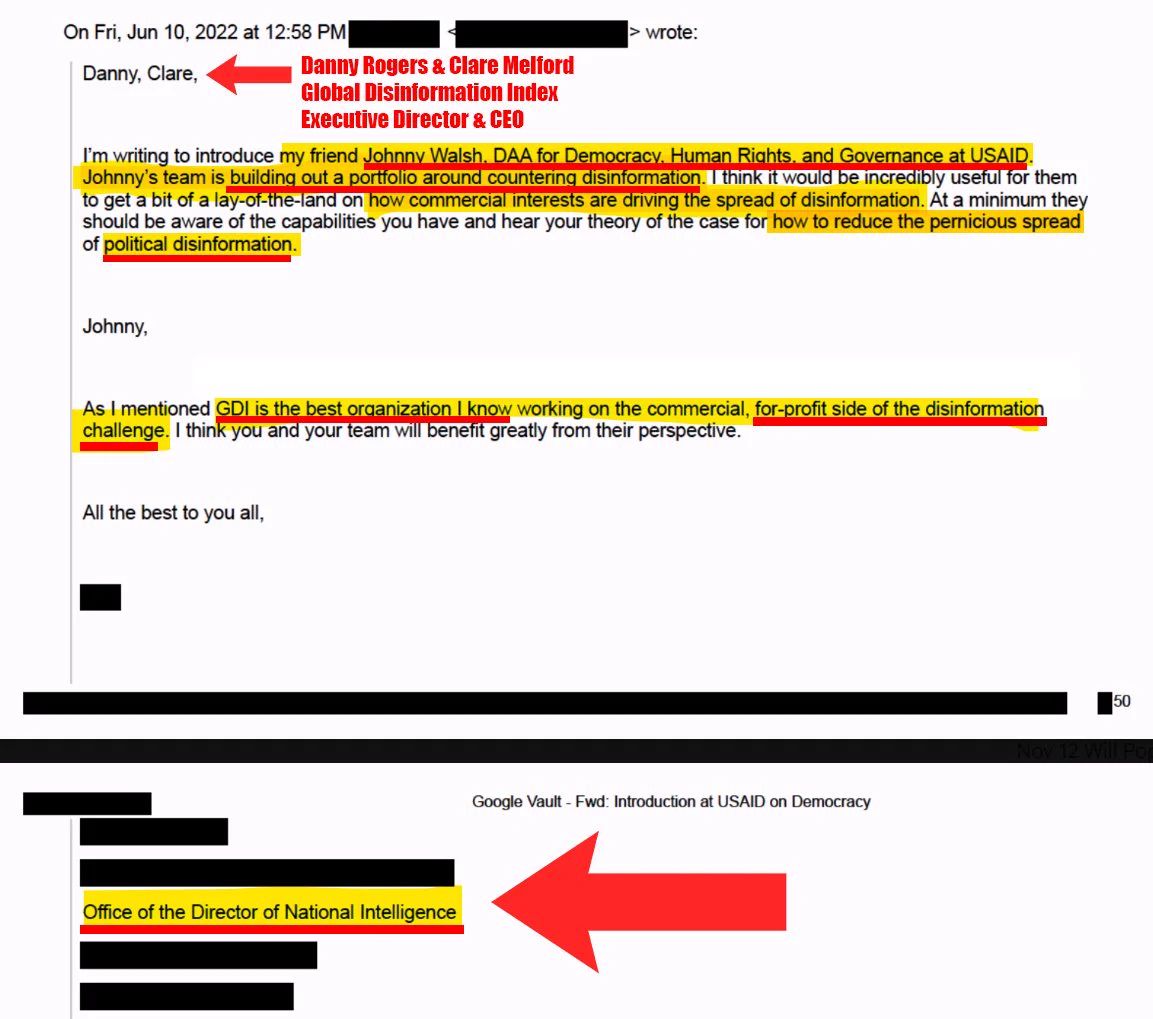
The pictured email supports a narrower version of the claim. Reporting on the released USAID files states that an official of the Office of the Director of National Intelligence made the introduction and called GDI 'the best organization I know', which matches the June 2022 email shown. The email itself, as displayed, is redacted, so the sender's name is not visible. That supports 'an ODNI official recommended GDI to USAID'. Saying 'the US intelligence community' recommends something implies an institutional decision by the intelligence agencies as a whole, which the document does not show. The confidence is moderate rather than high because our check of this element rests on one line of reporting about the files plus our reading of the screenshot, not on an unredacted document.
Still open: The sender's name is redacted in the image, so the exact title and office of the ODNI official are not visible to readers of the post.
What was posted
XA post on X by Mike Benz pairs a caption with a screenshot of an email document. The image shows redacted pages with yellow highlights and red boxes and arrows added to label people and organisations. The caption asks readers to believe that GDI ran an advertising blacklist against conservative US outlets, that it cost those outlets $200 million, and that the US intelligence community recommended GDI to USAID.
“GDI put nearly every major conservative news outlet in America on an ad blacklist to financially assassinate their businesses. GDI killed $200 million in ad revenue to media outlets reporting the wrong "narratives." GDI was recommended to USAID by the US intelligence community.”
Posted on X after the current US administration published 248 internal USAID files on usaid.gov on 24–25 November 2026. The image is a screenshot of one of those files, annotated by the poster.
Who posted it
XAccount check
Estimates from public signals — account age, posting pattern, audience — not a judgement of the person behind the account, and separate from whether this post is true.
What stood out
- Handle @MikeBenzCyber is the genuine, widely cross-referenced X account of Mike Benz (ex-State Dept./HUD, Trump speechwriter, founder of Foundation for Freedom Online) — podcasts and FFO pages link to it directly, so identity is not impersonated.
- Benz is a real, high-profile commentator (Joe Rogan, Tucker Carlson, Timcast, Bannon War Room, CPAC) whose claims have repeatedly driven mainstream news cycles, e.g. Elon Musk's USAID attacks.
- Multiple fact-checkers (Estadão Verifica, Aos Fatos, Folha) rated his USAID/Brazil allegations misleading or unsupported: no evidence USAID funded anti-disinformation laws, the TSE, or flipped the 2022 election.
- Mainstream investigations (NYT, NBC News) linked him to pseudonymous 'Frame Game' content promoting white-identitarian/Great Replacement views; Wikipedia notes claims he made about a 22-million-message censorship flagging figure that was actually under 3,000.
- His Murthy v. Missouri amicus claims were cited in a lower-court injunction later overturned 6-3, with Justice Barrett calling the evidentiary reading 'clearly erroneous'.
- He remains an active agenda-setting source in 2026 (Rogan JRE #2447, Timcast, Georgian/Hungarian state-adjacent media), but his output is advocacy-heavy and frequently lacking documentary support.
- Metadata supplied is nearly empty (no bio, follower count, creation date, posts) and isplatformverified=false, so behavioural/bot signals cannot be directly assessed from the payload.
- No evidence of automated or coordinated inauthentic operation of this account itself — it behaves as a high-volume human pundit account amplified organically by large right-wing networks.
Signals (9)+
- Identity confirmed
- Yes
- Known public figure
- Yes
- Affiliation
- Foundation for Freedom Online (executive director); former US State Dept/HUD official, Trump speechwriter
- Fact check history
- Repeatedly rated misleading/unsupported by Estadão Verifica, Aos Fatos, Folha de S.Paulo; NBC/NYT reporting on pseudonymous racist content
- Controversy
- Great Replacement/alt-right pseudonym allegations; antisemitism accusations; debunked USAID-Covid-impeachment claims
- Media reach
- Joe Rogan, Tucker Carlson, Timcast, RealClearPolitics, CPAC, foreign state-aligned outlets (RT DE, Magyar Nemzet, 1TV Georgia)
- Posting cadence
- Unknown (no recent posts in payload)
- Bot indicators
- None apparent; amplification is organic/political rather than automated
- Assessment
- Genuine human account with real institutional ties but a documented pattern of unsupported and debunked claims — treat as an advocacy source, not a reliable factual one
Account checked November 26, 2026, 02:56 UTC
The media
Image✓ What is genuine
The underlying document appears to be a real email file from the USAID trove, consistent with independent reporting on those files. The annotations are transparent highlighting and labelling, not fabricated content.
The tells
- ●●○ Supporting signal The detector scored the image as not AI-generated (0.87) with a deepfake score of 0.0, so there is no sign of synthetic generation.our detector
- ●●● Strong signal The date on the email, 10 June 2022, was a Friday, and the named individuals match their known roles at GDI and USAID.our visual review
- ●●○ Supporting signal The second panel's header block contains 'Office of the Director of National Intelligence', matching reporting on the released files.our visual review
- ●●○ Supporting signal Yellow highlights, red boxes and arrows are visible overlays added to annotate the document; they do not alter the underlying email text.our visual review
Synthetic-media detector
Detector ranThe claim stands or falls on whether the media is real, so the detector ran.
Scores are the detector’s estimate for the file as uploaded. A low score does not rule out editing, a spliced caption, or footage shown out of context — those are judged above. Model v3.
How we checked the media
- Reviewed the screenshot visually: redacted email pages with yellow highlights and red boxes and arrows added by the poster.
- Checked internal details against the record: 10 June 2022 was a Friday, Rogers and Melford are GDI's executive director and CEO, and Johnny Walsh was USAID's deputy assistant administrator for Democracy, Human Rights and Governance.
- Matched the document against independent reporting on the USAID files released on usaid.gov on 24–25 November 2026, including Newsweek's review.
- Ran the image through our AI-generation detector (hive-v3).
Sources
6 sources reviewed- 1USAID files show Biden admin involvement with social media companies ↗
Newsweek · newsweek.comUntiereduntiered — treated as signal only, never decisiveEvidence
Confirms the June 2022 GDI–USAID introduction by an ODNI official and describes the released USAID files.
- 2Disinformation Inc: How a government-backed group blacklisting conservatives views 'disinformation' ↗
Washington Examiner · vip-stage.washingtonexaminer.comLow reliabilityRight — partisanEvidence
Documents GDI's dynamic exclusion list and its ratings of conservative outlets before the file release.
- 3Disinformation Risk Assessment: The Online News Market in the United States (GDI) ↗
Global Disinformation Index · disinformationindex.orgUntiereduntiered — treated as signal only, never decisiveEvidence
GDI's own ranking of the ten highest-risk US outlets, confirming the blacklist element.
- 4USAID Files: How Jim Jordan, GOP Exposed Global Disinformation Index's Targeting of Conservative Media ↗
Breitbart · breitbart.comUntiereduntiered — treated as signal only, never decisiveContext
Reports that at least 39 conservative outlets were flagged on the exclusion list.
- 5Disinformation sites generate over $200m: study ↗
DW · dw.comReputable outletCenter — independent public intl broadcasterEvidence
Places the $200 million figure in its global, annual context.
- 6Mike Benz post on X ↗
X · x.comUntiereduntiered — treated as signal only, never decisiveContext
The post under review; source of the claim wording.
Further reading
- 1Newsweek Reviews the released USAID files, including the GDI introduction and the concept note on defunding and downranking.
- 2Washington Examiner The 2023 investigation that first described GDI's dynamic exclusion list and its ratings of conservative outlets.
- 3Global Disinformation Index GDI's own US market review, the primary document behind the list of highest-risk outlets.
- 5DW Shows where the $200 million-scale figure comes from: a global estimate covering thousands of high-risk sites.
The full story
The post is built on a real document. In June 2022, Danny Rogers and Clare Melford, the co-founders of the Global Disinformation Index, were introduced by email to Johnny Walsh, then USAID's deputy assistant administrator for Democracy, Human Rights and Governance. The email was among 248 internal USAID files that the current US administration published on usaid.gov on 24–25 November 2026. Reporting on that release says the introduction came from an official at the Office of the Director of National Intelligence, who described GDI as 'the best organization I know'.
The files add detail to a story that was already public. GDI rated news outlets for 'disinformation risk' and supplied exclusion lists to advertising-technology firms. Its own US market review placed the New York Post, Reason, RealClearPolitics, The Daily Wire, TheBlaze, OAN, The American Conservative, The Federalist, Newsmax and The American Spectator in its ten highest-risk slots. A 2023 Washington Examiner investigation described a dynamic exclusion list of at least 2,000 domains. Reporting after the file release describes a GDI concept note that talked about defunding, downranking and deplatforming high-risk media.
So why does the post feel plausible? Because the core is documented: a risk-rating system, advertiser exclusion lists, and a government connection. What the post does is attach a real statistic to a different target. GDI's roughly $200 million a year describes money redirected from high-risk sites worldwide, not a $200 million bill handed to US conservative media. The broad institutional phrase 'the US intelligence community' also smooths one official's introduction into an agency-wide recommendation.
Kernel of truth
GDI did rate many major conservative US outlets as high disinformation risk and supply exclusion lists to ad-tech firms, and an ODNI official did introduce GDI to USAID in June 2022.
Timeline
June 10, 2022
An email introduces GDI's Danny Rogers and Clare Melford to USAID's Johnny Walsh; the introduction is attributed in reporting to an official at the Office of the Director of National Intelligence. 1Newsweek
February 2023
The Washington Examiner publishes an investigation describing GDI's dynamic exclusion list of at least 2,000 websites and its ratings of conservative outlets. 2Washington Examiner
November 24, 2026
The current US administration publishes 248 internal USAID files on usaid.gov, including the June 2022 GDI email. 1Newsweek
How it was framed
The post starts from genuine documents and genuine facts, then frames them to suggest a larger and more targeted campaign than the record shows. The $200 million figure is real but repurposed from a global annual estimate into an apparent hit on US conservative media, and one official's introduction becomes 'the US intelligence community'.
- Emotional language. The phrase 'financially assassinate their businesses' frames an advertising rating system as a lethal attack.
- “Visual proof”. A screenshot of redacted email pages, with yellow highlights and red boxes and arrows, is presented as the proof of the claim.
- Missing context. The $200 million figure is quoted without the words 'per year' or 'globally' that define it in GDI's own material.
- Selective evidence. The post highlights the ODNI introduction but does not mention that the sender's name is redacted in the image.
Posted on X by Mike Benz, an account that posts about government and media. It appeared during a wave of posts after the USAID files were published on usaid.gov on 24–25 November 2026.
Bias
Leans anti-censorship-industry / pro-conservative media. The post is advocacy framing from a well-known critic of government-adjacent disinformation programmes: it uses charged language ('financially assassinate their businesses', scare quotes around 'narratives') and selects a statistic in a way that maximises the accusation. The underlying documents are real, but the presentation is built to push a conclusion rather than to neutrally summarise them.
Bias describes how the post frames its message — the slant of the language, selection and emphasis — and is judged separately from whether the claim is true. A true claim can still be framed with a strong slant.
How we checked
1 min 19 s- 1
Searched for reporting on GDI, conservative outlets, the blacklist and the $200 million figure.
- 2
Searched for the USAID email, Johnny Walsh, Danny Rogers and the ODNI introduction.
- 3
Searched for coverage of the USAID files released in November 2026.
- 4
Searched for independent fact-checks of this post and the file release.
- 5
Reviewed the screenshot visually and checked its internal details against the public record.
- 6
Ran the image through our AI-generation detector (hive-v3).
✓ Claim checked✓ Media checked✓ Sources checked
Why 72% confidence
ModerateWe are at MODERATE overall. The blacklist element is strongly supported by GDI's own publication and by reporting from different directions. The $200 million element is clearly resolved because the original source contradicts the post's use of it. The ODNI element is the weakest link: the email in the image is redacted, and our support for the sender's identity comes from one line of reporting on the files. That combination justifies a true-with-caveats verdict, not a flat true.
Limits. We could not inspect an unredacted copy of the email, and no public accounting breaks down revenue losses for individual conservative outlets.
What we don’t know
- How much advertising revenue, if any, each named conservative outlet lost specifically because of GDI's ratings.
- The name and exact office of the ODNI official who made the introduction; it is redacted in the image.
- Whether the GDI concept note described in reporting was adopted or acted on by USAID.
Spot it yourself
Find the overstatementLooks suspicious, isn’t proof
- Annotations on the image — yellow highlights, red boxes and arrows — can look like someone doctoring a document, but here they label parts of an email and leave the text visible.
- The partisan source and the alarmist phrase 'financially assassinate' are reasons to slow down, not evidence the facts are wrong.
- The redactions in the screenshot can look like concealment, but redaction is normal in released government files and does not by itself make the document fake.
The actual evidence
- Independent reporting on the released USAID files describes the same June 2022 introduction, including the ODNI official's praise of GDI.
- GDI's own published US market review lists the ten conservative outlets the post refers to as its highest disinformation risk.
- The $200 million figure traces to GDI's own material, where it is a global, per-year estimate covering thousands of high-risk sites.
- The individual details in the email — the date, the named people, their roles — match the public record.
- 1
Find the number's original home
Search the exact figure plus the organisation's name. Check whether the source says 'per year', 'globally', or 'per outlet' before you accept how a post uses it.
- 2
Separate the document from the caption
Read what the screenshot actually says. Here the email supports an introduction; it does not contain the $200 million figure or the phrase 'intelligence community'.
- 3
Ask who would report it if true
A newly released government document trove would be covered beyond one political side. Look for coverage from outlets with different audiences describing the same files.
- 4
Watch how a group becomes an institution
Check whether a claim names a specific person, an office, or a whole agency. 'An ODNI official' and 'the US intelligence community' are different claims.
Takeaway
A real statistic can be true and still mislead once it is moved to a new target. Always check the scope, the time frame and who the number was originally about.
Questions people ask
Did GDI really put conservative outlets on an advertising blacklist?+
GDI rated news outlets for disinformation risk and supplied exclusion lists to advertising-technology firms. Its own US market review placed the New York Post, Reason, RealClearPolitics, The Daily Wire, TheBlaze, OAN, The American Conservative, The Federalist, Newsmax and The American Spectator in its ten highest-risk slots. A 2023 investigation described an exclusion list of at least 2,000 domains.
Is the $200 million figure real?+
The number comes from GDI's own material, which says roughly $200 million a year has been redirected away from high-risk sites globally as a result of its work and its partners'. That is a worldwide annual estimate covering thousands of domains, not a cumulative $200 million lost by US conservative media.
Was GDI recommended to USAID by the US intelligence community?+
Reporting on the released USAID files says an official at the Office of the Director of National Intelligence introduced GDI's co-founders to USAID and called GDI 'the best organization I know'. That supports the introduction by one official. It does not show that the intelligence agencies as a whole made a recommendation.
Are the USAID files shown in the post genuine?+
The document appears genuine. It matches the June 2022 email described in reporting on the 248 internal USAID files published on usaid.gov on 24–25 November 2026. The highlights, boxes and arrows were added by the poster to annotate the pages, not to change the email text.
What is the Global Disinformation Index?+
GDI was an organisation that rated news websites for 'disinformation risk'. Its ratings were shared with advertising-technology partners and were used in decisions about where advertising money went. The USAID files show its co-founders being introduced to a USAID democracy and governance office in June 2022.
Go deeper
- Global Disinformation Index (GDI)
- An organisation that rated news websites for disinformation risk and shared those ratings with advertising-technology partners.
- Dynamic exclusion list
- A list of websites that advertising systems were told to avoid placing ads on, which can reduce a site's ad revenue.
- Office of the Director of National Intelligence (ODNI)
- The US office that coordinates the country's intelligence agencies and advises the president on intelligence matters.
- False context
- When genuine content is shared with information that changes its meaning, such as a real statistic attached to the wrong target.
People also search for
For educators+
- The post contains a real statistic. What exactly would you need to know about how that statistic was measured before deciding it supports the caption?
- How does describing a risk-rating list as a 'blacklist' change how a reader feels about it? Is the change in wording a change in fact?
- If a government document is genuine but a post's caption overstates it, what is the right way to describe the post?
About this check
- Platform
- X
- Posted by
- @mikebenzcyber
- Posted
- November 25, 2026
- Age when checked
- Under 24 hours old when checked
- Where it spread
- United States
- Audience
- US audience
- Language
- EN
- Status
- ● Post is live
- Verified
- November 26, 2026, 02:58 UTC
- Published
- November 26, 2026, 02:58 UTC
Reach. 11,460 likes (syndication, 26 Nov); USAID Files drop widely shared (DC_Draino 14.1K likes, kylenabecker 12K likes)
This verdict was generated with AI from the sources shown. AI can make mistakes — check the sources before relying on it.
Check anything yourself, in seconds.
Share any social post or video to What the Fact and get the verdict, the confidence, and the receipts.