Did the Army detonate 10,000 pounds of lead azide plus hidden redacted materials in Iowa?
Did the Army detonate other, secret hazardous materials besides lead azide in Iowa, as a redacted EPA emergency permit supposedly shows?
True, but…
The detonation and the redactions are real; the hidden extra materials are not established.
The Army did detonate about 9,500 to 10,000 pounds of lead azide in 68 drums at the Iowa Army Ammunition Plant in Middletown, Iowa, on the morning of 25 November 2026. The EPA permit shown is genuine and does contain redactions. But the claim that other, hidden materials were also destroyed is an unverified inference.
 Genuine
Claims
✓ 2 trueThe US Army detonated about 10,000 pounds of lead azide at the Iowa Army Ammunition Plant.1235
This part of the post is accurate. On the morning of 25 November 2026, at about 9 a.m. local time, the Army carried out two controlled detonations of 68 drums of degraded lead azide at the Iowa Army Ammunition Plant in Middletown, Iowa. The weight is consistently reported as roughly 9,500 to 10,000 pounds. NBC News, the Guardian, CBS News, the Washington Times and the Associated Press all carry the same core facts, and the figures line up with the EPA's own public notice of an emergency permit for storage and treatment of lead azide by intentional detonation. Because several outlets with different ownership and different political leanings report the same number independently, we can treat the quantity and the event as settled. The sources are not simply repeating one press release: the Washington Times (rated Right by AllSides) and the Guardian (rated Lean Left by AllSides) give the same range. That agreement across the spectrum is what makes the central fact high-confidence.
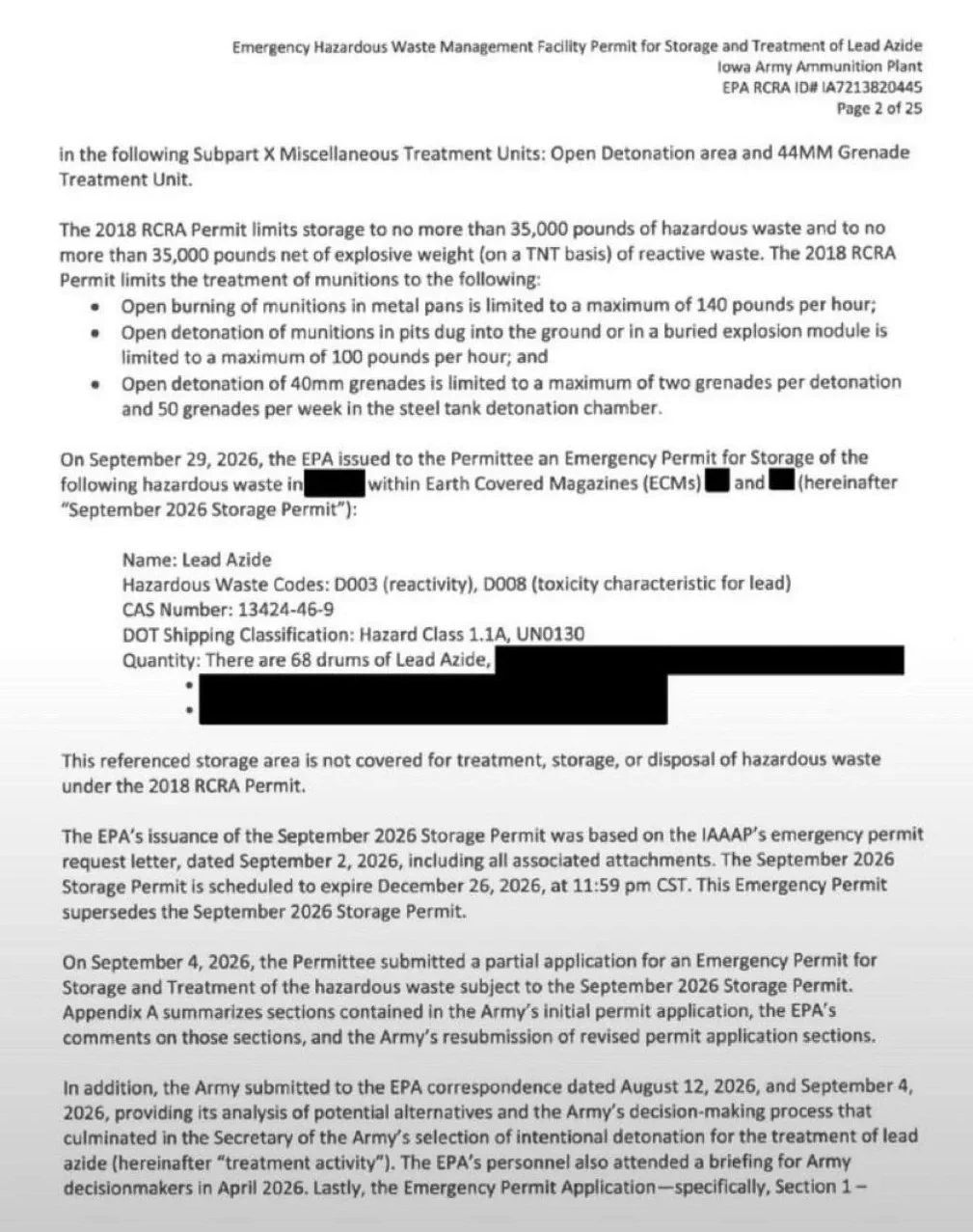
The EPA permit document has quantity and location details blacked out (redacted).456
The screenshot is not a fake and the black bars are not added by the poster. The page is page 2 of 25 of the EPA's emergency hazardous waste permit for lead azide at the Iowa Army Ammunition Plant, and the same text was posted publicly by the EPA. On that page the quantity line ends after 'There are 68 drums of Lead Azide,' with blacked-out text following, and storage magazine identifiers are also obscured. The EPA has said that the permit and application materials contain redactions for 'critical infrastructure security purposes at the request of Department of Army.' So the redactions are genuine and official. What they hide is a separate question: the fact of redaction tells us that some detail was withheld, not what that detail was. Snopes confirmed the document's authenticity while noting it could not establish what the redacted text said. The visual claim is therefore high-confidence true, but it is only a starting point.
The Army also detonated 'a bunch of other stuff' beyond the lead azide, hidden by the redactions.14
“along with a bunch of other stuff that they just blacked out?”
This is the part of the post that is not supported. It is an inference from the black bars, not a fact established by any source. The permit is titled for storage and treatment of lead azide, and the Army and EPA say the operation destroyed 68 drums — about 9,500 to 10,000 pounds — of lead azide and nothing else. No news report or court filing we found alleges that any other hazardous material was destroyed on 25 November. Snopes confirmed the document but left the 'other materials' rumour unrated because it could not establish what the redacted text covered. EPA says the redactions were made for critical infrastructure security at the Army's request, which is a routine basis for withholding facility layout and storage details, not evidence of a second waste stream. The claim is not proven false — we cannot read the blacked-out lines either — but it is unverified, and the strongest available official statements point the other way.
Still open: What exactly does the redacted quantity text say, and would the EPA or Army release it in response to a public records request?
What was posted
XA post on X shares what appears to be page 2 of an EPA emergency permit document for the Iowa Army Ammunition Plant. The visible text describes 68 drums of lead azide; some quantity and location details are blacked out. The caption asks readers to infer that officials detonated the lead azide together with other, secretly redacted materials.
“So they detonated 10,000 pounds of lead azide along with a bunch of other stuff that they just blacked out?”
Posted on X by the account @Mollyploofkins. The image is a screenshot of a permit page; the same page circulated on X from around 22–23 November 2026, before the 25 November detonation.
Who posted it
XAccount check
Estimates from public signals — account age, posting pattern, audience — not a judgement of the person behind the account, and separate from whether this post is true.
What stood out
- Profile metadata supplied is entirely empty (no bio, follower count, creation date, or posts), so grading relies on external evidence only.
- Account is a long-running, high-volume left-leaning political aggregator/commentator persona active on X and mirrored on Bluesky (joined Nov 2024), rather than an identifiable named individual or newsroom.
- Cited by mainstream outlets as a 'political commentator' (Yahoo News, Nov 2026), showing it is treated as a real, persistent voice rather than a throwaway sockpuppet.
- Posts are mostly reposted clips and screenshots with brief commentary (e.g., White House, Kaitlan Collins, Giuliani coverage) — sourcing is secondhand, with attribution usually to the original outlet or poster, not to documents.
- High output (~7.5 posts/day on Bluesky, 5.3k posts) is consistent with a curated/aggregation operation, but no evidence of automated bot networks or coordinated inauthentic behaviour was found.
- Unverified on both platforms and anonymous; right-leaning outlets (Twitchy) attack it as a 'resistance' account, indicating a clear partisan slant but not fabrication.
- No dedicated fact-check debunks found, but no correction/verification track record either; one 2026 post on the Iowa lead-azide detonation was picked up verbatim by international outlets.
- Verdict: genuine, human-run partisan commentary account — trustworthy as a signal of what the left is discussing, weak as a primary/factual source.
Signals (10)+
- Bluesky followers
- 60750
- Posting cadence
- High (~7.5 posts/day on Bluesky; consistent daily posting on X)
- Content type
- Reposted news clips, screenshots, short partisan commentary
- Political orientation
- Left-leaning / anti-Trump
- Notable news coverage
- Quoted as 'political commentator' by Yahoo News (Nov 2026); posts cited by The Cool Down and foreign outlets
- Fact check history
- No dedicated fact-check debunks located; no published corrections
- Bot network evidence
- None found
- Media criticism
- Twitchy (right-leaning) critiques framing and tone
- Cross platform presence
- X + Bluesky (same handle)
- Data completeness
- Very low — no profile fields provided
Account checked November 26, 2026, 14:52 UTC
The media
Image✓ What is genuine
The document itself is genuine: an EPA emergency permit for lead azide at the Iowa Army Ammunition Plant, with official redactions. The lead azide drums and the detonation it describes are real.
The tells
- ●●● Strong signal The page reads as page 2 of 25 of an EPA emergency hazardous waste permit tied to a specific RCRA ID and plant name.our visual review
- ●●● Strong signal The quantity line stops after 'There are 68 drums of Lead Azide,' followed by black bars, and storage magazine identifiers are also obscured.our visual review
- ●●○ Supporting signal Our image-origin detector scored the screenshot at roughly 1.9% probability of being AI-generated, with a deepfake score of 0.0.our detector
- ●●○ Supporting signal The same document text was published by the EPA and quoted by its X account on 23 November 2026, before the detonation.Snopes
Synthetic-media detector
Detector ranThe claim stands or falls on whether the media is real, so the detector ran.
Scores are the detector’s estimate for the file as uploaded. A low score does not rule out editing, a spliced caption, or footage shown out of context — those are judged above. Model v3.
How we checked the media
- Compared the visible page text and layout against the EPA emergency permit and public notice material described in our sources.
- Ran an automated image-origin detector on the screenshot to check for signs of AI generation or manipulation.
- Reviewed the visual details of the blacked-out lines and page numbering against the description in Snopes and the EPA notice.
Sources
7 sources reviewed- 1Army detonates cache of lead explosives, with toxic plume possible across Iowa ↗
NBC News · nbcnews.comReputable outletLean LeftEvidence
Confirms the detonation of 68 drums, about 9,700 pounds, of lead azide at the Iowa Army Ammunition Plant.
- 2Army triggers 'controlled detonation' of 10,000 pounds of degraded explosives at Iowa ammo plant ↗
Washington Times · washingtontimes.comLow reliabilityRight — partisanEvidence
Confirms the figure of about 10,000 pounds stored in 68 drums across two bunkers.
- 3US army calls Iowa lead detonation a 'huge success' – live ↗
The Guardian · theguardian.comReputable outletLean Left (AllSides)Evidence
Confirms the detonation of 68 barrels containing nearly 9,500 pounds of lead azide.
- 4Investigating rumor Army planned to detonate chemicals other than lead azide in Iowa ↗
Snopes (via Yahoo News) · yahoo.comUntiereduntiered — treated as signal only, never decisiveEvidence
Confirms the permit is authentic and the redactions were attributed to critical infrastructure security at the Army's request; leaves the 'other materials' claim unrated.
- 5Iowa Army Ammunition Plant, Middletown, Iowa — Public Notice of Emergency Permit ↗
U.S. Environmental Protection Agency · epa.govPrimary / fact-checkerprimary/official source (by domain)Evidence
The EPA's public notice confirms the emergency permit for storage and treatment of lead azide by intentional detonation.
- 6Nov 3, 2026 Public Notice: Emergency permit to store hazardous waste (Sept 29 – Dec 26, 2026) ↗
NoticeRegistry (reproducing EPA public notice) · noticeregistry.comUntiereduntiered — treated as signal only, never decisiveContext
Confirms the September 29 to December 26, 2026 emergency storage permit described on the page.
- 7Army to detonate degraded ammunition despite community concern ↗
Military Times · militarytimes.comUntiereduntiered — treated as signal only, never decisiveContext
Provides background that about 10,000 pounds of lead azide was moved to the Iowa Army Ammunition Plant in 2009.
Further reading
- 4Snopes (via Yahoo News) Snopes' investigation explains how the redactions became the basis for a rumour and why it left the claim unrated.
- 5U.S. Environmental Protection Agency The EPA's own public notice is the primary document behind the permit and the redactions.
- 1NBC News NBC News gives a clear account of the detonation, the quantity and the environmental concerns.
The full story
The kernel of truth here is large. The Iowa Army Ammunition Plant in Middletown, Iowa, held 68 drums of degraded, crystallized lead azide — roughly 9,500 to 10,000 pounds, described in reporting as the military's bulk stockpile. Lead azide is a sensitive primary explosive used in detonators, and deteriorating stock is dangerous to move. After litigation by the Iowa Environmental Council and the Sierra Club, and warnings that a dust plume could travel about 100 miles into Missouri, the Army went ahead with two controlled detonations at about 9 a.m. on 25 November 2026, after the Eighth Circuit reinstated an EPA emergency permit.
Officials called the blasts successful, said mitigation works contained them, and reported that EPA air monitors initially detected no airborne lead, with follow-up soil and water sampling continuing. The EPA permit page that circulated beforehand is a genuine public document, and its black bars are the agency's own. That combination — a real explosion, a real official document, and real redactions — is what made the post's suggestion feel plausible. A reader seeing black bars on a government page about an explosive being destroyed might reasonably wonder what else was in the drums.
But the redactions are explained by the EPA as critical infrastructure security at the Army's request, and the reporting and official statements describe only lead azide. The post turns a genuine gap in a document into an implied second secret, without evidence that one exists.
Kernel of truth
The Army really did detonate about 9,500 to 10,000 pounds of lead azide in 68 drums at the Iowa Army Ammunition Plant on 25 November 2026, and the EPA permit documenting it really is redacted.
Timeline
September 29, 2026
EPA emergency permit takes effect allowing the Army to continue storing reactive lead azide waste at the Iowa Army Ammunition Plant, running through 26 December 2026. 6NoticeRegistry (reproducing EPA public notice)
November 13, 2026
A further EPA emergency permit becomes effective for storage and treatment of lead azide by in-place, intentional detonation. 5U.S. Environmental Protection Agency
November 23, 2026
The EPA posts the permit text publicly and quotes it on its X account; screenshots of page 2 circulate on X around this time. 5U.S. Environmental Protection Agency
November 25, 2026
The Army carries out two controlled detonations of 68 drums of lead azide at the Iowa Army Ammunition Plant at about 9 a.m. local time. 1NBC News
How it was framed
The post uses a genuine government document and a genuine detonation to frame an inference — that other, hidden materials were destroyed — as though the blacked-out lines proved it. The redactions are real but their content is unknown, and official statements describe only lead azide.
- Missing context. The post points to the blacked-out lines without noting the EPA's stated reason for the redactions: critical infrastructure security at the Army's request.
- “Visual proof”. The screenshot of the permit page is presented as self-evident evidence that something else was destroyed.
- Emotional language. The phrasing 'a bunch of other stuff that they just blacked out' frames the redactions as a concealment rather than a routine security measure.
Posted on X by the account @Mollyploofkins. The image is a screenshot of page 2 of the EPA emergency permit, which had been published publicly and circulated on X from around 22–23 November 2026, before the detonation.
Bias
Leans anti-government / government-secrecy insinuation. The post pairs an accurate core fact (the large lead azide detonation) with a leading rhetorical question implying officials secretly destroyed additional, undisclosed hazardous material. That framing pushes a concealment narrative without evidence that anything besides lead azide was involved.
Bias describes how the post frames its message — the slant of the language, selection and emphasis — and is judged separately from whether the claim is true. A true claim can still be framed with a strong slant.
How we checked
52 s- 1
Searched for reporting on the Iowa Army Ammunition Plant lead azide detonation and the EPA emergency permit.
- 2
Compared the quantity and date across NBC News, the Guardian, the Washington Times and the EPA public notice.
- 3
Reviewed the image of the permit page and ran an automated image-origin detector to check for AI generation or manipulation.
- 4
Checked Snopes' investigation of the claim and the EPA's stated reason for the redactions.
- 5
Searched for any reporting or filing alleging that materials other than lead azide were destroyed.
✓ Claim checked✓ Media checked✓ Sources checked
Why 78% confidence
HighWe are highly confident in the central facts because multiple independent outlets with different ownership and political leanings report the same quantity and date, and the EPA's own notice matches. The 'other materials' claim is unverifiable and carries low confidence because no source establishes it and official statements describe only lead azide.
Limits. We could not read the redacted text or obtain the full unredacted permit. We did not independently sample air, soil or water, and we relied on published reporting for the outcome of the detonation.
What we don’t know
- What exact words or figures are hidden under the black bars on the permit page.
- Whether the EPA or Army would release the redacted details in response to a public records request.
- Whether any additional hazardous waste was present at the site, even if it was not detonated on 25 November.
Spot it yourself
Spot the fakeLooks suspicious, isn’t proof
- Black bars on an official document can look like concealment, but government permits routinely redact security-sensitive details such as storage locations and exact quantities.
- A social media account with a provocative tone is a reason to check the claim, not evidence that the document is fake.
- The fact that a screenshot circulated widely before the event is not proof of a hoax; official documents often circulate in advance of the action they describe.
The actual evidence
- Multiple independent outlets — NBC News, the Guardian, the Washington Times and the AP — confirmed the detonation of about 9,500 to 10,000 pounds of lead azide in 68 drums on 25 November 2026.
- The EPA itself published the permit text, and Snopes verified the document as authentic.
- The EPA stated that the redactions were made for critical infrastructure security at the Army's request.
- No reporting or court filing alleges that any material other than the lead azide drums was destroyed.
- 1
Check whether the document is genuinely from the agency it claims to be from.
Search the agency's own website for the permit title or the facility name, and compare the wording and page numbering with the screenshot.
- 2
Ask what the redactions are for, not just what they hide.
Look for an official statement or public notice explaining the basis for withholding, such as security or privacy.
- 3
See whether the implied claim would be widely reported if true.
Search for independent reporting on the specific allegation — here, that other materials were destroyed — and check whether any outlet or filing supports it.
- 4
Separate the verified fact from the inference.
Write down what is confirmed (the detonation, the quantity, the redactions) and what is only suggested (that other materials were destroyed), then judge each separately.
Takeaway
A genuine document with genuine redactions can still be used to suggest something that is not established. Check what the redactions are for and whether the implied claim is supported by any independent reporting.
Questions people ask
Did the Army really detonate 10,000 pounds of lead azide in Iowa?+
Yes. On 25 November 2026 the Army carried out two controlled detonations of 68 drums of degraded lead azide — roughly 9,500 to 10,000 pounds — at the Iowa Army Ammunition Plant in Middletown, Iowa. NBC News, the Guardian, the Washington Times and the AP all report the same core facts.
Is the EPA permit in the post real?+
Yes. The screenshot is page 2 of 25 of an EPA emergency hazardous waste permit for lead azide at the Iowa Army Ammunition Plant. The EPA published the same text, and Snopes verified the document as authentic. The black bars are the agency's own redactions.
Why were parts of the permit blacked out?+
The EPA said the permit and application materials contain redactions for 'critical infrastructure security purposes at the request of Department of Army.' That is a stated reason for withholding facility and storage details, not an admission that other materials were involved.
Did the Army destroy other materials besides the lead azide?+
There is no evidence for that. The Army and EPA say the operation destroyed 68 drums of lead azide and nothing else. Snopes left the 'other materials' rumour unrated because it could not establish what the redacted text said. The claim is unverified, not proven false.
Why do official documents get redacted at all?+
Agencies routinely withhold security-sensitive details such as exact storage locations, quantities or facility layouts from public copies of permits. The fact of redaction tells you something was withheld; it does not tell you what, and it is not by itself evidence of wrongdoing.
Go deeper
- Lead azide
- A sensitive primary explosive used in detonators and primers, which becomes dangerous when it degrades or crystallizes.
- Redaction
- The deliberate blacking-out or removal of specific text from a document before it is released publicly.
- Emergency permit
- A temporary authorization issued by a regulator, such as the EPA, to handle hazardous waste when immediate action is needed.
- Misleading content
- Information used in a way that frames an issue or person misleadingly, even when the underlying facts are real.
People also search for
For educators+
- The post asks a question rather than making a statement. Does that change how responsible it is? Why or why not?
- If a document is genuinely redacted, what would count as evidence that the redacted material is significant?
- How would you check whether a claim about a secret government action is true, using only public sources?
About this check
- Platform
- X
- Posted by
- @mollyploofkins
- Posted
- November 25, 2026
- Age when checked
- Under 24 hours old when checked
- Where it spread
- United States
- Audience
- US audience
- Language
- EN
- Status
- ● Post is live
- Verified
- November 26, 2026, 14:53 UTC
- Published
- November 26, 2026, 14:53 UTC
Reach. Mollyploofkins 2,215 likes; KnoxieLuv 9,859 likes; BigBicNick 8,666 likes (X syndication counts, 2026-11-26)
This verdict was generated with AI from the sources shown. AI can make mistakes — check the sources before relying on it.
Check anything yourself, in seconds.
Share any social post or video to What the Fact and get the verdict, the confidence, and the receipts.